

Is your business treating its quality management system as a compliance checkbox or as a strategic driver for operational excellence? With the official publication of ISO 9001:2026 on September 16, 2026, the landscape for ISO 9001 certification UK has shifted toward a rigorous focus on ethical leadership and climate risk integration. Organizations now face a mandatory three-year transition period to align with these updated requirements, yet many fear the process will result in excessive administrative friction and escalating overheads.
We recognize that navigating these regulatory updates requires a balance between technical precision and practical efficiency. This guide provides a methodical framework to help you secure a streamlined, independent certification that delivers a measurable ROI through refined internal processes. You’ll gain clarity on selecting a UKAS-accredited auditor, understanding current market day rates, and ensuring your quality management system meets the latest supply chain mandates without the burden of legacy red tape.
Key Takeaways
- Identify the critical transition milestones for the ISO 9001:2026 revision and how they impact your existing quality management framework.
- Discover the specific criteria for selecting an agile, UKAS-accredited auditor as a cost-effective alternative to legacy certification bodies.
- Learn how to leverage ISO 9001 certification UK to eliminate process inconsistencies and secure a competitive advantage in domestic supply chains.
- Understand the technical requirements of the Stage 1 and Stage 2 audit phases to ensure a streamlined verification process from the outset.
- Gain insights into managing the three-year certification cycle, including annual surveillance audits and long-term recertification planning.
Navigating ISO 9001 Certification in the UK: 2026 Market Trends
The ISO 9001 standard remains the definitive global benchmark for quality management systems. In the United Kingdom, the recent adoption of BS EN ISO 9001:2026 has introduced a more structured approach to corporate governance. This updated standard moves beyond simple process documentation; it now prioritizes strategic risk management and ethical leadership. For organizations pursuing ISO 9001 certification UK, the focus has shifted from administrative compliance to a culture of continuous improvement that supports long-term commercial stability. It’s no longer enough to maintain a static manual.
UK supply chains are increasingly mandating this certification for tier-1 suppliers. Public sector contracts and high-stakes technical sectors now view a UKAS-accredited certificate as a non-negotiable prerequisite for entry. Certificates without UKAS accreditation often fail to meet the rigorous requirements of large corporate tenders. This trend reflects a move away from “tick-box” exercises toward a system that actively identifies operational vulnerabilities. By integrating quality management into the core business strategy, firms can reduce waste and ensure consistent delivery across complex international networks. The standard’s evolution reflects this need for operational agility in a volatile market.
The 2026 Revision: Transitioning Your QMS
The official release of the 2026 revision on September 16, 2026, initiated a critical three-year transition period. Organizations currently certified to the 2015 version have until September 2029 to complete their transition audits. The updated standard places significant emphasis on digital resilience and the integration of climate change considerations into the quality framework. To avoid certification gaps, businesses should begin gap analysis immediately. This proactive approach ensures that new requirements for ethical behavior and quality culture are embedded before the final deadline.
UK Regulatory Alignment and Market Access
Achieving ISO 9001 certification UK serves as a vital tool for market access. It often underpins the technical documentation required for UKCA marking and simplifies the pre-qualification stages of public sector procurement. For UK exporters, the standard acts as a universal passport, providing international partners with verified evidence of procedural integrity. For a foundational understanding of these requirements, refer to ISO 9001: The Comprehensive Guide. This alignment ensures that UK firms remain competitive in a landscape where regulatory adherence is a key differentiator.
Strategic ROI: Why Quality Management Systems Matter in 2026
Viewing a Quality Management System (QMS) as a mere marketing asset is a strategic oversight in the current commercial environment. While a certificate serves as verification of standard adherence, the primary value lies in the optimization of internal workflows. A robust QMS facilitates a transition from reactive problem-solving to proactive process management. By establishing clear operational benchmarks, businesses eliminate redundancies that often go unnoticed in less structured environments. This focus on operational excellence ensures that every department contributes to the overarching goal of consistent delivery, creating a foundation for sustainable growth.
Cost reduction is achieved through the systematic identification of waste. This includes the inefficient allocation of human resources and time as well as material losses. In the competitive UK market, where supply chain volatility remains a factor, process consistency acts as a safeguard against financial loss. A well-implemented system serves as a diagnostic tool, highlighting internal vulnerabilities before they escalate into significant liabilities. This risk mitigation is essential for maintaining brand reputation and avoiding the high costs associated with service failures or product non-conformity. It’s a methodical approach to securing the business’s financial health.
Quantifying the Value of Certification
The commercial impact of ISO 9001 certification UK is most visible in procurement outcomes. Many UK government and high-value private contracts require evidence of a UKAS-accredited QMS as a mandatory entry requirement. Beyond tender success, organizations typically observe a measurable reduction in customer complaints and rework costs. These efficiencies contribute directly to the bottom line by preserving resources. For more detailed insights on investment requirements, you should consult our Cost of ISO 9001 Certification UK guide, which provides comprehensive pricing and ROI analysis for the 2026 period.
Digital Integration and Efficiency
Modern auditing practices have evolved to minimize operational disruption. Advanced IT infrastructure allows for a tech-led verification process, moving away from the paper-heavy systems that characterized legacy auditing. Real-time data access enables auditors to conduct assessments with greater precision and speed. This digital approach ensures that the assurance process is agile and integrated into daily operations rather than being an external interruption. Businesses seeking to modernize their compliance framework can explore our full range of management system certification options to understand how a digital-first approach benefits their specific sector.
Selecting a Certification Body: BSI vs. Independent Auditors
Choosing the right partner for ISO 9001 certification UK requires a careful evaluation of operational style versus institutional prestige. Legacy bodies like BSI often represent the traditional face of the industry, carrying significant brand recognition. However, many UK businesses, particularly those in high-stakes technical sectors, find that large institutional bodies can be slow to respond. This lack of agility often manifests in longer lead times for audits and delayed certificate issuance. Independent certification bodies provide a streamlined alternative, prioritizing efficiency and technical precision without the bureaucratic overhead.
Accreditation and Global Recognition
Accreditation by the United Kingdom Accreditation Service (UKAS) is the primary indicator of a certification body’s competence and impartiality. A UKAS-accredited certificate ensures that your quality management system meets the rigorous standards required by public sector tenders and international trade agreements. For businesses pursuing ISO 9001 certification UK, the combination of local UKAS oversight and a global regional network is essential. This dual presence ensures that standards remain consistent across all international offices. You can verify our commitment to these standards by reviewing our accreditations, which highlight our standing as an independent, globally recognized body.
The Audit Experience: Bureaucracy vs. Partnership
The auditing process shouldn’t feel like a punitive inspection. Legacy bodies frequently adopt an inspectorial tone that can create friction within a workforce. In contrast, an agile independent auditor focuses on supportive verification. This approach identifies areas for improvement while confirming adherence to the standard. Technical documentation reviews are conducted with an emphasis on clarity and practical application rather than rigid administrative adherence. Quick turnaround times are a hallmark of this partnership model. While legacy firms might take months to process final reports, tech-led independent bodies utilize advanced IT infrastructure to accelerate certificate delivery.
It’s vital to select a body that maintains a strict separation between auditing and consultancy. International Associates focuses exclusively on independent assessment to ensure there’s no conflict of interest. This ethical boundary protects the integrity of your certification. By choosing an auditor with specific sector expertise, you ensure the verification process is relevant to your unique operational challenges.
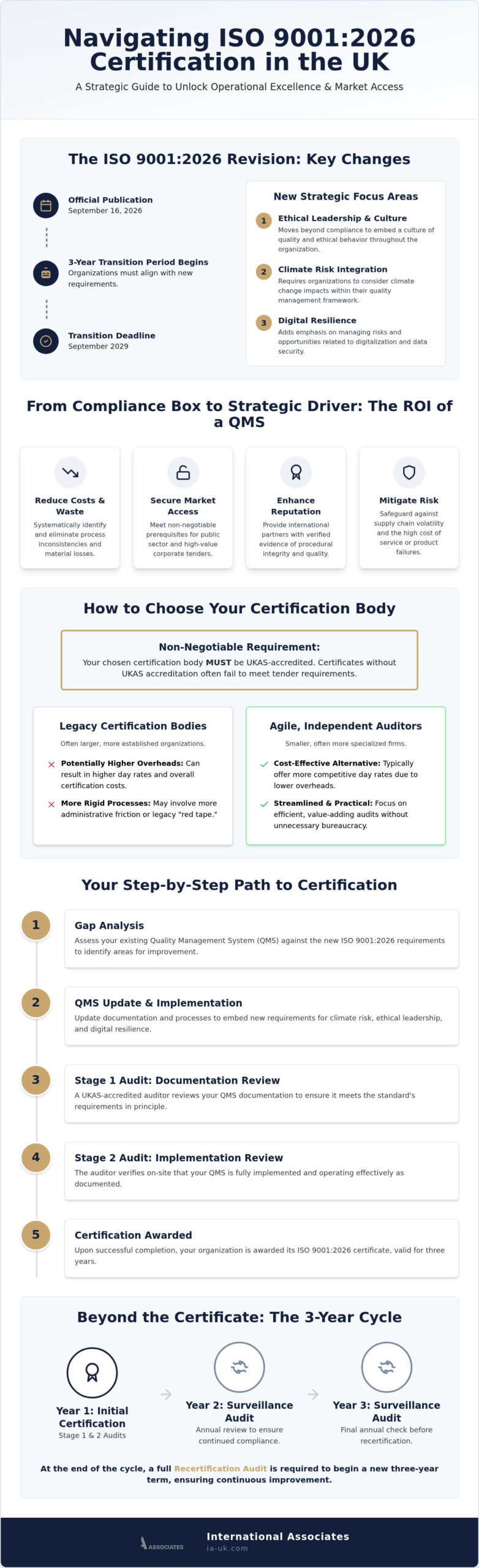
The Step-by-Step Path to UK ISO 9001 Certification
Achieving ISO 9001 certification UK is a methodical process designed to verify that your quality management system is both compliant and effective. The journey begins with a formal enquiry and scoping exercise. This step is vital because it defines the boundaries of your QMS, ensuring that all high-stakes technical processes are included in the assessment. A clear scope prevents ambiguity during the later audit stages and ensures the final certificate accurately reflects your operational capacity. It’s the foundation of a reliable verification process.
The process moves into the Stage 1 Audit, which serves as a documentation review and readiness check. During this phase, the auditor examines your QMS framework to confirm it meets the technical requirements of the BS EN ISO 9001:2026 standard. This isn’t just a paperwork exercise; it’s a strategic evaluation to identify any gaps that could lead to failure during the implementation phase. If the documentation is sound, the organization proceeds to the Stage 2 Audit, where the focus shifts to real-world application.
Stage 2 involves the verification of implementation. The auditor assesses whether your documented procedures are active in your daily operations. This can involve on-site inspections, staff interviews, and remote data verification using modern IT infrastructure. Following a successful Stage 2 audit, the findings undergo an independent technical review. Only after this rigorous verification is the UKAS-accredited certificate issued, providing the gold-standard proof of your commitment to quality. The entire cycle is designed to build institutional trust.
Preparing for Your Initial Assessment
Success in the audit process depends on thorough preparation. Conducting a comprehensive gap analysis allows you to identify missing elements in your current framework before the auditor arrives. Internal audits are equally important, as they provide a dry run of the Stage 2 experience and ensure your team is familiar with the requirements. To build the necessary internal expertise, you can explore our training options for lead and internal auditors. This proactive approach minimizes the risk of major non-conformities during the formal assessment.
Navigating Technical Documentation
Technical documentation remains the foundation of a successful audit. You must maintain a clear Quality Policy, a defined Scope, and an updated Risk Register that accounts for the 2026 requirements regarding climate change and ethical behavior. IA-UK utilizes advanced IT infrastructure to streamline document submission, reducing the administrative burden on your staff. This digital approach helps you avoid common non-conformities, such as version control errors or incomplete risk assessments, which frequently stall ISO 9001 certification UK audits. Precision in documentation reflects precision in operation.
If you’re ready to begin your assessment, you can start your management system certification journey with a clear, tech-led scoping session.
Beyond the Certificate: Surveillance and Integrated Systems
Securing the initial ISO 9001 certification UK is a significant milestone, but the long-term value is realized through the maintenance phase. Certification isn’t a permanent status; it operates on a three-year cycle designed to ensure continuous adherence to the standard. This cycle involves periodic assessments that verify the ongoing effectiveness of your quality management system. If a business finds that its current auditor is too bureaucratic or slow, transferring the certificate to a more agile body is a standard industry procedure. This transfer process involves a technical review of existing documentation and previous audit reports to ensure a seamless transition without a loss of certified status. It allows organizations to move away from legacy bodies that no longer fit their operational pace.
Annual Surveillance and Recertification
During the first and second years of the cycle, surveillance audits are conducted to monitor specific elements of the QMS. These are not full-system audits but rather targeted checks to confirm that the system remains operational and compliant. In the third year, a comprehensive recertification audit is required to renew the certificate for another three-year period. This methodical approach ensures your organization remains listed on the global registry of certified firms, which is often a requirement for maintaining international trade partnerships. You can find more details on managing this cycle through our Management System Certification services.
Integrating ISO 9001 with ISO 14001 and 45001
Many UK businesses choose to combine their ISO 9001 certification UK with other standards like ISO 14001 for environmental management and ISO 45001 for occupational health and safety. Creating an Integrated Management System (IMS) allows for a unified approach to compliance, reducing the total number of audit days required. By aligning common requirements such as leadership, planning, and performance evaluation, organizations can significantly lower their certification costs. This integration eliminates the redundancy of hosting multiple separate audits and streamlines technical documentation. For a deeper look at the advantages of multi-standard systems, refer to our ISO 45001 Certification Guide.
Securing Your Operational Future with Strategic Certification
The publication of the 2026 revision marks a pivot toward ethical leadership and digital resilience in quality management. For businesses across the country, maintaining a UKAS-accredited system is no longer just a regulatory requirement; it’s a critical asset for winning high-value contracts and ensuring supply chain integrity. By selecting an independent partner that prioritizes technical precision over legacy bureaucracy, you ensure that your quality framework drives genuine process improvement rather than just administrative overhead.
Our Glasgow head office coordinates a global regional network to deliver modern, IT-led auditing with rapid certificate turnaround times. This tech-led approach minimizes site disruption while providing the rigorous verification necessary for international market access. Transitioning to the new standard provides an ideal opportunity to evaluate your current provider and ensure your ISO 9001 certification UK aligns with your long-term commercial goals. If you’re ready to modernize your compliance framework, request a tailored ISO 9001 certification quote today to begin your transition. We look forward to supporting your organization’s commitment to excellence and international growth.
Frequently Asked Questions
How much does ISO 9001 certification cost in the UK for 2026?
Fees for certification depend on your organization’s head count, the complexity of your industrial sector, and the number of operational sites. Total investment consists of initial Stage 1 and Stage 2 assessment fees plus annual surveillance costs. While industry auditor rates have shifted in 2026, you should request a tailored quote to understand the specific fees for your ISO 9001 certification UK journey. This ensures a transparent breakdown of technical review costs.
How long does it take to get ISO 9001 certified in the UK?
The certification process typically spans three to six months from the initial enquiry to the final certificate issuance. This duration depends on the maturity of your existing quality management system and your team’s availability for audits. Organizations with well-documented processes can often move through Stage 1 and Stage 2 more rapidly. Our advanced IT infrastructure supports efficient data verification, which helps maintain a quick turnaround for final technical reviews.
Can we achieve ISO 9001 certification remotely in 2026?
Remote auditing is a standard option in 2026, utilizing secure digital platforms to conduct interviews and documentation reviews. While some high-stakes technical sectors may require physical site visits, many Stage 1 and Stage 2 assessments are performed via remote verification. This approach reduces travel expenses and minimizes operational downtime. We utilize modern IT-led auditing tools to ensure that remote assessments maintain the same level of rigor as traditional on-site inspections.
What is the difference between ISO 9001:2015 and the 2026 revision?
The 2026 revision introduces explicit requirements for quality culture, ethical leadership, and the integration of climate change risks into the management framework. While the 2015 version focused heavily on risk-based thinking, the updated standard requires top management to demonstrate how these values are embedded within the organization. Businesses have a three-year transition period, ending in September 2029, to align their systems. It’s an evolution toward more socially responsible corporate governance.
Do we need a consultant to get ISO 9001 certified?
Engaging a consultant isn’t a mandatory requirement for achieving ISO 9001 certification UK, though many firms find their expertise helpful for initial gap analysis. Your organization can develop the necessary documentation and internal audit capacity independently or through professional training. It’s vital to note that we provide independent assessment and verification services but don’t offer management system consultancy to maintain our impartiality and avoid any potential conflicts of interest.
Is UKAS accreditation necessary for my ISO 9001 certificate?
UKAS accreditation is essential for businesses that intend to participate in public sector procurement or supply to large corporate entities. A UKAS-accredited certificate is the only version recognized by the UK government as having the necessary level of oversight and competence. Certificates issued by non-accredited bodies often lack the global recognition required for international trade and are frequently rejected during tender pre-qualification stages by tier-1 suppliers.
How do I transfer my ISO 9001 certification to International Associates?
Transferring your certificate involves a technical review of your current certification status, previous audit reports, and any outstanding non-conformities. This process is designed to be seamless and doesn’t require a full re-audit if your existing certification is UKAS-accredited and valid. Once the review is successfully completed, we issue a new certificate under our accreditation, allowing you to benefit from our agile, tech-led auditing approach and global regional network.
What happens if we fail our Stage 2 audit?
If an auditor identifies non-conformities during a Stage 2 audit, you’ll be given a specific timeframe to implement corrective actions. Major non-conformities must be resolved before a certificate can be issued, while minor issues may be addressed through an agreed action plan. The goal of the audit is supportive verification; failing isn’t a permanent rejection but a signal that certain processes require further refinement to meet the standard’s rigorous requirements.