

The appointment of a UK Responsible Person is no longer a mere administrative formality; it’s the legal foundation upon which your entire British market strategy rests. You likely recognize that the post-Brexit regulatory landscape remains fluid, and the risk of market delays due to incorrect documentation is a constant concern for international compliance teams. Navigating MHRA registration for non-UK manufacturers requires more than just submitting paperwork. It demands a precise understanding of the shifting deadlines and fee structures that define the 2026 calendar year.
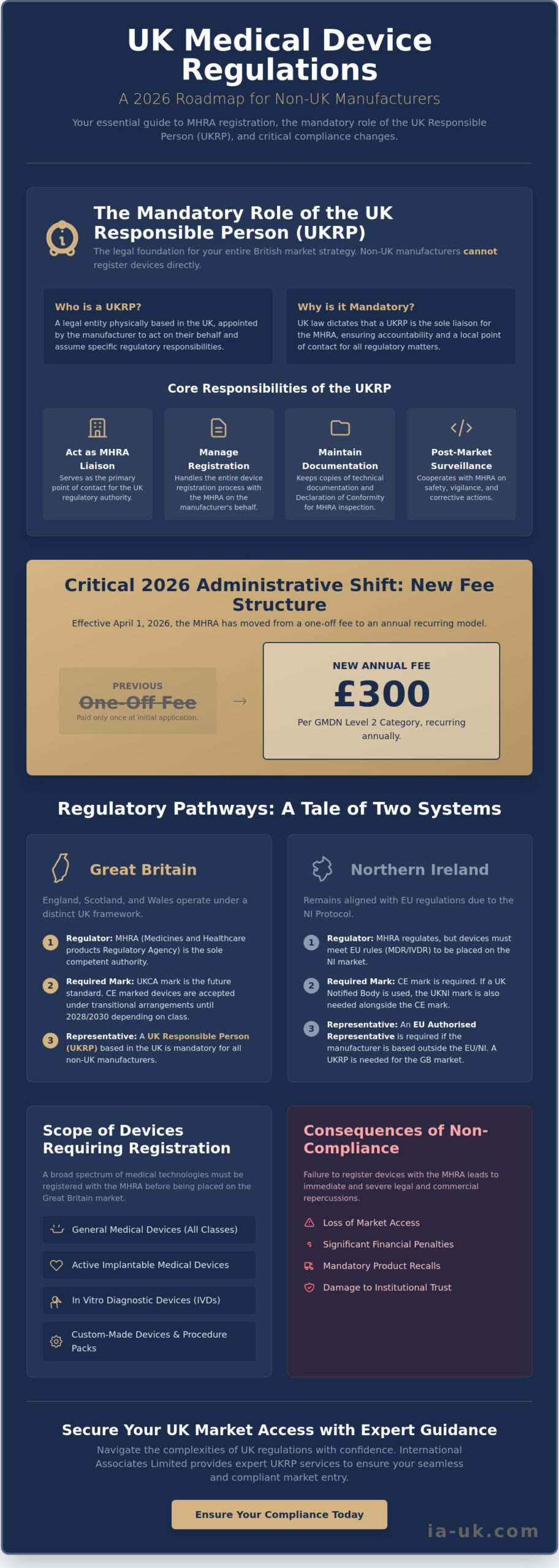
This article provides a professional roadmap to secure your legal standing in the United Kingdom while avoiding the pitfalls of non-compliance. We’ll detail the transition from the previous one-off application fee to the new £300 annual recurring fee per GMDN Level 2 category that took effect on April 1, 2026. You’ll also find clarity on the mandatory role of the UKRP and the diverging requirements between Great Britain and Northern Ireland. By following this structured assessment, your organization can maintain uninterrupted market access and uphold the highest standards of regulatory integrity.
Key Takeaways
- Establish the legal necessity of the UK Responsible Person (UKRP) as the mandatory liaison for all international manufacturers entering the British market.
- Navigate the technical requirements for MHRA registration for non-UK manufacturers to secure the authorized placement of medical devices within Great Britain.
- Identify the critical regulatory distinctions between the Great Britain market and Northern Ireland to ensure full territorial compliance and legal access.
- Anticipate the 2026 administrative shifts, including the implementation of the annual registration fee structure and updated role requirements for authorized representatives.
- Align UK market entry strategies with global quality management systems such as ISO 13485 to ensure a unified approach to international standards and certification.
Understanding MHRA Registration for International Manufacturers
MHRA registration is the mandatory gateway for any medical device intended for the British market. Unlike the centralized European system, the United Kingdom operates under the Medicines and Healthcare products Regulatory Agency (MHRA). This agency functions as the sole competent authority for England, Scotland, and Wales. It maintains a distinct database and regulatory framework that operates independently of European Union systems like EUDAMED. For international firms, this means that compliance in the EU doesn’t automatically grant access to the UK market.
A critical technicality exists regarding how this process is managed. MHRA registration for non-UK manufacturers can’t be executed directly by the foreign legal entity. UK law dictates that a manufacturer based outside the UK must appoint a UK Responsible Person (UKRP) to handle the registration process. This representative acts as the formal legal liaison, ensuring that all technical documentation and clinical evidence meet British standards. By 2026, the transition to the UKCA marking system has become more defined. While CE-marked devices continue to be accepted under transitional arrangements until 2028 or 2030 depending on the device classification, registration with the MHRA remains an immediate requirement regardless of the mark used.
The Legal Necessity of Registration
Compliance is strictly governed by the UK Medical Devices Regulations 2002 (UK MDR 2002). Failure to register devices results in immediate legal repercussions. The MHRA possesses the authority to issue forfeiture orders, financial penalties, and mandatory product recalls for unregistered equipment. Beyond legal penalties, registration is a prerequisite for supply chain integrity. Distributors and healthcare providers within the UK require proof of registration to verify that a device meets the safety requirements necessary for clinical use. It’s a foundational step in establishing institutional trust within the British healthcare sector.
Scope of Devices Requiring Registration
The requirement for registration encompasses a broad spectrum of medical technologies. All general medical devices, active implantable medical devices, and in vitro diagnostic devices (IVDs) must be accounted for in the MHRA system. This mandate also extends to custom-made devices and systems or procedure packs. For manufacturers aiming for high-level compliance, integrating these registration steps with ISO 13485 Medical Devices Certification ensures that the internal quality management system supports the technical data required for the UK market. Every device category requires specific GMDN codes to be correctly assigned during the registration process to ensure accurate regulatory oversight.
The Mandatory Role of the UK Responsible Person (UKRP)
The UK Responsible Person (UKRP) serves as the indispensable legal bridge between an international manufacturer and the British regulatory environment. Under the UK government’s medical device regulations, a UKRP is a legal entity physically based in the United Kingdom that assumes specific responsibilities on behalf of the foreign manufacturer. This isn’t a casual representative role. It’s a high-stakes legal appointment that must be formalized through a comprehensive legal contract. Without a valid UKRP, the process for MHRA registration for non-UK manufacturers cannot even commence.
Beyond the initial registration, the UKRP acts as the primary point of contact for the MHRA regarding post-market surveillance and device safety. They’re legally obligated to maintain a copy of the technical documentation and the Declaration of Conformity at all times. This ensures that the MHRA can quickly access critical safety data during an audit or investigation. Additionally, the UKRP’s name and address must be clearly displayed on the product labeling, outer packaging, or instructions for use (IFU). This transparency allows users and regulators to identify the party responsible for the device’s compliance within the British market.
Core Responsibilities of the UKRP
The duties of a UKRP extend far beyond administrative filing. They’re tasked with verifying that the manufacturer’s technical file is complete and that the appropriate conformity assessment has been successfully conducted. If the MHRA identifies a safety concern, the UKRP must collaborate immediately with the manufacturer to facilitate corrective or preventive actions (CAPA). This includes managing field safety notices and coordinating product recalls if necessary. Engaging a professional UK Authorised Representative ensures that these complex legal obligations are handled with the precision required by international standards.
Selecting a Qualified UKRP
Choosing the right partner is a strategic decision that impacts long-term market stability. While some firms offer basic administrative services, professional auditing and certification bodies provide a level of regulatory depth that simple filing agents lack. A qualified UKRP should possess deep expertise in medical device regulations and a stable institutional presence that can withstand the rigors of legal scrutiny.
Many manufacturers mistakenly appoint their local distributors as their UKRP. This often creates a significant conflict of interest. A distributor’s primary goal is sales, whereas a UKRP’s duty is regulatory compliance. If a safety issue arises, a distributor may be hesitant to report it to the MHRA for fear of disrupting their commercial operations. By contrast, an independent UKRP provides an impartial layer of oversight, ensuring that your compliance remains the priority. This independence is a foundational pillar of global reliability in the auditing and assurance industry.
Regulatory Pathways: Great Britain vs. Northern Ireland
The regulatory environment in the United Kingdom is defined by a dual-pathway system that requires careful navigation. Great Britain, comprising England, Scotland, and Wales, operates under the UK MDR 2002 framework. Conversely, Northern Ireland maintains alignment with European Union regulations under the Windsor Framework. This divergence means that MHRA registration for non-UK manufacturers involves distinct legal obligations depending on where the device is being placed. Manufacturers must adopt a bifurcated strategy to ensure compliance across the entire United Kingdom without compromising their legal standing in either territory.
Market Access Requirements for Great Britain
In Great Britain, the transition to the UKCA mark is the primary regulatory objective. While the UKCA mark is currently available for use, the MHRA has established clear transitional arrangements for CE-marked devices to prevent market disruption. General medical devices compliant with the EU MDD or AIMDD can be placed on the market until June 30, 2028. For IVDs compliant with the EU IVDD and general medical devices compliant with the EU MDR, this period extends to June 30, 2030. Despite these grace periods, all international firms must adhere to the UK Responsible Person (UKRP) requirements to maintain active registration and market access.
The registration process varies by device classification. Class I devices, as well as IVDs and custom-made devices, require immediate registration before being placed on the GB market. For higher-risk Class II and III devices, manufacturers must provide evidence of conformity assessment from a UK Approved Body or a recognized EU Notified Body. This structured approach ensures that only verified technologies enter the clinical supply chain, reflecting the UK’s commitment to rigorous safety standards.
Northern Ireland and the EU MDR Alignment
Northern Ireland presents a different set of compliance challenges due to its continued alignment with the EU MDR and IVDR. Manufacturers must meet European standards to access this market, which includes specific administrative deadlines. A critical milestone is May 27, 2026, which serves as the registration cutoff for certain medical devices placed on the Northern Ireland market. Additionally, registration on the European Database on Medical Devices (EUDAMED) becomes mandatory for the NI market on May 28, 2026.
If a manufacturer chooses to use a UK Approved Body for devices intended for Northern Ireland, the product must carry the UK(NI) mark in addition to the CE mark. It’s also necessary to appoint a Northern Ireland-based Authorised Representative if the manufacturer is located outside the EU or NI. This role is distinct from the UKRP used for the Great Britain market. Managing these dual registrations is essential for maintaining seamless distribution across both British and European jurisdictions, ensuring that your organization remains compliant with the evolving demands of the Windsor Framework.
Step-by-Step Guide to the MHRA Registration Process
The progression toward British market access is a methodical sequence that transforms technical data into legal authorization. For international firms, the process is linear but requires rigorous preparation at each stage to prevent administrative rejection. MHRA registration for non-UK manufacturers follows a specific five-step framework designed to ensure that every device entering the clinical supply chain is fully accounted for and verified by a local representative.
The journey begins with the formal appointment of a UK Responsible Person (UKRP). This must be established through a legal contract that clearly delineates the representative’s duties. Once the UKRP is appointed, the manufacturer must prepare a comprehensive Technical File and a formal Declaration of Conformity. The third step involves the UKRP creating or updating an account on the Device Online Registration System (DORS). Following this, the specific device details are submitted through the portal, and the relevant statutory fees are paid. The process concludes with the MHRA review, after which a registration confirmation is issued, allowing the device to be legally placed on the market.
Information Required for DORS Submission
Precision in data entry is critical during the DORS submission phase. Manufacturers must provide accurate Global Medical Device Nomenclature (GMDN) codes to ensure devices are categorized correctly within the MHRA database. Submissions also require detailed manufacturer information, including proof of a functional Quality Management System (QMS). For higher-risk devices, the UKRP must upload a valid certificate of conformity issued by a recognized UK Approved Body or an EU Notified Body. Accuracy at this stage is vital; errors in nomenclature or certification can lead to significant delays in market entry.
Timelines and Fee Management
Effective April 1, 2026, the MHRA implemented a significant shift in its financial structure for device oversight. The previous one-off registration fee of £261 has been replaced by a recurring annual fee. This fee is currently set at £300 per GMDN Level 2 category. This lifecycle approach to funding ensures ongoing post-market surveillance and regulatory integrity. Standard processing times for registration typically range from five to ten working days, though complex files or those requiring additional clarification may take longer.
Managing updates to existing registrations is equally important. Any change in the device’s status, manufacturer details, or the UKRP appointment must be reflected in the DORS system promptly. For organizations seeking a reliable partner to manage these technical submissions and maintain ongoing compliance, our UK Authorised Representative services provide the institutional stability required for high-stakes regulatory environments.
Leveraging International Associates Limited for UK Market Compliance
Successful market entry is merely the initial phase for international firms. MHRA registration for non-UK manufacturers should be viewed as a vital component of a broader quality strategy rather than an isolated administrative hurdle. International Associates Limited facilitates this transition by aligning your UKRP requirements with established global standards. By integrating your registration with ISO 13485, your organization ensures that the technical evidence supporting your device remains robust and consistent with international quality management expectations.
The Glasgow-based administrative base of International Associates Limited provides a direct channel for regulatory liaison within the United Kingdom. This local presence is balanced by an expansive network of international offices, providing a unique global-local duality that supports seamless communication across time zones. Before any data is submitted to the DORS portal, our expert teams conduct a meticulous technical documentation review. This rigorous verification process identifies potential gaps in clinical data or labeling, which reduces the risk of regulatory friction and ensures a higher probability of registration success.
Beyond Registration: Long-term Compliance
Maintenance of legal access requires ongoing vigilance and adherence to post-market surveillance (PMS) requirements. International Associates Limited provides sustained support through vigilance reporting and annual surveillance audits to ensure that your device remains compliant with evolving UK MDR 2002 standards. Organizations seeking to strengthen their internal expertise can also access specialized Lead Auditor Training. These programs empower your regulatory teams to manage internal audits and maintain the integrity of your quality systems throughout the product lifecycle. This lifecycle approach to compliance mirrors the MHRA’s shift toward ongoing regulatory oversight.
Why Choose an Independent Auditing Body as Your UKRP?
The medical device sector demands a level of impartial verification that only an independent auditing body can provide. Choosing an entity that isn’t involved in your commercial distribution prevents conflicts of interest and reinforces your commitment to patient safety. International Associates Limited operates as a meticulous guardian of standards, bridging the gap between complex British regulations and your business objectives. Our firm offers a tailored compliance roadmap that prioritizes procedural integrity and global reliability. Contact International Associates Limited to establish a secure and professional foundation for your UK market operations through our UK Authorised Representative services.
Securing Your Strategic Position in the British Market
The regulatory framework for medical devices in the United Kingdom continues to mature, moving toward a lifecycle approach that prioritizes ongoing vigilance and structural integrity. Success in this environment depends on more than just technical documentation; it requires a partnership with a representative who understands the legal weight of the UKRP role. By aligning your MHRA registration for non-UK manufacturers with global quality standards and territorial nuances, you ensure that your clinical innovations reach the patients who need them without administrative interruption.
International Associates Limited provides the institutional stability and technical depth necessary for this high-stakes environment. From our Glasgow-based head office and through our global network of regional offices, we offer specialized expertise in ISO 13485 and UKCA regulations. This dual-local and global presence allows us to act as a sophisticated bridge between your international operations and the British regulatory landscape. Our methodical approach ensures that your technical files meet the rigorous standards expected by the MHRA.
Take the decisive step toward verified compliance. Appoint International Associates Limited as your UK Responsible Person today to secure your legal standing and support your long-term growth in the United Kingdom. We’re ready to provide the steady hand your organization needs to navigate the complexities of corporate compliance.
Frequently Asked Questions
Does a non-UK manufacturer need a UK Responsible Person for every product?
A non-UK manufacturer must appoint a single UK Responsible Person to manage the registration of their entire product portfolio. While the UKRP represents the legal entity rather than individual devices, every medical device intended for the British market must be registered under that UKRP’s account. This ensures a centralized point of contact for the MHRA regarding the safety and compliance of all devices placed on the market by the foreign firm.
Can our UK distributor act as our UK Responsible Person for MHRA registration?
A UK distributor can legally act as a UK Responsible Person, but this arrangement often introduces significant conflicts of interest. Distributors prioritize commercial sales, whereas a UKRP’s duty is to ensure regulatory compliance and report safety concerns to the MHRA. Appointing an independent auditing body as your UKRP maintains impartial oversight and protects your legal standing if a dispute or safety issue arises with a commercial partner.
How long does the MHRA registration process take for international companies?
MHRA registration for non-UK manufacturers typically requires five to ten working days for standard processing through the Device Online Registration System (DORS). This timeline assumes that all technical documentation and GMDN codes are accurate upon submission. Complex files or those requiring additional clarification from the manufacturer can extend this period. Early preparation of the technical file is essential to avoid delays in market entry.
Is CE marking still accepted for MHRA registration in 2026?
CE marking remains accepted for the Great Britain market under specific transitional arrangements effective as of 2026. General medical devices compliant with EU MDD or AIMDD are recognized until June 30, 2028. Devices compliant with the EU MDR or IVDs compliant with the EU IVDD are accepted until June 30, 2030. Despite this recognition, manufacturers must still register their devices with the MHRA and appoint a UK Responsible Person to maintain legal access.
What are the specific registration requirements for Northern Ireland?
Northern Ireland requires alignment with EU MDR and IVDR standards under the Windsor Framework. Manufacturers must ensure their devices are registered on the European Database on Medical Devices (EUDAMED) by May 28, 2026. If a manufacturer is based outside the EU or Northern Ireland, they must appoint a Northern Ireland based Authorised Representative. This role is distinct from the UKRP required for the England, Scotland, and Wales markets.
How often do we need to renew our MHRA registration?
Manufacturers must now adhere to an annual registration cycle following the fee structure changes implemented on April 1, 2026. The MHRA has transitioned from a one off application fee to a recurring annual fee of £300 per GMDN Level 2 category. This lifecycle approach ensures that device information remains current and that post market surveillance activities are adequately funded. Your UKRP manages these annual updates to ensure uninterrupted compliance.
What happens if our technical documentation is found to be non-compliant during registration?
If technical documentation is found to be non-compliant, the MHRA may reject the registration or issue a forfeiture order for devices already on the market. The agency possesses the legal authority to mandate product recalls and impose financial penalties under the UK MDR 2002. A professional UKRP mitigates this risk by conducting a thorough review of the technical file and Declaration of Conformity before submission to ensure all standards are met.
Are there different fees for different classes of medical devices?
Statutory registration fees are calculated based on GMDN Level 2 categories rather than the specific risk class of the medical device. As of April 2026, the cost is approximately £300 per category annually. While the risk classification determines the depth of the required conformity assessment, the administrative fee for maintaining the MHRA registration for non-UK manufacturers remains consistent across these categories for all international firms.