

By the end of 2026, an estimated 30% of existing cosmetic formulations will require modification to remain compliant with the UK’s increasingly independent safety standards. It’s understandable if you feel overwhelmed by the widening gap between UK and EU regulations, particularly with new prohibitions on substances like 4-Methylbenzylidene Camphor (4-MBC) becoming effective on July 15. The process of appointing a UK responsible person for cosmetics has evolved from a simple administrative task into a critical strategic necessity for any brand wishing to maintain access to the British market.
This expert guide clarifies the legal complexities of the current regulatory landscape, providing you with a clear path toward seamless compliance and protection from regulatory fines. You’ll gain a thorough understanding of how a qualified partner manages interactions with the Office for Product Safety and Standards (OPSS) while maintaining your Product Information Files (PIF) to the highest technical standards. We will examine the mandatory roles of the Responsible Person, the latest ingredient restrictions under SI 2026/23, and the critical labeling deadlines you must meet by December 2027 to ensure your products remain on the shelves of major retailers and digital marketplaces.
Key Takeaways
- Understand the mandatory legal requirement for a UK-based address to ensure uninterrupted market access in Great Britain under current safety regulations.
- Identify the rigorous technical obligations of the Responsible Person, including the maintenance of the Product Information File for a ten-year period and the verification of safety reports.
- Follow a structured five-step roadmap for appointing a UK responsible person for cosmetics to establish a formal written mandate and secure your brand’s regulatory standing.
- Evaluate the suitability of using a UK-based manufacturer, an importer, or a specialized third-party representative to fulfill this critical legal function.
- Leverage a global network with a local Glasgow presence to manage the complexities of diverging UK and EU regulatory frameworks with professional precision.
Understanding the UK Responsible Person (RP) Requirement
The regulatory framework for cosmetic products in Great Britain is defined by the Product Safety and Metrology etc. (Amendment etc.) (EU Exit) Regulations 2019. While the structural requirements originally drew from the EU Cosmetics Regulation 1223/2009, the legal systems have fully diverged. This separation means that an entity based in the European Union cannot fulfill the legal obligations required by UK authorities. Every cosmetic product sold in England, Scotland, and Wales must have a designated UK Responsible Person (RP) with a physical address within the United Kingdom.
The RP acts as the legal guarantor of a product’s safety. They ensure that every item meets the standards set by the UK government before it reaches a single consumer. Without this local representative, a brand has no legal standing to sell within the territory. The requirement for a UK-based address isn’t merely a formality; it’s a jurisdictional necessity that allows the Office for Product Safety and Standards (OPSS) to exercise its oversight. Non-compliance carries severe institutional risks, including:
- Immediate suspension of sales on digital platforms and physical retail shelves.
- Mandatory product recalls coordinated by the OPSS.
- Significant financial penalties and potential legal action against company directors.
- Forfeiture of stock at the UK border by customs authorities.
The Legal Framework: Schedule 34 and Beyond
Schedule 34 of the 2019 Regulations provides the specific statutory instructions for cosmetic compliance in Great Britain. This legislation empowers the OPSS to act as the primary regulator. It’s no longer sufficient for brands to rely on a global compliance strategy that treats the UK as an extension of the EU. The OPSS maintains the Submit Cosmetic Product Notifications (SCPN) portal, which is entirely separate from the EU’s CPNP. A UK RP must manage all notifications through this domestic portal to ensure traceability and safety verification.
When Must You Appoint a UK RP?
For any manufacturer based outside the UK, appointing a UK responsible person for cosmetics is a mandatory step that must occur before the product is placed on the market. Placing on the market refers to the initial action of making a product available for sale or distribution. This means the appointment should be the first priority in your market entry strategy. Online marketplaces like Amazon UK have implemented rigorous verification processes. They frequently audit listings to ensure a UK RP is present. If a brand can’t provide a valid UK address and RP mandate, their storefront is often suspended until compliance is proven.
Core Duties and Technical Obligations of the UK RP
The role of a UK Responsible Person (RP) extends far beyond serving as a mailing address for regulatory correspondence. It is an active technical function that requires a deep understanding of the Official UK Government Guidance and the specific safety standards mandated by the OPSS. When a brand begins the process of appointing a UK responsible person for cosmetics, they must ensure the chosen entity possesses the expertise to manage a complex suite of technical dossiers and safety assessments with absolute precision.
One of the most critical duties involves the verification of the Cosmetic Product Safety Report (CPSR). The RP must confirm that this report is signed by a qualified toxicologist whose credentials meet the stringent requirements of the UK regulations. Additionally, the RP is responsible for ensuring that the manufacturing process adheres to Good Manufacturing Practice (GMP) standards, typically verified through ISO 22716 certification. These steps are foundational to product safety. They are often the first items scrutinized during a regulatory audit or a request for information from authorities.
The Product Information File (PIF) Management
The UK RP is legally obligated to maintain a comprehensive Product Information File (PIF) for every cosmetic product placed on the market. This file must be kept for at least 10 years after the final batch of the product has been distributed. During a technical review, the RP ensures the PIF contains the qualitative and quantitative composition, physical and chemical characteristics, and microbiological specifications. The PIF must be readily accessible in English and stored at the address specified on the product label. If a formulation changes or new toxicological data emerges, the RP must update the PIF immediately to reflect these developments. Securing a UK Authorised Representative ensures these technical files remain audit-ready and compliant with evolving standards.
Reporting and Market Surveillance
Monitoring product performance in the live market is a mandatory safety requirement. The RP manages the Submit Cosmetic Product Notification (SCPN) portal entries, which is a distinct system from the EU’s CPNP. This transition requires meticulous data entry to ensure UK authorities have accurate records of all products in circulation. If a consumer experiences a Serious Undesirable Effect (SUE), the RP must report this incident to the OPSS within strict statutory timelines. They act as the primary liaison for corrective actions, which may include updating usage instructions, changing labeling, or coordinating a full product recall. This proactive surveillance protects the brand from the legal and reputational damage associated with safety failures. Appointing a UK responsible person for cosmetics who understands these reporting triggers is essential for long-term market stability.
Who Can Act as Your UK Responsible Person?
The legal hierarchy for determining the Responsible Person is rigid. Under the UK Responsible Person requirements, the responsibility defaults to the UK-based manufacturer for products produced within the territory. For brands based outside the United Kingdom, the legal burden automatically shifts to the importer. This default status means many logistics firms or wholesalers find themselves legally liable for product safety without their explicit consent or technical preparation. While this satisfies the letter of the law, it often leaves the brand owner in a vulnerable position regarding long-term market stability.
Appointing a UK responsible person for cosmetics via a formal written mandate allows a brand to bypass these default assignments. This “Mandated RP” is a professional entity that accepts legal responsibility on behalf of the manufacturer. This choice is vital for non-UK brands that want to maintain control over their regulatory destiny. It ensures that their representative possesses the technical acumen to handle audits and OPSS inquiries with the required level of professional diligence.
The Risks of Using a Distributor as your RP
Distributors are primarily sales and logistics partners. They rarely possess the specialized toxicological or regulatory departments required to manage a Product Information File (PIF). Entrusting a distributor with your RP duties creates a significant conflict of interest. The PIF contains proprietary formulation data and trade secrets. Allowing a commercial partner access to this intellectual property can compromise your competitive advantage. Additionally, your market access becomes tethered to that specific commercial relationship. If you terminate the distribution agreement, your product notifications on the SCPN portal remain tied to them. This can freeze your ability to sell through other channels until the notifications are legally transferred.
Why Appoint a Professional Third-Party Representative?
A professional third-party representative provides a layer of institutional independence that is essential for global brands. By appointing a UK responsible person for cosmetics that doesn’t have a stake in your sales volume, you ensure that safety and compliance remain the sole priorities. This independence is particularly valuable when managing sensitive data. Professional representatives maintain strict confidentiality protocols, protecting your formulations from commercial eyes.
This approach also ensures consistency across multiple sales channels. Whether you sell via Amazon UK, high-street retailers, or your own e-commerce site, a single professional RP provides a unified point of contact for the OPSS. This centralized oversight simplifies the management of safety updates. It ensures that your brand’s technical integrity is maintained regardless of how many distributors you utilize. It acts as a stable bridge between your global manufacturing base and the specific demands of the UK market.
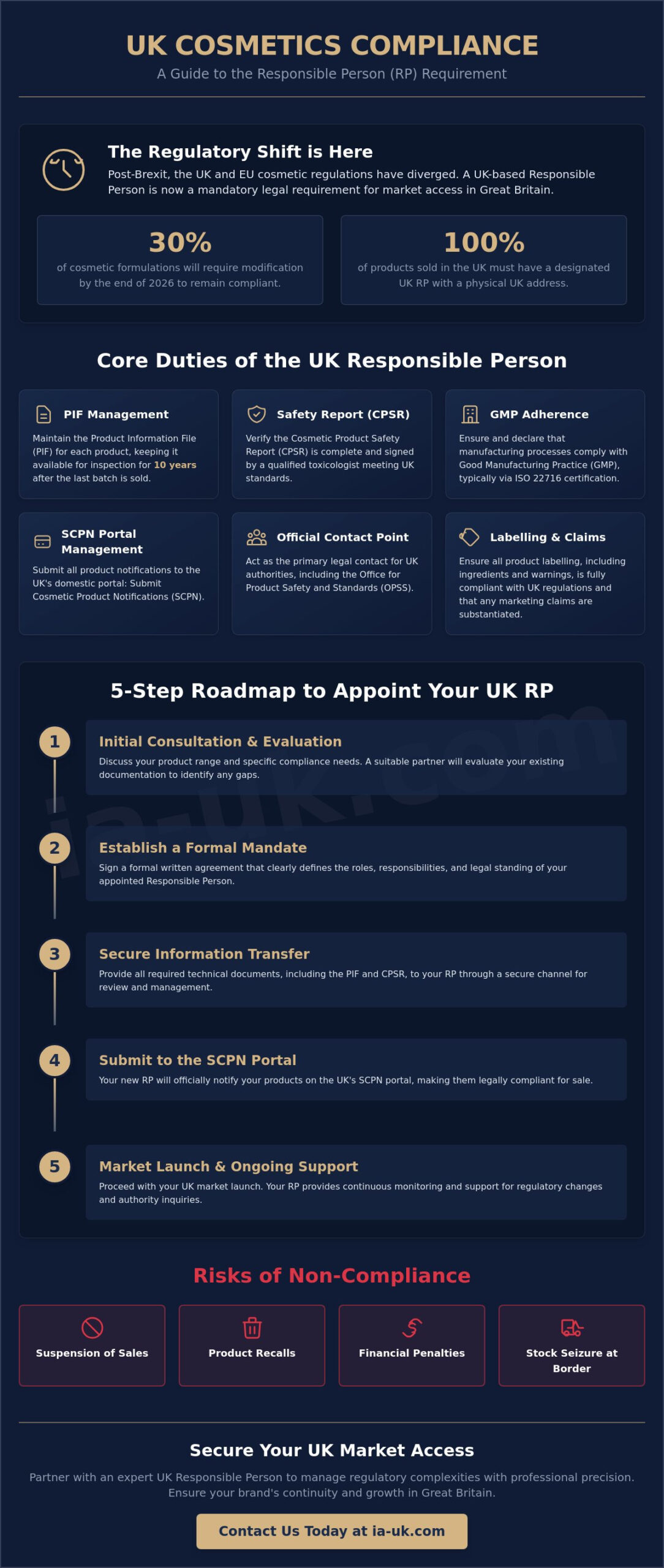
How to Appoint a UK Responsible Person: A 5-Step Roadmap
The transition to a UK-specific compliance model requires a methodical approach to ensure no disruption in supply chains. The process of appointing a UK responsible person for cosmetics involves a series of technical and legal milestones that transform a brand’s regulatory status from an external entity to a compliant UK participant. This transition is not instantaneous. It requires a disciplined verification of safety data and a formal transfer of legal liability to a representative with a physical presence in Great Britain.
Step 1 & 2: Audit and The Written Mandate
Before any legal agreement is finalized, a preliminary technical audit of the existing Product Information File (PIF) and Cosmetic Product Safety Report (CPSR) is essential. This audit identifies potential gaps, such as missing stability data or safety assessments that don’t meet current UK statutory requirements. Once the technical data is verified, a formal written mandate is established. This document must clearly define the scope of the appointment and the specific products covered. The mandate is only legally valid upon the “Written Acceptance” by the appointed person. This dual-signature process ensures that both the brand and the representative understand their respective legal obligations under the 2019 Regulations. Without this formal acceptance, the brand remains non-compliant, regardless of any verbal or informal agreements.
Following the mandate, the transfer of technical documentation occurs. The UK RP must receive a complete copy of the PIF and the CPSR for verification. This step is critical because the RP assumes legal responsibility for the safety of these formulations. They must be satisfied that the toxicological data is robust and that the safety assessor’s qualifications are recognized by UK authorities. This verification process often takes several weeks, particularly for brands with extensive product catalogs or complex formulations.
Step 4 & 5: Labeling and Notification
Compliance on the shelf is as critical as compliance in the dossier. By December 31, 2027, all cosmetic products sold in Great Britain must feature the UK Responsible Person’s name and address on the packaging. While EU addresses are currently permitted during the transition period, forward-thinking brands are updating labels now to avoid last-minute logistical bottlenecks. The address must be a physical location in the UK where the PIF is accessible to the OPSS. This requirement ensures that regulatory authorities can conduct inspections or safety inquiries without jurisdictional barriers.
The final stage involves the Submit Cosmetic Product Notification (SCPN) portal. Each SKU must be individually registered with details including the product category, formulation, and a digital image of the label. This ensures the OPSS has immediate access to safety information in the event of an inquiry. For brands seeking a reliable partner to manage these technical steps, our team acts as a professional EU and UK Authorised Representative, providing the local infrastructure needed for total market compliance. Successfully navigating the SCPN portal is the final hurdle in securing legal market access, confirming that all technical and administrative duties have been fulfilled.
Ensuring Market Continuity with International Associates Limited
International Associates Limited provides a stable foundation for global brands managing the specific requirements of the British regulatory environment. Operating from our Glasgow headquarters, we serve as a central administrative hub for companies seeking a reliable local presence in the United Kingdom. Our global network is designed to support brands as they transition from EU-centric models to a dual-market strategy. By appointing a UK responsible person for cosmetics through an established auditing and certification body, manufacturers ensure that their regulatory adherence is managed with institutional weight and professional precision.
The synergy between our representative services and ISO 22716 Good Manufacturing Practice (GMP) certification creates a robust framework for product safety. We apply a methodical approach to verification, ensuring that every technical dossier is scrutinized against current UK standards. This rigorous oversight reduces the risk of market friction and provides the security businesses need to expand their operations without fear of regulatory intervention. Our role is to act as the steady hand in corporate compliance, bridging the gap between complex international standards and local statutory obligations.
Professional UK Representation Services
We function as an independent and authoritative bridge to the UK market. Our technical teams conduct comprehensive reviews of Product Information Files (PIF) to ensure every component, from toxicological assessments to labeling, meets the strict criteria set by the OPSS. This ongoing surveillance is not a static process; it involves continuous monitoring of regulatory shifts to protect your market access. Many of our clients integrate these representative functions with ISO 9001 quality management systems. This integration ensures a holistic approach to compliance, where quality standards and legal representation work in tandem to support long-term growth and operational integrity.
Beyond Cosmetics: A Global Compliance Partner
Our expertise extends into a diverse range of highly regulated industrial sectors. We support brands in building consumer trust through Social Accountability Audits, which verify ethical practices throughout the supply chain. For companies operating at the intersection of beauty and health, we provide specialized knowledge in medical device standards via ISO 13485 certification. This breadth of capability allows us to handle high-stakes certifications for sensitive sectors with the same meticulous care we apply to cosmetic representation.
The process of appointing a UK responsible person for cosmetics is a critical step in securing your brand’s future in Great Britain. Our Glasgow office is equipped to handle the legal and technical complexities of this role, providing a local-global duality that few other entities can offer. Contact our administrative base today to discuss how our network of international offices and technical experts can secure your UK market position and ensure your products remain compliant in an evolving landscape.
Strategic Alignment for the 2026 Cosmetic Market
The shifting regulatory landscape requires more than reactive adjustments; it demands a permanent, technical presence within Great Britain. By consolidating the PIF management and SCPN notification processes discussed throughout this guide, brands ensure their market access remains uninterrupted. Appointing a UK responsible person for cosmetics represents a commitment to these standards, providing a layer of protection against the enforcement actions of the OPSS. This strategic alignment is the only way to navigate the 2026 requirements without compromising supply chain stability.
International Associates Limited offers the institutional reliability necessary to manage these complex legal roles. With our Glasgow headquarters and over 20 years of global certification expertise, we act as a meticulous guardian for your brand’s technical dossiers. Our expansive network of accredited Lead Auditors provides the proof of competence required for high-stakes compliance. Secure your UK market access with International Associates Limited’ professional representation services. Establishing this foundation today ensures your brand’s continued growth and stability in the UK market for years to come.
Frequently Asked Questions
Can my EU Responsible Person also cover the UK market in 2026?
No, an EU-based Responsible Person cannot fulfill legal obligations in Great Britain. Post-Brexit regulations require the Responsible Person to have a physical address within the United Kingdom. While the systems share historical roots, the UK’s Office for Product Safety and Standards (OPSS) only recognizes representatives within its own jurisdiction to ensure legal accountability and effective market surveillance.
What is the difference between an Authorised Representative and a Responsible Person?
In the cosmetics sector, the “Responsible Person” is the specific legal term defined by the UK Cosmetic Products Safety Regulations. While “Authorised Representative” is a broader term used across various product sectors like medical devices or electronics, the duties are functionally similar. Both roles involve acting as the legal liaison between the manufacturer and the national regulatory authorities to ensure product compliance.
Do I need to re-notify my products on the UK SCPN if they are already on the EU CPNP?
Yes, you must complete a new notification on the UK’s Submit Cosmetic Product Notifications (SCPN) portal for every product SKU. The EU’s CPNP and the UK’s SCPN are entirely separate databases with no data synchronization between them. Failure to register each item on the domestic portal before placing it on the Great Britain market results in immediate non-compliance and potential fines.
What happens if my UK Responsible Person resigns or ceases to exist?
You must immediately stop placing products on the market until you have completed the process of appointing a UK responsible person for cosmetics to take their place. A cosmetic product cannot legally exist on the UK market without an active and valid RP. You must also update the SCPN portal and your product labeling to reflect the new representative’s details as soon as the transition is finalized.
Is the UK Responsible Person liable for the safety of my cosmetic products?
Yes, the UK RP holds primary legal responsibility for ensuring that every cosmetic product complies with all relevant safety regulations. This includes verifying the safety assessment and maintaining the Product Information File for a ten-year period. While the manufacturer is responsible for the actual production standards, the RP is the entity the OPSS will hold accountable during audits or safety incidents.
Can one company act as the Responsible Person for multiple different brands?
Yes, a professional third-party representative can act as the RP for an unlimited number of brands and products. This is a standard industry practice that allows non-UK manufacturers to leverage the specialized regulatory expertise of a single, authoritative partner. This centralized approach ensures that all brands under their mandate follow a consistent compliance methodology and remain audit-ready at all times.
How much of my formulation does the UK RP need to see?
The UK RP requires access to the full qualitative and quantitative formulation of the product to fulfill their legal duties. This information is a mandatory component of the Product Information File (PIF) which the RP must keep available for immediate inspection by authorities. Professional representatives maintain strict confidentiality protocols to protect this sensitive intellectual property while ensuring the formulation meets all domestic safety restrictions.
Does the UK RP address need to be on the outer packaging or the primary container?
The name and address of the UK Responsible Person must generally appear on both the primary container and the secondary (outer) packaging. This ensures that safety information is available to consumers and authorities even after the outer box is discarded. If the product is physically too small to fit this information, specific derogations allow for the use of abbreviated addresses or symbols pointing to an accompanying leaflet.