

The assumption that the UKCA mark remains entirely optional in 2026 is a strategic misconception that could lead to immediate market rejection for high-risk manufacturers. While the UK government maintains indefinite recognition of the CE mark for many consumer categories, the transitional period for specific Class IIb and III medical devices concluded on June 30, 2026. Securing a ukca marking certification is no longer a matter of administrative preference for these sectors; it’s a mandatory requirement for maintaining legal access to the Great Britain market.
You’re likely managing the technical burden of dual documentation while facing the pressure of ensuring your supply chain remains resilient against regulatory divergence. This guide provides the objective clarity required to master the 2026 landscape and identify the most efficient path for your product portfolio. We’ll examine the specific sectors where UKCA marking is now compulsory, the vital role of a UK Authorised Representative for non-UK entities, and how to utilize dual certification as a strategic tool for global stability and market differentiation.
Key Takeaways
- Identify which product sectors benefit from indefinite CE recognition and which high-risk categories require immediate transition to British standards.
- Determine the most efficient path for ukca marking certification by assessing product risk levels and the necessity of third-party technical file verification.
- Clarify the distinct regulatory boundaries between Great Britain and Northern Ireland to prevent border delays or market rejection of your goods.
- Evaluate the legal requirement for non-UK manufacturers to appoint a UK Authorised Representative for mandatory MHRA registrations and regulatory liaison.
- Streamline your compliance strategy by leveraging global-local expertise to maintain dual technical files and ensure long-term regulatory future-proofing.
The 2026 UKCA Landscape: Mandatory vs. Optional Compliance
The UKCA marking (UK Conformity Assessed) functions as the primary indicator of product conformity for the Great Britain market. In 2026, the regulatory environment is defined by a dual-track system. While the Department for Business and Trade has extended the recognition of the CE mark for 21 product regulations, including toys and machinery, this policy isn’t a universal exemption. For certain high-stakes industries, ukca marking certification is mandatory. Medical devices are a primary example; the transitional recognition for Class IIb and III devices concluded on June 30, 2026. Other sectors requiring specific UKCA compliance include chemicals (UK REACH) and rail interoperability. 2026 is a pivotal year because it marks the point where technical documentation must reflect these divergent paths to avoid border delays or market rejection.
Geographic Scope: Great Britain vs. Northern Ireland
The UK market isn’t a single regulatory monolith. Great Britain (England, Scotland, and Wales) operates under the UKCA framework, while Northern Ireland continues to follow EU rules as part of the Windsor Framework. Consequently, the CE mark remains the mandatory requirement for goods entering Northern Ireland. If your conformity assessment is conducted by a UK-based body, you must apply the UKNI mark alongside the CE mark. Placing goods across the whole of the UK requires a nuanced understanding of these three distinct regulatory zones. Failure to recognize these territorial distinctions often results in significant logistics disruptions at the point of entry.
The Risk of Regulatory Divergence
The primary challenge for global manufacturers isn’t just current compliance, but the inevitable drift between UK designated standards and EU harmonised standards. When these technical requirements diverge, a product carrying only a CE mark may no longer satisfy British safety laws. Obtaining ukca marking certification provides a necessary layer of protection against these legislative shifts. International Associates facilitates this process by acting as a sophisticated bridge. We help manufacturers maintain technical documentation that satisfies both jurisdictions, ensuring uninterrupted market access. You can explore our regulatory compliance services to see how we monitor these legislative shifts and provide the verification needed to confirm your products meet the latest British standards.
UKCA vs. CE Marking: Key Differences for Manufacturers
The distinction between the CE and UKCA marks is primarily defined by geographic jurisdiction and the specific legislative frameworks they represent. While the CE mark provides access to the European Union’s 27 member states and Northern Ireland, the UKCA mark is the dedicated conformity assessment for Great Britain. Manufacturers must recognize that although the technical requirements often align, the legal obligations differ. For instance, the UK Declaration of Conformity must specifically reference UK Statutory Instruments and British designated standards rather than EU Directives and harmonised standards. This administrative separation requires a meticulous approach to documentation to ensure that a product’s compliance status remains valid in both markets.
Adhering to the physical UK Labeling and Marking Requirements is another critical factor. The UKCA logo must maintain a minimum height of 5mm unless the specific legislation allows for a different dimension. It must be placed on the product itself or, in certain permitted circumstances, on the packaging or accompanying documents. Visibility and legibility are mandatory; a failure to meet these aesthetic standards can result in market withdrawal, even if the underlying technical file is compliant.
Technical File Discrepancies
A technical file for the British market must be available in English and contain evidence that the product meets UK-specific regulations. Global brands often find efficiency by maintaining a master technical file with regional appendices that address localized requirements. This structure simplifies the ukca marking certification process by isolating the variables, such as specific UK risk assessments or localized testing data. Manufacturers are legally required to retain these files for 10 years after the product has been placed on the market, ensuring they’re accessible to market surveillance authorities upon request.
Authorised Representatives and UKRPs
Non-UK manufacturers cannot fulfill regulatory obligations without a legal presence or a designated representative within the country. This role is distinct from the EU Authorised Representative. For medical devices, a UK Responsible Person (UKRP) is mandatory for registration with the MHRA. The UKRP assumes responsibility for the declaration of conformity and acts as the primary liaison with regulatory bodies. Managing these appointments is a core component of our regulatory compliance services, providing the institutional weight and local expertise needed to navigate the UK’s legal landscape. Establishing this reliable UK-based representation is the most effective way to mitigate the risk of border delays or regulatory friction.
Determining Your Path: How to Choose a Certification Strategy
Selecting a compliance strategy requires a granular assessment of both legislative mandates and commercial objectives. While the official UK government guidance confirms that CE marking remains accepted for many goods, relying on this indefinitely introduces a risk of regulatory lag. Manufacturers must first determine if their product falls under “self-declaration” or requires a third-party assessment by a UK Approved Body. If your product is high-risk, such as certain pressure equipment or specific medical devices, ukca marking certification is the only secure path for long-term market access. Even when not legally required, the cost-benefit analysis often favors adoption to satisfy the expectations of UK retailers and distributors who prioritize brand consistency and local compliance signals.
Decision Factors for 2026
Three primary factors should dictate your certification timeline. First, identify if your product is in a high-risk category; for Class IIb and III medical devices, the transition period ended on June 30, 2026, making the UKCA mark mandatory. Second, evaluate your supply chain requirements. Many British distributors now demand the UKCA mark to simplify their own inventory management and avoid consumer confusion. Third, consider your long-term presence in the UK market. If you’re planning a sustained commercial effort, adopting ukca marking certification now serves as a form of insurance against future regulatory divergence between the UK and EU, preventing costly mid-cycle redesigns or documentation overhauls.
Integrating UKCA with Management Systems
A robust technical file isn’t a static document; it’s a byproduct of a functional quality system. Achieving ISO 9001 certification provides the structured framework necessary to manage the certification process efficiently. By aligning your quality management system with UK designated standards, you ensure that every unit produced maintains consistent conformity. This integration allows for streamlined audits where a single assessment can verify compliance for multiple international standards. Utilizing an established management system reduces the technical overhead and ensures that your internal verification processes are rigorous enough to withstand scrutiny from market surveillance authorities.
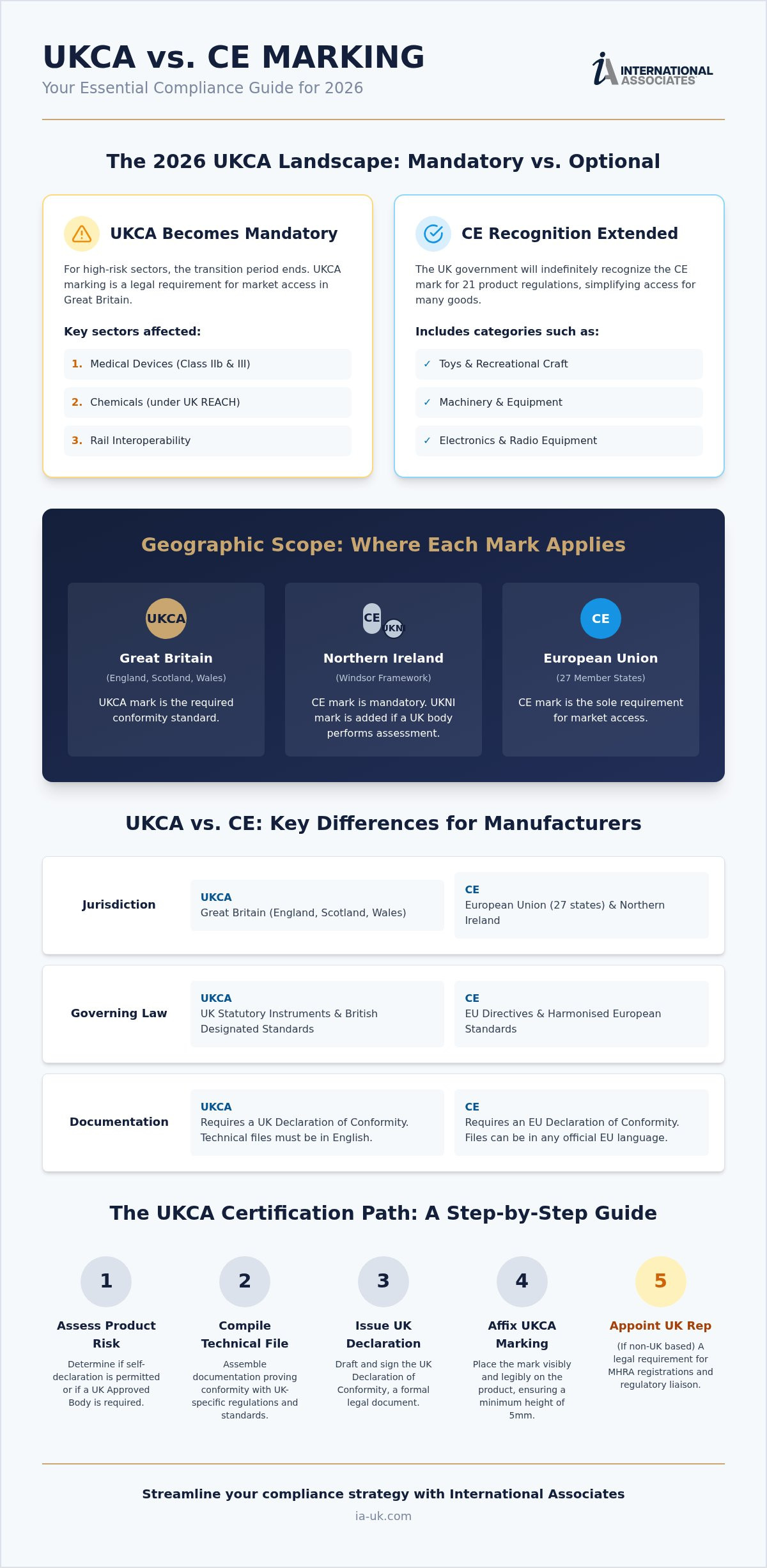
The UKCA Certification Process: A 2026 Step-by-Step Guide
Achieving ukca marking certification in 2026 requires a methodical approach that mirrors the rigorous standards of international auditing. Manufacturers must transition from a general understanding of the rules to a granular application of British Statutory Instruments. This process ensures that products entering Great Britain meet the specific safety and performance criteria established by the UK government. Following a structured roadmap reduces the risk of market rejection and ensures your technical documentation remains beyond reproach.
- Step 1: Identify Applicable UK Regulations. Determine which UK Statutory Instruments apply to your product. In 2026, you must ensure you’re using the latest British designated standards, which may differ from EU harmonised versions.
- Step 2: Determine Assessment Requirements. Verify if your product requires a third-party assessment by a UK Approved Body or if you can proceed via self-declaration. High-risk sectors often mandate independent verification.
- Step 3: Compile the Technical Documentation. Assemble a comprehensive Technical File that demonstrates compliance with all relevant UK regulations. This file must be maintained and updated as standards evolve.
- Step 4: Draft the UK Declaration of Conformity. Create a legal document stating that the product meets the required standards. It’s vital to reference the correct UK legislation rather than EU Directives.
- Step 5: Affix the Mark and Appoint a UKRP. Apply the UKCA mark to the product or packaging according to size and visibility rules. Non-UK manufacturers must also appoint a UK Responsible Person to act as a regulatory liaison.
Preparing for the Technical Documentation Review
A common pitfall in 2026 is the submission of technical files that rely on outdated EU test reports without verifying their alignment with UK designated standards. Reviews often fail when documentation lacks clear traceability or fails to address specific UK risk assessment criteria. The Technical File is the primary evidence of compliance for UKCA. To pass a rigorous audit, your reports must be precise, translated into English, and organized hierarchically to facilitate a methodical review by assessment bodies.
Post-Market Surveillance and Record Keeping
Compliance doesn’t end once the product is placed on the market. Manufacturers are legally obligated to retain their ukca marking certification records and technical files for usually 10 years. You must also establish a system for handling non-conformities and reporting safety issues to the relevant UK authorities. Maintaining this level of oversight is often supported by annual surveillance of your quality management systems. This ongoing verification ensures that your production processes remain consistent with the initial certification. Non-UK manufacturers should finalize their compliance strategy by securing a qualified UKRP through our regulatory compliance services to manage these long-term obligations.
Navigating UKCA Compliance with International Associates
International Associates Limited functions as a sophisticated bridge between complex British regulations and the global manufacturers who must adhere to them. Our Glasgow-based head office provides a distinct advantage, offering local technical expertise that is deeply rooted in the UK’s legal framework. This local presence is balanced by an expansive global network, ensuring that we provide institutional reliability regardless of your manufacturing location. By centralizing your ukca marking certification strategy with an independent body, you mitigate the risk of administrative errors that lead to market exclusion.
Our service portfolio is designed to address the specific technical burdens of non-UK entities. We provide:
- Independent technical documentation reviews for complex industrial and medical products.
- Comprehensive UK Responsible Person (UKRP) services, essential for MHRA registrations.
- Verification of technical files against the latest British designated standards.
- Authorised Representative functions to satisfy legal requirements for non-UK firms.
Why Partner with an Independent Certification Body?
Impartial verification is a foundational pillar of stakeholder trust. When an independent auditing body validates your technical file, it provides a level of security that self-declaration cannot match. This third-party assurance is often a prerequisite for UK distributors and insurance providers who require proof of regulatory adherence. Beyond verification, we support your internal growth through specialized professional development. You can enhance your internal compliance capacity by enrolling in our lead auditor training, which equips your team with the skills to manage complex auditing processes independently.
Comprehensive Regulatory Support
The role of the UK Responsible Person is particularly critical for medical device manufacturers in 2026. Given the fee structure for MHRA registrations, including the costs for additional devices and GMDN code applications, a meticulous approach to documentation is financially imperative. We handle these registrations with precision, acting as the steady hand in your regulatory liaison. Our expertise extends beyond the UKCA mark; we offer regulatory compliance services covering ISO 13485 for medical devices, Halal certification, and Social Accountability audits. This holistic approach allows you to streamline the ukca marking certification process while simultaneously satisfying other global supply chain requirements. To ensure your products meet the rigorous demands of the British market, contact International Associates Limited for a UKCA technical review today.
Future-Proofing Your Compliance Strategy for the British Market
The 2026 regulatory landscape requires manufacturers to move beyond reactive compliance and adopt a proactive strategy for the Great Britain market. While indefinite CE recognition provides a temporary reprieve for many sectors, the mandatory requirements for high-risk categories necessitate an immediate focus on technical file alignment. Securing a ukca marking certification ensures that your products remain accessible and compliant as UK designated standards begin to diverge from EU harmonised versions. This strategic foresight prevents costly logistics disruptions and maintains the integrity of your supply chain.
Managing this transition effectively depends on accurate technical documentation and the appointment of a reliable UK Responsible Person. International Associates provides the institutional stability needed to navigate these technical complexities. As an accredited certification and auditing body, we leverage our Glasgow-based regulatory expertise and a global network of regional offices to support your international growth. Our methodical approach minimizes the risk of market rejection and provides a clear path through the UK’s evolving legal framework. This objective oversight builds necessary trust with stakeholders and regulatory authorities alike.
Secure your UK market entry with a professional UKCA technical review to maintain your competitive advantage. We look forward to facilitating your continued success in the British market.
Frequently Asked Questions
Is UKCA marking mandatory in 2026 for all products?
No, the UKCA mark isn’t mandatory for all product categories in 2026. The UK government continues to recognize the CE mark indefinitely for 21 product regulations, including toys, electronics, and machinery. However, specific high-risk sectors have reached their transition deadlines. For Class IIb and III medical devices, achieving ukca marking certification became a mandatory requirement on June 30, 2026, to maintain legal access to the Great Britain market.
Can I still use CE marking for products sold in Great Britain?
You can continue to use the CE mark for the majority of manufactured goods under the government’s indefinite recognition policy. This applies to products that meet EU standards and carry a valid CE mark. It’s important to distinguish that this recognition applies only to Great Britain. Northern Ireland follows different rules under the Windsor Framework, where the CE mark remains the mandatory requirement for placing goods on the market.
What is a UK Approved Body and when do I need one?
A UK Approved Body is an independent organization appointed by the UK government to conduct conformity assessments. You must engage one if the specific UK legislation for your product requires third-party verification instead of self-declaration. This is generally mandatory for high-risk products where independent safety assurance is required. These bodies provide the same level of technical oversight in the UK that Notified Bodies provide within the European Union regulatory system.
How does UKCA marking differ from CE marking for medical devices?
The distinction lies in the regulatory authority and the specific compliance deadlines. UKCA marking requires registration with the MHRA and adherence to the UK’s specific medical device regulations. While CE marking follows EU MDR/IVDR, Class IIb and III devices required ukca marking certification by June 30, 2026. Additionally, non-UK manufacturers must appoint a UK Responsible Person, a role that is legally distinct from an EU Authorised Representative.
Do I need a UK Responsible Person (UKRP) if I am based in the EU?
Non-UK manufacturers are legally required to appoint a UKRP to place medical devices on the Great Britain market. This requirement applies to all firms based outside the UK, including those in the EU. The UKRP serves as the primary liaison with the MHRA and is responsible for registering devices and ensuring technical documentation is available for inspection. This role is essential for maintaining regulatory compliance and ensuring uninterrupted access to British healthcare markets.
What are the penalties for non-compliance with UKCA regulations?
Non-compliance triggers enforcement actions from UK market surveillance authorities. These measures include formal compliance notices, product recalls, and the immediate withdrawal of goods from the market. Serious violations can lead to unlimited fines and potential imprisonment for responsible officers. Authorities are rigorous in identifying incorrectly marked products to ensure consumer safety and maintain the technical integrity of the British marketplace. Establishing a robust technical file is the best defense against these penalties.
How long does the UKCA certification process typically take?
The duration of the process depends on product risk levels and the readiness of your technical documentation. A review of a comprehensive technical file by an independent body typically takes several weeks. If your product requires a third-party assessment by a UK Approved Body, the timeline can extend to several months. Factors such as the availability of test reports and the complexity of the UK’s designated standards will influence the final certification schedule.