

Recent audit data indicates that the leading cause of certification failure is not a lack of technical expertise, but rather inadequate maintenance records for height safety and PPE equipment. Navigating the transition to the latest standards requires a precise GWO audit checklist to avoid the risk of training suspension or WINDA upload errors. For training providers, the period leading up to the September 10, 2026, implementation deadline for Version 15 updates represents a critical window for rigorous operational alignment.
Maintaining a “living” safety management system amidst shifting GWO requirements is a complex undertaking that demands absolute precision. This guide outlines the exact documentation and physical evidence needed to achieve zero major non-conformities during your Stage 2 audit. You will gain a clear understanding of Version 14 certification requirements, effective instructor qualification tracking, and the technical standards necessary to ensure your facility remains a reliable link in the global wind energy supply chain.
Key Takeaways
- Identify specific regulatory updates in Version 15 and the September 2026 implementation deadline to ensure continuous training validity.
- Mitigate the primary cause of audit failure by implementing rigorous inspection logs for height safety and rescue equipment according to GWO technical standards.
- Utilize a structured GWO audit checklist to align your Quality Management System with WINDA integration requirements and prevent training suspensions.
- Verify instructor qualifications against the IQT V2 standard to maintain compliance between staff expertise and specific module delivery.
- Evaluate certification bodies based on their capacity to provide integrated audits across GWO and ISO 45001 standards for streamlined global operations.
GWO Audit Framework 2026: Navigating Version 14 Requirements
The GWO audit serves as a rigorous verification mechanism designed to ensure that training providers maintain global consistency and safety excellence. By adhering to the standards set by the GWO Audit & Compliance Committee, facilities demonstrate their ability to deliver high-stakes technical instruction without variance. This framework is built on a “by industry for industry” promise, meaning the audit rigor is directly informed by the safety needs of leading wind energy operators. For providers using a structured GWO audit checklist, this means moving beyond basic compliance toward a proactive safety culture that mirrors the operational demands of a wind turbine environment. Version 14 of the Requirements for Certification emphasizes this alignment, requiring a more integrated approach to how training providers manage their internal verification processes.
The Core Pillars of GWO Compliance
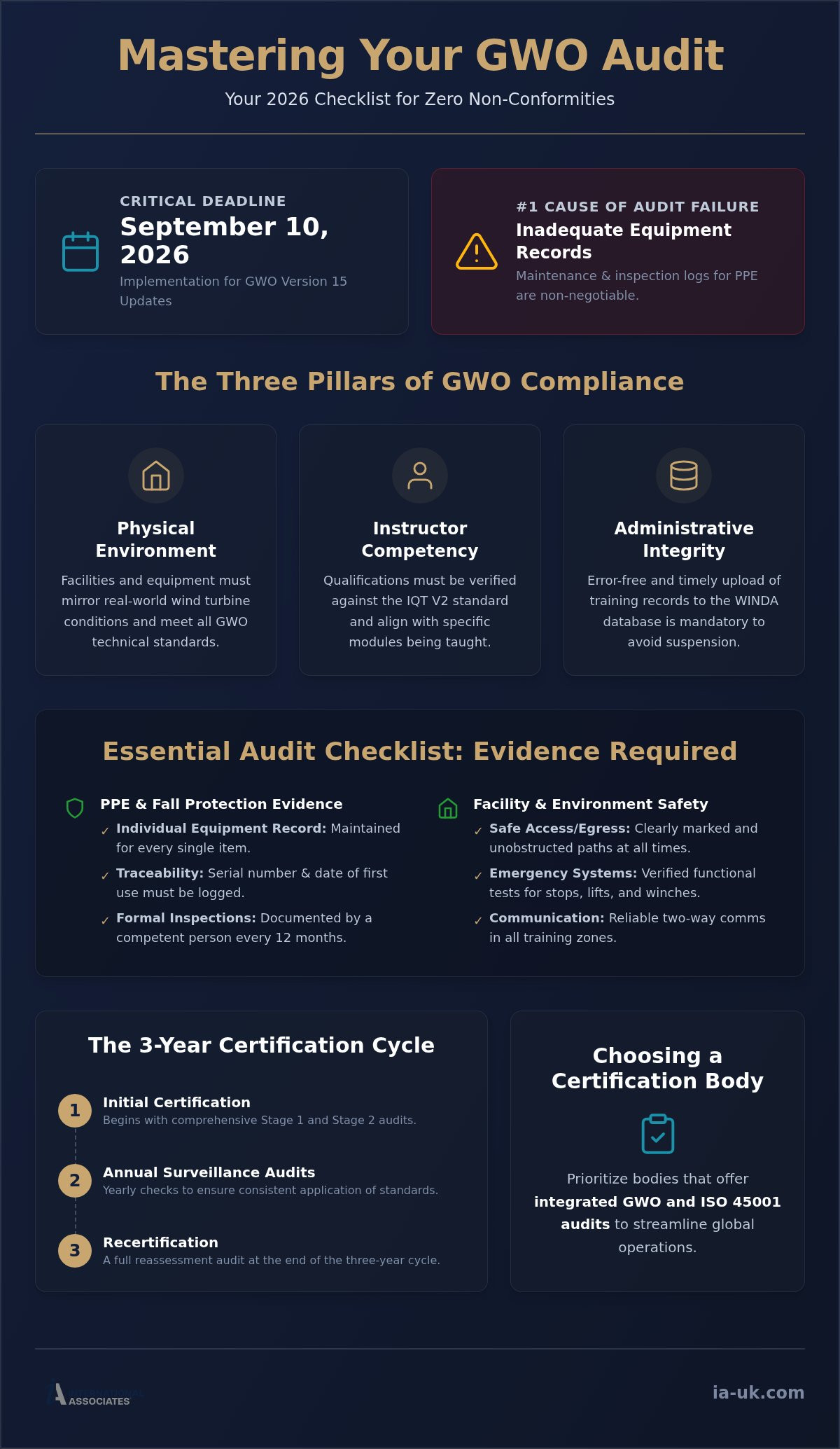
Three central pillars define GWO adherence: the physical environment, instructor competency, and administrative integrity. Facilities must verify that training areas meet “acceptable environment” criteria, including the meticulous maintenance of height safety equipment and PPE. Instructor records are scrutinized to ensure qualifications align with the specific GWO modules being delivered, particularly under the Instructor Qualification Training (IQT) Version 2 standard. Finally, the integrity of WINDA database management is essential. Any delay or error in uploading training records can lead to immediate non-conformities and risk the suspension of training activities. A comprehensive GWO audit checklist should prioritize these administrative links to ensure training records are synchronized with the central global database without friction.
Audit Cycles: Surveillance vs. Recertification
Certification operates on a three-year cycle, beginning with an initial Stage 1 and Stage 2 audit process. Once certified, training providers undergo annual surveillance audits to ensure that the standards verified during the initial assessment are consistently applied. These surveillance visits focus on operational implementation and maintenance logs rather than just high-level documentation. Preparation for the technical documentation review is a critical step before an auditor arrives on-site. Providers often find that integrating their GWO requirements with a broader management system certification, such as ISO 45001, creates a more resilient framework for these recurring assessments. This integrated approach reduces the administrative burden during recertification, as safety and quality protocols are already embedded within the organizational culture.
Technical Infrastructure and Equipment Audit Checklist
Auditors in 2026 prioritize the physical integrity and traceability of training assets over mere availability. A robust GWO audit checklist must detail the specific evidence required for every piece of safety hardware, ensuring each item is accounted for from purchase to its current state. Verification processes during Stage 2 audits focus heavily on the documentation of life-critical equipment, where any gap in the maintenance chain can lead to immediate audit failure. Technical infrastructure must not only meet the standards for specific modules but also demonstrate a consistent history of professional oversight.
PPE and Fall Protection Evidence
Auditors examine harnesses, lanyards, and helmets to ensure they match module-specific requirements, such as those found in Basic Safety Training (BST) V20 or Advanced Rescue Training (ART) V6. The focal point of this review is the “Individual Equipment Record.” This document must track the serial number, date of first use, and every subsequent inspection for each item. Fall arrest gear must undergo a formal, documented inspection by a competent person at least once every 12 months, or more frequently if manufacturer guidelines dictate. If these logs are missing or incomplete, auditors will likely issue a major non-conformity, as these records are the primary proof of trainee safety.
Facility and Environment Safety
The training environment must accurately mirror the high-stakes conditions found in a wind turbine. Safe access and egress points for high-altitude platforms must be clearly marked and unobstructed at all times. Emergency stop mechanisms on winches and lifts require verified functional tests, with the results recorded in the facility maintenance log. Communication systems, such as two-way radios or intercoms, must remain operational in all confined space and height zones to ensure instructor control. Auditors also verify that indoor facilities maintain appropriate temperature and ventilation controls to prevent trainee fatigue during intensive modules like Blade Repair (BR) V6.
Technical zones also require specialized medical support. Trauma kits must meet GWO Enhanced First Aid (EFA) V6 specifications, including high-pressure bandages and tourniquets, and they must be positioned within immediate reach of training zones. Ensuring these physical assets are managed through a centralized regulatory compliance framework provides the institutional weight auditors expect from a professional training provider. This level of preparation ensures that the physical facility remains as resilient as the management system supporting it.
Management Systems: The Documentation and Process Checklist
A robust Quality Management System (QMS) acts as the central nervous system for any GWO-certified facility, translating technical standards into repeatable operational processes. When developing a GWO audit checklist, training providers must ensure their QMS specifically addresses the “Requirements for Training” rather than relying on generic ISO 9001 documentation. Auditors verify that risk assessments are not merely static documents but active guides for every physical exercise, reflecting the specific hazards of the training environment. This documentation must also include a closed feedback loop where delegate evaluations are analyzed to drive tangible improvements in training delivery. This systematic approach ensures that the training provided is consistent, regardless of which instructor is leading the session.
Instructor Competency and Records
Maintaining the correct Instructor-to-Delegate ratio is a non-negotiable requirement that varies across modules. For example, modules involving practical exercises at height require specific ratios to ensure safe supervision and immediate rescue capability. Documentation must clearly show the “train-the-trainer” pathway for each staff member, supported by annual performance reviews and evidence of ongoing professional development. To strengthen these internal oversight mechanisms, many organizations invest in Lead Auditor Training to develop in-house expertise capable of identifying gaps before an external assessment occurs. This proactive approach ensures that instructor records remain current and aligned with the IQT V2 standard, which is a primary focus for auditors in 2026.
The WINDA Upload Process
The integrity of the WINDA database is the final hurdle in the certification process. Training providers must implement strict identity verification protocols to ensure delegate prerequisites are met before training commences. Once a module is completed, the “10-day rule” applies. All training records must be uploaded to the WINDA system within ten working days of the course completion date. Failure to meet this timeline is a frequent cause of non-conformities during surveillance audits and can lead to the suspension of a provider’s license. This administrative process must also respect data protection regulations like GDPR, ensuring that student records are handled with the necessary level of confidentiality and security. A detailed GWO audit checklist should include a dedicated section for administrative verification to prevent these high-impact errors.
Preparing for the Audit: Common Non-Conformities in 2026
Achieving compliance requires an analytical understanding of how auditors categorize deviations from the standard. Non-conformities are typically divided into minor and major categories. A minor non-conformity represents a localized lapse in a process that doesn’t compromise safety or training integrity. In contrast, a major non-conformity indicates a fundamental breakdown in the management system. In the wind energy sector, a major finding during a Stage 2 audit will immediately halt the certification process until the issue is rectified and verified. Utilizing a comprehensive GWO audit checklist during the Stage 1 Readiness Review allows providers to identify these critical gaps early, ensuring that the documentation is robust enough to support the implementation phase. This preliminary review acts as a safety net, preventing costly delays during the final assessment.
Avoiding Documentation Gaps
Missing equipment service records remain a primary cause of major non-conformities in the industry. Every harness and rescue device must have a verifiable, documented history of inspection that matches its serial number. Auditors also scrutinize instructor files to verify their GWO Auditor Qualification Training (AQT) status, ensuring that those leading the sessions possess the necessary pedagogical and technical expertise. For facilities operating across multiple regions, integrating these requirements into a broader management system certification helps maintain institutional consistency. This alignment ensures that safety protocols are not isolated but are part of a globally recognized quality framework that scales with the business and remains resilient under scrutiny.
The Mock Audit: A Self-Assessment Tool
Conducting a mock audit is the most effective way to test readiness before the official assessment. This involves a physical walk-through of the facility using the auditor’s perspective to evaluate equipment storage, signage, and technical training zones. During this self-assessment, providers should test their emergency response plan by simulating an incident during a mock training session. This exercise reveals whether instructors can effectively manage a crisis while maintaining trainee safety in a high-pressure environment. Additionally, the technical files for all medical devices used in first aid training must be reviewed to ensure they meet the latest trauma kit specifications. By identifying these issues internally, providers can refine their GWO audit checklist and enter the formal audit with earned confidence.
Ensuring your facility is prepared for a high-stakes assessment requires meticulous attention to detail and a disciplined approach to record-keeping. You can streamline your path to compliance by engaging with our management system certification services to ensure your documentation meets global standards before the auditor arrives.
Selecting Your GWO Certification Body: 2026 Selection Criteria
Choosing a certification body is a strategic decision that extends beyond the immediate audit. For training providers operating across multiple jurisdictions, the ability of a body to balance global reach with local expertise is essential. An auditor must understand the nuances of regional safety legislation while strictly adhering to the universal GWO framework. This global-local duality ensures that certification remains valid and respected by wind energy operators worldwide. Selecting a body capable of delivering multi-standard assessments, such as combining GWO with ISO 45001 and ISO 9001, significantly reduces administrative overlap. This integrated approach streamlines the verification process and allows for a more cohesive management system that is easier to maintain over the three-year certification cycle.
Independent assessment and verification build the necessary stakeholder trust for businesses seeking to expand in the renewable energy sector. When a certification body operates with transparency and independence, it provides a guarantee of quality to investors and turbine manufacturers. Efficient turnaround times for audit reports and certificate issuance are also critical. Delays in certification can prevent a training center from going live or cause gaps in their WINDA status, leading to lost revenue and reputational damage. A meticulous GWO audit checklist is only as effective as the certification body that verifies its implementation.
Why International Associates Limited for GWO Audits?
International Associates Limited serves as a sophisticated bridge between complex regulatory requirements and training providers. By leveraging a global network of auditors with deep technical expertise in the wind energy sector, we ensure that assessments are both rigorous and supportive of international growth. Our modern IT infrastructure is specifically designed for efficient audit processing, which facilitates a rapid turnaround for reports and certificate issuance. This technological advantage minimizes the operational friction often associated with high-stakes certifications. You can learn more about our commitment to institutional reliability by reviewing About IA’s Accreditations, which details our standing as a trusted independent assessment body.
The Final Decision: Cost vs. Value
The decision-making process involves a careful evaluation of fee structures against the long-term value of the certification. Providers must account for the initial assessment, annual surveillance, and the three-year recertification cycle. While cost is a factor, the return on investment for a rigorous audit is found in the significant reduction of operational risk and legal liability. A training facility that utilizes a precise GWO audit checklist and partners with a meticulous certification body is better positioned to avoid the costs of training suspensions or WINDA errors. This earned confidence provides a competitive advantage when bidding for contracts with major wind farm operators who demand the highest safety standards. For a detailed assessment of your facility’s readiness, you can Contact International Associates Limited for a GWO Audit Quote to begin your certification journey.
Achieving Long-Term Compliance in Global Wind Training
Successful certification in 2026 hinges on the seamless integration of technical rigor with administrative precision. By utilizing a structured GWO audit checklist, training providers can systematically address the nuances of Version 14 requirements while preparing for the September 10, 2026, deadline for updated training standards. Maintaining proactive oversight of equipment life cycles and instructor qualifications ensures that your facility remains compliant and competitive within the global wind energy market. International Associates Limited provides the independent verification necessary to bridge the gap between complex regulatory landscapes and operational growth.
As a Glasgow-headquartered global certification body with a worldwide reach, International Associates Limited is accredited for GWO and social accountability standards to support your international expansion. You can Request a GWO Certification Readiness Assessment to ensure your management system is robust enough to achieve zero major non-conformities during your next assessment. Your commitment to these rigorous safety standards reinforces the industry’s collective goal of a zero-harm working environment and provides the stability needed for sustained commercial success.
Frequently Asked Questions
What is the difference between GWO Version 13 and Version 14 for audits?
Version 14 is the current standard for certification as of 2026, while training providers must implement Version 15 training updates by September 10, 2026. The primary shift involves more rigorous requirements for management system alignment and digital record-keeping via WINDA. It also introduces specific criteria for instructor qualifications under the IQT V2 standard. Training providers must ensure their GWO audit checklist reflects these administrative and technical updates to maintain certification validity.
How often does a GWO training provider need to be audited?
Training providers operate on a three-year certification cycle. After the initial Stage 1 and Stage 2 audits, providers must undergo annual surveillance audits to verify continued compliance with technical and administrative standards. A full recertification audit is required every three years to renew the license. Maintaining a consistent internal audit schedule between these external visits is the most effective way to ensure readiness for the certification body’s arrival.
Can we conduct our GWO audit remotely in 2026?
Remote audits are typically restricted to Stage 1 documentation reviews or specific administrative surveillance activities. Because GWO certification requires the physical verification of training environments, equipment safety, and practical instructor demonstrations, Stage 2 and recertification audits must be conducted on-site. This ensures that the training facility meets the “acceptable environment” criteria and that all height safety mechanisms are fully functional in a real-world setting.
What are the most common non-conformities found in GWO audits?
Inadequate maintenance records for height safety and rescue equipment are the leading cause of audit failure in 2026. Other frequent issues include a mismatch between instructor qualifications and the specific modules they deliver, as well as delays in uploading records to the WINDA database beyond the 10-day limit. Utilizing a comprehensive GWO audit checklist helps providers identify these documentation gaps before the auditor arrives, preventing major non-conformities that halt certification.
How long does it take to get GWO certified after the audit?
The timeline depends on the audit outcome and the efficiency of the certification body. If zero major non-conformities are found, the auditor submits the report for technical review, a process that typically takes two to four weeks. Once the review is complete and the annual licensing fee is confirmed, the certificate is issued and training can be uploaded to WINDA. Providers using modern IT infrastructure for audit processing often experience faster turnaround times.
Do all GWO instructors need to have AQT (Auditor Qualification Training)?
No, AQT is specifically required for individuals performing internal or external audits rather than those delivering training. Instructors must instead meet the requirements of the Instructor Qualification Training (IQT) standard, currently at Version 2. This qualification ensures they possess the technical skills and pedagogical competence to lead modules like Basic Safety Training (BST) or Advanced Rescue Training (ART) safely and effectively.
What happens if we fail our GWO surveillance audit?
Failing a surveillance audit due to a major non-conformity results in the immediate suspension of the training provider’s license. The provider must implement corrective actions and undergo a follow-up assessment to verify that the issue has been resolved. During this suspension period, any training conducted cannot be uploaded to WINDA, which effectively prevents delegates from receiving valid certification for their wind energy roles.
How do GWO audits integrate with ISO 45001 health and safety standards?
GWO audits and ISO 45001 share a foundational focus on risk management and operational safety. Many providers choose to integrate these assessments to reduce administrative overlap and create a unified safety management system. Because International Associates Limited specializes in both GWO and ISO 45001, we can provide coordinated audits that verify technical training standards alongside broader occupational health and safety frameworks, ensuring global consistency across all operations.