

With over 1.3 million organizations worldwide maintaining active certificates, the publication of the ISO 9001:2026 standard in September marks a decisive shift in global quality management. For many quality managers, the transition from the 2015 version introduces a specific fear of major non-conformities, particularly regarding newly integrated climate change requirements. Utilizing a structured ISO 9001 audit checklist is no longer just a preparation step; it’s a strategic necessity to ensure your Quality Management System remains compliant and operationally sound.
It’s understandable that the complexity of interpreting revised clauses often leads to inconsistent internal auditing results and significant stress during external assessments. We recognize that maintaining institutional weight in a shifting regulatory environment requires more than a simple list of tasks. This guide provides a clear, decision-focused framework designed to bridge the gap between technical adherence and high-level operational excellence. You’ll gain a comprehensive understanding of how to verify QMS effectiveness, reduce audit-related friction, and secure successful certification with an accredited body. Our methodical approach ensures your organization is prepared for the 2026 transition while fostering a culture of continuous improvement and global reliability.
Key Takeaways
- Identify how the 2026 standard integrates climate change risks and digitalization into the core audit process to maintain operational resilience.
- Utilize a decision-focused ISO 9001 audit checklist to verify leadership commitment and align organizational context with stakeholder requirements.
- Distinguish between internal audits designed for system improvement and external certification assessments focused on strict regulatory conformity.
- Execute rigorous evidence collection through structured interviews and document reviews to mitigate the risk of major non-conformities during external audits.
- Select an accredited certification body by evaluating their global operational capacity and specialized technical expertise in your specific industrial sector.
Why a Strategic ISO 9001 Audit Checklist is Essential in 2026
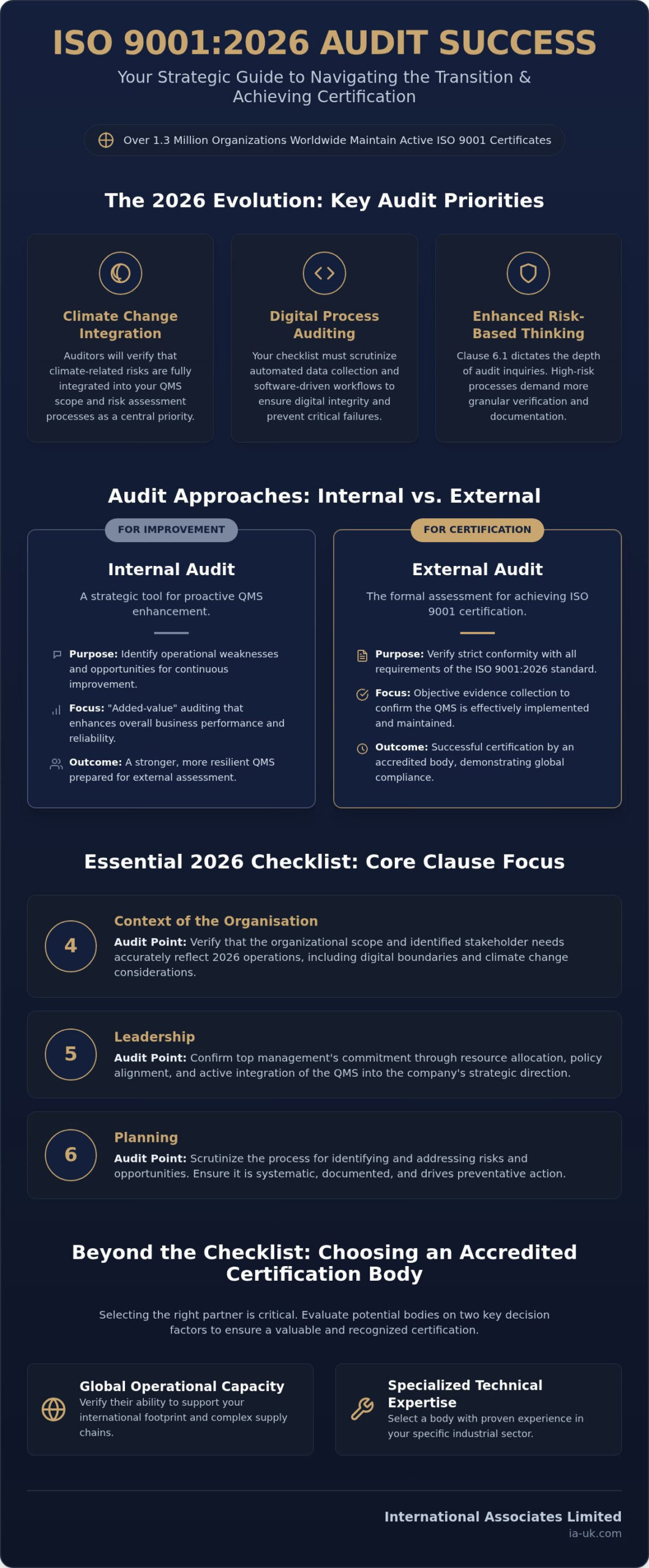
An ISO 9001 audit checklist serves as the foundational verification tool for assessing the effectiveness of a Quality Management System (QMS). It provides a structured methodology for confirming that internal processes align with the requirements of the ISO 9000 family of standards. In the context of the 2026 revision, the checklist functions as the primary defense against major non-conformities during Stage 2 external audits. Utilizing a robust checklist prepares the organization for the final assessment conducted by an accredited certification body such as International Associates Limited. While basic checklists often focus on binary compliance, a strategic version facilitates “added-value” auditing. This approach doesn’t just check boxes; it identifies operational weaknesses that, when corrected, improve overall business performance and reliability.
The 2026 landscape demands a transition toward digital process auditing. Modern checklists must account for automated data collection and the software-driven nature of contemporary quality management. Organizations that rely on outdated, manual verification methods risk overlooking critical failures in digital workflows. A well-designed checklist ensures that these technological integrations are scrutinized with the same rigor as traditional manufacturing or service processes. This focus on digital integrity is essential for businesses operating in high-stakes technical sectors where data accuracy is non-negotiable.
The Role of Risk-Based Thinking in Modern Auditing
The 2026 standard emphasizes that Clause 6.1 requirements regarding risks and opportunities must dictate the depth of audit inquiries. High-risk processes, such as those involving complex supply chains or sensitive data, require more granular verification within your ISO 9001 audit checklist. Professionalizing the internal audit team through Lead Auditor Training ensures that these risk assessments are conducted with the necessary technical depth. Additionally, the 2024 Climate Change amendment is now a central priority. Auditors look for evidence that climate-related risks are integrated into the QMS scope and risk assessment. This shift requires auditors to move beyond static documentation toward verifying how these risks are managed in real-time. Failure to document this consideration is a frequent source of non-conformity in current certification cycles.
Checklist vs. Process Approach: Which Wins?
A simple “yes/no” checklist is often insufficient for evaluating complex international standards. While a checklist provides structure, it should be used to prompt open-ended evidence collection rather than limiting the scope of the investigation. Effective auditing requires a process approach that tracks the flow of information and materials across departments. By using the checklist as a guide for deeper inquiry, organizations can ensure they meet the high regulatory standards detailed in ISO 9001: The Comprehensive Guide to Quality Management Systems in 2026. This method ensures that the audit provides a holistic view of system health rather than a fragmented assessment of individual clauses. It turns the audit into a tool for operational excellence rather than a mere administrative hurdle.
Essential Clause Breakdown: What Your 2026 Checklist Must Cover
To achieve certification, your ISO 9001 audit checklist must align with the specific requirements of the ISO 9001:2015 standard and its subsequent amendments. While the 2026 revision maintains the High-Level Structure (HLS), the emphasis has shifted toward verifying that the Quality Management System (QMS) is a living system integrated into the company’s strategic direction. A checklist that focuses purely on documentation will fail to capture the operational nuances required for modern compliance.
Auditing Leadership and Context (Clauses 4 & 5)
Clause 4 requires a deep dive into the “Context of the Organisation.” Your checklist should include prompts to verify that the organisational scope accurately reflects 2026 operations, including digital service boundaries and physical locations. For Clause 5, auditors must look for objective evidence of top management commitment. Don’t just ask if a quality policy exists; ask how leadership ensures quality objectives are compatible with the business strategy. Auditors should verify that leadership is accountable for the effectiveness of the QMS and that resources are available to support it. For those seeking to professionalize their internal teams, Lead Auditor Training provides the necessary skills to conduct these high-level interviews effectively.
Operational Controls and External Providers (Clause 8)
Clause 8 represents the core of service delivery and manufacturing. Your ISO 9001 audit checklist must prioritize the control of externally provided processes, products, and services. In a globalized economy, verifying that suppliers meet your quality standards is critical. Key checklist items include:
- Verification of criteria for evaluation, selection, and re-evaluation of external providers.
- Documentation of design and development changes to ensure they don’t compromise product integrity.
- Methods for ensuring traceability and preservation of outputs throughout the production cycle.
- Evidence that operational risks identified in Clause 6 are mitigated through specific control measures.
Auditors should also check if the design and development process (Clause 8.3) includes reviews and validations that prevent non-conforming products from reaching the customer. This level of scrutiny ensures that the QMS provides a reliable foundation for international growth.
Performance and Improvement (Clauses 9 & 10)
Sections 9 and 10 focus on the “Check” and “Act” phases of the PDCA cycle. Auditors must verify that internal audits are conducted at planned intervals and that the results lead to meaningful corrective actions. Your checklist should examine the effectiveness of the management review process, ensuring it isn’t merely a rubber-stamping exercise but a critical evaluation of system performance. Verification of data analysis from customer feedback and process monitoring is essential to prove that the system drives continuous improvement. If you’re preparing for your final assessment, our team offers professional management system certification services to validate your compliance with international standards.
Internal vs. External Audit Checklists: Key Differences for Success
Understanding the distinction between audit types is critical for Quality Management System (QMS) maturity. First-party audits are internal assessments conducted by the organization itself. Second-party audits involve evaluating suppliers or external providers to ensure supply chain integrity. Third-party audits are formal assessments performed by an independent, accredited certification body to verify conformity. While an internal ISO 9001 audit checklist often targets operational improvement and process efficiency, external checklists used by bodies like International Associates strictly measure adherence to the quality management systems standard.
First-Party Audits: The Internal Verification
Internal audits act as a diagnostic tool. They identify gaps before they become major non-conformities in a high-stakes certification environment. Maintaining auditor independence is a requirement; the individual auditing a process shouldn’t be the person who manages it. This objectivity allows the organization to build a “conformity roadmap” for the Stage 1 assessment. If internal teams lack the technical depth to mirror external rigor, professionalizing them through Lead Auditor Training is a strategic investment. It ensures the internal team understands how to apply the checklist with the same scrutiny as a global certification body.
Decision factors for using external experts to conduct internal audits include:
- Lack of internal staff with sufficient technical expertise or auditing experience.
- Need for an impartial, “fresh eyes” perspective to identify systemic blind spots.
- The complexity of global regulatory requirements across multiple manufacturing regions.
- A requirement for a highly specialized audit in a technical sector like medical devices.
Preparing for the Third-Party Certification Audit
Third-party auditors focus heavily on “objective evidence.” They look for verifiable proof that the QMS is functional and effective rather than just documented. Internal teams often miss subtle systemic failures because they’re too close to daily operations. An external auditor from an accredited body brings a broader industry perspective. They evaluate whether the ISO 9001 audit checklist has been used effectively to drive corrective actions and continuous improvement.
Choosing a certification body is a strategic decision. Organizations often transfer their certificate to a more specialized body if their current partner lacks expertise in high-stakes sectors. A specialized partner provides the institutional weight and global reliability needed for international growth. You should verify that your chosen body has the necessary accreditations and a network of international offices. This ensures the certification remains a valid credential for global market access. If you’re ready to advance your compliance journey, explore our management system certification services.
Executing the Audit: Identifying and Documenting Non-Conformities
Audit execution follows a disciplined sequence to ensure impartiality and procedural integrity. It begins with an opening meeting where the audit scope and criteria are confirmed with all relevant stakeholders. The process then transitions into the evidence collection phase, which is the most critical component of the assessment. Following data gathering, findings are categorized into Major Non-Conformities, Minor Non-Conformities, or Observations. A Major Non-Conformity represents a systemic failure or a significant risk to the quality of products and services, while a Minor Non-Conformity suggests an isolated lapse in adherence. The audit cycle concludes with a root cause analysis and a formal closing meeting to report results to top management, ensuring the organization understands the path toward corrective action.
The Art of Evidence Collection
Effective auditing requires moving beyond a “show me a document” mindset toward a “show me how this process works” approach. In the 2026 operational landscape, auditors must verify digital records and remote process performance with the same rigor as physical onsite inspections. Objective evidence is a verifiable fact through observation, measurement, or test. This evidence based approach ensures that the audit reflects the actual operational reality rather than just the stated procedures. It provides the institutional weight necessary for a credible assessment that stands up to global scrutiny. Auditors look for the consistent application of controls across different shifts, locations, and digital platforms.
Handling Non-Conformities Before Certification
Before engaging an accredited body for a formal assessment, organizations should use their ISO 9001 audit checklist to perform a comprehensive Gap Analysis. This internal review identifies specific areas where the current system falls short of the standard’s requirements. It’s essential to close Minor non-conformities promptly during this phase. If left unaddressed, these isolated incidents often aggregate into systemic Major non-conformities that can jeopardize certification success during the Stage 2 audit. This proactive management of findings ensures a smoother transition and demonstrates a high level of QMS maturity to external assessors. Using the checklist as a decision making tool allows management to prioritize resources where they’ll have the greatest impact on compliance.
Organizations seeking a reliable partner for their final assessment can explore our Management System Certification services to ensure their QMS meets the highest global standards.
Beyond the Checklist: Choosing an Accredited Certification Body
While the ISO 9001 audit checklist is a vital internal tool for verifying QMS effectiveness, the final certificate’s validity depends entirely on the authority of the body that issues it. Selecting a certification body is a strategic decision that carries significant weight in the global supply chain. An unaccredited certificate is essentially a document without institutional weight; it won’t be recognized by major international contractors or regulatory authorities. Therefore, the selection process must prioritize bodies that demonstrate a unique blend of global reliability and specialized technical expertise. International Associates Limited serves as a sophisticated bridge between complex global regulations and businesses aiming for international growth. Our modern, IT-driven auditing process ensures a quick turnaround, allowing organizations to achieve certification without unnecessary administrative friction.
The 2026 landscape requires a partner that understands the evolution of the standard, particularly the integration of climate change risks and digital process verification. A certification body should offer more than a simple compliance check. It should provide a methodical assessment that adds value to your operations by identifying systemic strengths and weaknesses. This ethical and rigorous approach builds a sense of procedural integrity, ensuring that your certification is a true reflection of your organization’s quality culture.
The Value of Accredited Certification
Global reliability is the foundation of any credible quality claim. Unaccredited “certificates” hold no value in high-stakes technical sectors because they lack the independent oversight required by international standards. By choosing an accredited partner, you ensure that your Quality Management System meets the highest level of regulatory adherence. International Associates maintains these standards through a global network of offices and a central administrative base in Glasgow. This dual presence allows for worldwide operational capacity while maintaining centralized institutional reliability. You can review Our Accreditations to understand the scope of our independent verification capabilities and our commitment to impartial auditing.
Integrating ISO 9001 with Other Standards
Efficiency is a primary driver for businesses navigating the 2026 regulatory environment. A single ISO 9001 audit checklist framework can often be expanded to support multiple certifications simultaneously, such as ISO 14001 for environmental management or ISO 45001 for occupational health and safety. Integrated audits reduce the administrative burden on your staff and minimize operational downtime. This approach allows for a streamlined assessment process that identifies commonalities across different regulatory niches. It’s a logical sequence for organizations looking to achieve comprehensive compliance across multiple standards. If your internal team has completed their preparation, our experts are ready to conduct Stage 1 and Stage 2 audits to verify your system’s effectiveness. Contact us today to schedule your Management System Certification assessment.
Secure Your 2026 Certification Success
Achieving compliance in the 2026 regulatory environment requires moving beyond static documentation toward a dynamic, risk-based approach. A comprehensive ISO 9001 audit checklist serves as your primary defense against major non-conformities by ensuring that leadership commitment, operational controls, and newly integrated climate change considerations are thoroughly verified. By distinguishing between internal improvement goals and external conformity requirements, your organization can build a resilient Quality Management System that supports long-term international growth.
As a UK-based firm with an expansive global network, International Associates Limited provides the institutional weight necessary for credible certification. We specialize in high-stakes technical sector auditing and serve as an accredited Lead Auditor Training provider to help professionalize your internal teams. Our IT-driven methodology ensures a quick turnaround for businesses seeking to navigate complex global regulations without unnecessary friction. We invite you to Request a Quote for ISO 9001 Certification Assessment to begin your formal verification process.
Your journey toward operational excellence is a significant step in establishing global reliability and market trust. We’re here to provide the steady hand and expert verification your business needs to succeed in a competitive landscape.
Frequently Asked Questions
What is the most important part of an ISO 9001 audit checklist?
The most critical component of an ISO 9001 audit checklist is the verification of Clause 5 regarding leadership and Clause 6 concerning planning. Auditors must confirm that top management is actively involved in the Quality Management System and that risks, including climate-related factors, are integrated into strategic objectives. Without evidence of leadership accountability, the system lacks the foundational support required for successful certification and long-term operational excellence.
Can I use a free ISO 9001 checklist for my certification audit?
You can utilize a free ISO 9001 audit checklist for internal preparation and preliminary gap analysis; however, the formal certification audit is conducted using the accredited body’s proprietary protocols. Free templates often lack the technical depth required to identify complex systemic failures in high-stakes industrial sectors. To ensure your system withstands a professional assessment, you should customize any generic checklist to reflect your specific operational context and digital workflows.
How often should I conduct internal audits using the checklist?
Internal audits should be conducted at planned intervals, generally at least once per year for every core process. High-risk areas or departments with a history of non-conformity often require more frequent verification. A risk-based audit schedule ensures that resources are allocated efficiently, allowing the organization to identify and resolve issues before the annual surveillance audit conducted by your chosen accredited certification body.
What happens if I find a major non-conformity during my internal audit?
If a major non-conformity is identified during an internal audit, you must document the finding and immediately initiate a root cause analysis. The organization is required to implement corrective actions to prevent recurrence and verify their effectiveness. Detecting such issues internally is a positive outcome, as it allows for remediation prior to the Stage 2 assessment, where a major non-conformity would prevent the issuance of your certificate.
Do I need a separate checklist for remote ISO 9001 audits?
A separate checklist is not strictly required for remote assessments, but the evidence collection methods must be adapted for digital environments. The checklist should include specific prompts for verifying electronic records, observing processes via video link, and interviewing staff through secure communication platforms. The focus remains on conformity to the standard, though the auditor must ensure that digital data integrity is maintained throughout the remote verification process.
What is the difference between an audit checklist and a gap analysis?
A gap analysis is a preliminary comparison between your current operations and the standard’s requirements, typically performed before a Quality Management System is fully implemented. In contrast, an audit checklist is a tool used to verify that an established system is functioning as documented. While both identify deficiencies, the checklist is designed for ongoing verification of system effectiveness, whereas the gap analysis serves as a roadmap for initial implementation.
How do I train my staff to use the ISO 9001 audit checklist effectively?
Staff can be trained to use the checklist effectively through structured Lead Auditor Training programs or internal workshops. Training should focus on the art of evidence collection, open-ended questioning techniques, and the objective categorization of findings. Ensuring that your internal auditors understand the technical requirements of the standard reduces the risk of inconsistent results and prepares the organization for the rigor of an external assessment by a global body.
Is the 2026 ISO 9001 checklist different from previous years?
The 2026 version of the checklist is different due to the mandatory integration of climate change risk assessments and a greater emphasis on digitalization. Auditors now scrutinize how environmental factors impact the scope of the Quality Management System and how automated processes are controlled. These updates reflect the evolution of global business environments and ensure that the standard remains relevant for modern, high-tech industrial operations across all international regions.