
Achieving ISO 9001 certification is a commendable milestone, but for rail industry suppliers, it represents only the baseline of a much more rigorous journey. Utilizing a robust iris certification audit checklist is essential to manage the transition toward technical precision in RAMS (Reliability, Availability, Maintainability, and Safety) and Life Cycle Costing protocols. We recognize that the complexity of these railway-specific standards often creates significant friction during the shift from general quality management to specialized rail compliance. The fear of major non-conformities is a valid concern for any organization seeking to maintain its competitive edge in high-stakes global tenders.
Our comprehensive 2026 guide is designed to bridge this gap, helping you master the “IRIS Certification® Performance Assessment:2023” rules and secure your market position. By following this structured preparation guide, you can approach your formal assessment with the confidence that your systems meet the latest UNIFE requirements. We’ll examine the critical requirements of ISO/TS 22163:2017 and provide a methodical framework to eliminate major non-conformities. This ensures your organization maintains its status as a reliable partner in the global supply chain while achieving the performance levels necessary for modern rail operations.
Key Takeaways
- Understand the transition from general quality management to the specialized ISO/TS 22163 requirements and the latest 2026 performance assessment rules.
- Implement a detailed iris certification audit checklist to ensure technical compliance across critical areas such as RAMS, LCC, and project risk management.
- Learn how to effectively manage sub-tier suppliers and project lifecycles to prevent major non-conformities during your formal certification assessment.
- Discover the practical steps for conducting a thorough gap analysis and utilizing lead auditor training to streamline your internal preparation process.
- Leverage your certification to gain global visibility and reduce audit fatigue by meeting the unified standards required by major international rail manufacturers.
What is IRIS Certification? The 2026 Standard for Railway Quality
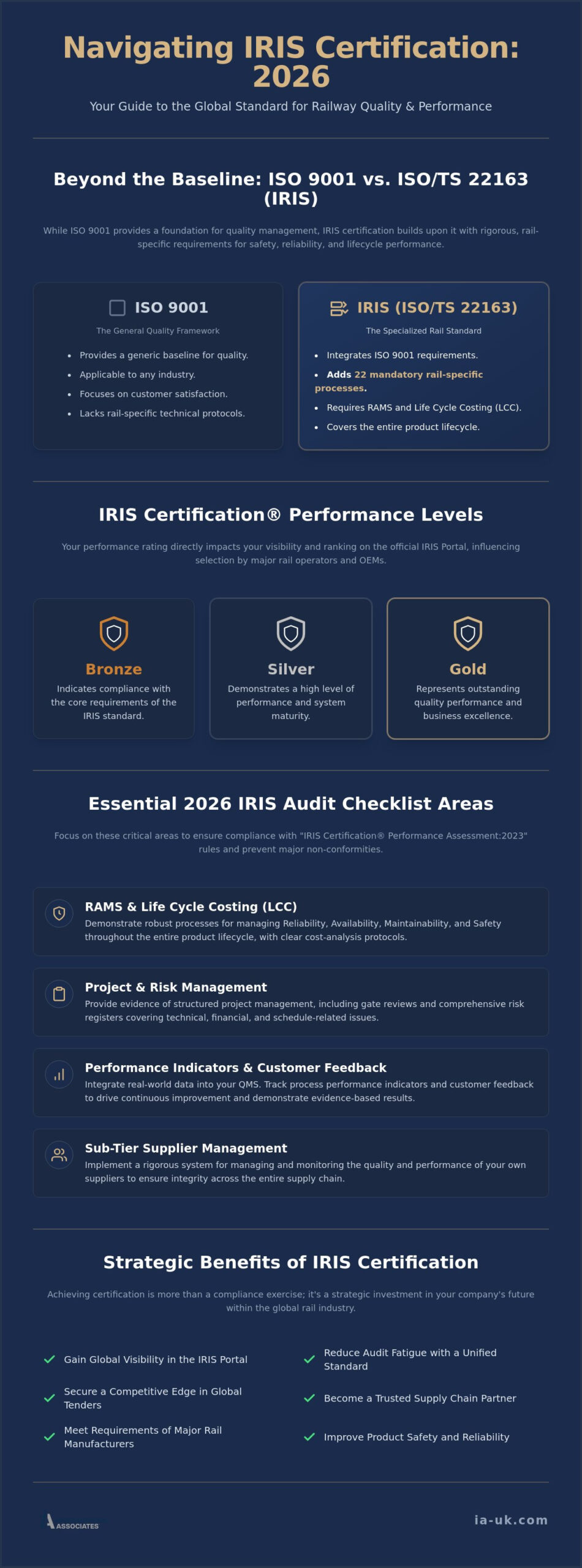
IRIS (International Railway Industry Standard) represents the highest tier of quality assurance within the global rail supply chain. While ISO 9001 provides a generic framework for quality management, IRIS integrates these requirements with specialized technical standards mandated by the European Rail Supply Industry Association (UNIFE). This evolution resulted in the ISO/TS 22163:2017 standard, which remains the technical foundation for the scheme. The International Union of Railways (UIC) and the International Rail Quality Board (IRQB) collaborate to ensure these standards reflect the operational realities of modern rail transport, creating a unified language for quality across international borders.
2026 marks a decisive phase for the industry as the IRIS Management Center pursues an ambitious 5% growth target for global certifications. This push follows the release of the “IRIS Certification® Performance Assessment:2023” (Edition 2) in January 2025, which introduced a more robust evidence-based performance model. Suppliers must now integrate process performance indicators and direct customer feedback into their management systems. Utilizing a technical iris certification audit checklist helps internal teams verify that these new IT resources, such as the web-based audit tool, are correctly utilized before the formal assessment begins. Organizations looking to stabilize their market position often find that management system certification under this specialized framework is the only way to meet the rigorous demands of global rail tenders.
The Evolution from ISO 9001 to ISO/TS 22163
ISO/TS 22163 maintains the high-level structure of ISO 9001 but introduces 22 rail-specific processes that are mandatory for compliance. These include critical areas like RAMS (Reliability, Availability, Maintainability, and Safety) and Life Cycle Costing (LCC). The 2026 regulatory landscape demands a deeper focus on “Railway Applications,” ensuring that every component, from rolling stock to signaling systems, adheres to rigorous safety protocols. The standard tracks the entire lifecycle, from design and development to maintenance and decommissioning. It’s this focus on the total product lifecycle that distinguishes IRIS from generic quality systems, providing a level of industrial assurance that ISO 9001 alone cannot offer.
IRIS Certification Levels and Performance Ratings
The current certification scheme rewards operational excellence through a tiered system of Bronze, Silver, and Gold performance levels. These ratings aren’t just badges; they directly influence a supplier’s ranking within the IRIS Portal. Major rail operators and OEMs use this database to mitigate risk in their own supply chains. The 2026 assessment model integrates “Quality Performance Levels Specifications,” meaning your audit score is now tied to real-world outcomes like delivery precision and product reliability. Achieving a Gold rating requires a meticulous approach to the iris certification audit checklist during internal reviews to ensure every performance metric is documented and verifiable.
The Essential IRIS Certification Audit Checklist: Key Compliance Areas
The 2026 assessment cycle operates under the “IRIS Certification® Performance Assessment:2023” rules, which demand a transition from procedural compliance to evidence-based performance. Suppliers must demonstrate that their management systems don’t just exist on paper but actively drive project success and product safety. A technical iris certification audit checklist serves as the primary tool for verifying adherence to these high-stakes operational requirements. Within UNIFE’s IRIS Certification® system, the focus has shifted toward how processes integrate to produce reliable results across the entire rail supply chain.
Project management remains a mandatory process where auditors verify planning, execution, and integrated risk management. You must provide evidence of gate reviews and risk registers that address technical, financial, and schedule-related threats. Supply chain management is equally critical; the standard requires rigorous supplier evaluation and continuous sub-tier monitoring. It’s no longer enough to audit your direct partners. You must prove control over the entire procurement lifecycle to ensure that safety-critical components meet the specified requirements. Achieving this level of internal oversight often requires specialized lead auditor training to ensure your team can identify potential non-conformities before the formal assessment begins.
Product realization and measurement protocols form the final pillars of the checklist. Design and development phases must follow strict validation and verification steps to ensure the final product matches the initial rail application specifications. Measurement and analysis now include the “Quality Performance Levels Specification,” which integrates process performance indicators with customer perception. Auditors will examine how your organization utilizes this data to drive continuous improvement. If your KPIs don’t reflect actual customer feedback or delivery precision, it may result in a lower performance rating on the IRIS Portal.
RAMS and LCC: The Technical Core
Reliability, Availability, Maintainability, and Safety (RAMS) documentation is the technical heart of any iris certification audit checklist. Your team must maintain detailed records that justify safety claims for every component. Verifying Life Cycle Costing (LCC) calculations is also essential, as auditors look for data integrity over the projected lifespan of the rail equipment. A common pitfall is failing to provide a clear link between RAMS targets and the actual maintenance instructions provided to the end user.
Obsolescence Management and Configuration
Rail contracts frequently span several decades, making obsolescence management a high-priority audit area. You must have a documented strategy for component replacement and long-term availability. Configuration management ensures that every technical change is tracked and traceable across multi-year contracts. For safety-critical applications, the documentation must provide an unbroken chain of evidence, ensuring that any modification to the original design is fully validated and approved by the relevant authorities.
Strategic Benefits of IRIS Certification for Railway Suppliers
Positioning an organization within the global rail supply chain requires more than technical capability; it demands a demonstrable commitment to international quality standards. While the iris certification audit checklist is often viewed as a hurdle for compliance, its successful application transforms a management system into a powerful strategic asset. Certification signals to the market that a supplier has mastered the complexities of RAMS and LCC, moving beyond the foundational requirements of general quality management. This transition from a cost-driven compliance exercise to a value-driven strategic initiative is essential for suppliers aiming to secure long-term stability in the 2026 rail market.
Enhanced global visibility is perhaps the most immediate commercial advantage. Certified organizations are included in the IRIS database, a centralized portal utilized by major operators and Original Equipment Manufacturers (OEMs) to identify and vet reliable partners. As of December 2025, the industry saw 148 companies achieve certification for the first time, reflecting a growing recognition that this standard is the primary benchmark for quality. By appearing in this database with a high performance rating, your organization gains direct exposure to global procurement teams without the need for aggressive marketing. This visibility is backed by a network of 270 approved auditors who ensure that every listed entity maintains the procedural integrity required for high-stakes rail projects.
Operational efficiency and risk mitigation are the internal rewards of this rigorous process. The standard forces a reduction in waste by mandating a “Right First Time” approach across the factory floor. By strictly following an iris certification audit checklist during internal reviews, companies can identify inefficiencies in project management and supply chain protocols before they manifest as costly delays. This methodical approach reduces legal and financial liability by ensuring that safety-critical components are backed by an unbroken chain of technical evidence. Furthermore, the unified nature of the standard significantly reduces audit fatigue. Instead of undergoing separate, repetitive assessments from multiple OEMs, a single IRIS certificate is recognized across the industry, allowing your technical teams to focus on production rather than administrative preparation.
Competitive Advantage in Global Tenders
In the 2026 regulatory environment, IRIS certification has evolved from a differentiator into a “license to play” for major international contracts. Non-certified suppliers increasingly find themselves excluded from high-value tenders where technical verification is a mandatory prerequisite. To present a truly holistic corporate profile, many forward-thinking suppliers integrate their quality systems with Social Accountability Audits, ensuring they meet both technical and ethical procurement criteria. This comprehensive approach to compliance often results in higher success rates when bidding for projects managed by major European and Asian rail authorities.
Internal Efficiency and Quality Culture
The standard fosters a deep-rooted quality culture that aligns perfectly with broader management system certification principles. By embedding IRIS requirements into daily operations, organizations achieve long-term cost savings through superior Life Cycle Costing (LCC) management. This alignment ensures that every employee understands their role in maintaining the safety and reliability of the global rail infrastructure. It’s this internal discipline that ultimately drives the performance ratings visible to your customers, turning compliance into a sustainable competitive edge.
How to Prepare for an IRIS Audit: Practical Readiness Factors
Transitioning from strategic planning to tactical execution requires a disciplined approach to internal verification. A comprehensive iris certification audit checklist serves as the primary mechanism for identifying operational gaps before they escalate into major non-conformities. Preparing for the 2026 cycle involves more than a cursory review of documentation. It requires a deep dive into the “IRIS Certification® Performance Assessment:2023” Edition 2 rules, which were released in January 2025 to govern current assessments. Suppliers must conduct a rigorous gap analysis to ensure their processes align with these updated performance-based requirements.
Executing a ‘dry run’ or readiness review is a critical step in the preparation phase. This internal pre-audit should simulate the formal assessment environment, testing the organization’s ability to provide evidence under pressure. During this exercise, internal teams should verify that all 22 rail-specific processes required by ISO/TS 22163:2017 are fully operational and documented. This methodical verification ensures that the transition to the 2026 performance model is seamless. It also provides an opportunity to identify personnel who may require additional support during the formal interview process, ensuring that the entire organization is prepared for technical scrutiny.
Utilizing IRIS-approved audit software is no longer optional for suppliers seeking a competitive edge. The IRIS Audit-Tool is the mandatory software used by auditors, and internal teams should use it to collect and organize data. This ensures that the evidence provided during the formal audit is structured in a format the certification body expects. By integrating this software into your daily quality management routine, you reduce the administrative burden during the assessment. This allows your technical staff to focus on demonstrating their expertise in safety-critical rail applications rather than managing data entry errors.
Managing the IRIS Portal and Software Requirements
Correct registration on the IRIS Portal is the foundational step for any supplier. Organizations must choose between “Defined Registration” and “Advanced Registration” options, which often bundle the necessary publications and audit tool licenses. This portal acts as the central hub for managing your certification status and visibility. Securely uploading and managing audit evidence within this IT infrastructure is essential for a successful turnaround. Ensuring your IT systems are compatible with the web-based audit tool will prevent technical delays during the formal verification process.
Staff Training and Competency Verification
The human element of the audit is often where non-conformities are discovered. Key personnel must be identified and coached on how to articulate complex RAMS and LCC implications during interviews. Professional development through specialized Lead Auditor Training ensures your internal team possesses the technical vocabulary and auditing skills necessary to maintain the system. This training bridges the gap between general quality knowledge and the high-stakes requirements of the rail industry. To ensure your team is fully prepared for the 2026 assessment cycle, book your lead auditor training session today.
Navigating IRIS Certification with International Associates
Selecting a certification body is a critical decision for suppliers seeking to validate their adherence to international rail standards. International Associates Limited acts as a sophisticated bridge between complex regulatory frameworks and the businesses that must adhere to them. Our global network of regional offices across Europe, Asia, and the Middle East provides a unique blend of institutional reliability and localized operational capacity. This infrastructure is essential for multi-site rail organizations requiring consistent auditing standards across diverse geographical locations. While your internal iris certification audit checklist ensures readiness, our independent verification provides the industrial assurance necessary to maintain your standing in the IRIS database.
Our approach is rooted in meticulous technical verification and impartial assessment. We utilize a modern IT infrastructure to ensure an efficient audit turnaround, allowing your organization to achieve or maintain certification without unnecessary administrative friction. Our specialists are deeply immersed in specialized regulatory niches, ensuring that safety-critical assessments are conducted with the highest level of expertise. By partnering with an independent body, you gain a steady hand in the world of corporate compliance, ensuring that your technical claims regarding RAMS and LCC are robust and verifiable.
The IA-UK Advantage: Professionalism and Precision
IA-UK operates with a commitment to ethical auditing and procedural integrity. This professionalism is reflected in our streamlined assessment processes, designed to provide a quick turnaround while maintaining the rigor required by UNIFE and the IRQB. Trust is foundational to our operations; you can review Our Accreditations to understand the high-level expertise we bring to every assessment. We focus on providing a clear, predictable path to certification, ensuring your iris certification audit checklist results in a successful formal outcome.
Integrating IRIS with Other Management Systems
Many rail suppliers find that integrating IRIS with other standards, such as ISO 14001 for environmental management, improves overall process efficiency and resource management. IA-UK supports your long-term certification cycle by offering integrated audits that reduce operational disruption and administrative costs. This holistic approach ensures that your organization remains compliant with both technical and environmental regulations simultaneously. To begin your assessment process for the 2026 cycle, contact us for an IRIS Audit Quote today.
Securing Your Position in the 2026 Global Rail Market
Mastering the transition to the latest IRIS performance assessment rules requires a disciplined focus on technical verification and evidence-based performance. By implementing a rigorous iris certification audit checklist, your organization can effectively manage the complexities of RAMS and LCC while eliminating the risk of major non-conformities during formal assessment. This methodical preparation ensures your management system is not just compliant but optimized for the high-stakes demands of international rail tenders. Successfully navigating these requirements is the definitive way to secure long-term stability and growth within the global supply chain.
International Associates Limited provides the global network of regional offices and specialized expertise needed to navigate these high-stakes technical sectors with precision. Our meticulous, ethical auditing standards offer the impartial assurance required to maintain your organization’s visibility and reputation within the IRIS database. We act as a steady partner in corporate compliance, helping you achieve a competitive edge through technical precision and industrial reliability. Secure your IRIS Certification with International Associates today and advance your organization’s global operations with confidence.
Frequently Asked Questions
What is the difference between ISO 9001 and IRIS certification?
ISO 9001 provides a generic framework for quality management applicable to any industry. IRIS certification, based on ISO/TS 22163, incorporates the entire ISO 9001 structure but adds 22 mandatory rail-specific processes. These additions focus on high-stakes technical requirements such as RAMS, Life Cycle Costing, and obsolescence management that aren’t addressed in the standard quality model.
How long does it take to achieve IRIS certification for a new supplier?
The timeline for a new supplier typically ranges from 6 to 12 months depending on the maturity of existing systems. This duration accounts for the initial gap analysis, the implementation of rail-specific documentation, and the mandatory readiness review. Suppliers should also factor in time for staff training and the execution of internal “dry run” audits to ensure compliance.
Is IRIS certification mandatory for all railway suppliers in 2026?
IRIS certification isn’t legally mandatory for every supplier, but it’s a standard contractual requirement for major Original Equipment Manufacturers (OEMs) and national operators. In the 2026 market, many high-value international tenders require certification as a prerequisite for bidding. It serves as a “license to play” that verifies your organization can meet the industry’s rigorous safety and reliability standards.
What are the most common non-conformities found in IRIS audits?
Auditors frequently identify major non-conformities in project risk management, sub-tier supplier monitoring, and RAMS documentation integrity. Utilizing a technical iris certification audit checklist during internal preparation helps teams identify these evidence gaps before the formal assessment. Failure to demonstrate a clear link between technical safety claims and actual maintenance instructions is another common pitfall.
How much does an IRIS certification audit cost?
Total costs are determined by the size of your organization, the number of sites, and the technical complexity of your products. While the “IRIS Certification® Performance Assessment:2023” publication is priced at €108 for the public, the audit fees depend on the required assessment days. We recommend requesting a formal quote to understand the specific investment for your certification cycle.
Can we combine an IRIS audit with our ISO 45001 health and safety audit?
Yes, integrated audits are an efficient strategy for organizations holding multiple certifications. Combining your IRIS assessment with ISO 45001 or ISO 14001 reduces administrative overhead and minimizes disruption to your production schedule. This approach provides a unified view of your compliance status and ensures that safety and quality protocols are aligned across the business.
What is the IRIS Portal and why do I need access to it?
The IRIS Portal is the centralized management platform for the entire certification scheme, managed by UNIFE. You need access to it to register your organization, purchase mandatory audit tool licenses, and maintain your visibility to global procurement teams. Your performance rating on the portal directly influences your ability to win contracts with major rail operators.
What happens if we fail our IRIS recertification audit?
Failing a recertification audit typically results in the suspension of your certificate and the loss of your “certified” status on the IRIS Portal. Your organization will be required to implement corrective actions for all major non-conformities within a strictly defined timeframe. A follow-up audit is then conducted to verify these improvements before the certificate can be reinstated.