

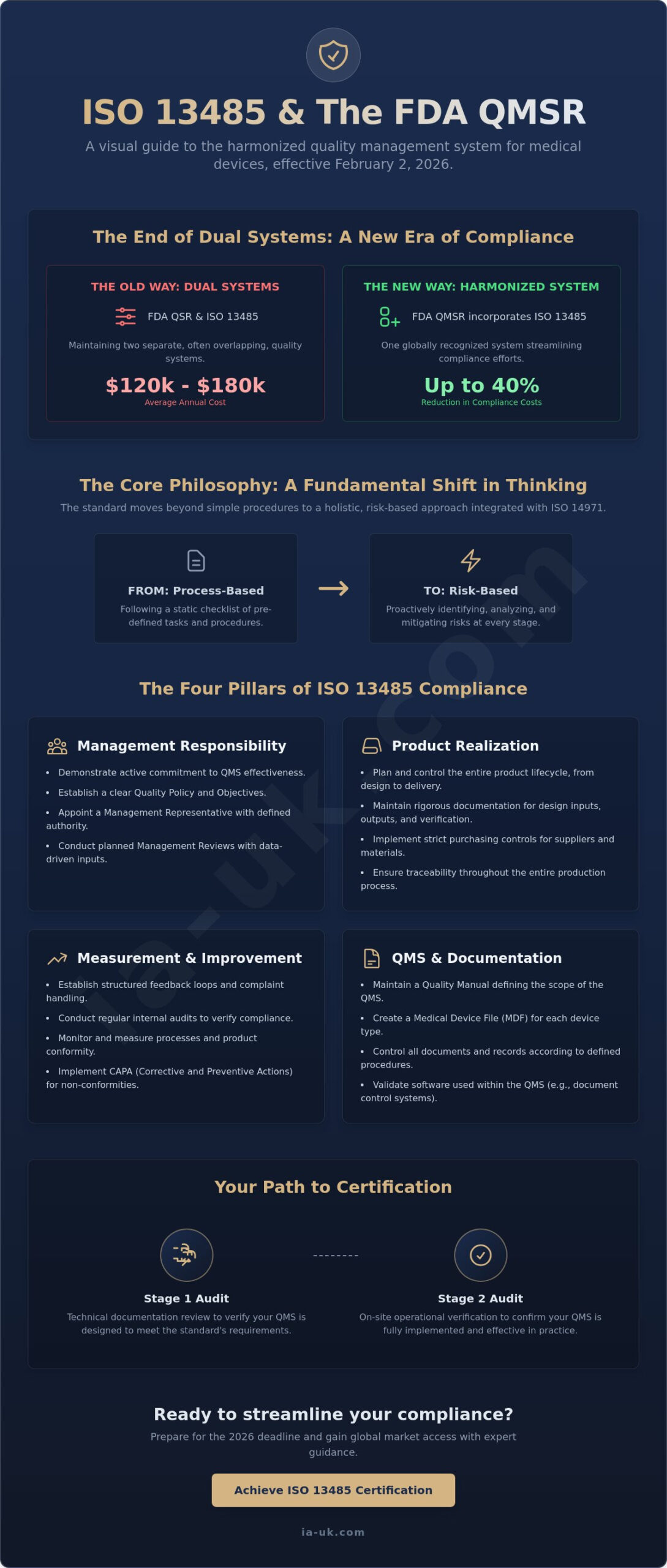
Did you know that as of February 2, 2026, the U.S. FDA officially transitioned to the Quality Management System Regulation (QMSR), which directly incorporates ISO 13485:2016 by reference? This shift marks a definitive end to the era of maintaining dual quality systems, a practice that previously cost facilities an average of $120,000 to $180,000 annually. We understand that the technical language of international standards can feel like a barrier to operational efficiency, especially when the stakes of an audit non-conformity are so high. It’s difficult to balance the speed of innovation with the meticulous documentation required for global market access.
This article provides a comprehensive breakdown of the core iso 13485 requirements to ensure your quality management system aligns with current global regulatory expectations. By following this roadmap, you’ll gain a clear understanding of the risk-based approach and the practical steps needed to streamline your compliance efforts. We’ll explore how full harmonization can reduce compliance costs by up to 40% while preparing your organization for the specific additions required under the new QMSR framework and upcoming 2026 regulations for medical software and artificial intelligence.
Key Takeaways
- Understand the mandatory transition from process-based to risk-based quality management systems to align with modern global regulatory frameworks.
- Identify the specific obligations of management, including the appointment of a designated representative to oversee system integrity and resource allocation.
- Master the rigorous iso 13485 requirements for product realization, covering essential documentation for design inputs, outputs, and supplier purchasing controls.
- Implement structured feedback loops and complaint handling processes to satisfy international expectations for post-market surveillance and reporting.
- Prepare for the certification pathway by distinguishing between the technical documentation review of a Stage 1 audit and the operational verification of Stage 2.
Foundational ISO 13485 Requirements and the Risk-Based Approach
ISO 13485:2016 serves as the definitive international benchmark for quality management systems within the medical device sector. While it shares roots with the ISO 9001 framework, it’s specifically tailored to address the rigorous safety and efficacy demands of the life sciences industry. For a comprehensive ISO 13485 overview, it’s clear that the standard prioritizes regulatory adherence over broad customer satisfaction metrics. This focus ensures that manufacturers maintain the highest levels of safety throughout the product lifecycle, regardless of where they operate globally.
The most critical evolution in the current standard is the transition from a process-based approach to a risk-based methodology. Modern iso 13485 requirements aren’t just a static checklist of tasks. Instead, they demand that risk management is woven into the fabric of every QMS process. This means that decisions regarding supplier selection, training frequency, and audit depth are all dictated by the potential risk to device safety and performance. It’s no longer sufficient to follow a procedure; you must prove that the procedure is robust enough to mitigate identified risks.
Regulatory requirements serve as the primary driver for implementation. As of February 2, 2026, the U.S. FDA’s Quality Management System Regulation (QMSR) has fully incorporated ISO 13485:2016 by reference. This alignment means that market access in the United States is now directly tied to these international standards. While the scope of the standard is broad, exclusions are permitted within Section 7, provided the organization can technically justify why a requirement, such as design and development, doesn’t apply to their specific business model. These justifications must be documented with precision to withstand the scrutiny of an external audit.
The Core Philosophy: Risk Management in the QMS
Risk-based thinking must be applied to every process within the QMS, not just the physical device. This requires deep integration with ISO 14971, the standard for medical device risk management. Organizations are expected to document the justification for their risk-based decisions. For instance, if a manufacturer determines that a specific production process has a negligible impact on safety, they must provide the data-driven rationale for the level of control they’ve chosen to implement during the design and development phase.
General QMS Documentation Requirements
The documentation hierarchy is structured to ensure procedural integrity. It begins with the Quality Manual and moves through standard operating procedures (SOPs) to specific work instructions and records. Central to this is the Medical Device File (MDF). This file must contain or reference all documentation necessary to demonstrate conformity for each device type. Additionally, in 2026, the validation of software used within the QMS is a critical focus. Any digital tool used for document control, complaint handling, or data analysis must be validated before use to ensure it meets its intended purpose without introducing new risks to the quality system.
Management Responsibility and Resource Management
Top management must demonstrate commitment through more than just a signature on a document. Under the official ISO 13485:2016 standard, leaders are held accountable for the effectiveness of the quality management system. This involvement includes ensuring that the organization understands the critical nature of statutory and regulatory requirements. It’s about fostering a culture where safety and performance aren’t secondary to production targets. Leaders must provide evidence of their commitment by establishing a quality policy and ensuring that quality objectives are met across all departments.
A designated Management Representative must be appointed to oversee the QMS. This individual holds the authority to ensure that processes are established, implemented, and maintained. They report directly to top management on the system’s performance and any need for improvement. Management Reviews are the formal venue for this reporting. These reviews must occur at planned intervals and use data from internal audits, customer feedback, and process performance to identify necessary changes. Organizations seeking ISO 13485 Medical Devices Certification often find that a structured review process is the most effective way to demonstrate high-level oversight during an external audit.
Resource management extends beyond financial budgeting. It includes providing the infrastructure and work environment necessary to achieve product conformity. For many medical device manufacturers, this involves maintaining controlled environments or cleanrooms to prevent contamination. The standard requires that these environments are monitored and controlled according to the specific needs of the device being produced. If the work environment can have an adverse effect on product quality, the organization must document the requirements for health, cleanliness, and clothing of personnel.
Quality Policy and Objectives
The Quality Policy must be more than a mission statement; it needs to provide a framework for setting and reviewing quality objectives. These objectives should be measurable and aligned with the organization’s commitment to safety and regulatory compliance. Every functional level within the company should have clear targets that contribute to the overall quality of the medical device. Management is responsible for communicating the importance of meeting these objectives throughout the entire organization.
Human Resources and Competence
Personnel performing work that affects product quality must be competent based on appropriate education, training, skills, and experience. It’s not enough to simply provide training. iso 13485 requirements mandate that organizations verify the effectiveness of those training actions. Documentation must be maintained to prove that employees are aware of the relevance and importance of their activities in achieving quality objectives. This meticulous approach to competence ensures that every individual understands their role in protecting the safety of the end user.
Product Realization: From Design to Purchasing
Product realization requires a methodical planning process that documents the entire device lifecycle. Organizations must define quality objectives and requirements for the product while establishing the necessary processes and infrastructure. This stage is where the risk-based approach becomes operational. Every decision made during realization must consider the potential impact on the safety and performance of the medical device. It’s not merely a manufacturing phase; it’s a controlled sequence of events that translates a concept into a safe clinical tool.
The alignment of international standards with national laws is exemplified by the FDA Quality Management System Regulation (QMSR). This regulation mandates adherence to these structured realization processes for any manufacturer entering the U.S. market. Compliance involves rigorous control over production and service provision to ensure the final output consistently meets predetermined specifications. Process validation is essential when the resulting output cannot be verified by subsequent monitoring or measurement, ensuring that the manufacturing environment remains stable and predictable.
Design and Development Controls
Design controls represent a significant portion of the iso 13485 requirements. Manufacturers must distinguish clearly between design verification and design validation. Verification ensures that the design output meets the design input requirements. Validation confirms that the resulting device meets the needs of the end user and its intended use. Managing the design transfer to the manufacturing environment is a critical step. It ensures that specifications are correctly translated into production instructions. Any changes made to the design after initial approval must be controlled to prevent unintended consequences to patient safety.
Purchasing and Supplier Monitoring
Managing a global supply chain requires a proactive stance on supplier evaluation. Organizations must establish clear criteria for the selection and re-evaluation of vendors based on the risk associated with the component or service provided. Written Quality Agreements are necessary for critical vendors to define responsibilities and quality expectations. Verification of purchased products is mandatory. This ensures they meet specified purchase requirements before they’re integrated into the manufacturing process. This level of oversight ensures the integrity of the medical device is maintained from the raw material stage through to final assembly.
Measurement, Analysis, and Post-Market Improvement
Measurement and analysis represent the closing of the quality loop. It’s not enough to design and manufacture a safe device; organizations must verify that the risk controls established during the product realization phase remain effective once the product is in clinical use. A robust feedback system is mandatory for gathering post-market data. This data provides the necessary inputs for the risk management file and ensures that iso 13485 requirements for safety and performance are maintained throughout the entire product lifespan. This continuous oversight is a fundamental expectation of modern regulatory bodies.
Complaint handling is a critical legal obligation that requires documented procedures for receiving, evaluating, and investigating feedback. If a complaint involves a potential regulatory breach or a serious safety risk, timely reporting to the relevant authorities is essential. This process must align with global expectations, including the EU Medical Device Regulation (MDR) and UKCA frameworks. Internal audits serve as an impartial check on the system’s health. They provide management with objective evidence to confirm that the QMS is implemented and maintained effectively. For organizations seeking to demonstrate their system’s maturity to global partners, achieving ISO 13485 Medical Devices Certification provides the necessary independent validation of these post-market processes.
Monitoring and Measurement of Products and Processes
Organizations must apply statistical techniques to analyze QMS data and identify trends. If a process shows signs of instability, it must be corrected before non-conformities occur. Control of non-conforming product is vital; it must be clearly identified and segregated to prevent unintended use or delivery. Documentation of conformity is a non-negotiable prerequisite for product release. This ensures that only devices meeting all specified requirements reach the end user, maintaining the integrity of the brand and the safety of the patient.
The CAPA Lifecycle
The Corrective and Preventive Action (CAPA) process is the engine of organizational improvement. Root cause analysis must move beyond surface-level fixes to identify the systemic failure that allowed a non-conformity to occur. It’s not enough to fix the symptom; you must address the source. Documenting the effectiveness of corrective actions taken is required to close the CAPA loop. Preventive actions focus on identifying potential risks before they manifest as actual problems. This proactive stance reflects the risk-based philosophy of the standard and is a key indicator of a mature quality management system.
Achieving Compliance: The ISO 13485 Certification Pathway
The certification process represents the final objective verification of an organization’s adherence to iso 13485 requirements. It begins with the Stage 1 Audit, which focuses on a technical review of the Quality Management System documentation to ensure readiness for the full assessment. During this phase, auditors evaluate the Medical Device File and the hierarchy of procedures to identify any systemic gaps. If the documentation meets the criteria, the organization proceeds to the Stage 2 Audit. This is a comprehensive verification where auditors observe processes in action to confirm that the QMS is fully implemented and effective across all operational levels.
Compliance isn’t a one-time achievement. Organizations must undergo annual surveillance audits to ensure continued alignment with the standard. Every three years, a full recertification audit is conducted to renew the certificate. This cycle provides stakeholders with the confidence that the manufacturer maintains institutional reliability and procedural integrity. By achieving certification, manufacturers create a stable foundation for entering high-stakes markets such as the European Union and the United Kingdom. It serves as the steady hand that guides a firm through the complexities of international trade and legal adherence.
The global-local duality of compliance is particularly evident when manufacturers target multiple jurisdictions simultaneously. While iso 13485 requirements provide a unified quality framework, organizations must still account for regional nuances. For instance, the transition to the FDA’s QMSR in the United States and the specific post-market surveillance requirements of the EU MDR both rely on the ISO 13485 foundation. A centralized QMS that addresses these diverse needs allows a firm to act as a sophisticated bridge between its home operations and its international offices, maintaining a single source of truth for global quality management.
Preparation for Certification
A successful audit starts with a rigorous gap analysis against current ISO 13485:2016 expectations. Selecting an accredited certification body with global expertise ensures that the audit results are recognized by international regulatory authorities. Internal teams play a vital role in this process. Investing in ISO 13485 lead auditor training equips personnel with the specialized skills needed to maintain the system and conduct meaningful internal assessments that mirror the intensity of a professional audit.
Global Market Access and Representation
ISO 13485 certification acts as a strategic bridge to global compliance. It supports the requirements for establishing an EU Authorised Representative vs UK Responsible Person, which are essential for manufacturers located outside these regions. The standard also integrates seamlessly with other ISO standards for medical devices, such as ISO 14971 for risk management. This alignment streamlines the technical documentation reviews required for MDR and UKCA markings, ensuring that the organization can navigate complex legal frameworks without unnecessary friction.
Securing Global Market Access through Quality Excellence
Maintaining a quality management system that satisfies iso 13485 requirements is no longer just a regulatory hurdle; it’s a strategic necessity for global expansion. We’ve explored how the shift toward risk-based thinking and the integration of post-market surveillance data ensure that patient safety remains at the forefront of every operational decision. By mastering these foundational pillars, your organization can navigate the complexities of the FDA’s QMSR and the EU’s MDR with confidence.
International Associates Limited serves as a sophisticated bridge for manufacturers seeking to validate their systems through independent assessment. As a UKAS Accredited Certification Body with a global network of regional offices, we provide the specialized expertise required for thorough MDR and UKCA technical reviews. Our methodical auditing process ensures that your certification reflects the highest standards of procedural integrity and professional competence.
Request a formal ISO 13485 certification quote from International Associates Limited to begin your pathway toward verified compliance. Achieving this benchmark is a significant milestone that demonstrates your organization’s commitment to excellence and long-term stability in the life sciences sector.
Frequently Asked Questions
What are the 8 clauses of ISO 13485?
The standard is organized into eight distinct clauses. The first three are introductory, covering Scope, Normative References, and Terms and Definitions. The remaining five define the operational iso 13485 requirements: Quality Management System, Management Responsibility, Resource Management, Product Realization, and Measurement, Analysis, and Improvement. These clauses provide a hierarchical structure for maintaining regulatory adherence across the device lifecycle.
Is ISO 13485 mandatory for medical device manufacturers in the UK?
ISO 13485 is not a strict legal mandate for all manufacturers in the United Kingdom, but it’s the primary method for demonstrating compliance with the UK Medical Devices Regulations 2002. Obtaining certification is often a commercial necessity for securing the UKCA mark. It also facilitates smoother entry into global markets that recognize the standard as a benchmark for quality and safety.
How does ISO 13485 differ from ISO 9001 requirements?
ISO 13485 prioritizes regulatory compliance and device safety, whereas ISO 9001 focuses on customer satisfaction and continuous improvement. The medical device standard excludes the ISO 9001 requirement for continuous improvement in favor of maintaining the established system’s effectiveness. It also adds specific demands for risk management, sterile production, and meticulous documentation that aren’t present in the broader ISO 9001 framework.
What is the ‘Medical Device File’ requirement in ISO 13485?
The Medical Device File, required under Clause 4.2.3, is a collection of records for each device type or family. It must contain or reference all documentation necessary to demonstrate conformity with the standard and applicable legal requirements. This typically includes technical specifications, instructions for use, and detailed descriptions of the manufacturing and installation processes.
Can a company be excluded from certain ISO 13485 requirements?
Organizations can exclude specific iso 13485 requirements located within Clause 7, such as design and development, if those activities aren’t performed by the business. Any such exclusion must be formally documented and technically justified within the Quality Manual. Auditors will verify these justifications during the assessment process to ensure they don’t compromise the integrity of the quality system.
What are the documentation requirements for software validation?
Documentation for software validation must include a clear definition of the software’s intended use and documented evidence that it meets those specifications. This process requires validation protocols, test results, and records of any changes made to the software. A risk-based rationale is used to determine the depth of validation needed for software tools used in production or within the quality system itself.
How often are ISO 13485 surveillance audits conducted?
Surveillance audits are conducted annually to verify that the quality management system remains effective and compliant. These audits occur in the first and second years following the initial certification. In the third year, a full recertification audit is performed to renew the certificate for another three-year cycle, ensuring the organization maintains its commitment to international standards.
What is the relationship between ISO 13485 and ISO 14971?
ISO 13485 establishes the requirement for a risk-based quality management system, while ISO 14971 provides the specific methodology for managing those risks. They’re complementary standards designed to be used together. ISO 13485 mandates that risk management is woven into every process, and ISO 14971 defines the technical framework for identifying, evaluating, and controlling those risks throughout the device’s lifespan.