

Your 2026 environmental budget isn’t just a spreadsheet; it’s a reflection of your organization’s risk profile and its commitment to the newly updated ISO 14001:2026 standard. Many organizations find that the total ISO 14001 certification cost 2026 remains elusive, often obscured by vague quotes or unexpected fees during surveillance audits. We recognize that addressing these financial complexities requires a methodical approach to ensure global compliance without unnecessary friction.
This guide provides a definitive framework for mastering your environmental management system budget. You’ll gain a clear understanding of the three-year certification cycle, including the impact of the April 2026 standard update on audit day calculations. We clarify the distinction between consultancy fees and certification fees while identifying strategies to streamline the verification process. By the end of this article, you’ll have the technical insight needed to forecast costs accurately and maintain institutional integrity throughout your certification journey.
Key Takeaways
- Understand how the three-year certification cycle and the ISO 14001:2026 update influence long-term financial planning and transition requirements.
- Identify the specific technical components that comprise the ISO 14001 certification cost 2026, distinguishing between mandatory audit fees and internal implementation expenses.
- Discover how organizational variables, such as effective headcount and environmental risk profiles, directly determine the number of required audit days and your final quote.
- Learn to mitigate “hidden” expenses by utilizing structured resources and avoiding the financial pitfalls associated with follow-up audits for non-conformities.
- Explore the benefits of an independent, global assessment process that ensures regulatory adherence while supporting your organization’s international growth.
Understanding the ISO 14001 Certification Cost Components
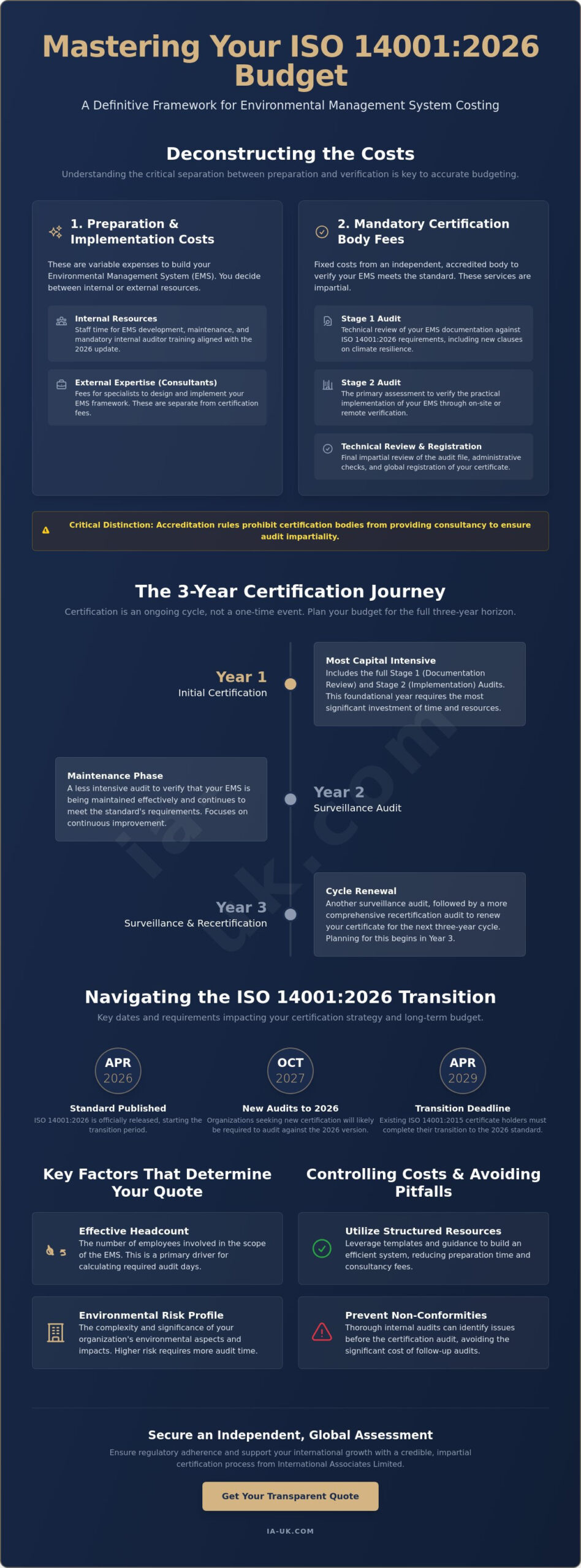
Navigating the financial requirements for environmental compliance requires a clear distinction between the various phases of the certification process. The total ISO 14001 certification cost 2026 is generally divided into two primary categories: preparation and verification. It’s essential to recognize that these two functions are legally and ethically separated to maintain the integrity of the audit process. While some organizations might seek a single provider for all needs, international accreditation rules strictly prohibit certification bodies from providing consultancy services to the same clients they audit. This independence ensures that the final certificate remains a credible and impartial indicator of your environmental performance within the broader ISO 14000 family of standards.
Mandatory Certification Body Fees
The fees charged by an independent auditing body are centered on the verification of your Environmental Management System (EMS). These costs are structured around the audit cycle and technical review requirements. The process begins with a Stage 1 Audit, which focuses on a technical documentation review. Auditors assess whether your system design meets the requirements of the ISO 14001:2026 standard. This is followed by the Stage 2 Audit, the primary assessment where auditors verify the practical implementation of the EMS through on-site inspections or remote interviews. Finally, a technical file review is conducted by a separate committee to ensure administrative accuracy before the certificate is officially registered globally.
Internal vs. External Preparation Costs
Preparation costs often represent the most variable part of a budget. Organizations must decide between utilizing internal resources or engaging external expertise to build their system architecture. Internal costs include the allocation of staff time for EMS development and the mandatory training of internal auditors. These individuals must understand the nuances of the 2026 update to perform effective self-assessments. External preparation involves hiring consultants to design the framework. While consultants provide specialized knowledge, their fees are separate from the certification body’s quote. It’s a common pitfall to assume that preparation ends once the system is built; ongoing resource allocation for system maintenance is required to ensure the EMS remains functional prior to the formal audit.
The 2026 update introduces more rigorous documentation requirements regarding climate resilience and life cycle perspectives. Consequently, the time required for the initial Stage 1 documentation review may increase for many organizations. Auditors must now verify these new technical dimensions with greater precision before proceeding to the implementation phase. This structured approach to budgeting ensures that your organization avoids unexpected financial friction during the certification journey.
The 3-Year ISO 14001 Budget Cycle and 2026 Transition
Effective financial planning for environmental compliance requires a shift from viewing certification as a singular event to understanding it as a multi-year cycle. The initial year is the most capital intensive, as it encompasses the Stage 1 and Stage 2 audits described in the previous section. However, the true ISO 14001 certification cost 2026 is only understood when you look at the full three-year horizon. This cycle includes the initial certification, two years of surveillance, and a comprehensive recertification audit in the third year. Each phase serves a distinct purpose in maintaining the integrity of your Environmental Management System (EMS).
The publication of ISO 14001:2026 in April 2026 has introduced a specific transition requirement that impacts your long-term budget. Organizations currently holding ISO 14001:2015 certificates have until April 2029 to complete their transition to the revised standard. If you’re seeking a new certificate after October 2027, you’ll likely be required to certify against the 2026 version immediately. This transition adds a necessary layer of preparation to your budget, particularly regarding the alignment of your management system with new requirements for climate resilience and life cycle perspectives. This foresight helps avoid last-minute compliance friction.
Annual Surveillance and Maintenance
Surveillance audits are conducted in years two and three to verify that the EMS is maintained properly and continues to meet the standard’s requirements. These audits are less intensive than the initial assessment; surveillance audits typically represent one-third of the initial audit duration. Despite the reduced scope, they’re essential for maintaining your global registry status and ensuring continuous improvement. Various factors influencing certification cost, such as the number of sites and the complexity of your operations, will dictate the specific time required for these visits.
Preparing for the 2026 Standards Update
Transitioning to the 2026 edition involves a gap analysis to identify where your current system falls short of the new requirements. This process often necessitates updated Lead Auditor Training to ensure your internal team can interpret the revised clauses correctly. Investing in this training early reduces the friction encountered during the formal transition audit. By training your staff on the updated technical requirements, you ensure that internal audits are robust and capable of identifying non-conformities before the external certification body arrives.
Recertification occurs at the end of the three-year cycle. This is a more thorough review than a surveillance audit and requires a budget uplift to cover the increased auditor time. For a detailed breakdown of how these cycles apply to your specific industry, you can request a formal quote from International Associates Limited to begin your planning process. This methodical approach to budgeting ensures that your organization remains compliant while supporting sustainable global growth.
Key Factors Influencing Your ISO 14001 Quote
A formal quote for environmental certification is not an arbitrary figure. Instead, it’s a technical calculation based on standardized tables provided by the International Accreditation Forum (IAF). These tables determine the minimum number of audit days required based on your organization’s effective headcount, which includes full-time, part-time, and seasonal staff involved in processes with environmental impacts. While headcount sets the baseline, the ISO 14001 certification cost 2026 is further refined by the technical complexity of your operations and the number of sites included in the scope.
Efficiency can be gained by integrating your environmental management with other standards. If your organization already maintains an ISO 9001 quality management system, a combined audit can lead to significant resource optimization. Integrated management systems often allow for a 20% to 40% reduction in total audit time because shared processes, such as management reviews and document control, are assessed simultaneously. This methodical approach ensures that your regulatory adherence is both thorough and cost-effective.
The Impact of Environmental Risk
Organizations are categorized into high, medium, or low-risk brackets based on their industrial sector. A chemical manufacturing plant or a construction firm faces more rigorous scrutiny than a professional services firm because their environmental aspects have a greater potential for significant impact. This categorization is vital as it requires auditors with specific technical expertise to verify compliance with complex legal frameworks. The complexity of an organization’s environmental aspects directly dictates the mandatory auditor day mandates set by international accreditation forums. Professionals often consult ISO 14001 training and auditing courses to better understand how these risk levels influence the depth of a technical assessment.
Geographic Scope and Travel Costs
The physical location of your facilities plays a practical role in budgeting. Multi-site organizations require a sampling plan where a specific number of locations are audited during each cycle. Travel expenses for auditors can fluctuate, but these can be managed by leveraging a global network of professionals. By utilizing auditors located near your international offices, travel friction is minimized while local regulatory nuances are respected. In the 2026 regulatory landscape, certain administrative reviews may be conducted via remote auditing technologies. However, high-risk sites still require on-site verification to maintain the institutional weight of the certification. This balance between global reach and local presence ensures a reliable and stable verification process for your entire enterprise.
Controlling Costs: Avoiding Common ISO 14001 Budget Pitfalls
Managing a certification budget requires foresight to avoid inflationary pressures that arise from procedural inefficiencies. While the baseline ISO 14001 certification cost 2026 is determined by your organization’s scope, the final expenditure often depends on your internal readiness. A primary pitfall is treating the Stage 1 readiness review as a formality. If an auditor identifies significant gaps during this phase, your organization may face delays that require additional technical reviews or even a full restart of the Stage 2 timeline. Preventing these setbacks ensures that your project remains on schedule and within the projected budget.
The Price of Non-Compliance
Non-conformities identified during the formal assessment represent a significant “hidden” cost. Major non-conformities prevent the issuance of a certificate until corrective actions are verified; this often requires a follow-up on-site visit. Minor non-conformities, while less severe, still necessitate a formal review of corrective action plans, which incurs administrative fees. You can mitigate these risks by conducting robust internal audits that mirror the rigour of an external assessment. A well-prepared team identifies and resolves technical discrepancies before they become expensive external findings.
Efficiency Through Infrastructure
The transition to the 2026 standard emphasizes a life cycle perspective, which increases the volume of evidence required for verification. Organizations that utilize advanced IT infrastructure for document control often experience a smoother audit process. When evidence is organized and readily accessible, auditors can complete their sampling more efficiently. It’s established that a 10% improvement in documentation readiness can save up to two audit days over a full cycle.
To achieve this level of preparedness, many firms utilize a structured ISO 14001 certification checklist to ensure every clause is addressed before the auditor arrives. This methodical approach reduces the time an auditor spends searching for records, directly impacting your total ISO 14001 certification cost 2026. Maintaining a mature and well-integrated management system further supports this efficiency by reducing the redundancy of checks across different departments. Securing an accurate assessment starts with understanding your current standing. If you’re ready to define your certification path, you can request a technical consultation to discuss your specific operational requirements.
Securing an Independent ISO 14001 Assessment with International Associates Limited
International Associates Limited provides a sophisticated bridge between complex global regulations and businesses seeking environmental certification. Our approach to independent verification ensures that your management system meets the rigorous requirements of the 2026 revision without unnecessary friction. With a central administrative base in Glasgow and an expansive network of international offices, we offer a unique blend of institutional reliability and worldwide operational capacity. This structure allows us to provide a comprehensive and transparent breakdown of the ISO 14001 certification cost 2026, ensuring that your financial planning remains accurate over the entire three year term. We prioritize precision in our technical reviews to provide businesses with the confidence needed to navigate the evolving regulatory landscape.
Efficiency is maintained through our commitment to modern auditing practices. We utilize advanced IT infrastructure to manage the audit process, from the initial technical documentation review to the final issuance of the certificate. This digital integration reduces administrative friction and supports a quick turnaround time once compliance is verified. By streamlining the flow of information, we ensure that your certification journey is methodical and highly organized. This procedural integrity is a direct reflection of our role as a meticulous and ethical expert in the field of international standards. We don’t just perform inspections; we provide a stable framework for your organization’s global growth.
Why Independence Matters in 2026
Impartiality is the foundation of the auditing and assurance industry. Maintaining an ethical distance between consultancy and certification is necessary to uphold the value of your certificate in the eyes of global stakeholders. International Associates Limited auditors act as the steady hand in corporate compliance, providing thorough assessments that prioritize technical adherence. Accessing our regional offices minimizes travel related expenses, which helps maintain a stable budget while ensuring that local regulatory nuances are respected. This global local duality provides our clients with the security of a worldwide network backed by central administrative expertise.
Next Steps for Your 2026 Budget
Transitioning to the 2026 standard requires a structured approach to resource allocation. Planning for the 2026 transition requires a clear timeline for Stage 1 and Stage 2 assessments. Organizations should begin by requesting a formal quote that encompasses the full three year certification cycle to avoid unexpected fiscal shifts or hidden fees. This proactive approach allows you to allocate resources effectively for internal staff training and system updates. To begin your assessment process and secure a reliable partner for your environmental goals, you may Contact International Associates Limited for a tailored certification proposal that aligns with your organizational risk profile and global objectives.
Strategic Budgeting for Global Environmental Compliance
Transitioning to the ISO 14001:2026 standard requires a methodical approach to financial planning. We’ve examined how organizational complexity and industrial risk profiles serve as the primary drivers of audit duration. By understanding the three-year cycle, from the initial assessment to biennial surveillance, your organization can avoid the friction of unexpected fees. Accurately forecasting the ISO 14001 certification cost 2026 is a vital step in maintaining institutional integrity while pursuing international growth. A well-prepared Environmental Management System doesn’t just ensure compliance; it acts as a foundation for long-term operational efficiency.
Securing an independent, impartial assessment is essential for maintaining trust with global stakeholders. As specialists in high-stakes technical sectors, we offer the stability of a global network of regional offices combined with the precision of UKAS accredited-style independence. Our technical expertise ensures a predictable and professional certification process for every client. You can Request a Transparent ISO 14001 Certification Quote for 2026 to begin your compliance journey with confidence. We look forward to supporting your commitment to environmental excellence and sustainable operational practices.
Frequently Asked Questions
How much does ISO 14001 certification cost for a small business in 2026?
The cost for a small business is primarily determined by the number of audit days required under the International Accreditation Forum (IAF) mandatory guidelines. These requirements are based on your organization’s effective headcount and the technical complexity of your environmental aspects. A formal quote will encompass the initial Stage 1 documentation review and the Stage 2 implementation assessment. While small firms generally require fewer audit days than large enterprises, the specific industrial risk level remains a significant factor in the final calculation.
Is there a difference in cost between ISO 14001:2015 and the 2026 update?
The publication of the new standard in April 2026 has introduced specific transition requirements that may influence your ISO 14001 certification cost 2026 during the three-year migration window. Organizations currently certified to the 2015 edition must complete their transition by April 2029. This process involves a technical gap analysis and an updated documentation review. While the core audit structure remains similar, the additional time required to verify new requirements regarding climate resilience and life cycle perspectives may lead to a slight increase in initial assessment days.
How are ISO 14001 audit days calculated by certification bodies?
Audit days are calculated using standardized tables known as IAF MD5, which ensure consistency across the global certification industry. These tables establish a mandatory minimum duration based on your total employee count and the environmental risk category of your sector. Auditors also consider the number of physical sites and the complexity of your processes. High-risk operations or organizations with multiple international locations will naturally require more time for a thorough and reliable verification of compliance.
What are the recurring costs after the initial ISO 14001 certification?
Ongoing costs are centered on annual surveillance audits and a full recertification audit every third year. Surveillance audits are less intensive than the initial assessment and typically represent about one-third of the original audit duration. These visits ensure your management system is maintained and continues to meet the standard’s requirements. You should also account for internal costs such as staff time for system maintenance and the training of internal auditors to perform mandatory self-assessments.
Can I reduce my ISO 14001 cost by integrating it with ISO 9001?
Integrating your environmental management system with ISO 9001 can reduce total audit time by 20% to 40%. An integrated management system allows the certification body to assess common elements, such as management reviews, internal audits, and document control, in a single combined visit. This efficiency directly impacts the total ISO 14001 certification cost 2026 by optimizing auditor time and reducing the administrative friction associated with managing multiple separate assessments.
What happens to my fees if my organisation fails the Stage 2 audit?
If major non-conformities are identified during the Stage 2 audit, a follow-up visit is usually required to verify that corrective actions have been implemented. This follow-up visit incurs additional fees based on the time required for the auditor to return to your site. Minor non-conformities don’t usually require a return visit but involve administrative fees for the technical review of your corrective action plans. Robust internal audits and a thorough Stage 1 readiness review are the best ways to avoid these unexpected expenses.
Are travel expenses for auditors included in the certification quote?
Travel expenses are generally billed separately from the professional audit fees and include transport, accommodation, and subsistence. These costs fluctuate based on the location of your facilities relative to the auditor’s base. Utilizing a certification body with an expansive network of international offices helps minimize these charges. By deploying auditors from regional offices close to your sites, travel friction and associated costs are significantly reduced while maintaining a high level of technical expertise.
How does the environmental risk level of my industry affect the price?
High-risk sectors, such as chemical manufacturing or construction, require more audit days than low-risk industries like professional services. This categorization is based on the potential for significant environmental impact and the complexity of the legal frameworks governing your operations. High-risk sites necessitate auditors with specialized technical knowledge to perform a rigorous and thorough assessment. This ensures that the verification process is sufficiently robust to meet international standards for high-stakes industrial sectors.