

For decades, environmental management was viewed primarily as a defensive shield against regulatory fines, but in 2026, it has evolved into a critical framework for global supply chain trust. You likely recognize that maintaining a competitive edge now requires more than basic compliance; it demands a sophisticated approach to climate resilience. However, the ambiguity surrounding the latest climate action amendments often creates a sense of uncertainty for organizations aiming to renew or achieve their status. Navigating the modern ISO 14001 certification requirements doesn’t have to be a source of institutional friction or excessive cost.
This guide provides the technical clarity you need to master the 2026 standards and secure your global certification efficiently. We’ve structured this resource to bridge the gap between complex international regulations and your operational reality. You’ll find a methodical breakdown of the ten mandatory clauses, an objective analysis of the new climate-related stakeholder requirements, and a strategic roadmap for managing multi-site audits across different regional offices. By following this disciplined assessment process, your organization can achieve a seamless transition to the ISO 14001:2026 standard while reinforcing its reputation for reliability and environmental stewardship.
Key Takeaways
- Understand how the mandatory climate action amendments in Clauses 4.1 and 4.2 require organizations to evaluate climate change as a critical strategic factor within their management systems.
- Navigate the High-Level Structure of the ten mandatory clauses to ensure your Environmental Management System remains aligned with modern international standards and integrated frameworks.
- Identify the distinct technical expectations of Stage 1 and Stage 2 audits to effectively transition from initial documentation reviews to full implementation verification.
- Master the specific ISO 14001 certification requirements necessary to satisfy accredited bodies and secure global recognition for your environmental performance.
- Evaluate the advantages of modern, IT-driven auditing processes that facilitate rapid certificate turnaround and maintain consistent compliance across international operations.
Navigating ISO 14001:2026 Requirements: The Climate Action Amendment
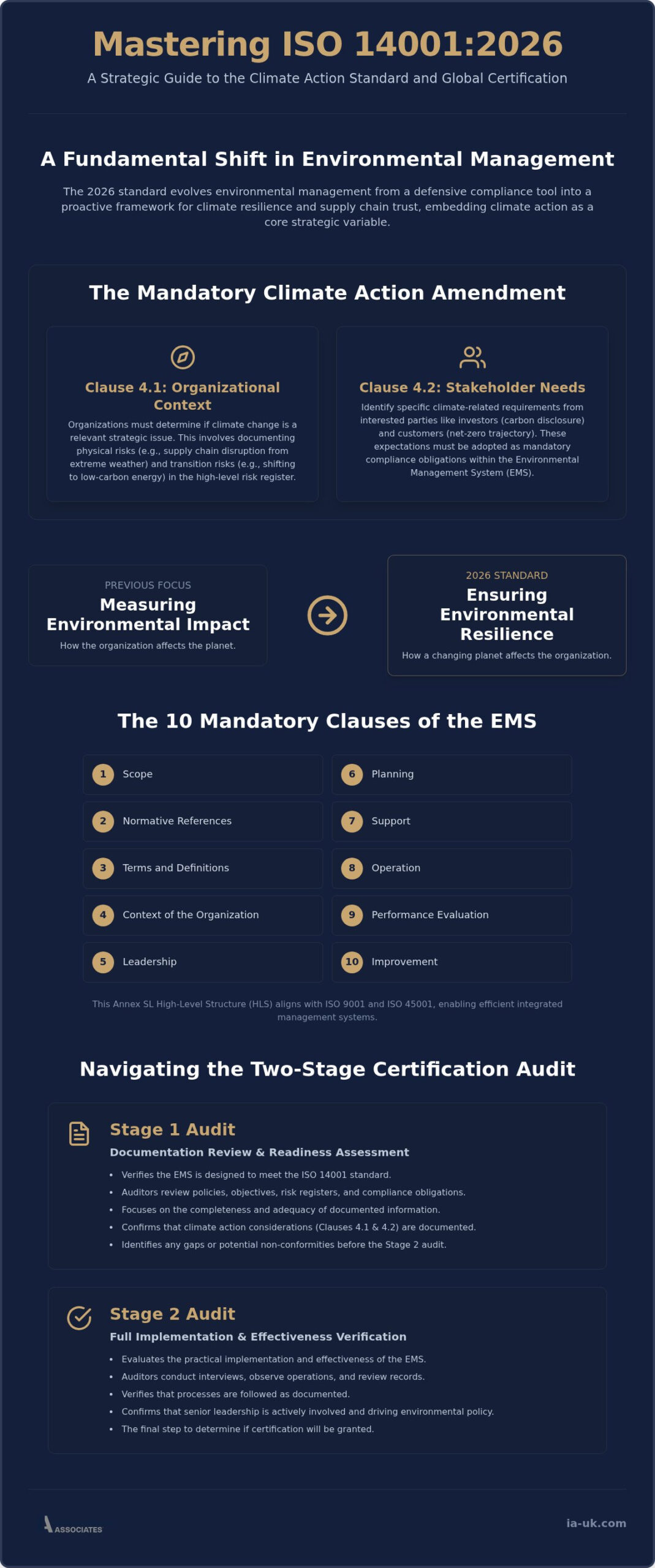
The ISO 14001:2026 standard, published in April 2026, represents a fundamental shift in how environmental management is verified. Central to these updates is the mandatory climate action amendment, which transitioned from a supplementary consideration in 2024 to a core pillar of the 2026 framework. Organizations seeking to meet ISO 14001 certification requirements must now demonstrate that climate change is not merely an external concern but a strategic variable embedded within their management system. Failure to provide documented evidence of this consideration results in major non-conformities during current audits.
Clause 4.1: Understanding Your Organisation’s Context
Under Clause 4.1, the organization is required to determine whether climate change is a relevant issue to its purpose and strategic direction. This involves a systematic review of internal and external factors. For instance, a manufacturing firm might document physical risks like supply chain interruptions caused by extreme weather events or transition risks like shifting to low-carbon energy sources. Conversely, a service-sector business might focus on the energy efficiency of data centers or the carbon footprint of its digital infrastructure. Auditors in 2026 expect to see these factors linked directly to the organization’s high-level risk register.
Clause 4.2: Stakeholder Needs and Climate Expectations
The amendment to Clause 4.2 expands the scope of interested parties. It’s no longer sufficient to monitor general environmental expectations; businesses must identify specific climate-related needs from investors, customers, and regulatory bodies. Investors increasingly demand transparency regarding carbon disclosure, while customers may require proof of a net-zero trajectory before awarding contracts. These expectations must be converted into mandatory compliance obligations within the EMS. For organizations managing multiple standards, the integration of these climate requirements into a single management system certification framework ensures consistency and reduces audit fatigue.
To satisfy a 2026 auditor, the organization must explicitly identify which climate-related requirements of its interested parties are adopted as mandatory compliance obligations within its management system.
From Environmental Impact to Resilience
The evolution of ISO 14001 certification requirements signals a transition from measuring environmental impact to ensuring environmental resilience. While previous versions focused on how an organization affects the planet, the 2026 standard emphasizes how a changing planet affects the organization’s viability. Documenting this resilience involves assessing resource scarcity, energy security, and the long-term sustainability of operations. By integrating these factors, a business moves beyond basic adherence and establishes a framework for institutional stability in a volatile global market.
The 10 Mandatory Clauses of the Environmental Management System (EMS)
The ISO 14001:2026 standard is constructed upon the Annex SL High-Level Structure (HLS). This unified framework is shared with ISO 9001 and ISO 45001, which allows for the efficient implementation of integrated management systems. Through the adoption of this architecture, environmental objectives are aligned with broader corporate governance, ensuring that ISO 14001 certification requirements are satisfied without the creation of redundant documentation. A methodical approach is established, moving from the organizational context into specific operational niches.
Leadership and Environmental Policy (Clause 5)
Under Clause 5, environmental management is positioned as a fundamental governance priority. During the 2026 audit process, senior leadership is interviewed directly to verify that the environmental policy is utilized as a driver for strategic decision-making. It’s required that this policy be appropriate to the nature and scale of the organization’s environmental impacts. Although the mandatory appointment of a ‘Management Representative’ has been removed in recent revisions, the accountability for the system’s performance is firmly placed upon top management. They’re responsible for ensuring that necessary resources are allocated and that the EMS remains effective.
Planning for risks and opportunities is addressed in Clause 6, where a rigorous assessment of environmental aspects is conducted. These findings are then used to dictate the operational controls found in Clause 8. The 2026 standard places a heavy emphasis on the ‘Life Cycle Perspective’ within these controls. Organizations are compelled to evaluate the environmental footprint of their entire value chain. This ensures that ISO 14001 certification requirements are viewed as a comprehensive strategy rather than a narrow focus on internal facility management.
Life Cycle Perspective in Operational Control (Clause 8)
Operational control requires a comprehensive analysis of a product or service’s journey, from raw material procurement to final disposal. Organizations are expected to exert influence over suppliers and contractors, even when direct control isn’t possible. Non-conformities are frequently identified when documentation fails to address end-of-life impacts or recycling protocols. By integrating these life cycle considerations into an accredited management system, a business demonstrates its commitment to global sustainability standards while maintaining institutional reliability.
Preparing for the Certification Audit: Stage 1 vs. Stage 2 Requirements
Achieving certification is a two-stage process designed to verify both the design and the execution of your Environmental Management System (EMS). This methodical approach ensures that ISO 14001 certification requirements aren’t only understood on paper but are actively managed within the organization’s daily operations. By separating the assessment into distinct phases, the certification body provides a structured path for identifying and resolving gaps before the final registration audit occurs.
Mandatory Documentation Checklist for Stage 1
The Stage 1 audit serves as a readiness review where the auditor assesses the system’s architecture. It’s a critical phase that identifies technical deficiencies before the more intensive Stage 2 assessment begins. To pass this stage, you must provide:
- A clearly defined EMS scope that aligns with your organizational context and strategic direction.
- An environmental policy endorsed by top management that includes a commitment to the protection of the environment.
- A comprehensive register of environmental aspects and their associated impacts, including the logic used for significance testing.
- A legal register documenting all relevant compliance obligations and evidence of how these are monitored.
- Documented evidence that at least one full cycle of internal audits and a formal management review have been completed.
If the documentation is found lacking, the auditor will issue findings that must be resolved before the organization is deemed ready to proceed to the next phase.
Evidence-Based Verification in Stage 2
Stage 2 focuses on the practical implementation and effectiveness of the system. The auditor moves beyond the boardroom to verify that the procedures documented in Stage 1 are followed on the shop floor or in the field. This phase involves deep-dive interviews with personnel at all levels to assess their awareness of the environmental policy and their specific roles in achieving environmental objectives. Physical inspections are conducted to evaluate waste management practices, chemical storage protocols, and the availability of emergency response equipment like spill kits.
The auditor employs a triangulation method by cross-referencing documented procedures with staff interviews and physical evidence to confirm the system’s actual performance.
Findings during these stages are classified as either major or minor non-conformities. A major non-conformity represents a total failure of a system requirement and will prevent certification until it’s rectified and verified. A minor non-conformity indicates an isolated failure that doesn’t compromise the system’s overall effectiveness; certification can usually proceed provided a corrective action plan is accepted. Once certification is granted, the organization enters a three-year cycle. This includes annual surveillance audits to ensure continued adherence to ISO 14001 certification requirements, culminating in a full recertification audit at the end of the third year. This structured oversight maintains the integrity of the global management system certification and supports continuous improvement.
How to Choose an Accredited Certification Body for Global Operations
Selecting a certification body is a strategic decision that affects the long-term validity of your environmental credentials. For organizations with international operations, it’s essential to verify that the body is accredited by a recognized national authority like UKAS. This independent oversight ensures that the certification process remains impartial and technically sound. Without such accreditation, your credentials may not be accepted by global stakeholders who prioritize ISO 14001 certification requirements as a baseline for supply chain security. This global recognition is the foundation of institutional trust.
Evaluating Auditor Expertise and Industry Knowledge
Auditor expertise is a primary driver of a successful assessment. You should ask specific questions regarding the auditor’s professional experience in your specific industrial niche before the process begins. A common bottleneck in the industry is the technical review of files; organizations that utilize advanced IT infrastructure can often bypass these administrative delays. For businesses navigating complex legal landscapes, leveraging IA regulatory compliance expertise ensures that your auditor is capable of verifying adherence to regional environmental laws. This technical depth prevents the ambiguity that often leads to audit friction.
Cost vs. Value: Avoiding the ‘Big Body’ Premium
Understanding the fee structure is vital for long-term budget planning. Certification costs are typically divided into initial assessment fees, annual surveillance costs, and administrative overheads. While legacy bodies often charge a premium for their brand name, the real value lies in the efficiency and reliability of the audit process. One effective strategy to manage costs is the implementation of Integrated Management Systems (IMS). By combining your environmental assessment with other standards, you can reduce the total number of audit days required to meet ISO 14001 certification requirements. This integrated approach not only lowers costs but also provides a more holistic view of your organizational risks.
Modern auditing models now favor a hybrid approach that combines global administrative reliability with local technical presence. This duality allows for a consistent audit methodology across multiple international sites while ensuring that local environmental nuances are understood. It’s a structure that provides the institutional weight of a major firm with the operational flexibility of a regional office. This balance is critical for maintaining a stable compliance posture across diverse regulatory jurisdictions. If you’re seeking a streamlined, UKAS-accredited assessment for your global sites, you can contact our technical team for a certification quote.
Achieving ISO 14001 Certification with International Associates
International Associates (IA) serves as a sophisticated bridge for organizations navigating the complexities of ISO 14001 certification requirements. Based in Glasgow, our technical team manages an expansive worldwide network of auditors, ensuring that institutional reliability is maintained across diverse industrial sectors. We recognize that the certification process shouldn’t be a source of operational friction. By utilizing advanced IT infrastructure, we’ve modernized the auditing workflow to ensure a quick certificate turnaround, directly addressing the administrative bottlenecks that often delay global compliance goals.
Our expertise extends into highly regulated and sensitive sectors, including Medical Devices, Halal certification, and Social Accountability. This breadth of technical knowledge allows us to handle high-stakes certifications with the precision required by international legal frameworks. The path to certification with IA is designed to be transparent and rigorous, providing a steady hand for businesses seeking international growth without compromising on standards. We act as a guardian of these standards, ensuring your environmental management system is both thorough and supportive of your strategic aims.
Integrated Auditing for 14001, 9001, and 45001
Efficiency is a cornerstone of our service delivery, particularly for organizations maintaining multiple international standards. We specialize in management system certification that integrates ISO 14001 with ISO 9001 and ISO 45001. This streamlined approach minimizes business disruption by aligning audit schedules and consolidating documentation reviews. By identifying overlapping requirements, we reduce the total number of audit days, allowing your team to focus on core operations while we verify your adherence to global benchmarks.
Global Assurance, Local Expertise
Institutional reliability is supported by our dual operational capacity. While our administrative base remains in the UK, our regional offices in Europe, Asia, and the Middle East provide the local expertise necessary to navigate specific geographic jurisdictions. This network ensures that your auditor understands the regional regulatory nuances that affect your ISO 14001 certification requirements. Whether you operate a single facility or a complex multi-site global network, our auditors provide a consistent, high-level assessment that satisfies international stakeholders and regulatory bodies alike.
Securing your environmental credentials requires a partner that balances rigorous technical standards with operational efficiency. Our professionals are prepared to support your transition to the 2026 standard with clarity and precision. To begin your assessment process, you may request a formal ISO 14001 certification quote today.
Securing Strategic Environmental Resilience for 2026 and Beyond
Adhering to the latest ISO 14001 certification requirements is no longer a matter of simple regulatory box-ticking; it’s a strategic commitment to institutional stability and climate resilience. Organizations must move beyond internal facility management to embrace a lifecycle perspective that satisfies the evolving needs of global stakeholders. By mastering the mandatory clauses and documenting clear climate-related risks, your business establishes itself as a reliable partner in an increasingly sensitive global market.
International Associates provides the steady hand needed to navigate this complex landscape. As a UKAS accredited certification body with a global network of regional offices, we offer the technical expertise required for high-stakes auditing in sensitive sectors. Our modern, IT-driven approach ensures that your certification process is efficient and transparent. You can Get a Fast-Track ISO 14001 Certification Quote to begin your journey toward a more sustainable and globally recognized operational framework. We’re prepared to support your organization’s international growth with precision and integrity.
Frequently Asked Questions
What are the mandatory documents required for ISO 14001:2026?
The standard requires several key documents to demonstrate compliance. These include the defined scope of the Environmental Management System, the environmental policy, and the register of significant environmental aspects and impacts. Organizations must also maintain a legal register to track compliance obligations. Documented evidence of internal audits and management reviews is essential to prove the system’s ongoing effectiveness during the assessment process.
How has the Climate Action Amendment changed ISO 14001 requirements?
The amendment introduces specific obligations under Clauses 4.1 and 4.2. Organizations are now required to explicitly determine whether climate change is a relevant issue to their strategic direction. Additionally, they must identify if any interested parties have climate-related requirements. These factors must be documented within the organizational context to satisfy current ISO 14001 certification requirements and ensure the system remains resilient against environmental volatility.
Can I integrate ISO 14001 with my existing ISO 9001 system?
Integration is highly effective because both standards utilize the Annex SL High-Level Structure. This common architecture allows for unified documentation and integrated audits, which significantly reduces business disruption. Combining these systems provides a more holistic view of organizational risks while lowering the total number of required audit days. It’s a methodical way to manage quality and environmental objectives through a single, streamlined framework.
What is the difference between a Stage 1 and Stage 2 audit?
A Stage 1 audit is a readiness review focused on assessing your documentation and EMS scope to identify technical gaps. This phase ensures the system’s design meets the standard’s criteria. In contrast, a Stage 2 audit is the registration assessment where the auditor verifies the practical implementation and effectiveness of the system. This is achieved through direct staff interviews and physical site inspections to confirm operational control.
How long does it take to get ISO 14001 certified in 2026?
The timeline typically ranges from three to six months depending on the organization’s size and the maturity of its existing environmental processes. Larger or more complex multi-site operations may require additional time for full implementation across all jurisdictions. Utilizing an IT-driven certification body can often reduce this duration by streamlining the technical review of files and accelerating the certificate issuance phase.
Is an internal audit mandatory before the certification audit?
An internal audit is a mandatory requirement that must be completed before the certification body conducts the Stage 1 readiness review. This internal assessment provides necessary evidence that the management system is functioning as intended. It also allows the organization to identify and rectify any non-conformities before the formal external audit begins, ensuring a more predictable path toward achieving ISO 14001 certification requirements.
What happens if my business fails the Stage 2 audit?
If an auditor identifies a major non-conformity, certification cannot be granted until the failure is rectified and verified through a follow-up assessment. Minor non-conformities don’t necessarily prevent certification; however, the organization must submit a corrective action plan that is accepted by the certification body. The integrity of the system is maintained through these rigorous verification protocols, ensuring that only effective systems receive accredited status.
How do I choose the best ISO 14001 certification body in the UK?
Selecting a body with UKAS accreditation is essential to ensure your credentials receive international recognition and satisfy global stakeholders. You should also evaluate the auditor’s technical competence in your specific industrial niche and the body’s ability to support global operations via a regional network. A certification body that offers integrated audits and quick certificate turnaround provides the best long-term value for your compliance investment.