

By October 11, 2026, organizations within the European Union consuming more than 2.75 GWh of energy annually are required to implement a compliant management system or undergo mandatory audits. This regulatory deadline, coupled with the persistent challenge of rising operational costs, places significant pressure on technical teams to maintain precise standards. You’re likely aware that establishing credible Energy Performance Indicators (EnPIs) is no longer just a technical exercise; it’s a core requirement for demonstrating ESG progress to global stakeholders.
This guide provides a professional iso 50001 energy audit checklist to help you master the complexities of the 2018/Amd 1:2024 standard. We’ll outline a clear framework for choosing between internal verification and external certification paths, ensuring your organization remains resilient against shifting legal landscapes. You’ll find a methodical breakdown of the evidence required for compliance and the practical factors that determine your readiness for a successful certification audit.
Key Takeaways
- Understand how ISO 50001 integration aligns with ESOS Phase 4 requirements and 2026 carbon reduction mandates to ensure long-term corporate resilience.
- Utilize a technical iso 50001 energy audit checklist to evaluate organizational context and leadership commitment as defined in Clauses 4 and 5.
- Compare the impartiality and specialized expertise of internal audits against external certification bodies to select the most effective verification path.
- Master the procedural requirements of Stage 1 readiness reviews and Stage 2 certification audits to minimize friction during the on-site assessment.
- Leverage a global network of professional auditors to gain local regulatory insights while maintaining adherence to international energy management standards.
Why a Strategic ISO 50001 Energy Audit Checklist is Mandatory in 2026
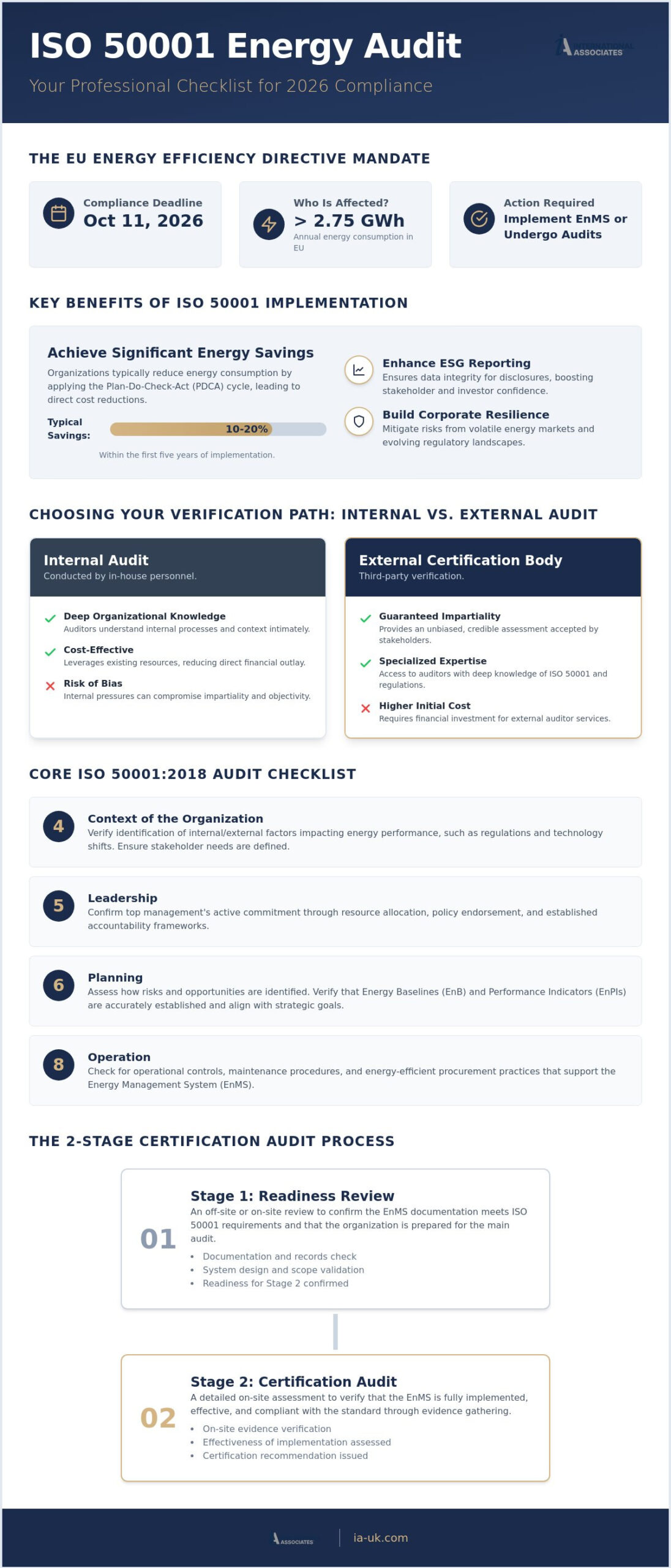
The global energy market remains volatile, transforming energy management from a peripheral operational concern into a central pillar of corporate resilience. Organizations that fail to establish rigorous oversight face not only escalating costs but also significant regulatory exposure. By October 11, 2026, companies within the European Union with an annual energy consumption exceeding 2.75 GWh are required to implement a compliant Energy Management System (EnMS) or conduct regular audits under the Energy Efficiency Directive (EED). Utilizing a robust iso 50001 energy audit checklist isn’t just a recommendation; it’s a procedural necessity for maintaining legal standing and operational continuity.
A structured checklist serves as a safeguard against common non-conformities that often derail certification efforts. While a simple walk-through inspection might identify visible waste, a professional audit involves a systematic, evidence-based evaluation of the entire management framework. This includes verifying the accuracy of energy baselines and the validity of Energy Performance Indicators (EnPIs). For UK-based entities, this level of detail is critical as they approach the qualification period for ESOS Phase 4 at the end of 2026.
The Evolving Landscape of Energy Management
The transition from basic energy-saving initiatives to integrated EnMS performance marks a shift toward institutional accountability. In 2026, regulators and stakeholders demand more than just intent; they require demonstrable data. The ISO 50001 standard provides the international framework for this rigor, especially with the 2024 amendment requiring organizations to account for climate change risks. For businesses seeking a broader perspective on how these standards integrate with other operational goals, exploring International Associates management system certification provides essential context for global compliance strategies.
Checklist Objectives: Beyond Compliance
A strategic checklist identifies untapped energy saving opportunities (ESOs) that often remain hidden during routine maintenance. Organizations that implement ISO 50001 typically achieve energy savings between 10% and 20% within the first five years by applying the Plan-Do-Check-Act (PDCA) cycle. Beyond immediate financial gains, a verified iso 50001 energy audit checklist ensures data integrity for ESG disclosures. This transparency is vital for stakeholders who prioritize environmental stewardship and long-term sustainability in their investment decisions.
The Core ISO 50001:2018 Audit Checklist: Essential Clauses
Successful certification hinges on demonstrating how the Energy Management System (EnMS) is integrated into the organizational fabric. A comprehensive iso 50001 energy audit checklist must prioritize the high-level structure of the 2018 standard. Clause 4 requires the identification of internal and external factors, such as regional energy regulations or technological shifts, that impact energy performance. Clause 5 mandates that top management doesn’t just endorse a policy but actively demonstrates commitment through resource allocation and the establishment of clear accountability frameworks.
Planning under Clause 6 is where the technical strategy is formalized. Auditors verify how risks and opportunities are identified to prevent undesired outcomes or system failures. This process involves setting specific energy objectives that align with the organization’s strategic direction. It’s a rigorous assessment of how you intend to meet the 2026 mandates and carbon reduction goals discussed previously.
Energy Performance Indicators (EnPIs) and Baselines
Verification of the Energy Baseline (EnB) remains a critical audit milestone. Auditors examine whether the 2026 data sets accurately reflect the organization’s consumption patterns before improvements were implemented. Energy Performance Indicators (EnPIs) are the quantitative metrics used to measure energy performance. The methodology behind EnPI selection must be technically sound; it should account for relevant variables like production volume or ambient temperature to ensure that performance comparisons remain valid over time.
Operational Controls and Procurement
Clause 8 focuses on the practical execution of the EnMS within daily operations. An effective iso 50001 energy audit checklist includes a review of energy-efficient design for new facilities or equipment upgrades. Procurement processes must also be scrutinized to ensure they support the energy policy. Auditors look for evidence that energy performance is a weighted criterion when purchasing high-energy-consuming equipment or services. This oversight extends to ensuring that both staff and contractors possess the necessary competency and awareness to maintain the integrity of the energy system. Achieving this level of operational rigor requires a methodical approach to verification. For organizations aiming to validate their systems, exploring ISO 50001 Energy Management certification provides a clear path toward recognized international standing.
Internal Audit vs. External Certification Body: A 2026 Comparison
Deciding between internal resources and an accredited third party is a strategic choice that directly impacts the long-term ROI of the Energy Management System (EnMS). While both parties utilize an iso 50001 energy audit checklist, the objectives of their assessments differ fundamentally. Internal auditors focus on “checking the system” to ensure daily operational adherence and to identify minor non-conformities before they escalate. Conversely, an external certification body is tasked with “certifying the system,” providing a rigorous, independent validation that the organization meets international standards. This external verification is often the prerequisite for global market access and stakeholder confidence.
Selecting the right partner is paramount for businesses facing the 2026 regulatory shift. Understanding choosing a certification body in the UK involves evaluating the technical depth and industrial relevance of the auditor. For organizations operating across multiple jurisdictions, the impartiality of a third-party audit offers a level of assurance that internal teams, despite their best efforts, may struggle to maintain due to inherent proximity to the operations. The cost-benefit analysis of professional certification often reveals that the risk of non-compliance and missed efficiency gains far outweighs the initial assessment fees.
When to Rely on Internal Audits
Internal audits serve as a vital tool for ongoing surveillance and system health checks. They allow for the rapid identification of performance gaps and ensure the Plan-Do-Check-Act cycle remains active between certification cycles. To be effective, these auditors must undergo formal training to maintain objectivity and technical competence. However, in high-stakes regulatory environments, internal audits alone lack the institutional weight required for legal compliance and high-level ESG reporting. They’re best used as a preparatory phase for external scrutiny.
The Value of Independent Third-Party Certification
Independent certification provides global recognition that transcends local borders, building immediate trust with international stakeholders and investors. A third-party review of technical documentation acts as a robust safeguard against regulatory fines, which is particularly relevant as thresholds for mandatory compliance tighten. By utilizing International Associates energy security services, organizations gain access to specialized expertise that can identify complex systemic risks. An external auditor brings a fresh perspective to the iso 50001 energy audit checklist, transforming a compliance exercise into a strategic assessment of energy resilience.
How to Execute Your Energy Audit: Stage 1 and Stage 2 Preparation
Executing an ISO 50001 audit is a two-phased process designed to ensure both the structural integrity and the operational effectiveness of your Energy Management System. While the iso 50001 energy audit checklist provides the necessary framework, the auditor’s role is to verify that these elements are active and producing measurable results. This progression from documentation to demonstration separates a certified organization from one that simply maintains a policy on paper. The process is methodical, moving from a desktop review to a deep dive into physical operations.
Stage 1: Documentation and Gap Analysis
The Stage 1 audit, frequently called the Readiness Review, focuses on the system’s architecture. Auditors evaluate the Energy Policy and EnMS scope to ensure they align with 2026 compliance requirements and the recent climate change amendments. This phase identifies critical gaps in energy data collection and analysis before the more intensive Stage 2 assessment begins. It’s during this review that the validity of the Energy Baseline (EnB) and Energy Performance Indicators (EnPIs) is first tested against the documented methodology. Establishing a clear timeline for Stage 2 readiness depends entirely on how effectively these documentation gaps are bridged.
Stage 2: On-Site Verification and Performance
Stage 2 is the Certification Audit where the focus shifts to on-site implementation. Auditors interview key personnel to gauge energy awareness and leadership commitment across the organization. They observe operational controls and maintenance procedures in real-time to ensure they reflect the documented system. For organizations looking to upgrade their facilities to meet these high standards, you can discover CFS group Limited for expert property maintenance and refurbishment. Crucially, the auditor seeks objective evidence of continuous energy performance improvement. This isn’t just about following procedures; it’s about proving that the EnMS is driving measurable reductions in energy consumption as evidenced by the 2026 data sets.
If non-conformities are identified during these stages, the organization must develop and implement corrective action plans. These plans must address the root cause of the issue rather than just the immediate symptom. Major non-conformities require a follow-up audit to verify that the system is back in alignment with the standard. Minor issues might only require an agreed plan for future resolution during surveillance audits. Once the auditor is satisfied that the EnMS meets all requirements, a final recommendation is made for the issuance of the ISO 50001 certificate. For organizations ready to begin this formal verification process, initiating an ISO 50001 certification audit provides the necessary independent validation to satisfy global regulatory demands.
Partnering with International Associates for ISO 50001 Certification
International Associates acts as a sophisticated bridge between complex global regulations and the businesses that must adhere to them. Our global network of auditors provides localized expertise while maintaining rigorous adherence to international standards. This ensures that the application of an iso 50001 energy audit checklist remains consistent across different regions, from Europe to Asia. By choosing an independent certification body with worldwide operational capacity, organizations gain the institutional reliability required to satisfy stakeholders and regulatory authorities alike.
We utilize an advanced IT infrastructure designed for efficient audit reporting and a quick certificate turnaround. This technical framework minimizes the friction often associated with high-stakes certifications. Our fee structures are transparent, covering both the initial assessment and subsequent annual surveillance audits. This predictability allows organizations to manage their compliance budgets without the ambiguity of hidden costs. Our commitment to impartiality and high standards of regulatory compliance is foundational, providing a steady hand in the world of corporate assurance.
Why Choose International Associates?
Our Glasgow-based head office serves as a central administrative base for a network that spans multiple continents. This global-local duality allows us to offer specialized expertise in regulatory compliance and complex management systems. We maintain a meticulous, ethical approach that is supportive of our clients’ international growth. Organizations benefit from a professional assessment process that prioritizes clarity and precision, ensuring that the path to certification is methodical and well-organized.
Next Steps to Certification
The transition from internal preparation to formal certification begins with a technical documentation review. This initial step assesses the maturity of your current EnMS and identifies any critical gaps before the on-site audit. Organizations often find it beneficial to enroll team members in accredited lead auditor training to strengthen their internal oversight. This proactive approach ensures that your team is fully equipped to maintain the standards required by the iso 50001 energy audit checklist. Contact our administrative office to receive a tailored certification quote that reflects the specific scale and complexity of your global operations.
Securing Your Energy Management Resilience for 2026
The transition toward mandatory energy management by October 2026 necessitates a shift from casual oversight to rigorous, evidence-based verification. Utilizing a technical iso 50001 energy audit checklist ensures that your organization doesn’t just meet basic regulatory thresholds but establishes a foundation for continuous energy performance improvement. While internal reviews maintain system health, independent certification remains the definitive benchmark for building trust with international stakeholders and navigating the complexities of the Energy Efficiency Directive.
As a UKAS accredited certification body with a global network of regional offices, International Associates provides the specialized expertise required for high-stakes technical auditing. Our methodical approach helps businesses achieve recognized compliance without unnecessary operational friction. To begin your verification process, Contact International Associates for a Professional ISO 50001 Audit Quote. We look forward to supporting your organization’s commitment to global energy standards.
Frequently Asked Questions
What is the most important part of an ISO 50001 audit checklist?
The most critical component of an iso 50001 energy audit checklist is the verification of Energy Performance Indicators (EnPIs) and the Energy Baseline (EnB). These metrics provide the quantitative evidence required to demonstrate continuous improvement. Auditors prioritize these sections because without a technically sound baseline, any claimed energy savings cannot be verified against international standards.
How often should an internal energy audit be conducted?
Internal energy audits should be conducted at least once per year to ensure the management system remains effective between external surveillance visits. A risk-based approach is often more effective; higher-frequency audits may be necessary for significant energy-using (SEU) areas or following major operational changes. Regular internal reviews allow technical teams to identify and rectify minor non-conformities before they impact certification status.
Can ISO 50001 be integrated with ISO 14001 audits?
ISO 50001 can be seamlessly integrated with ISO 14001 audits due to their shared High-Level Structure (HLS). This integration reduces administrative duplication and allows organizations to manage environmental and energy objectives within a single framework. Combined audits are particularly efficient for organizations seeking to demonstrate comprehensive ESG progress to stakeholders while minimizing operational disruption.
What evidence is required to prove energy performance improvement?
Demonstrating energy performance improvement requires objective data that compares current Energy Performance Indicators (EnPIs) against the established Energy Baseline (EnB). Evidence must be normalized to account for variables such as production volume or ambient temperature. Auditors look for documented energy saving opportunities (ESOs)—such as those identified by climate control specialists like Ultra Air Heating and Cooling—that have been implemented and validated through metered data or technical calculations.
How long does the ISO 50001 certification process take?
The ISO 50001 certification process typically spans three to six months from the initial application to the final certificate issuance. This timeline depends on the maturity of the existing Energy Management System and the complexity of the organization’s energy profile. Stage 1 readiness reviews and Stage 2 on-site audits are the primary procedural milestones that dictate the overall duration of the assessment.
What are the most common non-conformities in energy audits?
Common non-conformities often involve inadequate identification of Significant Energy Uses (SEUs) or a failure to link energy objectives to the core energy policy. Auditors also frequently identify gaps in staff competency and awareness regarding operational controls. Ensuring that every technical requirement in the iso 50001 energy audit checklist is backed by documented evidence is the most effective way to prevent these findings.
Is ISO 50001 certification mandatory for large businesses in the UK?
ISO 50001 certification is not strictly mandatory for all large UK businesses, but it serves as a primary route for compliance with the Energy Savings Opportunity Scheme (ESOS). Organizations that maintain a certified EnMS covering at least 95% of their total energy consumption are exempt from standard ESOS audit requirements. This makes certification a strategic choice for businesses aiming to streamline their regulatory obligations.
What is the role of top management during an ISO 50001 audit?
Top management must demonstrate active commitment to the EnMS by establishing the energy policy and ensuring that energy objectives are integrated into the organization’s strategic direction. During an audit, leaders are interviewed to verify that sufficient resources have been allocated and that accountability for energy performance is clearly defined. Passive endorsement is insufficient; auditors look for evidence of direct leadership in driving the Plan-Do-Check-Act cycle.