

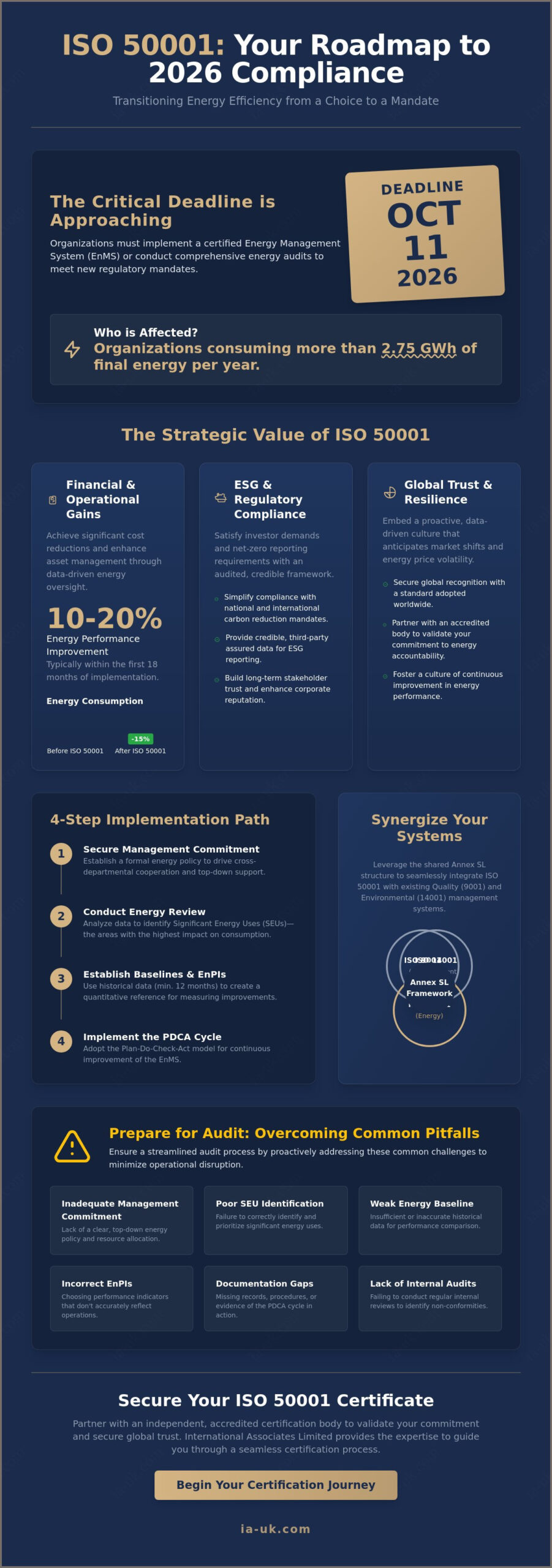
By October 11, 2026, organizations consuming more than 2.75 GWh of final energy per year must transition from viewing efficiency as a strategic choice to managing it as a legal mandate. This shift centers on the meticulous implementation of ISO 50001, an international standard providing a structured framework for quantifying and improving energy performance. You’re likely facing the dual pressure of volatile utility markets and the rigorous demands of net-zero reporting. It’s natural to feel concerned about the technical complexity of an Energy Management System (EnMS) or the potential for audit disruption during this transition.
We understand that achieving compliance requires a balance of technical accuracy and operational continuity. This guide provides a comprehensive roadmap to help you secure accredited certification while achieving energy performance improvements of 10-20% within the first 18 months of implementation. We’ll examine the data-driven PDCA cycle, explore how to integrate these requirements with your existing management systems, and outline the steps to build long-term resilience against energy price volatility.
Key Takeaways
- Understand why 2026 is a pivotal year for energy management due to new regulatory mandates and the necessity of organizational resilience.
- Learn the systematic process for establishing an iso 50001 framework, focusing on identifying significant energy uses and securing management commitment.
- Discover how to leverage the shared Annex SL structure to seamlessly integrate energy excellence with your existing quality and environmental management systems.
- Identify common technical pitfalls and documentation gaps to ensure a streamlined audit process and minimize operational disruptions.
- Recognize the importance of partnering with an independent, accredited certification body to secure global trust and validate your commitment to energy accountability.
The Strategic Value of ISO 50001 Certification in 2026
Organizations across the globe now recognize that energy is no longer a fixed overhead but a variable that requires rigorous oversight. The iso 50001 standard stands as the international gold standard for an Energy Management System (EnMS), providing a structured methodology for organizations to enhance their energy performance. By 2026, the landscape of energy accountability has shifted. It’s no longer sufficient to simply track utility bills; businesses must now demonstrate a systematic approach to energy conservation and carbon reduction.
October 11, 2026, marks a significant regulatory milestone. Under new directives, companies consuming more than 2.75 GWh of final energy per year must implement a certified EnMS or conduct comprehensive audits. This transition from voluntary adoption to mandatory compliance highlights why 2026 is the critical year for institutional resilience. Moving from a reactive stance to a proactive, data-driven management model allows firms to anticipate market shifts rather than merely responding to them. Utilizing the ISO 50001 energy management system framework ensures that energy efficiency becomes embedded within the corporate culture, fostering long-term stakeholder trust through independent, third-party assurance.
Financial and Operational Benefits
Implementing a certified EnMS delivers immediate impact on the bottom line. Organizations typically achieve energy performance improvements of 10-20% within the first 18 months of certification. These savings directly reduce utility overheads, providing a buffer against the energy price volatility that has characterized the mid-2020s. Beyond cost, the standard improves operational efficiency by identifying significant energy uses (SEUs). This targeted focus leads to better asset management and more predictable maintenance schedules, ensuring that high-consumption machinery operates at peak efficiency. It’s about quantifying waste and transforming it into operational capital.
ESG and Regulatory Compliance
The pressure to meet net-zero targets isn’t coming solely from governments; it’s coming from the capital markets. Investors and lenders now demand credible, audited energy data as part of Environmental, Social, and Governance (ESG) reporting. With the Materials sector reaching a 33% adoption rate in 2025, the industry is setting a high bar for transparency. A certified iso 50001 system simplifies compliance by providing a unified framework that satisfies multiple national and international carbon reduction mandates. It serves as a moral and technical signature, proving that an organization values social responsibility as much as financial performance.
Step-by-Step Guide: Implementing an ISO 50001 EnMS
Successful implementation of the iso 50001 standard requires more than a checklist; it demands a fundamental shift in how an organization perceives its energy consumption. The process begins with securing unwavering management commitment. This is codified through a formal energy policy that outlines the organization’s dedication to achieving energy excellence. Without this directive from the top, the technical requirements of the EnMS will struggle to gain the necessary cross-departmental cooperation.
Following this, the technical core of the system is built through a comprehensive energy review. During this phase, you must analyze your energy data to identify Significant Energy Uses (SEUs). These are the specific processes, facilities, or systems that represent a substantial portion of your total energy consumption. By focusing your efforts on these SEUs, you ensure that your action plans yield the most significant returns on investment. This focused approach allows organizations to typically achieve energy performance improvements of 10-20% within the first 18 months.
Setting the Energy Baseline and EnPIs
Establishing a credible starting point is essential for quantifying future improvements. You should gather at least 12 months of historical data to account for seasonal variations and operational cycles. This data allows you to select relevant Energy Performance Indicators (EnPIs) tailored to your specific industrial context. An Energy Baseline is the quantitative reference for performance comparison. Whether you’re measuring energy per metric ton of product or per square meter of facility, these indicators provide the transparency needed for accurate reporting. Our Lead Auditor Training can equip your team with the skills to verify these complex datasets internally.
The PDCA Cycle in Energy Management
The Plan-Do-Check-Act (PDCA) cycle provides the structural rhythm for continual improvement. In the Plan phase, you identify energy saving opportunities and set measurable objectives based on the energy review. The Do phase involves the practical implementation of action plans and operational controls, including staff training to embed a culture of efficiency. Finally, the Check and Act phases involve monitoring performance against the baseline and conducting management reviews. This methodical approach ensures that the EnMS remains resilient and adapts to changing energy landscapes, preventing the system from becoming a static document.
Synergising ISO 50001 with ISO 14001 and ISO 9001
The adoption of Annex SL has transformed how global organizations manage multiple regulatory requirements. This high-level structure provides a universal framework of 10 core clauses, ensuring that iso 50001 shares a common language with other management systems. By aligning terms and definitions, Annex SL eliminates the need for redundant systems. It allows for a single, unified management approach. This integration is particularly effective for the 20% of European firms that already hold multiple certifications, as it enables them to embed energy performance directly into their existing operational workflows.
Integrating energy management into an existing ISO 14001 Environmental Management System Certification is a logical progression for many manufacturers. It’s a strategic move that addresses the 10-20% energy performance improvements typically seen within the first 18 months of implementation. While the environmental standard addresses a broad spectrum of impacts, iso 50001 provides the technical depth required to drive significant energy savings. Streamlining documentation across these standards reduces the administrative burden on your compliance team. Instead of maintaining separate registers for risks, you can manage them within a centralized framework. This ensures that energy objectives are consistent with your broader environmental goals.
Commonalities in Management Structures
Shared requirements for leadership commitment and organizational context simplify the transition between standards. Since both energy management and ISO 9001 Quality Management System Certification demand top-level accountability, your executive team can provide oversight through a single management review process. Unified approaches to risk management allow you to identify energy-related threats alongside quality risks. You can leverage existing processes for document control, ensuring that your energy data meets the same rigorous standards as your quality metrics.
The Combined Audit Advantage
A multi-standard certification approach offers clear operational benefits for global organizations. Scheduling combined audits reduces the time your personnel spend hosting auditors, which minimizes downtime. This synchronized approach often leads to cost-efficiencies in surveillance fees, as auditors verify shared clauses once for all standards. Beyond financial savings, a combined audit provides a holistic view of institutional resilience. It demonstrates a unified commitment to quality and energy accountability through a single, independent verification process.
Preparing for the Audit: Overcoming Common Pitfalls
Achieving iso 50001 certification is the final verification of your organization’s commitment to energy excellence, yet the audit process often reveals systemic gaps that could’ve been mitigated during the implementation phase. As an independent certification body, we observe that the most resilient organizations view the audit not as a disruption but as a rigorous validation of their operational efficiency. Preparation requires a meticulous review of all technical documentation to ensure it’s current, accessible, and verified against actual performance data. It’s essential to brief your team on their specific roles within the EnMS, as auditors will look for evidence that energy awareness is embedded across all levels of the workforce.
A robust internal audit and management review cycle is your most effective tool for identifying non-conformities before the formal assessment begins. Organizations that fail to conduct a thorough internal audit often struggle during the certification stage. With the October 11, 2026, deadline approaching for companies consuming over 2.75 GWh annually, the pressure to secure accredited certification has never been higher. Ensuring your system is audit-ready requires a focus on data integrity and clear evidence of continual improvement.
Top Non-Conformities to Avoid
The most frequent non-conformities we encounter involve inadequate data collection or unreliable Energy Performance Indicators (EnPIs). If your EnPIs don’t accurately reflect your significant energy uses, the entire system lacks a credible foundation. We also see a common lack of clear evidence regarding management commitment; auditors need to see more than just a signed policy. They require proof of resource allocation and active participation in management reviews. Finally, ensure your energy objectives are directly linked to the findings of your energy review. Disconnected goals are a red flag that suggest the system isn’t being used to drive actual performance gains.
The Stage 1 and Stage 2 Audit Process
The certification process is divided into two distinct stages. Stage 1 is a technical review of your documentation and system readiness. During this phase, the auditor determines if your EnMS meets the structural requirements of the standard. Stage 2 is the on-site verification of implementation and performance, where the auditor looks for evidence that the system is functioning as described. If findings are identified, you’ll need to implement effective corrective actions that address the root cause, rather than just the symptoms. To begin your journey toward accredited certification, you can request a formal quote for ISO 50001 Energy Management services today.
Securing Your ISO 50001 Certificate with International Associates
Selecting an independent, accredited certification body is the final step in validating your energy management efforts. For organizations operating across diverse international markets, a certificate from a recognized body provides the necessary assurance that energy data is quantified according to the iso 50001 standard. International Associates Limited operates as a gatekeeper of quality and safety; we ensure that your compliance isn’t just a paper exercise but a reflection of technical accuracy. Our role is to provide an objective, third-party perspective that puts global investors and regulatory authorities at ease regarding your institutional resilience.
Our approach to auditing is methodical and highly structured. We utilize an IT-driven methodology to ensure the process remains efficient and minimizes operational disruption for your technical departments. With a global presence anchored by our offices in Glasgow and Dublin, we possess the cultural intelligence and technical reach to serve organizations worldwide. We don’t merely check boxes. We apply a rigorous, evidence-based methodology that aligns with our core commitment to social responsibility and technical excellence.
The International Associates Certification Journey
We provide a clear pathway through the initial assessment and subsequent surveillance audits. Our fee structures are transparent, ensuring your executive team can plan for the three-year certification cycle without unexpected costs. While we maintain the highest regulatory standards, our streamlined processes allow for a quick turnaround for certificates once compliance is verified. Additionally, we offer professional training for internal auditors and lead auditors to help your team maintain the system’s integrity between formal visits.
Partnering for Long-Term Energy Success
Certification isn’t a one-time event; it’s an ongoing commitment to energy excellence. We provide consistent support through the recertification cycle, ensuring your management system evolves alongside energy technology and changing legislation. By building a resilient iso 50001 system today, you prepare your organization for the energy landscape of 2026 and beyond. Request a formal quote for ISO 50001 certification today.
Securing Institutional Resilience Through Energy Accountability
The transition toward a certified iso 50001 framework is a fundamental component of institutional resilience. By addressing the October 11, 2026 regulatory deadline today, your organization secures a competitive advantage through quantified energy performance improvements. We’ve detailed how a data-driven EnMS, integrated via the universal Annex SL structure, reduces administrative burdens while enhancing stakeholder trust through independent verification.
International Associates Limited serves as your Expert Guardian throughout this certification journey. As a UK-based accredited certification body with a global presence across Europe, Asia, and the Middle East, we provide the impartial assurance required for complex regulatory landscapes. Our expertise in technical environments like MDR and UKCA ensures your audit experience is professional and evidence-based. We prioritize accuracy and reliability to put your organization at ease regarding compliance standards.
Begin your journey to energy excellence with International Associates to transform your energy profile into a pillar of corporate social responsibility. We’re ready to support your organization’s growth with meticulous attention to detail and international scale.
Frequently Asked Questions
What is the primary difference between ISO 14001 and ISO 50001?
ISO 14001 provides a broad framework for managing all environmental impacts, whereas iso 50001 focuses exclusively on improving energy performance through technical and behavioral change. While the former includes waste and emissions, the latter requires a deep dive into significant energy uses. This specialization allows organizations to achieve specific energy performance improvements of 10-30% within the first few years of implementation.
How long does it typically take to achieve ISO 50001 certification?
The timeline for achieving certification generally ranges between 6 and 12 months. This duration depends on the maturity of your existing management systems and the complexity of your energy profile. Smaller organizations with centralized data may move faster; however, larger manufacturers with multiple significant energy uses (SEUs) require more time to establish robust monitoring and measurement processes before the Stage 1 audit begins.
Can a small business benefit from ISO 50001, or is it only for large industry?
Small businesses frequently see higher proportional returns because they often start from a less optimized energy baseline. Organizations implementing the standard typically see energy performance improvements of 10-20% within the first 18 months. Even without the massive consumption of the Materials sector, which reached 33% adoption in 2025, small firms gain resilience against energy price volatility and improve their standing in global supply chains.
Is ISO 50001 certification mandatory for UK businesses?
Certification becomes a legal requirement for high-energy consumers starting October 11, 2026. Specifically, organizations consuming more than 2.75 GWh of final energy per year must implement an EnMS based on iso 50001 or conduct a formal energy audit. By October 11, 2027, this requirement tightens for those consuming over 23.6 GWh annually, making a certified management system the primary pathway for legal compliance.
What are Energy Performance Indicators (EnPIs) and why are they required?
Energy Performance Indicators are the quantitative measures used to track and analyze energy efficiency across your operations. They’re required because they allow an organization to compare current performance against its established energy baseline. Without these specific metrics, it’s impossible to demonstrate the “continual improvement” required by the standard. Common EnPIs include energy used per production unit or per square meter of facility space.
How much does ISO 50001 certification cost for a mid-sized organisation?
Costs aren’t fixed and vary based on organizational complexity and the number of sites. For context, some UK-based firms provide pricing starting at £1,995 for very small entities, while USA-based data suggests a general range of $10,000 to $25,000 for larger certification projects. As an independent body, we provide bespoke quotes based on the specific audit days required to verify your system’s compliance and technical accuracy.
Can we use existing energy data for our initial energy baseline?
You can and should use existing historical data to establish your baseline. The standard typically requires 12 months of data to ensure that seasonal variations and production cycles are fully accounted for. If your current data is incomplete, you may need to implement additional sub-metering to capture specific information on your significant energy uses (SEUs) before the Stage 2 on-site verification audit takes place.
What happens if we fail our Stage 2 certification audit?
Failing an audit usually means the auditor identified major non-conformities that prevent certification. You’ll be given a specific timeframe, often 90 days, to implement corrective actions that address the root cause of these issues. Once these actions are verified through a follow-up review or document submission, the certification process can proceed. It’s a structured path to improvement rather than a permanent rejection of your management system.