

Is your certification body a strategic asset that drives organizational improvement, or merely a bureaucratic hurdle that complicates your market access? Many businesses accept inconsistent communication or slow report turnarounds as standard industry practice, yet these are often clear signs you need a new ISO certification body. It’s common to feel that your auditor doesn’t fully grasp the technical nuances of your sector, particularly in highly regulated fields like medical device manufacturing or information security. When administrative fees become unpredictable and technical expertise is lacking, the value of your certification begins to diminish.
We understand that the prospect of transferring your certification can seem daunting, especially when maintaining global compliance is non-negotiable. This guide will help you identify critical red flags in your current auditing relationship and demonstrate how to transition to a more efficient, technically-proficient partner. You’ll learn how to secure predictable costs and gain access to auditors who provide genuine sector expertise; ensuring your certification remains a mark of global reliability rather than an administrative burden. We will examine the methodical process of a seamless transfer that protects your standing in the global market.
Key Takeaways
- Understand the critical role of a certification body as a strategic partner that adds value through technical depth rather than serving as a mere administrative hurdle.
- Identify the specific signs you need a new ISO certification body, such as persistent communication delays, unexpected administrative fees, or a lack of industry-specific expertise.
- Learn why prioritizing technical competence over the lowest audit price prevents hidden risks and ensures your management system receives actionable, high-level insights.
- Follow a structured, four-step technical review process to transfer your existing certification seamlessly without disrupting your global operations or regulatory standing.
- Discover the benefits of partnering with a global auditing firm that combines centralized administrative reliability with an expansive network of regional technical experts.
The Strategic Role of an ISO Certification Body
An ISO Certification Body (CB) functions as an independent third-party verifier, tasked with assessing whether an organization’s management system adheres to specific international standards. This relationship shouldn’t be merely transactional. Instead, it must be established on a foundation of impartiality, technical competence, and procedural efficiency. A high-performing accredited certification body provides more than a certificate; it offers a rigorous technical assessment that identifies systemic risks and opportunities for improvement. This independent verification is the cornerstone of trust in global supply chains.
The distinction between a “rubber-stamp” audit and a value-adding assessment is significant. A superficial audit might grant a certificate, but it often leaves the organization vulnerable to operational failures or regulatory non-compliance. Conversely, a technically proficient auditor understands the specific legal and industrial frameworks of your sector, acting as a vital bridge to international market access. If your current provider fails to offer this depth, it’s one of the primary signs you need a new ISO certification body to maintain your competitive edge. A strategic partner ensures your management system evolves alongside global regulatory shifts.
Certification vs. Accreditation: Why it Matters
It’s vital to distinguish between the certification provided to your business and the accreditation held by the CB. Accreditation bodies, typically national entities, oversee CBs to ensure they maintain the highest levels of integrity and competence. You can review our accreditations to understand how this oversight functions. Utilizing an unaccredited body carries substantial risk. Many global procurement departments and government agencies will reject tenders backed by unaccredited certificates, leading to lost contracts and diminished global recognition. Professional organizations prioritize accredited bodies to guarantee their certifications are recognized worldwide.
The Three-Year Certification Cycle
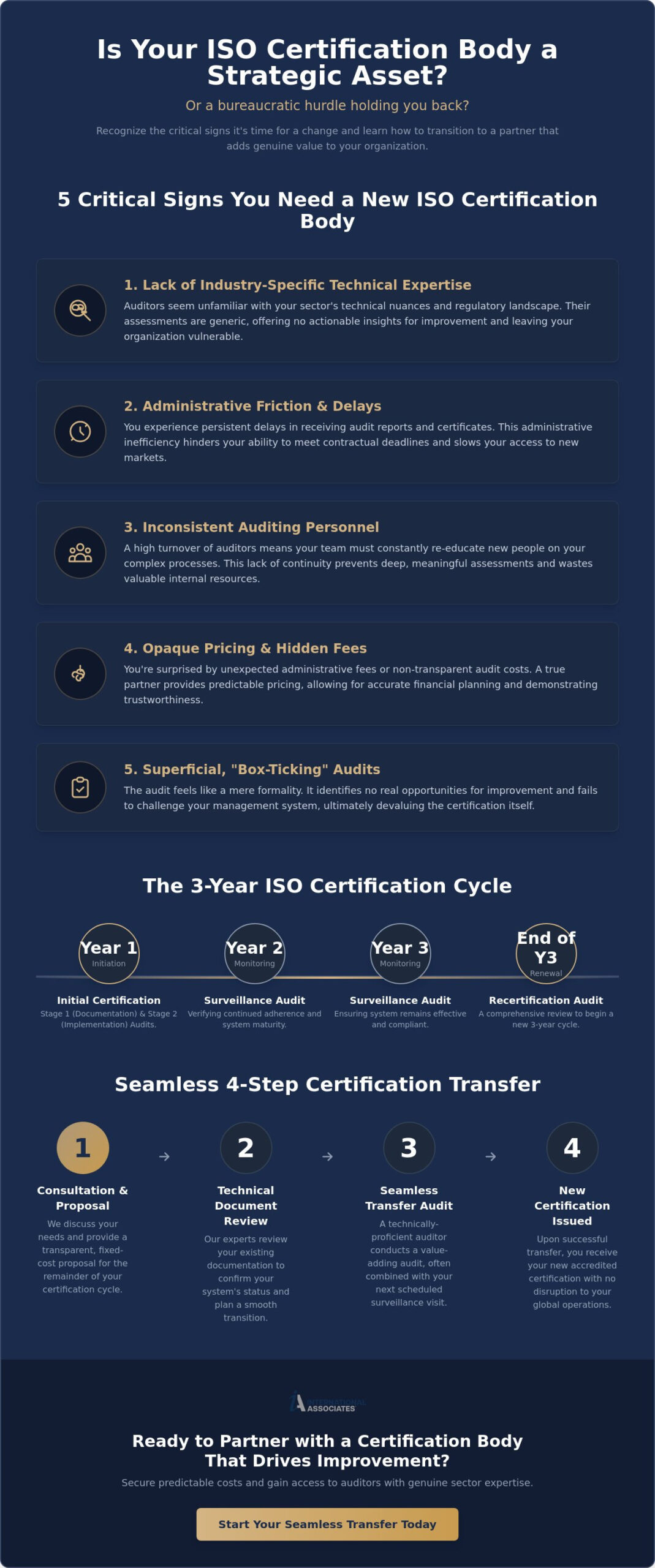
The certification journey is a structured, three-year process designed to verify ongoing management system certification. This cycle is meticulously organized to monitor compliance over time. It includes a Stage 1 documentation review, a Stage 2 implementation audit, and annual surveillance audits to ensure continued adherence. The cycle concludes with a comprehensive recertification audit in the third year. Frictions typically emerge during surveillance or recertification phases when the level of service begins to decline. Persistent administrative delays or auditors who lack sector-specific knowledge during these stages are clear signs you need a new ISO certification body to ensure your compliance remains robust, reliable, and technically sound.
5 Critical Signs You Need a New ISO Certification Body
The relationship between an organization and its certification body should be characterized by technical synergy and administrative transparency. When this dynamic shifts toward friction and inefficiency, the value of the certification is compromised. Recognizing the signs you need a new ISO certification body is a vital step in safeguarding your organization’s reputation and operational efficiency. Five critical indicators often signal that a transition is necessary to maintain global compliance standards.
- Lack of Industry-Specific Technical Expertise: Auditors who lack experience in specialized sectors, such as medical device manufacturing or high-stakes social compliance, cannot provide meaningful assessments.
- Administrative Friction: Persistent delays in report processing or certificate issuance can hinder your ability to meet contractual obligations or enter new markets.
- Inconsistent Personnel: Frequent changes in auditing staff lead to a lack of continuity, forcing your team to re-explain complex processes during every surveillance visit.
- Opaque Pricing: Unexpected administrative fees or hidden costs for surveillance audits disrupt financial predictability and erode trust.
- Regulatory Posture: An auditor who adopts the role of a “policeman” rather than a professional assessor often focuses on trivial clerical errors instead of systemic risks.
Red Flag: The Technical Knowledge Gap
A significant risk arises when generalist auditors are assigned to specialized standards. For instance, the technical requirements of ISO 13485 for medical devices demand a deep understanding of regulatory pathways and risk management. If an auditor lacks this sector-specific depth, they may raise incorrect non-conformities or, more dangerously, overlook critical safety risks. The ANSI National Accreditation Board (ANAB) emphasizes the necessity of technical competence in the accreditation process; if your current body fails to meet this threshold, it jeopardizes your standing in highly regulated markets. If your audit reports consistently lack depth or fail to address sector-specific risks, these are definitive signs you need a new ISO certification body.
Red Flag: Bureaucratic Delays
Efficiency in certificate turnaround is not merely a convenience; it’s a commercial requirement. Organizations seeking to move beyond administrative box-ticking often find that social accountability audits require a higher degree of ethical scrutiny and faster reporting than their current provider can offer. Many legacy certification bodies rely on outdated IT systems that cause months of delay between the closing meeting and the final certificate issuance. This inefficiency can prevent you from bidding on time-sensitive contracts. Distinguishing between a rigorous technical review and simple administrative sluggishness is essential for your long-term growth. A modern partner should provide a streamlined, methodical approach that respects your operational timelines without sacrificing the integrity of the audit process.
Evaluating Value: Technical Depth vs. Administrative Box-Ticking
The selection of a certification body should be viewed through the lens of return on investment rather than merely the lowest procurement cost. A superficial audit that focuses on administrative box-ticking often fails to identify underlying systemic risks. While the initial daily rate might appear attractive, an auditor who lacks the technical depth to challenge your processes provides little value. When an audit report lacks actionable insights and instead provides only generic findings, these are clear signs you need a new ISO certification body. A professional assessment should provide a meticulous evaluation that strengthens your organizational resilience.
Specialized assessments, such as Social Accountability Audits, demand a specific auditor mindset that goes beyond simple verification. These audits require an ethical sensitivity and an understanding of local labor laws that generalist auditors often lack. Additionally, a CB’s global reach is a critical factor for organizations with international supply chains. You must evaluate whether your partner can provide consistent auditing standards across diverse regions like Asia or the Middle East. The International Accreditation Forum (IAF) provides the definitive criteria for How to Transfer Your ISO Certification, ensuring the transition is based on objective technical standards rather than administrative convenience.
The True Cost of Certification
Calculating the total cost of certification requires a methodical breakdown of all associated expenses over the three-year cycle. Initial assessment fees are only one component. You must also account for long-term surveillance costs and technical documentation review fees, which vary significantly in complex sectors like medical device manufacturing. Hidden costs, such as auditor travel and accommodation, can escalate quickly if the CB lacks a regional office network. A provider with a global-local duality can mitigate these expenses by deploying local experts who understand both the international standard and the regional regulatory context.
Auditor Professionalism and Consistency
Consistency in your lead auditor is a significant advantage for business continuity. An auditor who understands your business’s evolution can provide more nuanced insights during surveillance visits. Furthermore, a certification body that invests in its own personnel demonstrates a commitment to high-level expertise. Reviewing the quality of a CB’s Lead Auditor Training programs can serve as a benchmark for their internal standards. If your current provider frequently rotates staff or sends auditors who aren’t familiar with your previous audit history, these are definitive signs you need a new ISO certification body that prioritizes professional stability and technical excellence.
How to Transfer Your ISO Certification: A Seamless 4-Step Process
Once you’ve identified the signs you need a new ISO certification body, the transition to a more technically proficient partner is a structured, regulated process. Many organizations hesitate to switch because they fear a loss of certification status or a disruption to their 3-year cycle. However, international accreditation rules are designed to facilitate these transfers without compromising the integrity of your management system. This methodical approach ensures that your global compliance remains intact while you gain access to superior technical expertise.
The transfer process follows a logical sequence of verification and assessment:
- Step 1: Technical Review: Conduct an internal assessment of your current certification status. Ensure all previous non-conformities have been closed and that your audit history is well-documented.
- Step 2: Transfer Review: Submit your existing certificates and the latest audit reports to the new certification body. They will perform a “Transfer Review” to confirm the validity of your current certification and the competence of the previous issuer.
- Step 3: Pre-Transfer Audit: In some instances, a site visit or remote assessment may be required. This ensures no major systemic failures have occurred since your last surveillance audit.
- Step 4: Issuance of New Certificates: Upon successful review, the new body issues certificates under its own accreditation. Your original 3-year cycle usually continues uninterrupted.
Timing Your Transfer for Maximum Efficiency
Strategic timing is essential to avoid unnecessary administrative costs. The most efficient period to initiate a transfer is immediately following a successful surveillance audit or approximately six months before your recertification is due. This window allows you to manage the notice period required by your current provider without risking a gap in your certification validity. Maintaining a continuous chain of certification is critical for international trade and regulatory adherence. A professional partner will coordinate with you to ensure the new certificate is issued before the old one expires.
Documentation Requirements for a Smooth Move
A successful transfer relies on the quality of your documentation. The new certification body will require a comprehensive data package, including your current certificate, the previous three years of audit reports, and evidence of non-conformity closures. Utilizing modern Regulatory Compliance Software can significantly simplify this data transfer by centralizing all audit history and corrective actions in a single, accessible location. This transparency reduces the time required for the technical review and mitigates common fears about “losing progress” in your management system’s maturity. If you’re ready to secure a more reliable auditing partnership, you can request a technical transfer review to begin the process today.
Choosing a Global Partner for Long-Term Compliance
International Associates Limited represents the evolution of the certification industry, moving away from bureaucratic inertia toward technical agility. Our operational model is built on a global-local duality, featuring a centralized administrative head office in Glasgow while maintaining an expansive network of international offices. This structure ensures that clients receive the institutional reliability of a major global entity alongside the localized technical expertise required for specific regional regulations. We act as a steady hand in the world of corporate compliance, providing the stability necessary for businesses to navigate complex international markets.
A significant differentiator in the modern market is the integration of advanced IT infrastructure. While many legacy certification bodies struggle with outdated, paper-based report processing systems, our digital-first approach ensures a rapid turnaround for certificates and audit reports. This efficiency directly addresses the administrative friction often cited as one of the primary signs you need a new ISO certification body. By streamlining the verification process, we enable our clients to achieve market access without unnecessary delays or procedural ambiguity. Reliability is the foundation of our brand identity, and our technological investments reflect this commitment.
Our commitment to ethical auditing standards extends beyond basic quality management. We provide specialized verification for sensitive sectors, including Halal certification and comprehensive social accountability audits. This rigorous approach to ethical behavior provides the necessary proof of competence for businesses operating in high-stakes environments. We don’t just issue certificates; we act as a guardian of standards, ensuring that your organization’s ethical and quality claims are backed by meticulous, independent assessment.
Specialised Expertise in High-Stakes Sectors
We maintain deep-rooted experience in highly regulated sectors, particularly regarding ISO 13485 and international medical device regulations. Our auditors possess the technical depth required to evaluate complex supply chains through specialized frameworks such as RJC, WRAP, and SLCP. This independent assessment serves as a sophisticated bridge between your internal processes and the expectations of global stakeholders, building a foundation of trust that unaccredited or generalist bodies simply cannot provide. When your industry demands high-level expertise, generic auditing is no longer an option.
Ready to Experience a Better Audit?
Transitioning to a technically-proficient partner is a strategic decision that protects your organization’s international standing. If you’ve identified the signs you need a new ISO certification body within your current relationship, we invite you to initiate a confidential conversation regarding your transfer options. Our team provides a methodical assessment of your existing certification status to ensure a transition that is both seamless and procedurally sound. You can contact International Associates for a seamless certification transfer quote to begin securing a more efficient auditing partnership.
Securing Your Organization’s Future Through Technical Excellence
Maintaining a certification that lacks technical depth or administrative efficiency presents a significant risk to your long-term growth. Persistent delays, opaque pricing, and a lack of sector-specific knowledge are definitive signs you need a new ISO certification body. By shifting toward a partner that offers genuine technical insight, you ensure your management system remains a robust tool for risk mitigation and global market access. A certification should be a strategic asset that validates your commitment to international standards.
International Associates Limited combines a Glasgow-based administrative center with an expansive network of global regional offices to provide institutional reliability. Our advanced IT infrastructure is designed to deliver a rapid turnaround for certificates, ensuring your operations aren’t hindered by bureaucratic friction. As specialists in high-stakes medical device and social accountability standards, we provide the technical depth required for complex regulatory landscapes. You can request a seamless ISO certification transfer assessment from International Associates to begin optimizing your compliance framework. We look forward to supporting your organization’s continued evolution and international success.
Frequently Asked Questions
Can I switch my ISO certification body at any time during the cycle?
You can transfer your certification at any point during the three-year cycle. While it’s procedurally smoother to switch immediately following a successful surveillance audit, the transition is possible at any time provided your current certificate is valid and accredited. A professional assessment of your documentation will ensure no gaps in coverage occur during the move.
Will I lose my ISO certification if I change providers?
You won’t lose your certification during a standard transfer process. The transition is designed to be seamless, with the new body issuing a replacement certificate that maintains your original expiry date. This continuity is essential for businesses that rely on verified standards for international trade and legal compliance. We ensure that the chain of certification remains unbroken throughout the technical review.
What are the main costs involved in transferring an ISO certificate?
Transfer costs primarily consist of a one-off administrative review fee and, in certain cases, a pre-transfer audit fee. These costs are often offset by the long-term savings gained from more predictable surveillance fees and reduced administrative friction. Identifying these fiscal signs you need a new ISO certification body early helps prevent long-term budget overruns and unexpected expenses.
How long does the ISO certification transfer process typically take?
The transfer process typically spans four to eight weeks from the initial technical review to the issuance of the new certificate. This timeline depends on the availability of your previous audit reports and the complexity of your management system. Our advanced IT infrastructure ensures that data processing is handled with maximum efficiency to meet your market access deadlines.
Do I need to undergo a full Stage 1 and Stage 2 audit again if I switch?
You don’t need to repeat Stage 1 and Stage 2 audits when transferring an accredited certificate. The new body accepts the findings of your previous audits and simply continues your current three-year surveillance cycle. This preserves the progress you’ve made in your management system maturity while providing a fresh, technically proficient perspective on your processes.
Is my current certification body obligated to help me transfer?
Your current body isn’t required to facilitate the move, but they must provide you with your certification data and audit history upon request. Under accreditation rules, they can’t unreasonably withhold this information. If a provider becomes uncooperative or difficult to contact, it’s often one of the clear signs you need a new ISO certification body that prioritizes professional integrity and client support.
What should I look for in a new certification body to avoid previous issues?
Prioritize a body that demonstrates genuine technical expertise in your specific industrial sector and maintains a transparent fee structure. Look for a partner with a global-local duality, offering regional experts backed by centralized institutional reliability. Verifying their accreditation status and reviewing their auditor training standards will help you avoid recurring service issues and ensure a strategic partnership.
Can International Associates handle multiple ISO standards in a single integrated audit?
International Associates provides integrated audits that cover multiple management system standards simultaneously. We can verify ISO 9001, ISO 14001, and ISO 45001 within a single, methodical assessment process. This approach reduces audit fatigue, lowers total certification costs, and provides a more holistic view of your organizational compliance across different regulatory niches.