

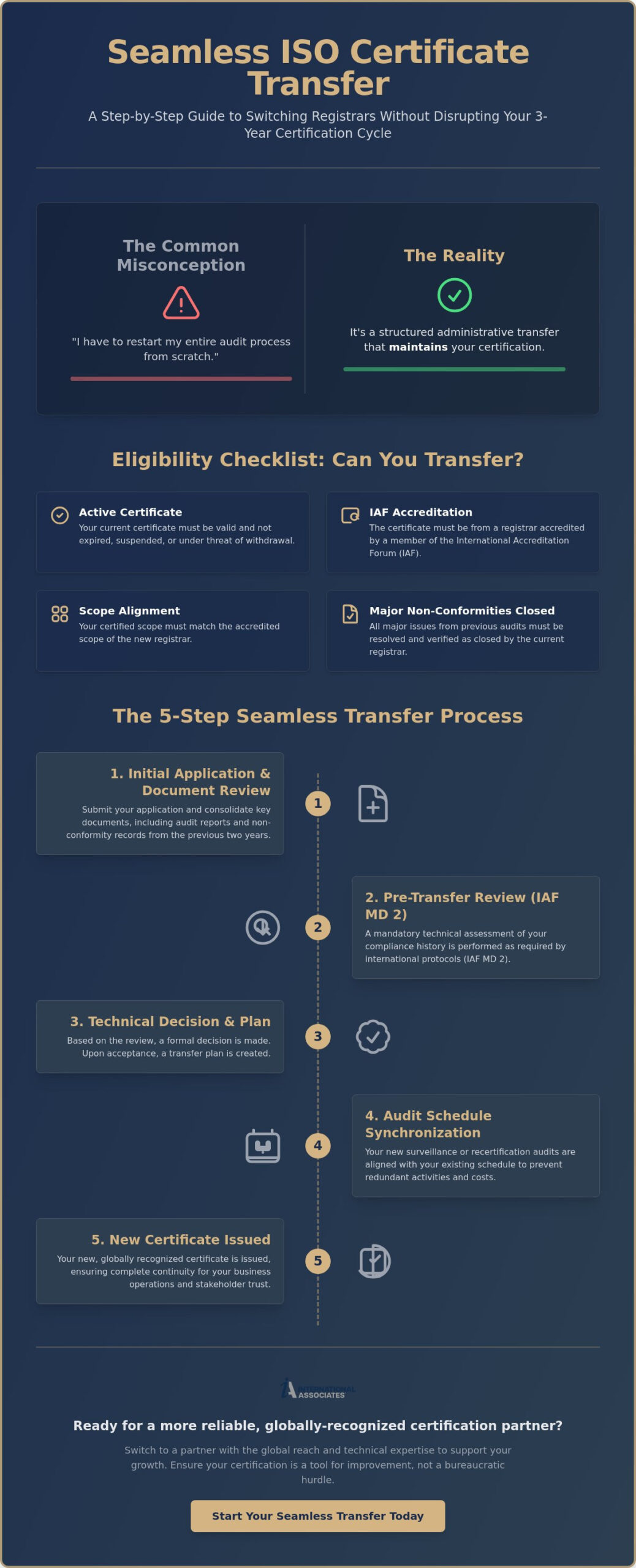
The belief that switching registrars requires starting your entire audit process from scratch is a common misconception that often prevents businesses from seeking better service. Many organizations feel trapped by partners that provide poor communication or slow technical reviews, yet they hesitate to act because they fear a total disruption of their certification status. If you’re considering transferring your ISO certificate to a new registrar, it’s important to recognize that this is a standard administrative transition governed by international protocols designed to maintain your operational continuity.
We understand that stability and global recognition are the foundations of your corporate trust. This guide provides a clear roadmap to help you transition seamlessly to a more reliable partner without losing your certification or halting your daily workflows. You’ll discover the specific requirements of IAF MD 2, learn how to evaluate the costs of new audit activities, and see how a methodical approach ensures your business stays compliant and competitive in the 2026 regulatory environment.
Key Takeaways
- Recognize that a registrar transition is a structured administrative action that maintains the integrity and timeline of your existing three-year certification cycle.
- Confirm that your current certificate is active and issued by an IAF-accredited body before initiating the process of transferring your ISO certificate to a new registrar.
- Prepare for the mandatory pre-transfer review by consolidating audit reports and non-conformity records from the previous two years for technical assessment.
- Ensure your new certification partner synchronizes with your established surveillance dates to prevent redundant auditing activities and unnecessary expenditure.
- Utilize global operational networks and digital infrastructure to streamline document processing and expedite the formal issuance of your new certificate.
Understanding ISO Certificate Transfer: Why and When to Switch
Transferring your ISO certificate to a new registrar is a formal administrative transition that allows an organization to move its existing, valid certification from one accredited body to another. This process doesn’t signify a failure or a restart of your management system. Instead, it’s a strategic adjustment designed to align your compliance needs with a partner that offers superior technical expertise or broader global reach. A critical aspect of this transition is that the three-year certification cycle remains completely intact. You don’t lose the progress you’ve made; the new registrar simply assumes responsibility for the remaining surveillance or recertification audits within the current cycle.
The decision to initiate the process of transferring your ISO certificate to a new registrar often occurs when the relationship with a current provider no longer supports your commercial trajectory. These inflection points typically involve inconsistent auditing, where different auditors provide conflicting interpretations of the same standard, or excessively slow turnaround times for technical reviews. When your business relies on certification to secure international contracts, waiting weeks for a certificate update is an unacceptable operational risk. A transition ensures that independent verification remains a tool for improvement rather than a bureaucratic hurdle, maintaining the trust of your stakeholders and regulatory bodies.
Common Triggers for Changing Your Certification Body
Financial transparency is frequently a primary driver for a change. Many businesses find their compliance budgets strained by unexpected administrative fees or high surveillance costs that weren’t clearly defined at the outset. If a registrar lacks an expansive network of regional offices, the client often bears the burden of significant travel expenses for auditors. Beyond costs, technical specialization is vital. Manufacturers in the medical sector, for example, require auditors with deep expertise in ISO 13485 to ensure their quality systems meet the most rigorous international safety standards.
The Strategic Value of Global Reliability
There’s a distinct difference between a local certification vendor and a global certification partner. While a niche registrar might offer lower initial rates, they often lack the international infrastructure required to support a business expanding into foreign markets. A certificate issued by a globally recognized body carries institutional weight that facilitates smoother entry into new regions. This transition shifts the focus from a mere vendor relationship to a partnership model. In this scenario, the registrar acts as a steady hand, providing the global assurance and technical precision necessary for high-stakes industrial sectors to thrive across borders.
Eligibility Criteria: Can Your ISO Certificate Be Transferred?
Eligibility for a transfer is determined by specific regulatory benchmarks that protect the integrity of the international certification process. It is not a simple administrative hand-off; it is a meticulous verification of your compliance history. First, the certificate must be active. If a certificate has expired, been suspended, or is under a formal threat of withdrawal due to unresolved issues, it cannot be transferred. In such instances, the organization is typically required to undergo a full initial assessment rather than a streamlined transition.
Accreditation is the next pillar of eligibility. The current registrar must be accredited by a body that is a signatory to the International Accreditation Forum (IAF). Without this accreditation, the certificate lacks the necessary global standing for a seamless transition. Additionally, the scope of your current certification must align precisely with the accreditation scope of the potential new registrar. If you operate in a specialized field, the new body must have the technical authority and NACE codes to audit those specific sectors. Before initiating the process of transferring your ISO certificate to a new registrar, confirm that your current system is stable.
Finally, all major non-conformities from previous audits must be closed. A major non-conformity indicates a significant system failure that the current registrar must verify as resolved before another body can assume responsibility. Minor non-conformities, however, can often be transferred and addressed during the next scheduled surveillance audit. This ensures that the new registrar inherits a system that is fundamentally sound and compliant with the relevant international standards.
The Role of the IAF and Multilateral Recognition Arrangements (MLA)
The IAF serves as the global authority for management system accreditation, ensuring that certification bodies operate with impartiality and competence. Through the Multilateral Recognition Arrangement (MLA), certificates gain international validity. This framework ensures that a certificate issued in the UK is recognized with equal weight in Asia, the Middle East, or the Americas. Before transferring your ISO certificate to a new registrar, you should verify the status of your current provider on the IAF CertSearch database. This transparency protects your business from unaccredited certificates that lack market value.
Handling Suspensions and Expirations
If a certification body loses its accreditation, a “six-month rule” generally applies, allowing clients a window to move to an accredited registrar. However, if your specific certificate is already suspended, the transfer path is closed. You’ll need to restart the process with a Stage 1 and Stage 2 audit. To avoid these complications, verify the credentials of any new partner through their official list of Our Accreditations. To ensure your current standards align with a globally recognized framework, you may review our comprehensive management system certification services.
The 5-Step Process for a Seamless Registrar Transfer
A successful transition depends on a structured administrative sequence that respects your existing audit history and maintains the integrity of your certification. By following these steps, transferring your ISO certificate to a new registrar becomes a manageable operational task rather than a technical burden. The process is designed to be efficient, ensuring that your business remains compliant while you gain the benefits of a more reliable certification partner.
- Step 1: Application and Quotation. You begin by providing the new certification body with your current valid certificate and full audit reports covering the last two years. This data allows the new partner to conduct a preliminary risk assessment and provide a quotation for the remainder of your cycle.
- Step 2: Pre-Transfer Review. This is a mandatory technical assessment where the new registrar verifies the integrity of your existing management system. It’s a regulatory requirement under IAF MD 2 that ensures your certification was issued under proper accreditation.
- Step 3: Formal Acceptance. Once the review is successful, the new body confirms your eligibility. A formal transfer plan is issued, detailing the administrative milestones and confirming the transition timeline.
- Step 4: Certificate Issuance. The new registrar issues a replacement certificate. This document is carefully aligned with your existing expiry date to ensure there’s no gap in your certified status or disruption to your commercial contracts.
- Step 5: Integration into the Surveillance Cycle. Your next surveillance or recertification audit is scheduled according to your original timeline. This maintains the rhythm of your compliance efforts without forcing you to repeat previous audit stages.
Documentation Requirements: What You Need to Prepare
Preparation is the foundation of a swift transfer. You’ll need to compile your current ISO certificate, full audit reports for the current three-year cycle, and documented evidence of closure for any previous non-conformities. For organizations operating in high-stakes sectors, such as medical device manufacturing, a “Technical File” is often required to demonstrate adherence to specialized regulatory frameworks. A reliable registrar will manage the administrative heavy lifting once these documents are submitted, allowing your team to focus on core operations.
The Pre-Transfer Review: What Auditors Look For
The pre-transfer review is typically a desk-based audit of your existing documentation rather than a full on-site visit. Auditors focus on verifying that your management system has been effectively maintained and that any previous findings were addressed. This stage is critical because it confirms the technical validity of the transfer. Our Management System Certification transfers are specifically designed to be non-disruptive, providing a steady hand as you move toward a more globally recognized partnership.
Managing the Transition: Overcoming Risks and Common Misconceptions
Concerns regarding operational redundancy often prevent organizations from seeking a more compatible certification partner. One of the most frequent misconceptions is the fear of double auditing, where a business believes it must pay for a full initial assessment again. In reality, International Accreditation Forum (IAF) protocols ensure that the surveillance cycle remains synchronized. When you are transferring your ISO certificate to a new registrar, the incoming body is required to honor your existing audit timeline. This means you don’t pay twice for the same stage of the certification cycle; the new registrar simply assumes the responsibility for the next scheduled surveillance or recertification activity.
Consistency in your compliance history is vital for maintaining stakeholder confidence. Transferring does not reset your certification status or erase your historical data. Instead, it preserves the progress you’ve made while providing a more stable administrative platform. By aligning with a partner that understands the nuances of regulatory compliance, you ensure that your management system continues to add value without the friction of redundant administrative hurdles. This administrative continuity is a foundational pillar of the transfer process.
Myth-Busting: Will We Lose Our “Certified Since” Date?
A common anxiety involves the potential loss of the original registration date on the formal certificate. Professional registrars prioritize the continuity of your certification history by including this date alongside the new issue date. This ensures your marketing materials and contractual tenders accurately reflect your long-term commitment to quality. The original date remains a permanent part of your compliance record, provided the transfer is conducted while the certificate is valid and active. Professional registrars prioritize the continuity of your certification history above all else.
Navigating Contractual Obligations with the Outgoing Registrar
Managing the exit from your current provider requires a methodical review of your existing Service Level Agreement (SLA). Pay close attention to notice periods and potential termination penalties that could impact your compliance budget. You should never cancel your current contract until the new registrar has formally confirmed acceptance of the transfer. Maintaining a professional relationship with the outgoing body is essential; you may need their cooperation to access historical audit data or clarify previous findings during the technical review. If you are concerned about maintaining your audit timeline during a transition, explore our management system certification services for a detailed assessment.
The International Associates Advantage: Global Reach, Local Expertise
International Associates operates from a central administrative base in Glasgow while maintaining an expansive network of offices across Europe, Asia, and the Middle East. This global-local duality allows businesses to access international markets with the support of auditors who understand specific regional nuances. When you’re transferring your ISO certificate to a new registrar, the geographic reach of your partner determines the efficiency of your surveillance audits and the international acceptance of your credentials. We act as a sophisticated bridge between complex global regulations and the businesses that must adhere to them, providing a steady hand in the world of corporate compliance.
Our “IT-First” infrastructure is a key differentiator in the certification industry. By utilizing advanced digital platforms for document processing and technical reviews, we achieve quicker certificate turnaround times than traditional, paper-heavy registrars. This streamlined approach reduces administrative friction, ensuring that your operational continuity is never compromised by bureaucratic delays. Beyond standard management systems, our portfolio includes niche verifications such as Halal Certification and Social Accountability audits, positioning us as a comprehensive solution for diverse industrial requirements across the globe.
Specialized Support for High-Stakes Technical Sectors
Our expertise extends into highly regulated fields where technical precision is a legal necessity. We provide meticulous technical documentation reviews for ISO 13485 and offer professional guidance on MDR and UKCA regulatory compliance. Unlike generic registrars, our technical teams possess the specialized knowledge required to audit sensitive sectors with institutional weight and impartiality. This expertise ensures that your international growth is supported by a guardian of standards that understands the specific risks and legal frameworks of your industry.
Elevating Your Team Through Professional Training
A successful transition is supported by an informed internal team that understands the evolving landscape of international standards. We offer accredited Lead Auditor Training to ensure your staff is fully prepared for the nuances of the new surveillance cycle and future recertification audits. These workshops strengthen your management system post-transfer, turning compliance into a driver of internal excellence and operational reliability. If you’re ready to move toward a more reliable and globally-minded partnership, contact International Associates today for a seamless ISO certificate transfer quote.
Strategic Continuity for Global Operations
Securing a certification partner that aligns with your international growth is a vital step for any high-stakes industrial organization. The transition process is designed to be a seamless administrative movement that preserves your historical compliance data while ensuring your surveillance cycle remains uninterrupted. By verifying accreditation through UKAS and the IAF, your business maintains the global recognition required to compete in sensitive foreign markets. It’s clear that a partnership rooted in technical precision and global reliability is the foundation of long-term compliance success.
When you’re transferring your ISO certificate to a new registrar, the stability of your certification history is a primary objective. International Associates serves as a steady hand, providing the specialized technical expertise and global infrastructure necessary for complex regulatory environments. With an expansive network of offices across Europe, Asia, and the Middle East, we offer the institutional reliability required to navigate the 2026 landscape without operational friction. A transition toward a more supportive and technically proficient registrar strengthens your management system and supports long-term commercial growth.
Request a Professional Transfer Quote from International Associates
Frequently Asked Questions
How long does it typically take to transfer an ISO certificate?
A standard transfer typically takes between three and six weeks to complete. This timeframe depends on the promptness of document submission and the complexity of the technical review conducted by the new registrar. Because the process is primarily administrative, it doesn’t require a full on-site audit unless the pre-transfer review identifies significant system risks.
Will I need to undergo a full Stage 1 and Stage 2 audit again?
You won’t need to repeat the Stage 1 and Stage 2 audits if your current certificate is valid and accredited by an IAF member. The new registrar accepts your existing audit history and continues the current three-year cycle. This ensures that transferring your ISO certificate to a new registrar remains a non-disruptive transition for your daily operations.
Can I transfer my certification if I have open non-conformities?
Minor non-conformities don’t prevent a transfer and are usually addressed during your next scheduled surveillance audit with the new partner. However, major non-conformities indicate a significant system failure and must be closed by your current registrar before the transfer can proceed. This requirement maintains the integrity and technical validity of the international certification standards.
Is there a specific time in the audit cycle that is best for transferring?
The most efficient time to switch is shortly after a successful surveillance audit or at least ninety days before your next scheduled visit. This window provides ample time for the new registrar to conduct their mandatory technical review. It also prevents the risk of your current certificate expiring before the new one is formally issued.
What happens if my current registrar is not IAF accredited?
Certificates issued by bodies without IAF accreditation are generally ineligible for a streamlined transfer. Organizations in this situation must usually undergo a full initial assessment, including both Stage 1 and Stage 2 audits. This is necessary to ensure the management system meets the rigorous requirements of globally recognized accreditation and legal frameworks.
Will my new certificate have the same expiry date as my old one?
Your new certificate will maintain the same expiry date as your current one to preserve the integrity of the three-year cycle. The original registration date is also typically recorded to provide a continuous history of your compliance efforts. This consistency is essential for maintaining trust with international clients and high-stakes regulatory authorities.
Do I need to notify my current registrar before I start the transfer process?
You aren’t required to notify your current registrar to begin the inquiry process, but you must adhere to your contract’s termination clauses. It’s advisable to wait until the new registrar formally accepts the transfer before canceling your existing agreement. This prevents any potential gaps in your certification coverage during the administrative handover.
Are there additional fees for the pre-transfer review?
Most certification bodies charge a professional fee for the time required to conduct the technical pre-transfer review. While the IAF mandates that no fees are charged for the certificate transfer itself, the professional assessment of your existing audit reports is a billable service. These costs are a standard part of the verification process to ensure system compliance.