
In the 2026 global market, social compliance isn’t just an ethical badge; it’s a critical operational baseline for any supplier entering high-value supply chains. You’re likely facing intense pressure from international brands to provide verified proof of labor standards while simultaneously managing the costs of high staff turnover. Navigating complex regulatory landscapes often feels like a constant battle against shifting requirements and administrative friction. Understanding the specific benefits of sa8000 certification allows you to transform these compliance burdens into a measurable competitive advantage.
International Associates Limited provides this decision guide to help you evaluate how the 2026 standard drives efficiency and mitigates supply chain risk. We’ll explore the strategic business case for certification, compare its rigor to standard social audits, and provide a practical framework for selecting an independent partner to verify your social management system. This approach moves beyond simple checklists, offering a steady hand for businesses seeking to navigate the modern world of corporate compliance with confidence and precision.
Key Takeaways
- Understand the critical transition to the SA8000:2026 standard and its shift toward a risk-based human rights due diligence model.
- Evaluate the measurable benefits of sa8000 certification, such as improved worker retention and reduced operational downtime in manufacturing environments.
- Analyze the fundamental differences between SA8000 certification and audit frameworks like SEDEX or SMETA to determine the best fit for your target markets.
- Identify the practical requirements for implementation, including the execution of a gap analysis and the formation of an internal Social Performance Team.
- Learn how to select an independent certification body that provides the technical rigor and global reach necessary for high-stakes industrial verification.
The Strategic Value of SA8000 Certification in 2026
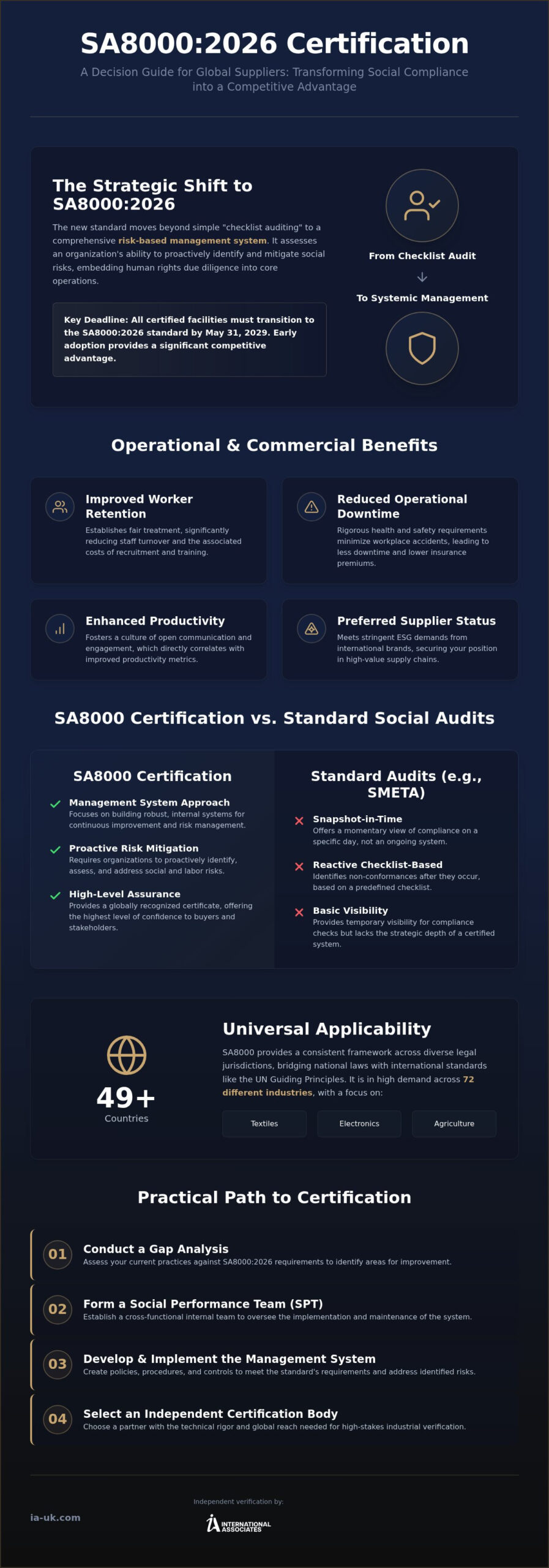
The publication of the SA8000:2026 standard on January 1, 2026, solidified its position as the premier framework for social management systems. It represents a fundamental shift from traditional “checklist auditing” to a model of systemic performance management. Under this revised standard, organizations are no longer evaluated solely on a snapshot of compliance. Instead, they’re assessed on their ability to proactively identify and mitigate social risks through a robust management system. This evolution ensures that the benefits of sa8000 certification extend beyond a simple certificate. It embeds social accountability into the core operational strategy of a business, making it a strategic asset rather than a reactive expense.
Meeting 2026 Regulatory and ESG Demands
The global regulatory landscape has become increasingly stringent, particularly with the full implementation of the EU Corporate Sustainability Due Diligence Directive (CSDDD). SA8000:2026 aligns directly with these requirements by emphasizing a risk-based, “Human Rights Due Diligence” model. Top-tier retailers and international brands now prioritize suppliers who can demonstrate verified ethical labor practices through independent, third-party certification. By adopting a management systems approach, suppliers secure a “preferred” status that one-off social audits don’t provide. While spot-check audits offer temporary visibility, a certified management system ensures continuous adherence to international standards. It provides the stability and confidence required by global buyers who must navigate complex ESG reporting requirements without friction.
The Universal Applicability of the Standard
SA8000 is currently utilized across 49 countries and 72 different industries. Demand is particularly high in sectors such as textiles, electronics, and agriculture, where value chain accountability is a critical commercial factor. One of the primary benefits of sa8000 certification is its ability to function effectively across diverse legal jurisdictions. It acts as a bridge between complex national laws and international human rights frameworks, such as the UN Guiding Principles and OECD Due Diligence Guidance. This universal applicability allows global suppliers to maintain a consistent standard of social performance regardless of their geographic location. International Associates leverages its global reach in social accountability audits to support organizations in navigating these localized challenges while maintaining international compliance. With a technical review team based at our Glasgow head office, we ensure that every audit reflects the high-level expertise and independence that the 2026 global market demands. Organizations should recognize that all certified facilities are required to complete their transition to the 2026 version by May 31, 2029, making early adoption a significant competitive advantage.
Operational and Commercial Benefits of SA8000
The operational advantages of implementing SA8000:2026 extend far beyond basic regulatory compliance. By embedding social accountability into the management structure, organizations realize tangible commercial gains that affect the bottom line. One of the primary benefits of sa8000 certification is the creation of a standardized social framework that streamlines multi-site operations and simplifies supply chain oversight. This unified approach replaces fragmented local policies with a globally recognized benchmark, allowing for more efficient resource allocation and risk management. It’s a strategic move that transforms social performance from a peripheral concern into a core operational strength.
Internal Efficiency and Worker Retention
Implementation of SA8000 standards establishes a baseline of fair treatment that directly correlates with significantly reduced staff turnover rates and a corresponding decrease in recruitment and training expenditures. Workplace stability is further enhanced through the standard’s protection of “Freedom of Association” and “Collective Bargaining.” These elements foster a culture of open communication, which often leads to higher employee engagement and improved productivity metrics. Additionally, the rigorous health and safety requirements embedded in the standard serve to minimize workplace accidents and health-related downtime. Organizations often find that these improvements lead to reduced insurance premiums and a lower exposure to legal liabilities, providing a clear return on investment for the certification process. When workers feel secure and respected, the resulting increase in operational output often offsets the costs of implementation.
Market Differentiation and Brand Protection
In a global economy where consumer and investor scrutiny is at an all-time high, SA8000 acts as a robust shield against the reputational damage associated with labor scandals. An independent, third-party verified social claim offers a level of credibility that self-reported audits cannot match. This verification becomes a powerful marketing tool, distinguishing your facility from competitors who may only offer vague promises of social responsibility. For many suppliers, this certification is a mandatory prerequisite for entering high-value markets in Europe and North America, where brands require verified proof of ethical labor practices. By integrating these social standards with other frameworks through International Associates management system certification, companies can develop a holistic approach to quality, environmental, and social governance. This integrated strategy not only protects the brand but also positions the organization as a reliable partner for top-tier international retailers. If you’re looking to strengthen your operational resilience, our technical team at the Glasgow head office can provide the independent oversight necessary to verify your social performance across your global network. This level of transparency is essential for securing long-term contracts with major apparel, electronics, and construction firms that prioritize ethical sourcing.
SA8000 vs. Alternatives: Decision Factors for Global Suppliers
Selecting the appropriate social compliance framework requires a technical understanding of the distinction between a point-in-time audit report and a management system certification. One of the primary benefits of sa8000 certification is its status as a formal, accredited standard that demands continuous systemic improvement. While many industry-led initiatives and buyer-specific schemes provide essential oversight for certain sectors, they often operate as voluntary reporting frameworks rather than independent, third-party certifications. For a global supplier, the decision rests on whether the objective is to fulfill a single buyer’s request or to establish a robust, cross-industry framework that satisfies the due diligence requirements of multiple international partners simultaneously.
Certification vs. Reporting Frameworks: Which Should You Choose?
It’s vital to distinguish between a certifiable standard and a social reporting framework. A certifiable standard requires an organization to implement a comprehensive social management system that is subject to regular, independent verification. In contrast, many popular social schemes function as membership-based platforms used to share audit reports. The decision factor for your business should be based on long-term stability and buyer expectations. If your partners require a verified system that proactively manages risk and identifies potential non-conformities before they occur, certification is the superior choice. If they only require a snapshot of workplace conditions at a specific point in time, a basic reporting audit might suffice. However, as global regulations shift toward mandatory human rights due diligence, a certified management system provides significantly more protection against the risks of value chain disruption.
Integrating Social Standards with ISO 45001 and ISO 9001
Operational efficiency is significantly enhanced when social accountability is integrated with existing quality and safety frameworks. The management system clauses in the 2026 standard mirror the High-Level Structure (HLS) utilized in ISO 9001 and ISO 45001. This alignment allows organizations to conduct integrated audits, which save substantial time and administrative costs by evaluating multiple standards during a single site visit. By synchronizing these processes, companies reduce the burden of redundant documentation and conflicting internal protocols. Managing these complex requirements through a single regulatory compliance partner ensures that all certifications remain technically sound and aligned with global expectations. International Associates Limited provides the independent verification necessary to maintain these integrated systems across diverse geographic locations. This methodical approach ensures that your social performance is as rigorous and predictable as your quality management, providing a unified front to international auditors and top-tier buyers who demand institutional reliability.
Practical Implementation: Achieving and Maintaining Compliance
The transition to the SA8000:2026 standard requires a methodical approach that prioritizes system integrity over simple compliance checklists. To realize the full benefits of sa8000 certification, an organization must move through a structured implementation roadmap. This process ensures that social accountability isn’t just an external requirement but a functional part of the management structure. Implementation follows five critical stages:
- Step 1: Conduct a comprehensive gap analysis against the nine social accountability elements to identify operational deficiencies.
- Step 2: Establish a Social Performance Team (SPT) comprising both management and worker representatives to drive internal change.
- Step 3: Implement formal Management System criteria, including a clear social policy, risk assessment protocols, and continuous monitoring procedures.
- Step 4: Engage workers and stakeholders in the verification process to ensure the system reflects workplace reality.
- Step 5: Select an accredited certification body to perform the formal independent audit.
Preparing for the Stage 1 and Stage 2 Audits
The certification process is divided into two distinct phases. During the Stage 1 audit, our technical team performs a thorough documentation review to ensure your management system meets the structural requirements of the standard. This phase identifies any systemic weaknesses before the on-site evaluation begins. The Stage 2 audit involves a rigorous on-site verification, where auditors observe facility conditions and conduct confidential worker interviews. These interviews are essential for verifying that the documented policies are actually practiced on the production floor. Common non-conformities often arise in areas like excessive overtime or incomplete health and safety records. Pre-empting these issues through internal reviews is vital for a successful outcome. Our Glasgow head office manages the technical review of these findings to ensure all assessments remain objective and reliable.
Training and Internal Capacity Building
Maintaining compliance between surveillance audits requires a high level of internal expertise. Organizations must invest in internal auditor training to ensure the Social Performance Team can identify risks before they escalate into non-conformities. Professional workshops and International Associates training services for lead auditors provide the technical knowledge needed to manage the system effectively. These courses help staff understand the nuances of the 2026 revision, including the shift toward risk-based due diligence. When your team is properly trained, the implementation timeline often accelerates, and the management system becomes more resilient. If you’re ready to begin your journey toward verified social accountability, you can request a formal audit proposal from our global team today. This proactive step ensures your facility remains aligned with international buyer expectations and the May 2029 full compliance deadline.
Choosing the Right Certification Body for Social Accountability
Selecting a certification body isn’t just a procedural step; it’s a strategic choice that impacts your brand’s global standing. While many entities offer social audits, only an accredited certification body provides the formal, independent verification required to realize the full commercial benefits of sa8000 certification. Global suppliers should prioritize partners who demonstrate a balance between worldwide operational capacity and specialized local knowledge in key manufacturing hubs. This dual approach ensures that audits are technically rigorous while remaining sensitive to regional legal contexts. It’s about finding a partner that provides stability in a shifting regulatory landscape.
Technical infrastructure also plays a vital role in your decision. Efficiency in certificate issuance is often a bottleneck in the supply chain, so it’s a core requirement for suppliers facing tight procurement deadlines. You need a partner capable of handling high-stakes certifications without unnecessary friction or delay.
The International Associates Advantage
International Associates provides a unique blend of institutional reliability and international reach. Our administrative base is located at our Glasgow head office, where a dedicated technical review team oversees the integrity of every assessment. This central oversight is supported by an expansive network of offices across Europe, Asia, and the Middle East, ensuring we can deploy specialized auditors to sensitive industrial sectors globally. We don’t just audit; we provide a bridge between complex global regulations and your specific business objectives.
Our advanced IT infrastructure allows for the efficient processing of social accountability audits, providing the rapid certificate turnaround times that modern supply chains demand. We maintain a strict focus on independent assurance, avoiding the conflicts of interest that can arise with consultancy-based services. This commitment to procedural integrity ensures your certification is recognized as a reliable indicator of ethical performance by international retailers and regulatory bodies alike. It’s this level of transparency that builds long-term trust with your global partners.
Next Steps: Securing Your 2026 Certification
Achieving compliance with the SA8000:2026 standard is a multi-year commitment to continuous improvement. Organizations should begin by requesting a formal quote for an Initial Certification Assessment, which establishes the baseline for your management system. Once certified, your facility enters a cycle of annual surveillance audits and a three-year recertification process. This regular oversight ensures that the benefits of sa8000 certification, such as improved worker retention and market differentiation, are sustained over the long term.
As the May 31, 2029, deadline for full transition to the revised standard approaches, early engagement is essential for maintaining uninterrupted market access. We invite you to contact International Associates for an SA8000 consultation to discuss your specific operational needs and regulatory requirements. Our team is prepared to act as the steady hand in your corporate compliance journey, ensuring your facility meets the highest international standards of social performance.
Securing Your Global Market Position in 2026
The transition to the SA8000:2026 standard is no longer optional for suppliers seeking to maintain top-tier status in a regulated global economy. By adopting this risk-based management model, your organization addresses the core requirements of modern human rights due diligence while simultaneously improving internal productivity and worker retention. One of the most significant benefits of sa8000 certification is the ability to demonstrate verified social performance to international brands through a single, globally recognized framework that supersedes fragmented audit reports.
International Associates provides the independent, UK-based verification necessary to validate these social claims. Our technical review team in Glasgow ensures every assessment meets rigorous standards of impartiality and professional integrity. With an expansive global network of regional offices and advanced IT infrastructure designed for quick certificate turnaround, we support your international growth without the friction of administrative delays. Taking this proactive step now ensures your facility is prepared for the May 2029 full compliance deadline and remains a preferred partner for ethical brands worldwide.
We’re ready to help you navigate these complex requirements with precision and confidence. Request a Quote for SA8000 Certification today to begin your journey toward verified social accountability.
Frequently Asked Questions
What are the 9 elements of the SA8000 standard?
The standard comprises nine core elements: child labor, forced or compulsory labor, health and safety, freedom of association and right to collective bargaining, discrimination, disciplinary practices, working hours, remuneration, and the management system. These elements provide a comprehensive framework for auditing social performance. It’s particularly critical to understand the management system element, as it ensures the other eight criteria are integrated into the organization’s daily operational procedures and long-term strategy.
How long does it take to achieve SA8000 certification in 2026?
Achieving certification typically requires six to twelve months, depending on the facility’s existing management system maturity. The process begins with a Stage 1 documentation review to identify gaps in the social performance framework. Following the resolution of any identified issues, a Stage 2 on-site audit is conducted to verify compliance through worker interviews and site inspections. The total duration doesn’t just depend on the audit itself but also on the organization’s ability to implement corrective actions.
Is SA8000 certification mandatory for global suppliers?
While SA8000 is a voluntary standard, it’s increasingly viewed as a commercial necessity for global suppliers. International brands often require independent verification of social compliance as a prerequisite for contract awards. The benefits of sa8000 certification include maintaining market access under new regulations like the EU CSDDD. In this context, certification serves as a vital tool for satisfying the rigorous due diligence requirements of top-tier buyers and securing a competitive advantage in crowded markets.
How much does an SA8000 audit cost for a medium-sized factory?
Certification costs are not fixed and vary based on the size, location, and industry of the facility. The primary factors influencing the total investment include the number of auditor-days required and the complexity of the supply chain being audited. These auditor-day requirements are determined by international accreditation guidelines to ensure a thorough assessment. Organizations don’t typically find a one-size-fits-all price; instead, they should request a formal proposal tailored to their specific operational scope.
Can SA8000 be integrated with ISO 9001 or ISO 45001 audits?
Integration with ISO 9001 or ISO 45001 is highly efficient because SA8000:2026 shares a similar management systems structure. Organizations can synchronize their social accountability audits with quality or safety assessments to reduce administrative overlap and minimize operational disruption. This integrated approach allows for a unified management system that addresses social performance, safety, and quality through a single set of protocols. It doesn’t just save time; it also reduces the total cost of the certification cycle.
What is the difference between SA8000 and a standard social audit?
The fundamental difference lies in the outcome and the level of verification. SA8000 is a certifiable management system standard that requires ongoing systemic performance and independent, third-party verification. A standard social audit often provides only a snapshot of workplace conditions at a specific point in time without requiring a functional management system. While a basic audit report may fulfill a single buyer’s request, SA8000 demonstrates a long-term commitment to a verified system that proactively identifies and mitigates social risks across the entire value chain.
How often are surveillance audits required for SA8000?
Surveillance audits are typically required every six or twelve months to ensure continuous compliance with the standard. These regular assessments verify that the social management system remains effective and that any non-conformities are addressed promptly. The specific frequency isn’t the same for every facility; it’s determined by the certification body based on the organization’s risk profile. A full recertification audit is mandatory every three years to maintain the validity of the certificate issued by International Associates Limited.
What are the main benefits of SA8000 for employees?
One of the primary benefits of sa8000 certification for workers is the establishment of a safe and healthy environment. Employees gain from protected rights regarding freedom of association and collective bargaining, ensuring their voices are heard in management decisions. The standard also guarantees fair remuneration and limits excessive overtime, which directly improves work-life balance. These protections foster a culture of respect and security, which doesn’t just improve morale but also enhances overall employee well-being and productivity.