

What if the annual reporting cycle wasn’t a period of administrative strain but a seamless validation of data already captured? For many industrial facilities, the transition to Higg FEM 4.0 in 2026 represents a shift toward more rigorous, data-driven transparency. While the higg fem remains the definitive holistic assessment for environmental performance, relying solely on an annual snapshot often leads to audit fatigue and data inaccuracies.
It’s understood that the pressure from international brands for real-time ESG transparency is accelerating, especially as global reporting mandates become more stringent. This guide provides a practical framework for choosing how to integrate Higg FDM and Higg FEM within your operations. You’ll discover how monthly quantitative tracking via the Facility Data Manager acts as a foundational engine for your annual verification. We’ll examine the specific decision factors that help you move from retrospective reporting to a proactive strategy that ensures regulatory adherence and operational efficiency throughout the 2026 cycle.
Key Takeaways
- Understand the operational distinction between the high-frequency Higg Facility Data Manager (FDM) and the comprehensive annual higg fem assessment to eliminate year-end reporting bottlenecks.
- Learn how to streamline the verification process by integrating real-time meter data and ERP systems into a structured monthly reporting cadence.
- Identify the specific triggers, such as facility complexity or evolving brand mandates, that necessitate a transition from annual snapshots to real-time transparency.
- Follow a practical implementation roadmap to map facility meters and establish internal accountability for consistent, verified data submission.
- Discover the strategic advantage of linking environmental performance data with social accountability standards like SA8000 and SLCP for a unified compliance strategy.
What is Higg FDM? The Shift to Real-Time Sustainability Data
The global manufacturing sector is undergoing a transition from retrospective environmental accounting to active performance management. At the center of this shift is the Higg Facility Data Manager (FDM), a high-frequency platform designed for monthly quantitative data collection. While the higg fem remains the industry standard for annual qualitative and quantitative assessment, it’s increasingly clear that once-a-year snapshots are insufficient for the 2026 regulatory environment. Global brands now require granular, verified data to mitigate supply chain risks and satisfy emerging transparency mandates.
FDM tracks specific, high-impact metrics including monthly energy consumption, water usage, waste generation, and wastewater quality. This continuous stream of information allows facilities to identify inefficiencies immediately rather than discovering them months later during a year-end audit. In 2026, compliance with the EU Corporate Sustainability Reporting Directive (CSRD) and the Corporate Sustainability Due Diligence Directive (CSDDD) demands this level of precision. Facilities must align their data strategies with regulatory compliance frameworks to maintain access to European markets. This approach supports the industry’s move toward the Foundational Environmental Performance (FEP) baseline announced by Cascale in May 2026.
FDM vs FEM: Understanding the Relationship
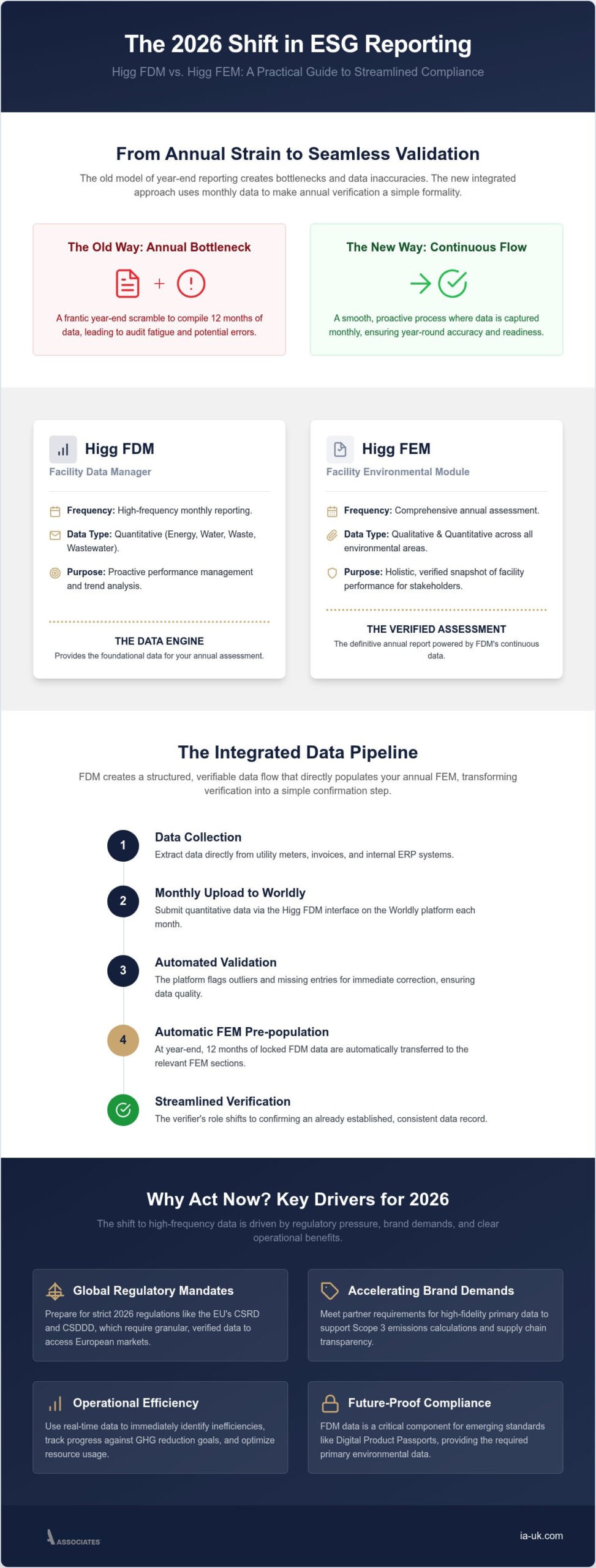
The Higg FDM acts as the quantitative data foundation for the annual higg fem assessment. Rather than scrambling to compile twelve months of utility bills and waste logs in January, facilities use FDM to record these figures as they occur. The Worldly platform facilitates an automatic data transfer mechanism at the end of the reporting cycle, prepopulating the relevant sections of the FEM module. This integration reduces audit fatigue by ensuring that data is collected once and verified throughout the year, making the final verification a streamlined formality.
The Role of Worldly and the Higg Index in 2026
Managed by Worldly, the exclusive technology host for the Higg Index, these tools align with the latest standards set by Cascale. In 2026, the focus has shifted toward interoperability and data quality. FDM data is now a critical component for Digital Product Passports, providing the primary environmental data needed to calculate a product’s footprint accurately. It’s no longer enough to offer vague claims; businesses need the technical infrastructure to provide granular evidence. By adopting these high-frequency tools, facilities position themselves as reliable partners in a global network that prioritizes institutional integrity and technical precision.
Technical Integration: How Higg FDM Streamlines Verification
Integrating facility meters and ERP systems directly into the Higg FDM platform transforms environmental reporting from a manual burden into a technical asset. Brands increasingly demand high-fidelity primary data to reduce the uncertainty of their Scope 3 emissions calculations. In response, Cascale released the latest version of its Higg Facility Environmental Module (Higg FEM), which emphasizes this synergy between monthly tracking and annual assessments. When data is validated monthly, the year-end verification process becomes a confirmation of existing records rather than a forensic investigation.
The validation process follows a logical sequence:
- Data is extracted from utility meters, invoices, or internal ERP systems.
- Information is uploaded to the Worldly platform via the FDM interface.
- Automated validation rules flag outliers or missing entries for immediate correction.
- Final monthly entries are locked, creating a permanent record for the verifier.
The role of third-party verifiers like International Associates Limited is central to this process. We ensure that the data flowing from these systems reflects operational reality. This independent oversight provides the global reliability brands seek. It’s a structured bridge that builds trust between manufacturing facilities and their international partners.
Monthly Monitoring and Target Setting
The FDM dashboard allows facilities to monitor real-time progress against Greenhouse Gas (GHG) reduction goals. By reviewing data monthly, managers can identify performance anomalies, such as unexpected spikes in water consumption or energy leaks, before they compromise the annual higg fem score. FDM empowers facility leaders to make mid-year strategy pivots based on precise consumption trends rather than waiting for annual summaries. The results are precise.
Preparing for Third-Party Data Validation
During the verification cycle, auditors scrutinize the consistency of monthly logs against supporting documentation. Manual tracking systems often suffer from data gaps or transcription errors that lead to verification failures. FDM solves these issues by providing a standardized, timestamped record of all inputs. For manufacturers seeking to ensure their data meets international standards, leveraging International Associates Limited Regulatory Compliance services provides the technical assurance needed for a successful audit.
Facilities can achieve higher levels of operational transparency by utilizing our expertise in energy management and verification.
Higg FDM Comparison: When Should Your Facility Upgrade?
Transitioning from the annual higg fem to a monthly FDM cadence is a strategic decision that depends on a facility’s operational complexity and regulatory exposure. For large-scale manufacturing sites, traditional spreadsheet-based environmental tracking is increasingly obsolete. Spreadsheet systems often lead to fragmented records and high error rates, which become liabilities during a formal audit. In contrast, the Facility Data Manager provides a centralized, technical repository that ensures data consistency across the Higg Index suite of tools. It’s a shift from passive accounting to active resource management.
Decision Factors for Manufacturers
The decision to adopt FDM often hinges on the facility’s internal capacity and its geographic market requirements. If your operations fall under strict EU or US ESG mandates, the granular, high-frequency data provided by FDM is essential for maintaining market access. Managing global supply chains via a centralized dashboard allows for the immediate identification of performance gaps. While monthly reporting requires a consistent time investment, it drastically reduces the intensive labor typically required for the annual higg fem verification cycle. Manufacturers must evaluate if their teams can sustain this monthly cadence to eliminate the high-stress “data crunch” that occurs every January.
Decision Factors for Brands and Retailers
For brands and retailers, the shift toward FDM is driven by a critical need for supply chain transparency and proactive risk management. By 2026, sustainability reports must rely on verified primary data to meet the expectations of investors and regulators. Brands use FDM to identify high-impact suppliers through real-time monitoring, which allows for rapid interventions when energy or water targets aren’t met. This verified primary data serves as a robust foundation for marketing claims, moving the narrative away from unreliable industry averages. Organizations seeking to align their supply chain with global standards often utilize regulatory compliance audits to validate these monthly submissions across diverse regions.
A cost-benefit analysis usually favors FDM for facilities with complex energy profiles or multiple production lines. While platform fees are a factor, the reduction in administrative man-hours during audit preparation is substantial. Facilities often discover that the cost of correcting errors found late in an annual cycle exceeds the investment in monthly tracking. This transition ensures that environmental data remains an active management tool rather than a passive reporting requirement. It provides the institutional reliability that defines modern corporate compliance.
How to Implement Higg FDM: A 2026 Implementation Roadmap
Implementation requires a methodical approach that prioritizes data hygiene before platform entry. Mapping facility meters to specific Higg parameters ensures that every kilowatt-hour and liter of water is accounted for accurately. This technical alignment is the first step toward a successful higg fem verification cycle. It’s a structured process that establishes the institutional reliability brands demand. Since facilities can begin posting their assessments as early as January 1, 2026, establishing this roadmap now is essential for timely compliance.
Phase 1: Internal Data Audit
Successful implementation begins with a retrospective review of all utility and waste records from the previous 12 months. This audit identifies data gaps and ensures that all meters are functioning within specified tolerances. Verification of calibration certificates is essential; uncalibrated meters lead to data rejection during final audits. Standardizing units of measure across different facility zones prevents conversion errors that frequently compromise reporting accuracy. Facilities must ensure that data sources are consistent and verifiable before any information is uploaded to the Worldly platform.
Phase 2: Platform Configuration and Onboarding
Once data hygiene is established, the focus shifts to platform configuration. Setting up distinct user roles for data entry and administrative approval creates an internal check and balance system. This structure is vital for linking the monthly FDM outputs to the annual higg fem module for seamless data transfer. Technical competency is the final pillar of this phase. Many organizations discover that existing staff lack the specialized knowledge required for complex environmental reporting. Consulting with International Associates training teams ensures that your personnel have the necessary skills to manage the platform interface and perform data entry without error.
Establishing a monthly reporting cadence is the final step in the roadmap. Facilities must appoint a dedicated sustainability lead to ensure data is captured by the 5th of each month. Accountability is maintained through a structured internal dashboard that mirrors the Worldly interface. Before the first live submission, conduct a final data quality review to cross-reference platform inputs against physical invoices. This rigorous process minimizes the risk of non-compliance. Consult with our experts for specialized training on Higg Index tools to ensure your facility remains compliant throughout the 2026 reporting cycle.
The Future of Compliance: Linking FDM to Social Accountability
Environmental performance and social responsibility are no longer viewed as separate silos in the 2026 regulatory environment. Global brands and regulators now demand a unified oversight model where quantitative environmental data from the FDM provides a foundation for qualitative social findings. This convergence is driven by the realization that operational efficiency and worker welfare are deeply interconnected. When a facility demonstrates meticulous resource management, it often reflects a broader culture of institutional discipline that extends to its social accountability standards. International Associates facilitates this transition by providing a technical bridge between environmental verification and social auditing, ensuring a consistent level of global reliability.
Synergy with SA8000 and Social Audits
Resource efficiency data captured via the FDM has a direct impact on worker health and safety, which is a core pillar of ISO 45001. For example, anomalies in wastewater management or energy leaks often signal underlying maintenance failures that can compromise the safety of the workplace environment. By integrating these technical data points into Social Accountability Audits, verifiers can cross-reference physical operational data with worker interviews to build a more accurate risk profile. This holistic approach is detailed further in our SA8000 Social Accountability Audit guide. It’s a method that replaces fragmented reporting with a comprehensive narrative of facility integrity, which is essential for maintaining stakeholder trust.
Preparing for a Holistic Audit Cycle
The most efficient strategy for 2026 involves scheduling the annual higg fem verification to coincide with social and quality management audits. Utilizing a single certification body for all global standards eliminates the redundancy of hosting multiple auditing teams and ensures that data is interpreted through a consistent technical lens. This unified approach allows for the discovery of synergies that separate audits might miss, such as how energy-saving initiatives from the higg fem action plan contribute to improved ventilation and worker comfort. It’s a methodical way to streamline compliance while reinforcing the facility’s commitment to international legal frameworks.
Facilities that adopt this integrated model are better positioned to respond to the high-stakes transparency requirements of modern supply chains. The result is a robust, verified record of performance that satisfies both environmental and social mandates simultaneously. To begin aligning your facility with these global expectations, the next step is requesting a Higg Index verification quote. Our global network of professionals is prepared to help you navigate these complex regulatory landscapes with precision and confidence.
Optimizing Your Sustainability Data Strategy for 2026
The transition toward real-time environmental data represents a permanent shift in how manufacturing facilities demonstrate institutional reliability. By moving away from retrospective accounting and adopting the monthly cadence of Higg FDM, businesses can eliminate the administrative strain of the annual higg fem cycle. This strategic integration ensures that data isn’t just a reporting requirement but a continuous management tool that identifies inefficiencies and tracks progress against global ESG mandates.
As a Glasgow-based authority with worldwide operational capacity, International Associates provides the technical oversight needed to bridge the gap between environmental metrics and social accountability standards like SA8000. Our accredited global verifiers apply a methodical approach to ensure your data meets the highest international legal frameworks. Ensure your Higg FDM data is audit-ready with International Associates to maintain a competitive advantage in an increasingly transparent global market. Establishing this foundation today secures your facility’s long-term growth and regulatory compliance. We’re prepared to support your journey toward verified excellence.
Frequently Asked Questions
What is the main difference between Higg FDM and Higg FEM?
Higg FDM focuses on high-frequency, quantitative data collection performed monthly, while the higg fem is a comprehensive annual assessment. FDM tracks specific operational metrics like energy and water consumption. In contrast, the FEM evaluates broader environmental management systems, chemical usage, and qualitative performance. Utilizing FDM throughout the year creates a robust data foundation that simplifies the year-end reporting process. It ensures quantitative figures are already organized for the final audit.
Is Higg FDM mandatory for all manufacturers in 2026?
FDM isn’t a universal requirement for all manufacturers in 2026, but its adoption is rapidly becoming a commercial necessity. Many global brands now mandate monthly tracking to satisfy their own ESG reporting obligations. Facilities operating within European markets find that FDM provides the granular data needed for CSRD compliance. While Cascale hasn’t made it compulsory for every facility, the shift toward real-time transparency means those without it face increased scrutiny from international partners.
How does FDM help with the Higg FEM verification process?
FDM streamlines the higg fem verification process by prepopulating the quantitative sections of the annual module. This automation reduces the administrative burden typically associated with the January reporting cycle. Because data is entered and validated monthly, verifiers spend less time investigating discrepancies and more time confirming established records. It’s a proactive approach that significantly reduces the risk of scoring errors and ensures that the final verification is a formal confirmation of operational reality.
Can Higg FDM data be used for CSRD or other EU regulations?
High-frequency FDM data is a critical asset for complying with the EU Corporate Sustainability Reporting Directive (CSRD) and other global mandates. These regulations require companies to provide verified, primary data regarding their supply chain’s environmental impact. FDM offers the precise monthly metrics needed to calculate Scope 3 emissions and resource depletion accurately. By moving away from industry averages and utilizing site-specific data, organizations can meet the rigorous transparency standards expected by European regulators and investors.
Do I need a third-party auditor to validate my FDM data?
Formal FDM validation is on the Cascale roadmap but isn’t yet a mandatory component of the official verification program. However, many facilities utilize third-party assurance providers like International Associates to validate their monthly entries. This independent oversight ensures data integrity and builds long-term trust with brand partners. Obtaining regular validation prevents the accumulation of errors that could compromise your annual assessment score, providing a layer of institutional security throughout the reporting year.
Can I integrate my existing energy management software with Higg FDM?
The Worldly platform is designed to facilitate technical integration with existing facility meters and ERP systems. Facilities can utilize API connections or bulk upload features to transfer data directly into the FDM interface. This technical synergy eliminates the errors associated with manual data entry and ensures that reporting remains consistent with internal management records. Implementing these integrations allows your sustainability team to focus on performance analysis rather than administrative tasks, enhancing overall operational efficiency.
What happens if I miss a monthly data entry in FDM?
Missing a monthly entry in FDM creates data gaps that can negatively impact your annual performance metrics. These omissions often trigger automated validation flags on the Worldly platform, signaling potential inconsistencies to your brand partners. Incomplete monthly records complicate the annual verification process, as auditors must then perform manual reconciliations for the missing periods. It’s essential to maintain a strict monthly cadence to ensure your final environmental footprint is accurate and defensible during a formal audit.
How do I transition from manual spreadsheets to Higg FDM?
Transitioning from manual spreadsheets requires a methodical audit of your current data sources and meter accuracy. You must map your existing internal records to the specific parameters defined within the Higg Index tools. Once the initial data hygiene is complete, establish clear user roles on the Worldly platform to manage data entry and internal approval. Establishing a formal monthly reporting schedule ensures accountability and prevents the data bottlenecks that typically occur when relying on fragmented, spreadsheet-based tracking systems.