
The 2026 revision of the SA8000 standard marks a fundamental shift from simple checklist auditing to a sophisticated, risk-based management system. While many organizations view social compliance as a static requirement, the most resilient firms treat it as a strategic pillar for global reliability. You’re likely facing the administrative pressure of the SA8000:2026 transition while simultaneously evaluating whether alternatives like SMETA, WRAP, or SLCP offer a more efficient fit for your specific supply chain needs.
This guide provides the technical clarity required to navigate the sa8000 social accountability audit process with professional precision. We’ve developed a clear decision framework to help you choose the right standard and manage the certification timeline effectively. We’ll examine the critical differences between leading audit methodologies and outline a streamlined path to achieving the SA8000:2026 certification. This approach ensures your business remains a trusted guardian of international labor standards while maintaining operational stability throughout the verification process.
Key Takeaways
- Understand the shift from snapshot audits to continuous management systems to manage the transition to the SA8000:2026 standard effectively.
- Compare SA8000 certification against SMETA and WRAP to determine which framework aligns with your specific industry requirements and validity needs.
- Implement the nine performance criteria of an sa8000 social accountability audit to address complex challenges like modern slavery and recruitment fee remediation.
- Follow a structured implementation guide to conduct gap analyses and establish Social Performance Teams that facilitate worker-management dialogue.
- Leverage a global network of independent expertise to transform social compliance into a verified asset for brand transparency and stakeholder trust.
The Evolution of Social Accountability: Why SA8000 Matters in 2026
The SA8000 standard remains the most authoritative global framework for organizations seeking to demonstrate ethical labor practices. Rooted in International Labour Organization (ILO) conventions and United Nations declarations, it provides a structured methodology for protecting worker rights across diverse industrial sectors. The landscape has shifted significantly as we move through 2026. Regulatory authorities and global retailers no longer view social compliance as an optional badge; it is now a fundamental requirement for market access. Executing an sa8000 social accountability audit allows businesses to move beyond static, point-in-time compliance and adopt a model of continuous social performance management.
This evolution is driven by the increasing enforcement of global ESG regulations, such as the EU Corporate Sustainability Due Diligence Directive (CSDDD). These frameworks mandate that companies identify and mitigate human rights risks throughout their entire value chain. Organizations that fail to implement a verified management system risk exclusion from high-value contracts with Western retailers. By contrast, those that maintain a rigorous, independently verified standard of accountability establish themselves as reliable partners in a sensitive and highly regulated global economy.
SA8000:2026 vs. Previous Versions
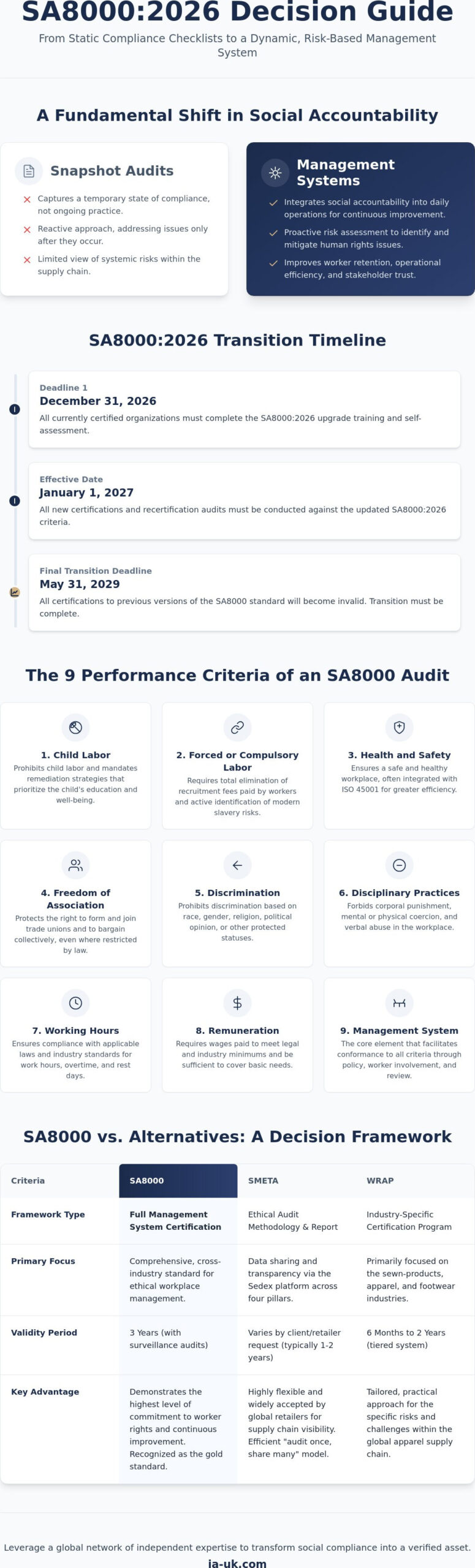
The 2026 revision introduces a more sophisticated emphasis on worker involvement and proactive risk assessment compared to the 2014 version. Organizations currently holding certification have until May 31, 2029, to complete their transition, but the administrative requirements begin much sooner. All certified entities must complete the 2026 upgrade training and self-assessment by December 31, 2026. International Associates Limited provides the technical oversight necessary to navigate these deadlines, ensuring that new certifications and recertifications from January 1, 2027, meet the updated criteria without operational ambiguity.
The Business Case for Management System Certification
Adopting a management system framework offers a distinct commercial advantage over the traditional compliance checklist. While a checklist only captures a temporary state, a management system certification ensures that social accountability is integrated into daily operations. This structured approach leads to improved worker retention and greater operational efficiency by reducing the frequency of workplace grievances. For a detailed analysis of how these standards function within a broader compliance strategy, consult the Social Accountability Audits: The Definitive Global Guide for 2026. This transition is a strategic necessity for firms aiming to maintain stability and institutional weight in the modern supply chain.
The 9 Performance Criteria of an SA8000 Social Accountability Audit
An sa8000 social accountability audit evaluates an organization against nine distinct performance criteria. These benchmarks ensure that social responsibility is not a secondary consideration but a core operational function. The first criterion, child labor, extends beyond simple age verification. It mandates the implementation of remediation strategies that prioritize the child’s education and well-being if non-conformities are discovered. Similarly, requirements regarding forced or compulsory labor now place a heavy emphasis on identifying modern slavery risks and the total elimination of recruitment fees paid by workers.
Occupational health and safety remains a foundational pillar of the standard. Organizations often find significant administrative efficiency by integrating these requirements with existing ISO 45001 certification frameworks. This alignment reduces redundancy while ensuring a safe, verified working environment. The standard also protects the freedom of association and the right to collective bargaining. It ensures that worker representation is respected even in jurisdictions where local law may be restrictive or ambiguous.
Discrimination, disciplinary practices, and working hours form the remaining operational criteria. The 2026 standard requires a sophisticated balance between local statutory limits and international benchmarks. For example, while local laws might permit extensive overtime, SA8000 maintains strict thresholds to prevent worker fatigue and ensure ethical treatment. Establishing these controls is a specialized task. You can explore our specific approach to social accountability audits to see how these criteria are verified during a formal inspection.
Wages and Remuneration in 2026
The Management System Element: The Core of SA8000
SA8000 vs. Alternative Frameworks: Choosing the Right Social Audit
Procurement managers must distinguish between a management system certification and a standard audit report when evaluating supply chain partners. An sa8000 social accountability audit results in a formal three-year certification cycle, which is maintained through periodic surveillance visits. This structure differs from platform-based audit methodologies that generate reports for data-sharing purposes. While those reports provide immediate snapshots for retail databases, they typically require annual renewals. In contrast, the SA8000 framework establishes a permanent internal management system that reduces the administrative burden of repetitive, year-on-year inspections.
The choice between these standards depends on the required level of institutional weight and buyer acceptance. SA8000 is recognized globally across all industrial verticals, making it a versatile asset for hardware, food, and manufacturing suppliers. Platform-driven reports are often sufficient for consumer goods retail, but they don’t always provide the same level of long-term risk mitigation. For businesses operating in high-stakes environments, the rigorous verification process offered by International Associates Limited ensures a more stable foundation for global reliability and stakeholder trust.
When to Prioritize SA8000 Over Reporting Platforms
Organizations with complex, high-risk operations find that a formal certificate offers a superior competitive advantage over simple data-sharing methodologies. SA8000 is particularly valuable when a business needs to prove its regulatory compliance to investors or government bodies. It provides a verified assurance that social performance is managed through a structured system rather than a series of annual snapshots. Suppliers who are simultaneously managing platform-based assessments should also consider understanding a SMETA audit report to effectively prioritize corrective actions and align their compliance strategy across both frameworks. For organizations evaluating how SLCP verification compares to SMETA and SA8000 certification in terms of audit fatigue reduction and data convergence, a structured framework comparison is an essential first step. This approach is ideal for firms seeking to minimize the cost of multiple audits while maintaining a high standard of social accountability.
Industry-Specific Considerations
In the electronics and manufacturing sectors, SA8000 is often the preferred choice due to its technical rigor and ability to integrate with ISO 9001 quality management systems. Apparel and textile firms must navigate a landscape of sector-specific manufacturing standards and industry-led convergence programs. However, SA8000 remains the only standard that transforms social performance into a scalable management system recognized across every industrial vertical. This versatility ensures that International Associates Limited can help a single facility satisfy the diverse requirements of a worldwide client base through one comprehensive certification cycle.
Preparing for Your SA8000 Audit: A Step-by-Step Implementation Guide
Preparation for an sa8000 social accountability audit begins with a rigorous gap analysis. This technical review identifies specific non-conformities against the SA8000:2026 standard before the formal assessment occurs. A central requirement for the 2026 version is the establishment of a Social Performance Team (SPT). This team facilitates a continuous worker-management dialogue, ensuring that social performance is a shared responsibility rather than a top-down mandate. Effective implementation requires policies and procedures that reflect actual site conditions, moving beyond generic templates to site-specific risk management.
Internal auditing serves as the final verification of system effectiveness. This process allows the SPT to identify and remediate weaknesses in a controlled environment. By the time the external certification body arrives, the management system should be fully operational and supported by comprehensive records. If you’re seeking to verify your current readiness, you can book a social accountability audit with our expert team to begin the formal certification process.
Stage 1 and Stage 2 Audit Expectations
The certification process is divided into two distinct stages. Stage 1 is a technical review of documentation. Auditors assess whether the system’s design meets the standard’s requirements and determine the organization’s readiness for the full assessment. Stage 2 is the on-site performance evaluation. During this phase, auditors conduct worker interviews and verify site conditions. A “no-blame” approach is strictly maintained during these interviews to protect worker confidentiality and ensure the impartiality of the findings. This ensures the final report accurately reflects the institutional reality of the workplace.
Common Non-Conformities and How to Avoid Them
Technical discrepancies often occur within working hour records and health and safety documentation. These areas require meticulous attention to detail, as inconsistent record-keeping can lead to major non-conformities. Investing in professional training for internal auditors is a strategic step to prevent these avoidable errors. For organizations looking to build deeper auditing competency, exploring lead auditor training courses for 2026 can equip your team with the advanced technical skills needed to manage complex risk assessments and documentation requirements with precision. This training equips your team to handle complex risk assessments and documentation requirements with precision. Following the audit, any identified non-conformities must be addressed through a formal corrective action plan. The timeline for closing these actions is strictly governed by the certification body to ensure that improvements are both immediate and sustainable.
Global Certification Excellence with International Associates Limited
International Associates Limited operates as a meticulous guardian of international standards. We provide the steady hand required to manage complex corporate compliance. Our global network of expert auditors is supported by a modern IT infrastructure designed to handle the high-stakes requirements of the 2026 revision. By maintaining a central administrative base in Glasgow while deploying professionals through local international offices, International Associates Limited provides a unique blend of institutional reliability and worldwide operational capacity. This structure ensures that every sa8000 social accountability audit is conducted with a deep understanding of regional nuances alongside a strict adherence to global benchmarks.
Independence and impartiality remain the foundational pillars of our verification services. We recognize that stakeholder trust isn’t granted; it’s earned through rigorous, objective assessment. Our auditing process avoids unnecessary friction. It focuses on providing clear, technical insights that support your organization’s international growth. This objective approach ensures that your certification serves as a verified asset rather than just a regulatory requirement. International Associates Limited prioritizes precision. Our team handles high-stakes certifications for sensitive industrial sectors with quiet, earned confidence.
Integrated Auditing Solutions
Efficiency in the certification cycle is achieved through our integrated auditing model. By combining the SA8000 audit with other standards such as ISO 9001, ISO 14001, or ISO 45001, organizations significantly reduce audit fatigue and administrative costs. Our management system certification services are designed to streamline the verification process. We utilize advanced IT systems to manage documentation and performance data. This holistic approach ensures that your social, environmental, and quality management systems function as a single, cohesive framework. It’s a strategic move for scalable growth.
Your Partner in Global Compliance
The value of a certificate depends entirely on the accreditation and reputation of the issuing body. The status and memberships held by International Associates Limited ensure that your certification receives global recognition across all industrial sectors and regulatory jurisdictions. We provide a tailored initial assessment to identify your specific needs and prepare your team for the formal certification cycle. This methodical approach ensures a predictable path to compliance without compromising the technical rigor required by international law. Contact International Associates Limited today for your SA8000 audit quote to secure your position as a leader in ethical supply chain management.
Securing Your Strategic Advantage in Social Accountability
Navigating the transition to the SA8000:2026 standard requires a methodical approach that prioritizes long-term institutional reliability over temporary compliance snapshots. By implementing a robust management system, your organization transforms ethical requirements into a scalable asset that satisfies the most rigorous global ESG regulations. Whether you’re comparing frameworks or preparing for a technical assessment, the objective remains the same: building stakeholder trust through verified, independent oversight.
International Associates provides the global expertise and SAI accreditation necessary to lead your business through a successful sa8000 social accountability audit. From our Glasgow head office to our expansive network of international offices, we offer integrated ISO and social compliance assessments that reduce administrative friction and audit fatigue. Our team ensures that your certification process is handled with meticulous precision, providing the steady hand needed in the current complex regulatory landscape.
Take the next step in verifying your supply chain transparency and enhancing your brand reputation. Request a formal SA8000 certification quote from International Associates to begin your implementation journey. We look forward to supporting your international growth through ethical excellence and professional auditing standards.
Frequently Asked Questions
What is the difference between an SA8000 audit and a SEDEX SMETA audit?
SA8000 is a certifiable management system standard that requires organizations to implement permanent internal controls, whereas SMETA is an audit methodology that results in a report shared via the Sedex platform. SA8000 involves a three-year certification cycle with periodic surveillance. SMETA focuses primarily on data sharing for retail compliance and doesn’t grant a formal certificate of conformity. Suppliers navigating both methodologies will benefit from understanding a SMETA audit report to effectively interpret findings and manage corrective actions across their compliance programs.
How long does the SA8000 certification process typically take?
The certification timeline typically spans three to six months, depending on the organization’s current readiness and the complexity of its operations. This period includes the initial gap analysis, system implementation, and the completion of both Stage 1 and Stage 2 audits. Efficient documentation management and Social Performance Team engagement are critical factors in meeting this schedule.
Can a small business achieve SA8000 certification, or is it only for large factories?
SA8000 certification is applicable to organizations of all sizes, including small and medium-sized enterprises. The standard’s requirements are scalable, focusing on the effectiveness of the management system rather than the total number of employees. Small businesses often benefit from increased operational efficiency and improved access to high-value international contracts.
What are the major changes in the SA8000:2026 standard revision?
The 2026 revision introduces a stronger emphasis on risk-based management systems and enhanced worker-management dialogue. Key updates include more stringent requirements for grievance mechanisms and the proactive identification of human rights risks within the value chain. Organizations must transition to this new standard by May 31, 2029, to maintain their certified status.
How much does an SA8000 social accountability audit cost?
The cost of an sa8000 social accountability audit is determined by the accredited certification body based on the facility’s size, location, and industrial complexity. While fixed fees apply to mandatory SAI training and self-assessments, audit day rates vary according to regional market conditions. Organizations should request a formal quote that accounts for both the initial assessment and the subsequent surveillance cycle.
Is SA8000 certification mandatory for exporting to the EU or UK?
Certification isn’t legally mandatory for export, but it’s frequently required by major Western retailers to satisfy corporate sustainability due diligence directives. Implementing an sa8000 social accountability audit helps organizations demonstrate compliance with the EU CSDDD and UK modern slavery legislation. It serves as a verified assurance of ethical practice for international procurement managers.
How often are surveillance audits required after initial certification?
Surveillance audits are typically conducted every six to twelve months following the successful completion of the initial certification. These periodic inspections ensure that the management system remains effective and continues to meet the standard’s performance criteria. A full recertification audit is required every three years to renew the certificate’s validity.
Does SA8000 cover the entire supply chain or just the certified site?
The SA8000 certificate applies specifically to the individual site or organization that’s been audited and certified. However, the standard requires certified entities to evaluate and monitor the social performance of their own suppliers and subcontractors. This ensures that accountability principles extend throughout the immediate value chain, even if those suppliers aren’t individually certified.