

The traditional hierarchy of tiered social audits has been replaced by a more streamlined, rigorous approach to global supply chain integrity. While many factory managers previously focused on ascending from Silver to Platinum status, the landscape for 2026 now centers on a unified annual validation. Achieving a WRAP certification is no longer about chasing a specific metal tier; it’s about demonstrating consistent, high-level adherence to twelve core principles that international retailers demand for market access.
It’s understandable if you feel overwhelmed by audit fatigue or the fear of a zero-tolerance issue leading to sudden decertification. You need a clear, predictable path that secures your standing with global brands without the friction of redundant paperwork or ambiguous requirements. This guide provides a technical breakdown of the 2026 compliance requirements, comparing the current unified certificate against alternative frameworks to help you make an informed strategic investment. You’ll learn how to navigate the audit process efficiently, identify potential risks before they become non-conformities, and position your facility as a reliable, ethical partner in the international marketplace.
Key Takeaways
- Understand the 2026 transition to a unified annual Certificate of Compliance and how the discontinuation of tiered levels affects your current standing.
- Evaluate the strategic benefits of WRAP certification versus SA8000 and SEDEX to select the most effective audit for your specific export markets.
- Identify the core requirements of the 12 Principles to prevent zero-tolerance issues that could lead to immediate decertification or loss of retailer trust.
- Learn how to utilize the Pre-Audit Self-Assessment to identify compliance gaps early and ensure a successful audit with zero non-conformities.
- Discover methods to integrate social accountability standards into your existing management systems for improved operational efficiency and global reliability.
What is WRAP Certification and Why is it Essential in 2026?
Worldwide Responsible Accredited Production (WRAP) is an independent, non-profit organization that monitors and certifies lawful, humane, and ethical manufacturing globally. It’s the world’s largest certification program specifically dedicated to the apparel, footwear, and sewn products sectors. In an era where supply chain transparency is a legal requirement rather than a voluntary choice, achieving a WRAP certification demonstrates a facility’s commitment to twelve fundamental principles of social responsibility.
The year 2026 represents a critical juncture for manufacturers. As of March 1, 2026, the program transitioned to a unified Certificate of Compliance, valid for one year. This shift reflects an industry-wide move toward annual due diligence and alignment with emerging ESG reporting standards. For factory owners, this means social compliance is no longer a static achievement but a continuous process of verification and improvement. It’s a strategic tool for risk mitigation that protects both the brand and the manufacturer from the fallout of labor violations.
The Apparel Industry Standard for Social Compliance
Unlike generic ISO standards that focus on broad management processes, WRAP is tailored to the specific risks inherent in the textile and footwear industries. It addresses unique challenges such as work hour limits and health and safety within high-intensity production environments. Independent, third-party verification is the cornerstone of this process. It ensures that audits are objective and free from the bias that internal assessments often carry. By focusing on the “sewn products” category, the standard provides a level of technical depth that multi-sector audits sometimes lack.
Core Benefits for Manufacturers and Retailers
The primary business case for WRAP certification is market access. Major retailers in the United States and Europe often mandate this specific audit as a prerequisite for partnership. By adhering to a globally recognized standard, facilities avoid the audit fatigue caused by redundant inspections from multiple buyers. This consolidation of standards allows management to focus on production rather than constant preparation for different audit formats.
- Access to high-tier international retailers who prioritize ethical sourcing.
- Enhanced operational efficiency through better worker retention and lower accident rates.
- Mitigation of legal risks associated with supply chain transparency legislation.
- Improved factory safety metrics that reduce long-term insurance and liability costs.
Utilizing specialized social accountability audits allows manufacturers to streamline their compliance efforts. This structured approach builds trust with global brands while ensuring the factory remains competitive in an increasingly regulated landscape. It’s the steady hand needed to bridge the gap between complex global regulations and day-to-day industrial operations.
The 12 Principles of WRAP: A Compliance Framework for 2026
The 12 Principles of WRAP form the technical foundation of the audit process. These standards are derived from International Labour Organization (ILO) conventions and mandate strict adherence to local laws and workplace regulations. For a facility to maintain its WRAP certification in 2026, it must demonstrate total compliance across these pillars, as even a single zero-tolerance violation can lead to immediate failure. This framework ensures that every aspect of the manufacturing process, from the hiring of personnel to the final shipment of goods, meets high-level ethical benchmarks.
Labour and Human Rights Requirements
Effective social compliance begins with transparent record-keeping and a culture of accountability. Auditors prioritize the verification of Principle 5 (Compensation and Benefits) and Principle 6 (Hours of Work) to ensure employees receive at least the legal minimum wage and all mandatory social insurance contributions. Timekeeping records are cross-referenced with production logs and electrical usage data to detect discrepancies in reported overtime or off-the-clock work. Freedom of association and collective bargaining rights are also scrutinized to ensure workers can communicate grievances to management without fear of retaliation or discrimination. Regarding the prohibition of harassment or abuse, auditors define this as any physical, sexual, psychological, or verbal conduct intended to intimidate, demean, or coerce a worker within the factory environment.
Operational and Environmental Principles
The framework extends beyond human rights to address the physical security and ecological footprint of the facility. Principles 11 and 12 focus on customs compliance and security, aligning closely with C-TPAT requirements to facilitate smoother international logistics and prevent unauthorized cargo from entering the supply chain. In 2026, there’s an increased emphasis on Principle 10, which governs environmental impact. Auditors now look for sophisticated chemical management systems and documented waste reduction targets that align with global sustainability goals. Health and safety (Principle 8) remains a critical focus, requiring rigorous inspections of fire safety equipment, chemical storage, and personal protective equipment usage.
Integrating these ethical standards into your existing Management System Certification creates a more resilient operational structure. This holistic approach ensures that social compliance isn’t a siloed activity but a core component of your quality and environmental management. If you’re preparing for an upcoming inspection, scheduling professional social accountability audits can help identify hidden gaps in your documentation before an official assessment occurs. This proactive strategy is the most reliable way to maintain your status as an approved global supplier.
Silver, Gold, or Platinum? Choosing Your Certification Level
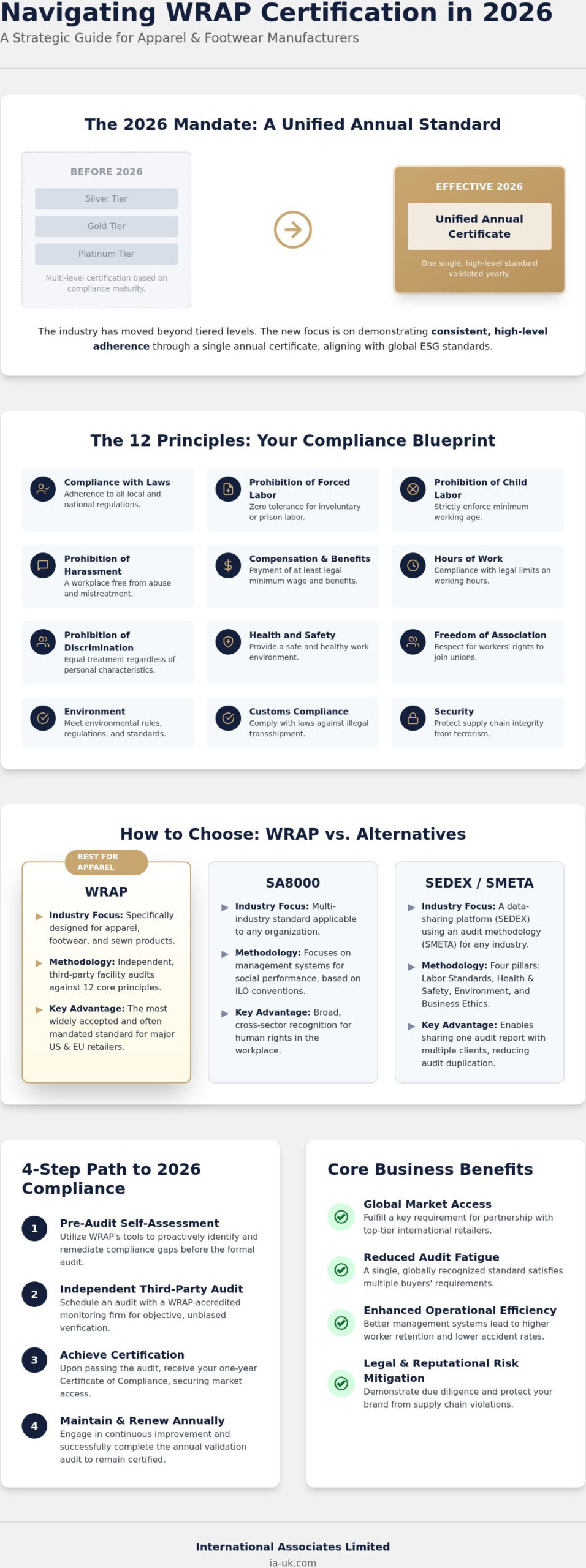
The landscape of WRAP certification underwent a fundamental structural revision on March 1, 2026. The historical hierarchy of Silver, Gold, and Platinum certificates has been superseded by a unified “Certificate of Compliance” to align with global ESG reporting requirements and supply chain legislation. This consolidation ensures a standardized level of social accountability across the apparel and footwear sectors, requiring all certified facilities to undergo an audit every twelve months. While the tiered nomenclature has changed, the rigorous performance standards associated with these levels continue to influence how international retailers evaluate factory risk profiles.
Previously, the Silver level was utilized for facilities demonstrating compliance with most principles but requiring minor improvements, while Gold represented the standard one-year certification. Platinum was reserved for factories achieving full compliance for three consecutive years. Although these tiered labels are no longer issued for new audits, the legacy of these categories remains relevant for factories transitioning their existing credentials to the 2026 unified standard.
Platinum vs Gold: Performance and Duration
Under the 2026 framework, the two-year validity period formerly associated with Platinum status has been discontinued in favor of a universal one-year cycle. This shift mandates annual verification for all facilities, regardless of their historical performance. Despite this change, the “Platinum” benchmark of three consecutive years of zero-non-conformity remains a critical metric for elite manufacturers. Maintaining this level of consistency requires a sophisticated internal management system to identify and rectify potential issues before an auditor arrives. Zero-tolerance failures, such as evidence of forced labor, child labor, or unethical recruitment practices, lead to immediate decertification and a mandatory waiting period before a facility can re-apply for the program.
How to Choose the Right Level for Your Business
Strategic planning in 2026 focuses on management system maturity rather than selecting a specific certificate tier. Factories that previously operated at the Silver level must now implement more robust tracking and documentation to meet the higher baseline of the annual unified certificate. It’s essential to evaluate your current operations against the twelve principles to determine if you’re prepared for the rigor of an annual cycle. Many high-tier retailers still prioritize facilities that can demonstrate a multi-year track record of excellence, effectively treating those factories as “Platinum-equivalent” partners in their sourcing hierarchy.
International Associates acts as a steady hand for manufacturers navigating these regulatory shifts. By conducting regular social accountability audits, we help you identify hidden gaps in your compliance framework. This proactive approach ensures your facility maintains its certified status without the disruption of corrective action plans or failed inspections. Our global network of professionals provides the independent verification necessary to secure your position in the international supply chain.
WRAP vs SA8000 vs SEDEX: Best Social Audit for Your Factory
Selecting the appropriate social audit requires a strategic analysis of your buyer portfolio and geographic targets. While WRAP certification remains the premier standard for the global apparel and footwear industry, manufacturers often face pressure to adopt multiple frameworks. Understanding the technical distinctions between WRAP, SEDEX, and the SA8000 Social Accountability Audit is essential for minimizing audit fatigue and maximizing your compliance ROI in 2026. Each standard serves a specific function in the global supply chain, and choosing the wrong path can lead to redundant costs without improving market access.
SEDEX/SMETA vs WRAP: The Apparel Manufacturer’s Dilemma
SEDEX is not a certification body but a membership organization that provides a platform for sharing audit data through the SMETA methodology. The primary differentiator is that a SMETA audit produces a descriptive data report for buyer review on a shared platform, whereas a WRAP audit results in a formal, facility-level certification of compliance. This distinction is critical for your internal planning. A SMETA report allows multiple buyers to view your results, which is highly efficient for factories serving diverse European retailers. However, a WRAP certification provides a definitive “pass” or “fail” status that is often preferred by US-based brands due to its rigorous, sector-specific focus and alignment with customs security protocols. While some retailers on the SEDEX platform accept WRAP audits to satisfy their due diligence requirements, you must verify this with each buyer to avoid the need for a second, separate SMETA inspection.
Decision Factors: Choosing Your Compliance Path
Your choice should be dictated by where your goods are sold and the maturity of your management systems. WRAP offers a higher ROI for apparel-focused factories because its 12 principles are specifically calibrated for textile production risks, such as high-volume labor management and specific chemical usage. In contrast, SA8000 is a multi-sector standard that focuses heavily on management system processes and requires a three-year certification cycle with periodic surveillance audits. For broader context on how these frameworks interact, you should consult the Social Accountability Definitive Guide. In 2026, the most successful manufacturers are those who integrate these requirements into a single, cohesive strategy rather than treating each audit as an isolated event.
Efficiency gains are achieved through integrated Social Accountability Audits that address the overlapping requirements of different standards. This holistic approach reduces operational downtime and administrative costs while providing the transparency that modern brands demand. If you’re ready to streamline your compliance efforts and secure your standing in the global market, you can request a professional compliance assessment from our global network of experts today.
The WRAP Certification Process: 2026 Implementation Roadmap
Achieving a WRAP certification requires a methodical approach that begins long before the auditor arrives on site. A facility has a maximum of six months from the date of registration to successfully complete the audit process. Failure to meet this timeline necessitates re-registration and the payment of additional fees. The process is structured into five distinct phases designed to ensure that management systems are robust enough to maintain compliance throughout the annual certification cycle.
The journey starts with the online application and the selection of an accredited monitoring firm. This is followed by the Pre-Audit Self-Assessment (PASA), where the factory evaluates its own operations against the 12 Principles. After the PASA is submitted, an unannounced or semi-announced on-site audit is conducted to verify these claims. If non-conformities are identified, a Corrective Action Plan (CAP) must be implemented and verified before the WRAP Review Board issues the official Certificate of Compliance and lists the facility in its global database.
Navigating the 2026 Fee Structure
The registration fees paid directly to WRAP are now tiered based on the facility’s workforce size. This structure is intended to make the program accessible to smaller manufacturers while reflecting the administrative complexity of larger operations. It’s important to note that these figures do not include the separate fees charged by accredited monitoring firms for the actual audit performance and associated travel expenses.
- Small Facilities (Up to 100 workers): US $650 registration fee.
- Medium Facilities (101 to 200 workers): US $950 registration fee.
- Large Facilities (201 to 1,000 workers): US $1,350 registration fee.
- Enterprise Facilities (1,001+ workers): US $1,550 registration fee.
Preparing for the Audit: Critical Success Factors
The PASA phase is the most frequent point of failure for factories. Many facilities struggle with inconsistent payroll records or inadequate health and safety documentation, which leads to costly delays. Investing in Professional Training for your internal compliance team ensures that they understand how to identify these gaps before the formal inspection occurs. Common non-conformities often center on Principle 5 (Compensation and Benefits) and Principle 6 (Hours of Work), where discrepancies between timecards and production logs can trigger a failed audit.
International Associates serves as a steady hand throughout this complex journey. Our global network of specialists provides the independent verification necessary to ensure your factory is fully prepared for the rigors of the 2026 standards. By utilizing our social accountability audits as a preparatory tool, you can identify hidden risks and implement corrective actions proactively. This disciplined approach minimizes the risk of decertification and secures your facility’s reputation as a reliable partner in the international supply chain.
Future-Proofing Your Factory Compliance Strategy
The transition to the 2026 unified annual certificate marks a significant shift toward continuous due diligence. Successfully maintaining a WRAP certification now depends on a factory’s ability to integrate the 12 principles into its daily operational management rather than treating audits as periodic events. By selecting the audit framework that best aligns with your primary export markets and buyer requirements, you can eliminate redundant inspections and focus on sustainable growth. It’s no longer just about passing a test; it’s about building a culture of transparency that global retailers trust.
International Associates stands as your steady partner in this evolving regulatory landscape. Headquartered in Glasgow with an expansive global auditing network, we provide the expertise of accredited social accountability specialists. Our advanced IT infrastructure enables a rapid certification turnaround, ensuring your facility remains compliant without unnecessary delays. Secure Your Global Supply Chain with WRAP Certification from International Associates. Taking these proactive steps today will secure your position as a trusted, ethical leader in the global apparel supply chain.
Frequently Asked Questions
How much does WRAP certification cost in 2026?
The 2026 registration fees are tiered based on worker count: $650 for up to 100 workers, $950 for 101 to 200, $1,350 for 201 to 1,000, and $1,550 for facilities with over 1,001 workers. These fees are paid directly to WRAP and don’t include the costs of the audit monitoring firm or travel expenses. Budgeting for a WRAP certification must account for both the administrative registration and the independent verification costs.
What is the difference between Gold and Platinum WRAP certification?
Effective March 1, 2026, WRAP discontinued its tiered Silver, Gold, and Platinum levels in favor of a unified Certificate of Compliance. All facilities that successfully pass the audit now receive a standardized certificate valid for one year. This change aligns the program with global ESG standards and ensures that all certified factories meet the same high-level requirements regardless of their historical performance or previous tier status.
How long does the WRAP certification process take from application to award?
A facility has a maximum of six months from the date of registration to successfully complete the entire audit and evaluation process. The actual duration depends on the factory’s readiness and the availability of the accredited monitoring firm. If the process isn’t finalized within this six-month window, the facility must re-register and pay the administrative fees again. Thorough preparation during the self-assessment phase is essential to avoid delays.
Can a WRAP certificate be used for multiple factory sites?
Certification is awarded on a facility-by-facility basis and cannot be transferred between different factory sites or shared across a corporate group. Each production unit must undergo its own independent audit to verify compliance with the 12 Principles. This site-specific approach ensures that the labor conditions, safety protocols, and environmental standards are verified for the exact physical location where the apparel or footwear is manufactured for international brands.
What are the zero-tolerance issues that lead to immediate decertification?
Zero-tolerance issues include the presence of forced labor, child labor, human trafficking, or physical abuse within the facility. Other critical violations involve unethical recruitment practices, such as charging workers recruitment fees, or providing false documentation to auditors. Detection of these issues leads to immediate decertification and a mandatory waiting period. These rigorous standards are designed to maintain the integrity of the WRAP certification and protect the global supply chain.
Is WRAP certification mandatory for selling apparel in the US?
While WRAP is not a legal requirement for importing apparel into the United States, it is a commercial necessity for accessing high-tier US retailers. Many major brands mandate this specific certification as a prerequisite for their suppliers to ensure ethical sourcing and mitigate brand risk. It serves as a critical market-access tool that demonstrates a facility’s commitment to international labor standards and workplace safety in a highly competitive sector.
How do I transfer my WRAP audit to a different monitoring firm?
You can change your accredited monitoring firm by submitting a formal request through the WRAP platform during the registration or renewal process. It’s important to select a firm that offers a global reach and deep technical expertise in social accountability audits. International Associates serves as an independent specialist capable of conducting these assessments, providing the steady hand needed to navigate the transition between different auditing bodies while maintaining continuous certification status.
Does WRAP certification satisfy the requirements for the EU Due Diligence Act?
WRAP certification provides a robust framework that supports compliance with the EU Corporate Sustainability Due Diligence Directive (CSDDD), but it doesn’t offer an automatic safe harbor. The unified annual audit cycle introduced in 2026 aligns with the directive’s requirement for continuous supply chain monitoring. Manufacturers should use their certification as a foundational element of their broader ESG reporting and risk management strategy to meet the technical demands of European legislation.