

With the global halal economy projected to reach $3.4 trillion by the end of 2026, compliance is no longer a niche preference but a fundamental requirement for global market access. You’re likely aware that maintaining supply chain integrity is becoming more complex as international standards like GSO 2055-1:2026 and OIC/SMIIC 1:2019 continue to evolve. The persistent fear of cross-contamination or traceability gaps is a valid concern for any quality manager overseeing high-stakes production lines. This guide provides a professional roadmap to mastering halal food certification requirements, ensuring your business remains audit-ready and compliant across multiple jurisdictions. We’ll examine the technical differences between global standards, provide a framework for choosing an accredited certification body, and show you how to integrate these protocols into your existing ISO 22000:2018 systems. By the end of this guide, you’ll have the technical clarity needed to manage complex regulatory landscapes without unnecessary friction or operational ambiguity.
Key Takeaways
- Identify and verify hidden “Mashbooh” (doubtful) substances and non-Halal animal derivatives in additives to ensure total upstream supply chain integrity.
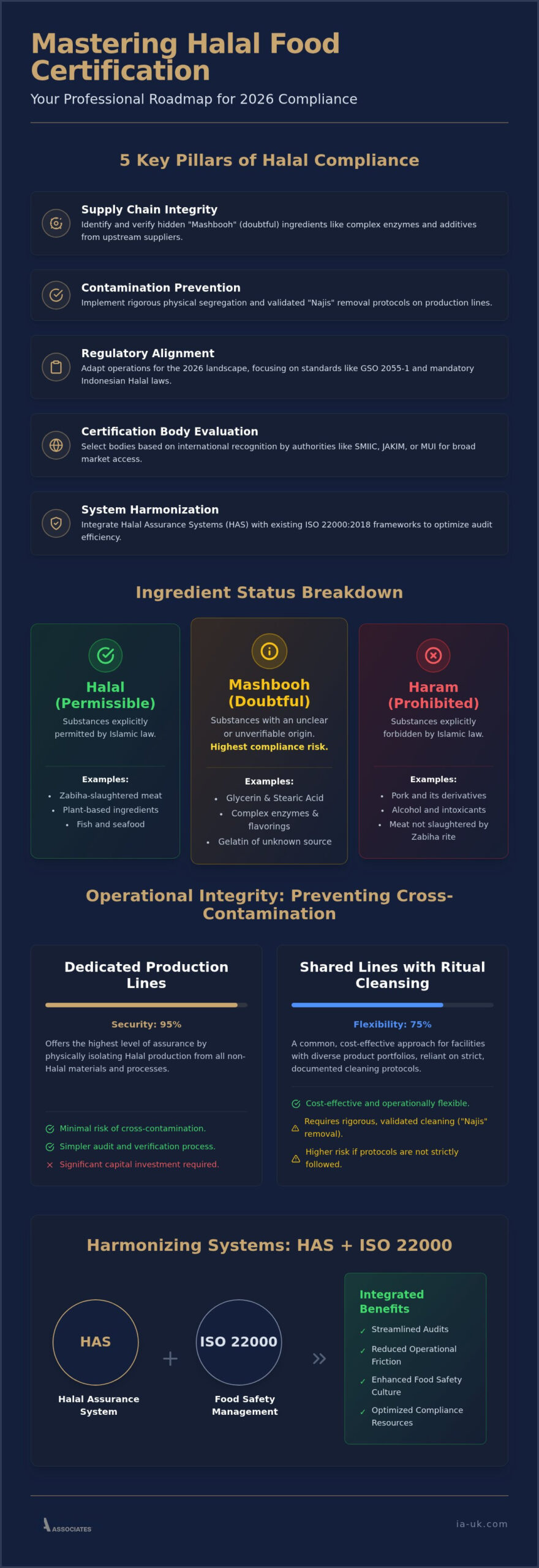
- Implement rigorous physical segregation and cleaning protocols to mitigate cross-contamination risks and meet strict “Najis” removal standards during production.
- Navigate the 2026 regulatory landscape by aligning your operations with updated halal food certification requirements such as GSO 2055-1 and the mandatory Indonesian regime.
- Evaluate certification bodies based on their international recognition by authorities like SMIIC, JAKIM, or MUI to facilitate seamless market access across the Middle East and Asia.
- Harmonize Halal Assurance Systems (HAS) with existing ISO 22000:2018 food safety frameworks to optimize audit efficiency and reduce redundant operational friction.
Core Dietary Requirements: Permissible vs. Prohibited Substances
In a 2026 manufacturing context, Halal compliance is defined as a rigorous management system ensuring all raw materials, additives, and processes align with Islamic dietary laws. It’s no longer sufficient to merely exclude pork or alcohol; modern standards like OIC/SMIIC 1:2019 demand absolute transparency across the entire supply chain. When assessing halal food certification requirements, your primary focus must be on the distinction between Halal (permissible), Haram (prohibited), and Mashbooh (doubtful).
Mashbooh ingredients present the highest risk for modern food processors. These are substances where the origin is unclear, such as complex flavorings, enzymes, or stabilizers. In 2026, verification requires more than a simple declaration; it necessitates technical data sheets that confirm the source of every derivative. For instance, glycerin and stearic acid are frequently Mashbooh because they can be derived from either vegetable or animal fats. If the origin is animal-based, the substance remains Haram unless the animal was slaughtered according to Zabiha rites. Similarly, ethanol levels are strictly scrutinized. While naturally occurring ethanol in fruit juices is often permitted within specific limits, added ethanol as a solvent in flavor extraction must meet the technical thresholds set by regional standards like GSO 2055-1:2026.
Ingredient Sourcing and Traceability
Establishing a robust supplier verification program is a non-negotiable step for audit readiness. Every additive, enzyme, and processing aid must be accompanied by a valid Halal certificate from an accredited body. Complex supply chains often hide non-Halal ingredients within “natural flavors” or “processing aids” that don’t appear on the final label. Your internal regulatory compliance team must map these hidden risks, ensuring that no cross-contact occurs at the supplier level. This level of scrutiny is essential for maintaining the integrity of the Halal Assurance System (HAS).
The Slaughter Act and Meat Sourcing
For meat-based products, the requirements for Zabiha are specific and technical. The slaughter must be performed by a sane Muslim, involve a sharp instrument to ensure a swift incision of the jugular vein and carotid artery, and include the invocation of the name of Allah (Bismillah). Humane treatment of the animal prior to slaughter is a mandatory component of the ethical framework. Verification involves more than checking a label; it requires confirming the slaughterhouse’s accreditation by recognized global bodies. For imported meat, you must ensure the chain of custody remains unbroken from the point of slaughter to your production facility, as any gap in documentation can invalidate the Halal status of the entire batch.
Operational Requirements: Preventing Cross-Contamination
Operational integrity forms the technical foundation of any Halal Assurance System. For businesses looking to meet 2026 halal food certification requirements, the primary challenge lies in the physical and procedural mitigation of cross-contamination. This involves a strategic choice between investing in dedicated production lines or implementing rigorous, validated cleaning protocols to remove “Najis” (impurities). While dedicated lines offer the highest level of security, many facilities successfully utilize shared equipment supported by ritual cleansing procedures that are verified through forensic-level documentation.
Physical segregation must extend beyond the production floor. Raw materials and finished goods require clearly defined storage zones to prevent accidental contact with non-Halal items. This is particularly critical in multi-user warehouses or logistics hubs where the risk of airborne or contact contamination is elevated. Managing these complexities is a core part of The Halal Certification Process, which demands verifiable evidence of segregation at every touchpoint of the supply chain.
Employee awareness is equally vital to maintaining standards. Technical staff and floor workers must understand that Halal integrity is a technical quality parameter, not just a religious one. Regular training ensures that personnel can identify potential risks, from shared personal protective equipment (PPE) to the accidental use of non-approved lubricants. For organizations seeking a holistic approach to factory standards, integrating these protocols with social accountability audits creates a more robust and ethical operational environment that satisfies both regulatory and ethical benchmarks.
Cleaning and Sanitization (Ritual Cleansing)
Ritual cleansing, or “Sertu,” is required when a production line transitions from handling heavy impurities to Halal production. This process involves specific washing steps that must be documented and often witnessed by a competent Halal officer. Cleaning agents must be verified to ensure they don’t contain animal-derived surfactants or prohibited alcohols. Validation through ATP testing or similar technical methodologies provides the objective proof required during a 2026 audit process.
Facility Layout and Dedicated Equipment
Designing a production flow to minimize contamination requires a meticulous assessment of airborne particles and shared utilities. Dedicated tools and color-coded utensils are standard requirements for preventing tool-swapping between lines. You should also evaluate shared water, steam, and air filtration systems. These can act as vectors for cross-contamination if they’re not properly managed through high-performance filtration or physical barriers that isolate Halal-compliant production zones.
The Halal Certification Process: Audit Readiness in 2026
Securing a certificate is a methodical four-step procedure designed to verify that every aspect of your operation aligns with halal food certification requirements. In 2026, the emphasis has shifted from simple inspections to a deep technical verification of the entire management system. The process begins with an application and a comprehensive technical documentation review. During this phase, the certification body evaluates your ingredient lists, raw material specifications, and supplier certificates to ensure they meet the foundational Core Dietary Requirements before proceeding to the physical inspection.
The second stage involves an on-site audit. This is a physical verification where auditors inspect production lines, storage facilities, and personnel practices to confirm that the documented Halal Assurance System (HAS) is being correctly implemented. Once the audit is complete, the findings undergo a technical review by an independent committee. This separation of duties ensures that the final decision is objective and free from auditor bias. If the committee is satisfied, the Halal certificate is issued. However, compliance isn’t a one-time event; annual surveillance audits are mandatory to ensure that standards don’t slip between certification cycles.
Critical Documentation for the Audit
Your HAS manual is the central pillar of audit readiness. It must clearly define your Halal policy, the composition of your internal Halal committee, and your procedures for managing non-compliant products. Auditors will scrutinize production logs and cleaning records to verify that no cross-contamination occurred during transitions. Additionally, you must maintain an organized database of current Halal certificates for every raw material. Since personnel competency is a frequent focus, keeping updated training records is essential for proving that your staff understands the technical nuances of Halal integrity.
Common Non-Conformities and How to Avoid Them
The primary reason for audit failure remains a lack of robust supplier documentation. If a single additive lacks a valid certificate from an accredited body, the entire product line can be disqualified. Another frequent issue is the gap in staff knowledge; employees on the factory floor must be able to explain the specific protocols they follow to prevent contamination. Finally, inadequate labeling in shared warehouses often leads to non-conformities. You can avoid this by implementing clear, color-coded identification systems that distinguish Halal-certified goods from non-certified inventory at every stage of storage and transit.
How to Choose a Halal Certification Body: Decision Factors
Selecting a certification body is a strategic decision that directly impacts your facility’s ability to enter specific international markets. While many organizations offer auditing services, only those with recognized accreditations provide the legal standing required for customs clearance in high-stakes regions. You must verify that a potential partner aligns with the specific halal food certification requirements of your target destination, whether that involves the SMIIC framework for OIC countries, JAKIM for Malaysia, or MUI for the Indonesian market.
Efficiency is a critical differentiator in modern supply chain management. Businesses don’t have the luxury of long lead times associated with traditional, manual auditing processes. We utilize an advanced IT infrastructure to streamline data collection and documentation review, which facilitates a faster certificate turnaround without compromising the rigor of the assessment. This technical capability is a hallmark of global reliability. Before finalizing your choice, review Our Accreditations to ensure the necessary jurisdictional coverage for your specific operations.
Global Recognition and Market Access
Market access is largely determined by the “Mutual Recognition Agreements” (MRAs) held by your certification body. If you’re targeting the GCC region, your auditor must demonstrate compliance with GSO 2055-1:2026 standards. Without these specific recognitions, your products might face rejection at the border despite meeting all other technical quality benchmarks. Choosing an auditor with a global network ensures that your certification is respected across diverse regulatory landscapes. For a detailed breakdown of these regional nuances, consult the Halal Certification: The Definitive Buying Guide for Global Businesses in 2026.
Technical Competence and Professionalism
The value of an audit lies in the technical competence of the auditing team. A professional body employs experts who possess a dual mastery of Islamic jurisprudence and food science. This ensures that complex chemical additives or biotechnology-derived ingredients are assessed with precision. Independent, third-party verification builds essential trust with global stakeholders and consumers alike. Transparency in fee structures and the methodical management of the certification cycle prevents unexpected operational friction. Our global network of professionals acts as a sophisticated bridge between complex regulations and your business goals. If you require a steady hand to manage your compliance journey, explore our Halal certification services to get started.
Integrating Halal with ISO 22000 Food Safety Systems
Treating Halal compliance as a siloed requirement often creates redundant paperwork and operational friction. For businesses aiming to meet 2026 halal food certification requirements, the most efficient path involves harmonizing the Halal Assurance System (HAS) with ISO 22000:2018. Because both frameworks utilize the same High Level Structure (HLS), they share foundational elements like leadership commitment, resource management, and corrective actions. This systemic alignment allows you to manage Halal parameters through the same rigorous risk-assessment lens applied to your core food safety protocols.
The integration doesn’t require a separate management hierarchy. It’s most effective at the level of Prerequisite Programs (PRPs). Your existing ISO 22000 procedures for supplier approval and allergen control can be expanded to include Halal verification without necessitating a total system overhaul. By embedding Halal checkpoints into your unified quality manual, you ensure that supply chain integrity is maintained as a standard operational procedure rather than an ad-hoc check. This approach builds a more resilient system that’s less prone to the documentation gaps often found in fragmented organizations.
Streamlining the Audit Process
Integrated audits for management system certification offer a sophisticated way to reduce the total audit duration and administrative burden. When you combine assessments for ISO 9001, ISO 22000, and Halal, you minimize the disruption to your production schedule and eliminate duplicate verification of shared controls. Our ISO 9001: The Comprehensive Guide to Quality Management Systems in 2026 details how these foundational standards create the necessary organizational discipline to support high-stakes technical certifications.
Building Long-Term Stakeholder Trust
Certification serves as a technical benchmark that transcends simple dietary compliance. It functions as a powerful driver for ethical branding and market differentiation in high-growth regions. As the global halal economy continues its rapid expansion, the ability to demonstrate audited compliance through a recognized third party is essential for securing long-term stakeholder confidence. This commitment to transparency aligns perfectly with broader Corporate Social Responsibility (CSR) goals, positioning your brand as a leader in ethical manufacturing. Secure your global market share with International Associates Limited Halal Certification.
Securing Your Global Market Access in 2026
Choosing a certification body with the right global recognitions is the final step in unlocking sensitive markets in the Middle East and Southeast Asia. International Associates Limited provides a sophisticated bridge between complex regulations and your operational goals. For entrepreneurs looking to further optimize their entry into the UAE market, you can check out Ventureprise Acquisitions for strategic consultancy on operational excellence. As a UKAS accredited certification body with a global network of expert auditors, we’re specialists in high-stakes technical sectors. Our advanced IT infrastructure ensures an efficient audit process and rapid certificate turnaround, allowing you to focus on international growth with confidence.
Beyond operational certification, maintaining financial integrity is vital for long-term success in the Middle East; Bin Hamad Mathew Joseph and Associates Chartered Accountants provides the expert auditing and accounting services necessary for businesses to remain fully compliant in the Dubai market.
Is Halal certification mandatory for exporting food to the Middle East?
Halal certification is mandatory for the majority of food products exported to the Middle East, particularly within the Gulf Cooperation Council (GCC) member states. Regulatory authorities in these regions require valid certificates from accredited bodies as a condition for customs clearance. This ensures all imported goods comply with GSO 2055-1:2026 standards. Failure to provide this documentation results in immediate shipment rejection at the border, making certification a critical prerequisite for market entry.
How long does the Halal certification process typically take?
The duration of the certification process typically ranges from one to three months, depending on the complexity of your supply chain and production facility. This timeline accounts for the initial technical documentation review, the scheduling of on-site audits, and the final review by an independent technical committee. Organizations with well-documented Halal Assurance Systems (HAS) often experience faster turnaround times. We utilize advanced IT infrastructure to streamline these stages and ensure efficient auditing processes for our global clients.
Can we use the same production line for Halal and non-Halal products?
You can utilize shared production lines for both Halal and non-Halal products provided that rigorous ritual cleansing protocols are strictly followed. This process, known as Sertu, involves deep sanitization to remove all traces of non-permissible substances before Halal production begins. Auditors require verifiable evidence of these cleaning cycles, including witnessed logs and chemical validation. While dedicated lines are the preferred industry benchmark for risk mitigation, shared lines remain compliant under high-level supervision and documentation.
What is the difference between Halal and Haram in food manufacturing?
In a manufacturing context, Halal refers to substances and processes that are permissible under Islamic law, while Haram denotes prohibited items. Haram substances include pork, blood, intoxicants, and derivatives from animals not slaughtered according to Zabiha rites. Compliance requires that halal food certification requirements are met by excluding these substances and preventing cross-contact with Haram materials. Mashbooh, or doubtful items, must be treated as Haram until their origin is technically verified through documentation.
Does Halal certification expire, and how often are surveillance audits required?
Halal certificates typically remain valid for one year, although some jurisdictions may issue them for longer periods within a three-year certification cycle. Annual surveillance audits are mandatory to verify that your facility maintains the standards established during the initial assessment. These recurring inspections ensure continued adherence to halal food certification requirements and identify any changes in your supply chain or personnel that could compromise integrity. Recertification is required before the current certificate expires to prevent market access gaps.
What are the specific requirements for Halal labeling on packaging?
Halal labeling must feature the official logo of the accredited certification body that conducted the audit. For products exported to specific markets like Indonesia, you must use the mandatory BPJPH “Gunungan” logo by the October 17, 2026 deadline. The label should be clearly visible, non-erasable, and placed on the primary packaging. It serves as a technical verification mark for both customs officials and consumers, indicating that the product has passed independent third-party assessment.
How does Halal certification differ from Kosher certification?
Halal and Kosher certifications are distinct systems based on different religious frameworks and technical standards. While both prohibit pork, Halal standards strictly forbid all forms of intoxicants, including ethanol used in flavorings, which may be permitted in Kosher production. Additionally, the specific invocation and slaughtering methods differ between the two. Because their requirements aren’t identical, a Kosher certificate isn’t a substitute for Halal certification when entering Muslim-majority markets; each requires its own independent verification process.
What qualifications must a Halal internal auditor possess?
A Halal internal auditor must possess a thorough understanding of international Halal standards, such as SMIIC or GSO, alongside proficiency in management system auditing techniques. They should have completed professional training to identify potential cross-contamination risks and evaluate supplier documentation. Qualifications often include a background in food science or quality assurance. We provide accredited Lead Auditor training to ensure that internal teams have the specialized technical expertise required to maintain a robust Halal Assurance System between external audits.