
Will your internal audit program survive an unannounced third-party inspection in 2026, or is it merely a checklist exercise that fails to identify systemic risks? Many organizations find that their internal auditor training doesn’t bridge the gap between basic compliance and the rigorous oversight required for international standards like ISO 9001 or SA8000. It’s a common challenge to distinguish between the foundational skills needed for internal checks and the advanced competencies required for lead auditor roles. Wasting resources on non-accredited courses often leads to management systems that fail under scrutiny from global certification bodies.
International Associates Limited understands that professional competency is the cornerstone of global reliability. This guide provides a methodical framework for selecting the right course to ensure your team can conduct audits that pass the most stringent verification processes. We’ll examine how to evaluate accreditation, choose between specialized standards, and align your training with the strategic goals of your organization. By following this decision-maker’s guide, you’ll secure the expertise necessary to improve management system performance and maintain a steady hand in corporate compliance throughout 2026.
Key Takeaways
- Distinguish between 2-day internal workshops and 5-day lead auditor intensives to select the most appropriate qualification for your professional role.
- Learn to verify training accreditation and tutor seniority to ensure your internal auditor training results in a certificate that carries global weight.
- Match your professional development to specific industry standards, such as ISO 13485 or SA8000, for precise regulatory adherence.
- Shift from basic checklist verification to risk-based performance assessments to meet the heightened auditing expectations of 2026.
- Discover why training with an active certification body like International Associates Limited provides a more practical bridge to successful management system certification.
The Strategic Importance of Internal Auditor Training in 2026
Internal auditor training represents the formal qualification process through which personnel learn to verify the effectiveness of management systems against international standards. In 2026, the global regulatory environment has moved beyond simple administrative checklists. Organizations now require a risk-based performance assessment that evaluates the actual resilience of a business rather than just its documentation. This transition demands a higher level of technical proficiency. Professionals who undergo rigorous internal auditor training are better equipped to identify latent vulnerabilities before they escalate into systemic failures.
Maintaining Management System Certification requires a sustained commitment to internal oversight. Without structured training, audit findings often remain superficial, failing to provide the objective evidence needed for third-party verification. High-quality training reduces the likelihood of major non-conformities during external assessments by ensuring that internal teams apply the same level of scrutiny as a certification body. This proactive approach protects the organization’s standing in the international market.
The Internal Auditor as a Guardian of Compliance
Effective auditing bridges the gap between high-level corporate policy and daily operational reality. It ensures that the procedures written in a boardroom are actually followed on the factory floor or in the regional office. The internal auditor serves as the critical first line of defense in regulatory compliance. By providing this internal layer of verification, organizations build deep stakeholder trust and ensure transparency across complex, global supply chains. To understand the broader scope of the profession, many decision-makers first research what is internal auditing to align their training goals with corporate governance standards.
Adapting to the 2026 Auditing Landscape
The current year has seen a significant rise in hybrid and remote auditing techniques. Globalized economies require auditors who can navigate digital environments without losing the depth of a physical inspection. Modern internal auditor training now incorporates advanced IT infrastructure to support real-time data verification and evidence gathering. This technological shift allows for a more methodical and data-driven approach to auditing. Teams must also prepare for updated ISO and social accountability requirements that emphasize environmental and ethical governance. Professional training ensures that your staff remains current with these evolving legal frameworks, providing a steady hand in an increasingly complex regulatory world.
Internal Auditor vs. Lead Auditor: Which Course is Right for You?
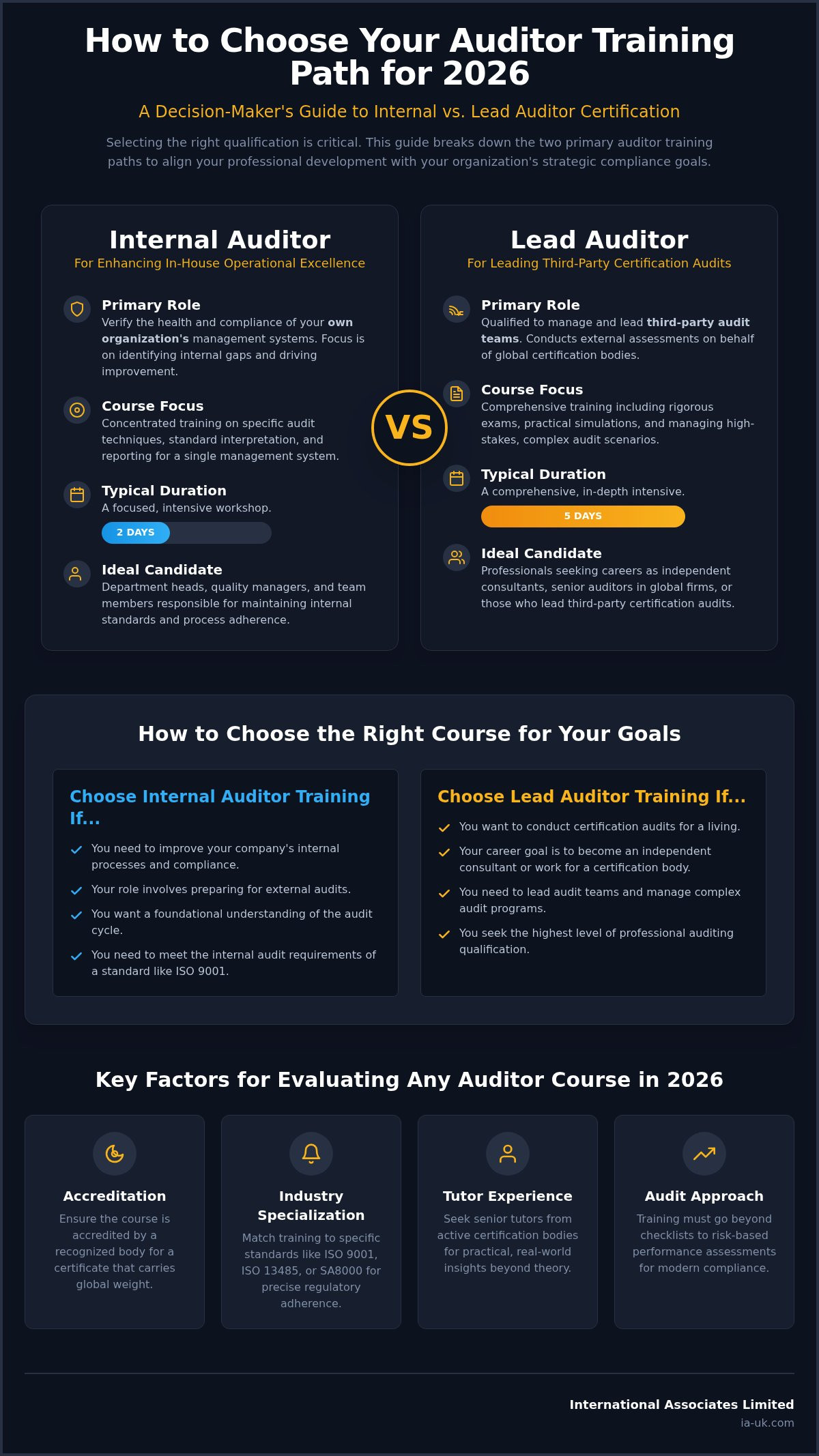
Deciding between these two professional paths requires a clear understanding of your long-term career objectives. Internal auditor training is designed for professionals who verify the internal health of their own organization’s management systems. This role focuses on identifying gaps and ensuring that internal processes align with established standards. Conversely, a lead auditor is qualified to manage third-party audit teams and conduct external assessments on behalf of global certification bodies. It’s a distinction that defines whether your influence remains within your company or extends across the international industrial landscape.
The investment in time and intensity varies significantly between these tracks. Internal workshops typically span 2 days; they provide a concentrated focus on audit techniques and standard interpretation for those working within a single management system. Lead auditor courses are 5-day intensives that include rigorous examinations and practical simulations of complex, high-stakes audit scenarios. While the lead auditor path requires a greater initial commitment, it offers a high career ROI for those seeking to work as independent consultants or within global auditing firms. For many, internal auditor training serves as the essential prerequisite for these advanced certifications, allowing professionals to build a foundational understanding of the audit cycle before tackling the challenges of managing a multi-disciplinary team.
Choosing Your Path: Internal Audit for Operational Excellence
This path is ideally suited for department heads, quality managers, and coordinators responsible for maintaining daily compliance. The primary objective is process improvement and the implementation of effective corrective actions that prevent non-conformities. By focusing on internal excellence, these professionals ensure their organization remains audit-ready at all times. If you find that your career goals extend beyond internal oversight, you should consult our guide on Lead Auditor Training to explore external verification roles.
The Lead Auditor Path: Independence and Global Verification
Achieving lead auditor status is a requirement for anyone wishing to conduct official certification audits for an accredited body like International Associates Limited. This role demands a shift from executing simple checklists to managing complex audit schedules and overseeing the performance of other auditors. Professionals in this tier often pursue the Certified Internal Auditor (CIA) designation to further solidify their standing in the global market. Lead auditors enjoy significant professional mobility, often transitioning into high-level consulting roles within sensitive and highly regulated sectors. To begin your journey toward these specialized qualifications, you can explore our range of accredited professional training courses.
Specialized Industry Paths: ISO 9001, 13485, and SA8000 Training
Professional internal auditor training must adapt to the technical requirements of specific industry sectors to provide genuine value. While ISO 9001 serves as the foundational standard for quality management across all global industries, it’s often insufficient for high-stakes environments. The 2026 landscape demands auditors who can navigate the complexities of integrated auditing. This is the practice where multiple standards, such as ISO 9001 for quality and ISO 14001 for environmental management, are assessed simultaneously. This approach optimizes the verification process and ensures that organizational management systems function as a cohesive whole rather than isolated silos. It’s a methodical way to reduce audit fatigue while maintaining a rigorous focus on regulatory adherence.
Even within the foundational ISO 9001 framework, the role of the internal auditor has evolved. It’s no longer just about confirming that a process exists. It’s about verifying that the process contributes to operational excellence and strategic objectives. This requires a sophisticated understanding of risk management that goes beyond the basic requirements of the standard. Auditors trained by International Associates Limited benefit from our experience as an active certification body, ensuring their internal assessments mirror the scrutiny of a global inspection.
Medical Device Auditing: Beyond Quality Management
Internal auditors in the medical sector require a level of technical documentation knowledge that exceeds standard quality management. Personnel must integrate ISO 13485 requirements with specific regional mandates, such as EU MDR and UKCA regulations. This ensures that every stage of the product lifecycle remains compliant with international safety standards. For those looking to manage these complex processes at an external level, consulting our ISO 13485 Lead Auditor Training guide is a logical next step.
Social Accountability: Auditing for Ethics and Sustainability
There is a rapidly growing demand for internal auditors skilled in Social Accountability Audits. Verifying labor rights and ethical supply chain practices requires a different methodology than traditional management system auditing. It involves a deep focus on transparency and social compliance that is central to the SA8000 standard. Organizations seeking to demonstrate ethical leadership often refer to our SA8000 Social Accountability Audit guide to align their internal auditor training with global sustainability goals. This specialized expertise provides a significant advantage in the 2026 global market.
How to Choose the Best Internal Auditor Course
Selecting the optimal internal auditor training requires a disciplined assessment of several quality indicators. It’s not merely about the syllabus; it’s about the institutional weight of the provider. A methodical selection process should prioritize the following factors:
- Accreditation status: Verification that the course is recognized by global bodies like IRCA or CQI.
- Tutor seniority: Ensuring instructors are active lead auditors with current field experience.
- Regulatory alignment: Inclusion of the latest 2026 updates and ISO 19011 guidelines.
- Delivery methodology: A preference for live-virtual interaction over isolated, self-paced modules.
- Verification services: Post-course support that includes professional registry and certificate authentication.
The delivery format is particularly critical in a globalized economy. While self-paced learning offers flexibility, it often fails to provide the real-time feedback necessary for mastering complex auditing techniques. Live-virtual workshops allow for interactive simulations that mirror the pressure of a real audit. This engagement is essential for developing the professional skepticism and analytical skills required to identify systemic risks. Finally, ensure the provider offers a clear path for certificate verification to maintain the integrity of your professional credentials.
The Importance of IRCA and CQI Recognition
Accreditation by international bodies ensures that the training follows a globally consistent standard of auditor competency. Certification bodies prioritize candidates with these backgrounds because they represent a known level of proficiency and ethical conduct. You can verify a training provider’s standing by reviewing Our Accreditations to ensure the training meets international expectations. This verification step is a fundamental pillar of corporate risk management and professional reliability.
Practical Training vs. Theoretical Learning
Effective internal auditor workshops move beyond the passive reading of standards. They utilize case studies and role-play simulations to prepare personnel for the unpredictable nature of live audits. An effective internal auditor is a professional who can translate complex management system theory into actionable and verifiable findings. Successful participation in remote training requires a stable IT infrastructure and advanced communication software to facilitate real-time data exchange. To secure your place in our next accredited workshop, you can view the upcoming schedule for internal auditor training.
Why Train with International Associates Limited?
Choosing a training provider requires evaluating the practical application of the curriculum. International Associates Limited differentiates itself by being an active certification body that conducts global audits every day. This means our internal auditor training is informed by real-world findings and current regulatory expectations rather than purely theoretical models. We provide a methodical learning environment where professionals gain insights from practitioners who navigate complex international standards every day. This direct link to the auditing field ensures that our trainees understand exactly what a certification body looks for during a formal inspection.
Our global-local duality is a foundational pillar of our service. While our central administrative base is located in Glasgow, our expansive network of regional offices ensures that we understand the specific legal and cultural nuances of the markets where you operate. This worldwide operational capacity allows us to deliver consistent training standards regardless of your location. We utilize advanced IT infrastructure and proprietary Software solutions to streamline the auditing process, ensuring that your team is prepared for the digital requirements of modern industry. These tools allow for real-time verification and a more methodical approach to evidence gathering during internal assessments.
Bridging the Gap Between Training and Certification
Effective training serves as the essential precursor to successful Management System Certification. Our workshops are designed to align internal audit results with the rigorous criteria used by third-party inspectors. By training with us, your personnel join a global community of certified professionals and gain access to a network of industry experts. We maintain a strict commitment to regulatory compliance and prioritize rapid certificate turnaround, ensuring your organization can demonstrate competency without unnecessary administrative friction. This approach secures your path toward international recognition and operational excellence in a competitive global market.
Your Global Partner in Professional Competency
The Glasgow headquarters of International Associates Limited acts as the steady hand coordinating excellence across our global network. We understand the intricate nuances of international trade and the high-stakes nature of technical sectors like medical devices and social accountability. Our internal auditor training programs reflect this deep immersion in legal frameworks and international standards. We don’t just teach the rules; we provide the analytical tools needed to apply them effectively in sensitive environments. To align your team with global best practices, we invite you to explore our upcoming Professional Training and Workshops and secure your organization’s future in the 2026 market.
Secure Your Professional Standing in the 2026 Audit Landscape
Achieving professional competency demands more than a certificate; it requires a deep understanding of how to verify complex management systems against evolving global standards. By choosing a course that emphasizes risk-based performance over administrative checklists, your organization maintains a steady hand in corporate compliance. This guide has highlighted the critical importance of verifying accreditation and selecting specialized industry paths like ISO 13485 or SA8000 to meet specific regulatory mandates.
International Associates Limited remains a meticulous guardian of these standards. Our Glasgow-based global auditing experts are accredited by major international certification bodies, ensuring that our internal auditor training reflects the most current industry requirements. We specialize in high-stakes regulatory sectors, providing the technical expertise necessary to bridge the gap between classroom theory and real-world certification success. We don’t just provide information; we build the foundational trust required for international growth.
Book Your Accredited Internal Auditor Training with International Associates Limited and ensure your team is prepared for the challenges of the modern auditing landscape. Your path to operational excellence starts with a commitment to professional integrity.
Frequently Asked Questions
What is the difference between an internal auditor and a lead auditor course?
The primary difference lies in the scope of authority and the duration of the workshop. Internal auditor training prepares you to verify management system effectiveness within your own organization, typically over two days. Lead auditor training is a five-day intensive that qualifies you to manage external audit teams for third-party certification bodies. While internal courses focus on process improvement, lead auditor courses emphasize independence and managing multi-disciplinary teams across global supply chains.
Is online internal auditor training recognized by certification bodies?
Online training is recognized by certification bodies provided the course is accredited by international organizations such as IRCA or CQI. International Associates Limited utilizes advanced IT infrastructure to deliver interactive, live-virtual workshops that mirror the rigor of in-person sessions. These digital formats support real-time data exchange and simulations. It’s essential to verify that the provider’s certificate includes a registry number for third-party authentication during management system certification audits.
How long does an internal auditor training certificate remain valid?
Professional competency certificates generally remain valid for a period of three years, which aligns with the standard international certification cycle. After this period, auditors should undergo refresher training or demonstrate continuous professional development (CPD) to maintain their skills. This ensures that personnel stay current with regulatory updates and changes to auditing guidelines like ISO 19011. Maintaining a valid certificate is vital for organizations that must provide evidence of auditor competency during external surveillance audits.
What are the prerequisites for attending an internal auditor course?
There are no mandatory legal prerequisites for attending a foundational internal auditor course, though a basic understanding of the relevant ISO standard is highly recommended. Participants should be familiar with their organization’s internal processes and management system documentation. For specialized sectors like medical devices, a technical background can be beneficial. Unlike lead auditor intensives, internal workshops don’t require prior auditing experience, making them an ideal entry point for department heads and quality coordinators.
Does internal auditor training cover multiple ISO standards?
Courses can be structured to cover a single standard, such as ISO 9001, or designed as integrated workshops covering multiple frameworks. Integrated internal auditor training allows personnel to assess quality, environmental, and safety systems simultaneously. This methodical approach reduces audit fatigue and improves organizational efficiency. International Associates Limited offers specialized paths for high-stakes sectors, including ISO 13485 for medical devices and SA8000 for social accountability, ensuring your team can handle complex, multi-standard requirements.
How difficult is the internal auditor exam compared to the lead auditor exam?
The internal auditor exam is generally less intensive than the lead auditor assessment, focusing on the practical application of audit techniques within a familiar environment. Lead auditor exams are part of a rigorous five-day curriculum that tests your ability to manage external teams and handle high-pressure scenarios. While the internal level requires a solid grasp of the standard, the lead auditor level demands a higher degree of professional skepticism and mastery of the entire audit cycle.
Are International Associates Limited training certificates recognized globally?
Yes, certificates issued by International Associates Limited carry global weight because we are an accredited certification body with a worldwide presence. Our Glasgow headquarters coordinates excellence across a network of regional offices in Europe, Asia, and the Middle East. This global-local duality ensures that our training meets international standards while respecting regional regulatory nuances. Organizations worldwide trust our certifications to verify the professional competency of their internal teams in highly regulated industrial sectors.
Do I need internal auditor training if I already have a quality management degree?
A quality management degree provides an excellent theoretical foundation, but it doesn’t replace the practical methodology taught in professional internal auditor training. Training workshops focus specifically on the auditing guidelines of ISO 19011 and the execution of objective evidence gathering. You’ll learn how to identify non-conformities and manage corrective actions in a way that satisfies third-party certification bodies. Professional training is a specialized requirement that demonstrates your ability to apply academic knowledge to real-world auditing scenarios.