

By October 17, 2026, every food, beverage, and cosmetic product sold in Indonesia must carry the official BPJPH logo or face immediate market exclusion. This regulatory shift highlights why understanding specific Halal certification requirements is no longer optional for global manufacturers seeking access to the 2.8 billion Muslim consumers projected by 2050.
You’re likely finding that managing conflicting regional standards between the UAE, Malaysia, and Saudi Arabia creates significant operational friction. It’s frustrating when your existing quality management systems don’t seem to align with these mandates, leaving your facility vulnerable to audit failures or cross-contamination risks.
This guide provides a technical framework to align your production lines with international standards while streamlining the documentation process. You’ll gain a clear roadmap to ensure your certification is recognized across all target export markets without redundant effort or administrative ambiguity.
We’ll examine the specific criteria for OIC/SMIIC and GSO standards, explain how to integrate Halal Assurance Systems with ISO 22000, and detail the exact steps for successful 2026 audit preparation.
Key Takeaways
- Understand why mandatory 2026 regulatory shifts in major markets make global Halal compliance a prerequisite for high-stakes international trade.
- Navigate the 5-step Halal certification requirements, moving efficiently from technical file submission to the final on-site verification audit.
- Determine the most effective accreditation standard for your specific target markets, including GSO for the Gulf region and BPJPH for Southeast Asia.
- Optimize your internal resources by aligning Halal Assurance Systems with ISO 22000 and Social Accountability Audits through a single, integrated auditing body.
Navigating Global Halal Certification Requirements in 2026
The landscape of international trade has undergone a fundamental transformation. Manufacturers no longer view Halal compliance as a niche religious requirement; it’s a technical prerequisite for the $2.5 trillion global food and beverage sector. By October 2026, the transition from fragmented, localized standards toward unified accreditation frameworks will be nearly complete. This shift simplifies market entry for manufacturers who align their operations with internationally recognized Halal certification requirements.
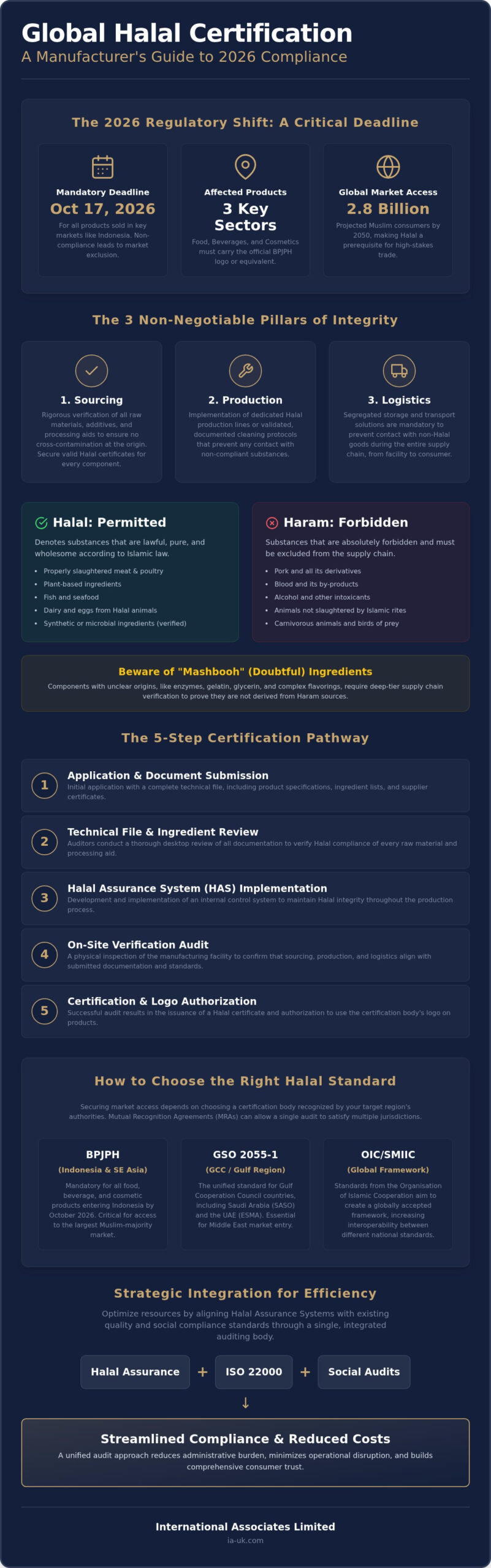
Integrity is maintained through three non-negotiable pillars:
- Sourcing: Rigorous verification of raw materials and additives to ensure no cross-contamination at the origin.
- Production: Implementation of dedicated lines or validated cleaning protocols that meet specific technical standards.
- Logistics: Segregated storage and transport solutions to prevent contact with non-compliant goods during transit.
For European exporters, the 2026 deadlines in Indonesia and the Gulf demand immediate action. Indonesia’s Government Regulation No. 42 of 2024 mandates that all imported food and cosmetics must be certified by October 17, 2026. Failure to secure an accredited certificate by this date results in an immediate halt of trade activities. These regulatory updates reflect a broader global trend toward mandatory, rather than voluntary, compliance.
The Strategic Importance of International Recognition
Securing market access depends heavily on the accreditation of the certification body. Regional authorities like GAC in Saudi Arabia and JAKIM in Malaysia maintain strict registries of approved entities. Mutual recognition agreements (MRAs) between these bodies ensure that a single audit can often satisfy multiple jurisdictions. This creates a more efficient supply chain and reduces redundant administrative costs. Beyond religious compliance, these standards serve as a benchmark for hygiene and safety. This increases consumer trust among non-Muslim demographics who associate the logo with high-quality oversight and transparency. You can review International Associates’ accreditations to see how global networks support these recognitions.
Industry-Specific Compliance Scopes
Compliance isn’t limited to meat and poultry. In the food sector, enzymes, stabilizers, and emulsifiers are under intense scrutiny. The pharmaceutical and cosmetic sectors must address complex supply chains involving gelatin, glycerin, and alcohol derivatives. The Core concepts of Halal dictate that even packaging materials must be free from “Najis” (impurities). This includes ensuring that lubricants or plastics used in manufacturing don’t contain animal-derived stearates. For chemical manufacturers, verifying the origin of every catalyst is essential to meet the precise Halal certification requirements established for 2026.
Core Compliance: Understanding Haram and Halal in Manufacturing
Halal compliance in industrial manufacturing is defined by the absolute exclusion of “Haram” (forbidden) substances and the rigorous management of “Mashbooh” (doubtful) components. Under Islamic Law, Halal denotes substances that are lawful, pure, and wholesome. Conversely, the Haram category includes swine and its derivatives, blood, intoxicants such as ethanol, and animals not slaughtered according to specific rites. For 2026 manufacturing standards, Halal compliance is the verified assurance that every product is free from prohibited substances and has been produced in an environment that prevents any form of ritual impurity.
Technical challenges often arise with “Mashbooh” ingredients. These are substances where the origin; whether animal, plant, or synthetic; is unclear. In complex formulations, items like enzymes, emulsifiers, and flavorings require deep-tier supply chain transparency to meet modern Halal certification requirements. Verification isn’t merely a checklist. It’s a technical audit of the molecular origin of every component used in the facility.
Ingredient Sourcing and Verification
The integrity of the final product depends on the compliance of every raw material supplier. Manufacturers must secure valid Halal certificates for all additives, E-numbers, and processing aids. This documentation is a cornerstone of the Halal certification process and documentation. While laboratory testing for porcine DNA or residual alcohol provides a layer of security, it doesn’t replace the need for robust traceability. Auditing the supplier’s production methods ensures that even sub-ingredients don’t compromise the Halal status of the formulation.
Managing Cross-Contamination and ‘Najis’
Production integrity is frequently threatened by “Najis,” or ritual impurities. In multi-purpose manufacturing facilities, physical segregation between Halal and non-Halal lines is the preferred standard. If a line is inadvertently contaminated with Haram substances, manufacturers must implement a strict protocol for ritual cleansing. This process involves specific cleaning agents and steps to restore the line to a state of purity. Establishing these protocols early helps prevent audit failures and ensures your Halal certification requirements are consistently met. You can streamline these efforts by incorporating them into your existing regulatory compliance strategy.
The 5-Step Halal Certification Process and Documentation
Achieving global market access involves a disciplined five-phase verification cycle. This structured approach ensures that every operational facet aligns with the technical Halal certification requirements mandated by international accreditation bodies. The process is designed to move from theoretical compliance to practical, on-site verification.
Phase 1 begins with the application and a preliminary technical documentation review. This stage identifies potential risks in the supply chain before physical inspections occur. Phase 2 transitions to the on-site audit. Auditors examine production lines, storage facilities, and sanitation protocols to verify that the facility’s actual practices match its documented procedures. Phase 3 involves a technical committee review. Independent experts evaluate the audit findings to ensure impartiality and institutional weight before a final certification decision is made.
To maintain compliance integrity, Phase 4 requires annual surveillance audits. These regular check-ins confirm that the manufacturer hasn’t deviated from the established standards. Finally, Phase 5 involves a comprehensive recertification and standard alignment process every three years. This ensures that the facility remains updated with the latest regulatory shifts, such as the 2026 mandates in Southeast Asia and the Gulf regions.
Essential Documentation for the Halal Audit
Documentation serves as the objective proof of a firm’s commitment to purity. Manufacturers must develop a robust Halal Assurance System (HAS) supported by specific Standard Operating Procedures (SOPs). A critical component of this is the creation of ingredient flow charts that identify Halal Critical Control Points (HCCP). These charts trace every component from the point of receipt to final packaging. Auditors also require evidence of an internal Halal committee and comprehensive training records. Organizations can strengthen their internal expertise through Lead Auditor Training to ensure their team is prepared for these technical evaluations.
Preparing Your Facility for the Auditor
Physical readiness is as vital as paperwork. Auditors prioritize evidence of segregation and strict sanitation. Staff hygiene protocols must meet purity standards, and personnel must demonstrate an understanding of cross-contamination risks. Storage areas require clear, unambiguous labeling to separate Halal-certified finished goods from non-certified inventory. It’s highly effective to perform an internal audit using a pre-defined checklist to identify and rectify non-conformities before the official visit. This proactive strategy ensures that Halal certification requirements are satisfied during the initial assessment, preventing costly delays. Many manufacturers find that aligning these preparations with their broader management system certification framework creates a more efficient and reliable compliance environment.
How to Choose the Right Halal Standard for Your Target Markets
Selecting a certification body is a strategic decision that directly dictates your facility’s export capacity. Not all certificates carry the same weight across international borders. Manufacturers must evaluate the specific Halal certification requirements of their destination markets before initiating the audit process. A mismatch between your auditor’s accreditation and your target market’s regulations can lead to costly delays or the rejection of goods at customs.
The global landscape is divided into primary spheres of influence. For the Middle East, alignment with the Gulf Accreditation Center (GAC) or the Ministry of Industry and Advanced Technology (MOIAT) is generally mandatory. In Southeast Asia, the landscape is defined by JAKIM in Malaysia and the BPJPH in Indonesia. Choosing a certification body that maintains mutual recognition agreements with these authorities is the most efficient way to achieve multi-market access. Additionally, ensuring your chosen auditor is aligned with ISO 17065 provides a baseline of technical competence and impartiality that is respected worldwide.
Market-Specific Accreditation Factors
Exporting to Indonesia requires navigating the BPJPH mandatory Halal law, which becomes fully enforceable for food and cosmetics by October 17, 2026. This regulation demands that the certification body is specifically registered with the Indonesian government. In contrast, the Gulf region requires compliance with GSO 2055-1 and related standards. For producers in the UAE, leveraging expert agricultural project management Abu Dhabi can ensure that facilities are designed and managed to meet these stringent Gulf standards from the start. While Western markets in Europe and North America often follow consumer-led requirements, having a high-tier international accreditation ensures your products meet the most rigorous global benchmarks for purity and safety.
Technical expertise in specific industrial sectors is essential for a successful audit. A certification body with experience in pharmaceutical manufacturing understands the complexities of ethanol residuals and gelatin capsules, whereas an auditor focused solely on meat processing might lack this specialized insight. The value of a global office network cannot be overstated. It allows for local support and verification while maintaining the institutional reliability of a central administrative base in Glasgow. You can leverage IA-UK’s regional expertise to bridge the gap between these complex global regulations and your operational growth.
Evaluating the global reach of your auditor ensures that your certification remains valid as you expand into new territories. Aligning with a body that offers a broad portfolio of services allows for a more integrated and cost-effective approach to compliance. Review our global accreditation portfolio to determine the best fit for your export strategy.
Strategic Integration: Combining Halal with ISO 22000 and Social Audits
Modern manufacturers often view compliance as a fragmented burden that requires separate teams and documentation. However, integrating Halal certification requirements into an existing ISO 22000 Food Safety Management framework creates a unified approach to quality. This alignment reduces operational redundancy by utilizing the shared principles of hazard analysis and critical control points. While ISO 22000 focuses on biological and chemical food safety, the Halal Assurance System (HAS) adds the essential layer of ritual purity; both rely on rigorous documentation and supply chain traceability.
There’s a growing technical intersection between Halal ethics and Social Accountability (SA8000). The concept of “Halalan Toyyiban,” which translates to lawful and wholesome, encompasses not just the physical ingredients but also the ethical treatment of workers and environmental stewardship; for those looking to apply these principles of wholesomeness to their personal health, wiseeatsnutrition.com offers expert guidance. Leveraging an advanced IT infrastructure allows for the centralized management of these diverse data points. It ensures that your compliance status is verifiable and transparent to international stakeholders through a single, secure interface.
Manufacturers can significantly reduce audit fatigue by coordinating surveillance visits for multiple standards simultaneously. Instead of hosting separate inspectors for ISO 9001, ISO 14001, and Halal, a single, independent body can assess the entire quality manual in one cycle. This efficiency is a core benefit of Management System Certification. Using existing quality manuals as a foundation for Halal proof ensures that your staff doesn’t have to manage competing sets of procedures. It’s a methodical way to ensure global reliability without increasing administrative costs or disrupting production schedules.
Future-Proofing Your Compliance Strategy
Maintaining internal standards requires a workforce that understands the nuances of multi-standard auditing and verification. Enrolling key personnel in Lead Auditor Training courses ensures that your internal Halal committee can pre-emptively identify non-conformities before a formal inspection. This proactive approach is vital as we look toward 2027, where the industry is shifting toward digital Halal traceability through blockchain and AI-driven supply chain monitoring. Preparing for these emerging trends now ensures your facility remains a leader in the global marketplace. It’s about building a stable foundation that can adapt to evolving Halal certification requirements across all target export markets.
Securing Your Competitive Advantage in the Global Halal Market
The transition toward mandatory Halal compliance in 2026 represents a significant pivot for international trade. Manufacturers who align their facilities with specific Halal certification requirements now will avoid the disruption of market exclusion in high-growth regions like Southeast Asia and the Gulf. Success depends on moving beyond religious checklists toward a technically rigorous Halal Assurance System that integrates seamlessly with existing ISO standards.
International Associates Limited serves as a steady hand in this complex transition. From our head office in Glasgow, we provide independent, ISO 17065-aligned auditing services through an expansive global network. We specialize in high-stakes technical sectors, ensuring your documentation stands up to the most demanding regulatory scrutiny across all target export markets. It’s a methodical approach designed to provide stability in a shifting regulatory landscape.
Secure your global market access with IA-UK’s independent Halal certification services.
Taking these procedural steps today ensures your business is positioned for sustained growth and operational integrity in an increasingly regulated global economy.
Frequently Asked Questions
What are the primary Halal certification requirements for food manufacturers?
The primary Halal certification requirements for food manufacturers include the absolute exclusion of Haram substances and the verification of every raw material’s origin. Facilities must implement a robust Halal Assurance System (HAS) to manage sourcing and production. Manufacturers are required to provide technical documentation for all additives and processing aids. They must also demonstrate rigorous hygiene protocols and clear physical segregation to prevent cross-contamination during the production and storage phases.
How long does the Halal certification process typically take?
The duration of the certification process depends on the complexity of the supply chain and the manufacturer’s readiness. Typically, the cycle moves from an initial application and documentation review through Stage 1 and Stage 2 audits. While prepared facilities might achieve certification more quickly, complex manufacturers should allow several months for full verification. Advanced IT infrastructure and well-organized technical files can significantly streamline this timeline for global organizations.
Can I use the same production line for Halal and non-Halal products?
Shared production lines are permissible if manufacturers implement validated cleaning protocols. If a line is used for non-Halal products, it must undergo a thorough cleaning process to ensure it’s free from impurities before Halal production begins. Some standards may require ritual cleansing depending on the nature of the previous product. However, many authorities recommend dedicated lines for high-risk items to minimize the risk of audit failure and ensure long-term compliance integrity.
Is Halal certification required for non-food items like cosmetics?
Halal certification is increasingly mandatory for non-food sectors like cosmetics and pharmaceuticals. For example, Indonesia’s 2026 regulatory deadline specifically includes cosmetics and personal care products sold within the region. These standards focus on the exclusion of porcine derivatives and specific alcohol types. Certification ensures that these items meet the purity expectations of Muslim consumers and comply with the mandatory import laws established in major global markets.
What is the difference between Halal and ISO 22000?
ISO 22000 is an international standard focused on food safety management and the prevention of biological, chemical, and physical hazards. In contrast, Halal certification requirements focus on the lawfulness and ritual purity of the product according to Islamic law. While ISO 22000 ensures a product is safe to consume, Halal certification confirms it’s permissible. Leading manufacturers often integrate these systems to create a comprehensive quality and compliance framework.
Does Halal certification expire, and how often must it be renewed?
Halal certificates are not permanent and require annual surveillance audits to maintain their validity. Most certification cycles operate on a three-year basis, with a full recertification assessment required at the end of this period. Regular surveillance ensures that the manufacturer’s Halal Assurance System remains effective. It also confirms that no prohibited ingredients or new suppliers have been introduced into the supply chain since the initial audit was conducted.
What are the most common reasons for failing a Halal audit?
Audit failures often stem from inadequate documentation of raw material origins or the use of unverified additives from third-party suppliers. Other common non-conformities include the absence of clear labeling in storage areas and insufficient staff training regarding cross-contamination risks. Failing to maintain a robust internal audit process or lacking a dedicated Halal committee can also lead to non-compliance during the formal assessment by an independent certification body.
How do Halal requirements differ between the UK and the Middle East?
In the UK, Halal certification is largely a voluntary, consumer-driven standard focused on market preference and transparency. Conversely, many Middle Eastern nations require mandatory compliance with GSO standards for market entry. These regional authorities, such as GAC in Saudi Arabia, maintain strict registries of approved certification bodies. Manufacturers must ensure their auditor holds the specific regional accreditations required by the destination country to avoid trade barriers or customs rejections.