

Energy savings in manufacturing rarely come from one machine or one shift. When energy use is spread across production lines, processes and operating schedules, it can be difficult to identify which changes will make a measurable difference. ISO 50001 certification for manufacturing can provide a structured way to manage energy performance, but certification alone doesn’t reduce consumption.
Reliable improvement starts with understanding where energy is used and establishing performance data teams can use to set priorities and assess results. Without a sound baseline and regular review, efficiency projects can be difficult to justify, and gains may not be maintained across shifts or over time.
This guide explains how manufacturers can identify significant energy uses, select practical efficiency measures and track performance through a continual improvement cycle. It also clarifies how ISO 50001 relates to an implemented energy management system: certification involves independent assessment of that system, while operational changes remain the manufacturer’s responsibility. Measurement, clear ownership and consistent review can help turn individual actions into a repeatable approach to managing energy.
Key Takeaways
- Map energy use across production, support systems, buildings and operating schedules before choosing efficiency measures.
- Use ISO 50001 to connect energy objectives, responsibilities, measurement and review in an ongoing management cycle.
- Compare operational adjustments, maintenance and equipment improvements by disruption, measurement method and site-specific conditions.
- Build a practical reduction plan by defining its scope, reviewing data, prioritizing opportunities, assigning actions and checking results.
- Assess whether ISO 50001 certification for manufacturing is the right next step by reviewing your system’s scope, responsibilities, documented processes and performance monitoring.
How to Reduce Energy Consumption in Manufacturing: Start with Energy Use
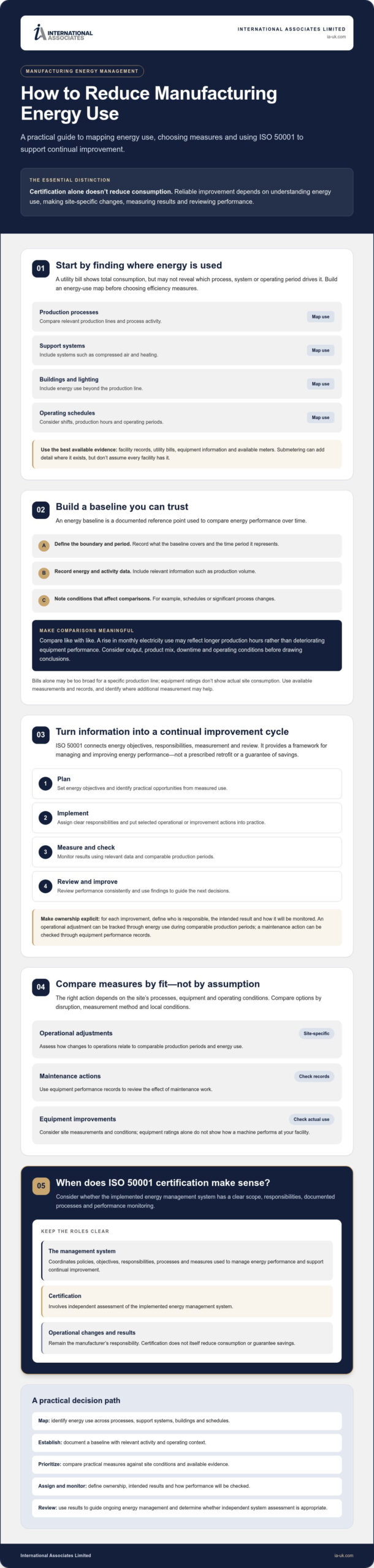
Before changing equipment or production methods, identify where energy is actually used. A factory’s utility bills show total consumption, but rarely explain which process, support system or operating period is driving it. Equipment ratings indicate capacity or expected performance under stated conditions, not necessarily how a machine performs at your site.
Separate energy use into practical categories so comparisons can guide decisions: production processes, support systems such as compressed air and heating, buildings and lighting, and operating schedules. A line running different shifts or producing at different output levels may use energy differently, so a site-wide total can conceal useful patterns. The principles behind ISO 50001 support a measured, systematic approach to managing energy performance.
Which manufacturing energy uses should be investigated first?
Start with the major processes and systems that appear to account for substantial or variable energy use. Use facility records, utility bills, equipment information and available meters to build an initial map. Submetering can provide more detail where it exists, but don’t assume every facility has it. Use the best available evidence and identify where additional measurement may help.
Compare like with like. Review energy use across relevant production lines, operating periods and shifts, noting differences in output, product mix, downtime or operating conditions. For example, a rise in monthly electricity use may reflect longer production hours rather than deteriorating equipment performance. Separating these factors helps teams investigate causes before selecting an operational adjustment, maintenance task or equipment change.
How can a factory establish a useful energy baseline?
An energy baseline is a documented reference point used to compare energy performance over time. To make it useful, record the period it covers, the organizational or operational boundary, the energy data and relevant activity information, such as production volume. Also note operating conditions that could affect comparisons, including schedules or significant process changes.
A baseline based only on bills may be too broad to assess a particular production line, while equipment ratings alone don’t show actual consumption. Use available measurements and records to define what the comparison represents. If production levels or operating conditions change, account for that context when reviewing later performance. Otherwise, a simple comparison of totals before and after a change may lead to the wrong conclusion.
This evidence gives manufacturers a more reliable basis for prioritizing action and reviewing results. It also helps clarify what an implemented energy management system covers before seeking ISO 50001 certification for manufacturing. For information about independent assessment of management systems, see management system certification.
How ISO 50001 Turns Manufacturing Energy Data into Ongoing Improvement
Identifying energy use is only the first step. ISO 50001 provides a framework for managing and improving energy performance, linking measured results to decisions, assigned responsibilities and regular review. It doesn’t prescribe a specific retrofit or guarantee savings. The measures selected depend on a site’s processes, equipment and operating conditions.
An energy management system is the coordinated set of policies, objectives, responsibilities, processes and measures an organization uses to manage energy performance and support its continual improvement. In a factory, that system helps translate findings into controlled operational action. A policy establishes direction, objectives identify intended results, and assigned responsibilities make clear who will implement actions, monitor performance and review progress.
How does the energy management cycle support factory improvements?
The cycle connects planning to implementation, checking and review. For each selected improvement, define an owner, the intended result and how it will be monitored. An operational adjustment might be tracked through energy use during comparable production periods. A maintenance action might be checked through equipment performance records. Choose a method that suits the action and the available data.
Reviewing results helps determine whether an action worked as intended and whether it should be adjusted, maintained or reconsidered. This is how individual projects can become part of a repeatable management process. Certification independently assesses an implemented system. It doesn’t create energy savings by itself or select technology for the manufacturer.
What should manufacturers measure and review?
Choose energy performance indicators that reflect the site’s relevant energy uses and objectives. An indicator could compare energy use with production output for a defined process, provided the underlying data and calculation are appropriate. Compare results with a defined baseline and account for operating context, such as changes in production levels or schedules. A change in total consumption alone may not show whether energy performance improved.
Set a review process to check whether the data remains reliable, indicators remain relevant and actions are producing the intended results. Keep the basis for each comparison clear so operational teams and management can interpret changes consistently.
Verify clause references, required documented information and edition-specific requirements against the applicable current version of the standard, including any amendments. Avoid relying on an outdated checklist when defining the system or preparing for assessment. Manufacturers considering ISO 50001 certification for manufacturing can review the scope of management system certification as a next step toward independent assessment of an implemented system.
Which Manufacturing Energy-Saving Measures Should You Compare First?
Compare measures by how well they fit the facility, rather than assuming one type will always deliver the greatest savings. Operational adjustments and maintenance may be simpler to trial, while equipment or process changes can involve capital, downtime and technical constraints. Assess each opportunity against production and quality requirements, then check it using evidence appropriate to the site.
An energy-saving action is a change intended to reduce energy use; evidence of improved energy performance is a measured result compared with a suitable baseline and operating context. Recording the action, its timing and relevant production conditions helps distinguish a genuine performance change from a shift in output or schedule.
| Measure to compare | Relevant energy use | Potential disruption | Possible measurement method | Site-specific dependencies |
|---|---|---|---|---|
| Review shutdown routines and avoidable idle operation | Production equipment and supporting systems left running during non-production periods | May require coordination across shifts and clear restart procedures | Compare energy use during comparable operating and shutdown periods | Process safety, restart time, product requirements and shift practices |
| Investigate maintenance issues | Equipment or systems operating inefficiently because of condition or control issues | May require planned access, maintenance resources or a production window | Review equipment records and relevant energy data before and after the work | Equipment condition, maintenance history, access and production schedule |
| Assess equipment or process changes | Major energy-consuming equipment or energy-intensive process steps | Can involve capital approval, installation work or downtime | Compare measured consumption with production and operating conditions accounted for | Technical compatibility, process settings, product quality and engineering constraints |
When should manufacturers prioritize operating practices and maintenance?
Ask operations teams where shutdown routines, idle running or maintenance practices vary by line, shift or production schedule. A difference between shifts can point to a practical investigation, but it doesn’t prove the cause of higher energy use. Record the practice change and relevant operating conditions, then review results before attributing any improvement to the action.
When might equipment or process changes need further assessment?
Review major energy-consuming equipment and process settings against output, product quality and operating needs. Treat a potential upgrade as an opportunity to investigate until technical feasibility and site data have been assessed. Consider capital requirements, installation constraints and possible downtime, and involve the appropriate operational and engineering expertise before committing to a change.
For manufacturers developing an ISO 50001 certification for manufacturing approach, this comparison supports evidence-based prioritization. It helps teams distinguish ideas worth investigating from actions whose results have been validated under relevant site conditions.
How to Build a Practical Manufacturing Energy-Reduction Plan
A practical plan turns energy opportunities into owned actions and verifiable reviews. Keep it proportionate to the facility: use available evidence, coordinate people who understand the processes and equipment, and distinguish early investigations from changes that need technical or investment assessment.
- Define the scope. Specify which site, processes, support systems and operating periods the plan covers.
- Review the data. Gather relevant energy records, production information and operating context, then identify gaps that affect comparisons.
- Identify opportunities. Record operational, maintenance, equipment or process options without treating preliminary ideas as proven savings.
- Assign actions. Agree who will coordinate each action, what will be measured and when it will be reviewed. Responsibilities can be shared across operations, facilities and management according to the site’s structure.
- Check results. Compare evidence with the relevant baseline and operating conditions, then retain, adjust or reconsider the action.
Prioritize opportunities using site evidence, operational importance, feasibility and readiness to measure. A shutdown-practice review may be suitable for an initial operational investigation. A major equipment change may need engineering review, investment approval and planning around production downtime. Document why each action was selected and what evidence could confirm its result.
How should a factory prioritize and assign energy actions?
Use a simple action register to keep responsibilities and review criteria visible. For example, an entry could track a proposed compressed-air leak investigation, its assigned owner, the measure to review, a review point agreed by the site and the evidence to consider. The owner might coordinate the work, while operations, facilities or management contribute data or approve changes as appropriate.
| Action | Owner | Measure | Due point | Evidence of review |
|---|---|---|---|---|
| Investigate a selected compressed-air system | Assigned site contact | Relevant energy data and system findings | Agreed review date | Recorded findings and comparison with operating context |
How can teams check whether an action worked?
Set the review point before implementation and compare results with the relevant baseline, accounting for production levels or other changed conditions. Record unexpected outcomes and revise the action if the evidence doesn’t support the expected result. Keep estimates distinct from verified results, and document calculation methods and assumptions rather than presenting an estimate as measured savings.
Where management-system planning includes related considerations, review relevant energy and security certification information. If your energy management system is implemented and ready for independent assessment, explore management system certification as a next step toward ISO 50001 certification for manufacturing.
When ISO 50001 Certification Makes Sense for a Manufacturing Site
ISO 50001 certification assesses whether an energy management system conforms to applicable requirements within an agreed scope. It doesn’t guarantee a particular level of energy savings, replace operational improvements or determine which equipment a factory should install. Its value depends on having a system that is implemented and maintained, with performance monitoring and review supporting ongoing attention to energy use.
What should a manufacturer consider before seeking certification?
Check whether leadership and operational teams can support the system as part of day-to-day management. Responsibilities should be assigned, relevant processes documented and energy performance monitored. Define which sites, activities and processes are intended to fall within the certification scope so the organization understands what an assessment is intended to cover. Verify current standard requirements and assessment arrangements with a competent certification body before planning the assessment.
These readiness factors help distinguish a functioning management system from a collection of improvement projects without consistent ownership or review. If responsibilities, monitoring or scope are still unclear, address those gaps before treating certification as the next step.
What does certification add to an energy-reduction programme?
Independent assessment provides evidence of conformity within the agreed certification scope. It doesn’t carry out the manufacturer’s implementation work or verify a guaranteed amount of savings. A consistent system can help an organization maintain accountability, review performance and keep energy objectives connected to operational decisions, while responsibility for improvements remains with the manufacturer.
Before comparing providers, ask about the proposed scope of assessment and verify applicable accreditation details. These factors help clarify what the certification covers and how the assessment relates to the site’s needs.
ISO 50001 certification for manufacturing may be a suitable next step when the system’s scope is defined, responsibilities are assigned, processes are documented and performance is monitored. It provides independent assessment of that system, not a substitute for practical action or evidence of a predetermined energy result.
For a measured next step, review ISO 50001 Energy Management certification information and consider whether independent assessment aligns with your site’s readiness and objectives.
Make Energy Improvement a Consistent Part of Manufacturing
Lasting progress begins with understanding where energy is used, then selecting actions that fit the site’s operating needs and can be reviewed with relevant evidence. A clear plan connects responsibilities, measures and regular checks, helping manufacturers learn from results and adjust when conditions change.
ISO 50001 certification for manufacturing is an independent assessment of an implemented energy management system, not a guarantee of a specific level of savings. It can provide external verification of conformity within the agreed scope, while practical improvement remains the manufacturer’s responsibility.
International Associates Limited provides independent assessment, verification and assurance services, and lists ISO 50001 Energy Management certification among its services. If your system is defined and ready for external assessment, explore International Associates Limited’s ISO 50001 Energy Management certification service.
With reliable measurement and consistent review, your facility can build a disciplined approach to energy performance and keep improvement moving forward.
Frequently Asked Questions
How can manufacturers reduce energy consumption?
Manufacturers can reduce energy consumption by reviewing where energy is used, establishing a suitable baseline and identifying opportunities supported by site evidence. Compare potential actions with production requirements and operating conditions, then assign responsibility for selected measures and review results against the baseline. A structured energy management system can coordinate this work over time. Measure the effects of each action rather than assuming a change in equipment or practice has improved energy performance.
What is ISO 50001 certification for manufacturing?
ISO 50001 certification for manufacturing is an independent assessment of an organization’s energy management system against the applicable requirements of the standard. For a manufacturer, the system can coordinate energy objectives, responsibilities, performance information and improvement activities. Certification doesn’t prescribe a particular technology or guarantee a defined reduction in energy use. Before planning an assessment, confirm the applicable edition and amendments, along with the intended certification scope and assessment arrangements.
Can ISO 50001 reduce energy consumption in a factory?
ISO 50001 provides a framework for managing energy performance, but certification alone doesn’t reduce a factory’s consumption. Results depend on which actions the organization selects, how they are implemented and whether their effects are measured. Establish a suitable baseline, account for operating conditions and review relevant evidence before attributing a change to a particular action. This helps separate measured performance improvement from changes in output, schedules or other factors.
How do you identify significant energy uses in manufacturing?
Map the facility’s production processes and support systems, then examine available energy records, operating schedules and equipment information. Use this evidence to decide which areas warrant closer investigation rather than assuming a specific machine or system is always the priority. The level of detail will depend on site data and measurement availability. Define the organizational boundary and verify terminology and applicable requirements against the organization’s energy management system and current standard.
What is an energy baseline in a manufacturing facility?
An energy baseline is a documented reference point for comparing energy performance over time. Define the scope and period it covers, and record relevant operating conditions that affect interpretation. It isn’t an energy target or a promise of savings. Document how the baseline was established and use suitable comparison methods as processes, production levels or schedules change. Without that context, a simple comparison of energy totals may not show whether performance improved.
Does ISO 50001 certification guarantee energy savings?
No. Certification confirms that an energy management system has been assessed against applicable requirements within its agreed scope. It doesn’t guarantee a specific reduction in energy use, costs or emissions. The organization remains responsible for choosing and implementing measures and evaluating their results. Before communicating outcomes, distinguish measured results from projections and avoid unsupported savings claims. Confirm the applicable standard edition and certification scope so statements about the assessment are accurate.
How should a manufacturer choose which energy-saving action to implement first?
Prioritize actions by reviewing facility evidence, operational importance, feasibility, production constraints and readiness to measure results. An operational practice or maintenance issue may warrant investigation, while an equipment or process change may need technical and investment review. Record why an action was selected, assign an owner and define how its effect will be checked. Compare results with an appropriate baseline and relevant operating conditions, rather than relying on projections alone.