

The most detailed risk assessment method isn’t automatically the best choice for your organisation. The right information security risk assessment methodology is one that supports clear business decisions and can be applied consistently to the risks that matter.
Comparing approaches can be difficult. ISO/IEC 27005, NIST SP 800-30, OCTAVE and FAIR use different structures and terminology, and an assessment loses value if its conclusions don’t guide action. A repeatable process helps you document and prioritise risks, while keeping your organisation’s assessment distinct from an independent ISO 27001 certification assessment.
This guide compares established approaches and explains how to choose one based on your organisation’s context, available evidence and intended decisions. It also outlines a practical process for applying a method consistently and explains how assessment records can support an ISO 27001 information security management system. The aim is not to find one universal method, but to select an approach your organisation can use and maintain.
Key Takeaways
- Choose a method based on the decisions your risk assessment needs to support, not its name or perceived complexity.
- Compare ISO/IEC 27005, NIST SP 800-30, OCTAVE and FAIR by their focus, evidence needs and fit with your organisation.
- Select an information security risk assessment methodology that matches your objectives, risk context, expertise and available evidence.
- Use a consistent workflow to define scope, analyse and evaluate risks, record decisions, and review them over time.
- Understand how documented risk assessment supports an ISO 27001 management system, while independent certification assesses conformity rather than performing your organisation’s risk work.
Information Security Risk Assessment Methodology: What It Helps You Decide
The task is not simply to list risks. Your organisation needs a repeatable way to identify, analyse and evaluate information security risks, then use the results to decide what action is appropriate. The right information security risk assessment methodology depends on the decisions you need to make and the context in which your organisation operates.
Definition: A risk assessment methodology is the structured approach an organisation uses to establish context, identify risks, analyse their significance and evaluate them against decision criteria.
A methodology is not the same as an assessment tool, a security control or an output. A tool may support data collection or scoring; a control is a measure used to address risk; and outputs are the records and decisions produced by the assessment. The methodology explains how these elements fit together. For a broad introduction to Risk assessment methodologies, see the overview of risk assessment, including its information security context.
Scope and context determine which risks are relevant. An assessment of a cloud-based service, for example, may need to consider the information it holds, access arrangements, suppliers and service dependencies. A different scope may bring other information assets or business activities into focus. No single method is automatically suitable for every organisation or decision.
Risk assessment is work the organisation performs; security certification is an independent assessment of whether a management system conforms to applicable requirements. For a separate certification topic, see the page on energy security certification.
What should an information security risk assessment produce?
Useful outputs give decision-makers a traceable basis for action. Depending on scope and method, records may include identified risks, analysis assumptions, prioritisation criteria and treatment decisions. They should also identify who owns each risk and who is authorised to accept or address it.
Risk owners and other decision-makers use these results to choose next steps, such as further analysis, treatment or acceptance under the organisation’s criteria. The evidence and reasoning should be clear enough for others to understand how the decisions were reached.
When should an organisation review its assessment approach?
Changes to business activities, information assets, technology, suppliers or operating context can alter the risks within scope. A significant change may warrant reassessing affected risks so the records and decisions remain relevant. Review timing should reflect the organisation’s circumstances rather than an assumed universal interval.
Updating an assessment does not necessarily mean changing the methodology. If the approach still supports consistent analysis and sound decisions, it may remain suitable. Reconsider the methodology when its criteria, evidence requirements or outputs no longer fit the organisation’s context or decision needs.
Compare Information Security Risk Assessment Methodologies by Fit
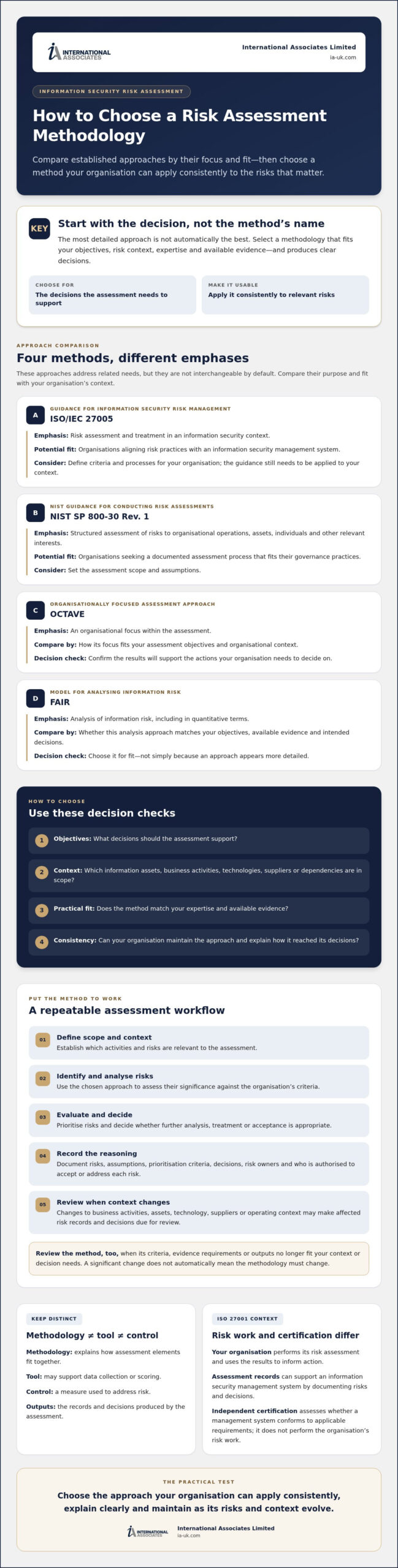
These approaches address related but distinct needs. ISO/IEC 27005 and NIST SP 800-30 provide guidance for risk work; OCTAVE offers an organisationally focused assessment approach; and FAIR provides a model for analysing information risk, including in quantitative terms. They can inform different parts of a process, but they aren’t interchangeable by default.
Choose a methodology according to your assessment objectives, organisational context and the decisions the results need to support.
| Approach | Purpose | Assessment emphasis | Likely fit | Implementation considerations |
|---|---|---|---|---|
| ISO/IEC 27005 | Guidance for information security risk management. | Risk assessment and treatment in an information security context. | Organisations aligning risk practices with an information security management system. | Define criteria and processes that fit the organisation. The guidance still needs to be applied to its context. |
| NIST SP 800-30 Rev. 1 | NIST guidance for conducting risk assessments. | Structured assessment of risks to organisational operations, assets, individuals and other relevant interests. | Organisations seeking a documented assessment process that fits their governance practices. | Set scope and assessment assumptions. Distinguish the guide from the broader NIST Risk Management Framework (RMF). |
| OCTAVE | An organisationally focused family of risk assessment approaches. | Critical assets, threats, vulnerabilities and organisational knowledge. | Teams that need business and operational perspectives alongside technical input. | Involve relevant personnel and define how findings will be prioritised and acted on. |
| FAIR | Factor Analysis of Information Risk, a model for analysing information risk. | Risk factors and, where appropriate, quantitative expression of risk. | Decision-makers who need to examine risk in financial or comparable terms. | Results depend on the quality of inputs, assumptions and analysis. Quantitative estimates aren’t guarantees of precision. |
How do ISO/IEC 27005 and NIST SP 800-30 differ?
ISO/IEC 27005:2022 provides guidance for information security risk management and can support practices connected to an ISO 27001 management system. NIST SP 800-30 Revision 1 is a guide for conducting risk assessments. Neither is universally superior. Compare its scope, terminology and assessment process with your existing governance and information security practices. Keep the NIST guide distinct from the NIST RMF, which addresses a broader risk management process.
When might OCTAVE or FAIR be relevant?
OCTAVE may be useful when an assessment depends on understanding critical assets and organisational conditions, rather than relying only on technical findings. FAIR may suit decisions that call for a structured, quantitative view of information risk. A team may combine approaches when their roles are clear, but should document how definitions, assumptions and outputs relate. Don’t treat results from different methods as directly comparable without checking their basis.
How to Select a Risk Assessment Method Without Overengineering
Choose an information security risk assessment methodology by starting with the decisions it must support, then checking whether your organisation can apply it consistently. A method that demands evidence or specialist expertise you can’t maintain may add complexity without improving decisions. A proportionate approach can still be rigorous: organisational size alone doesn’t determine the significance of its risks.
Which selection criteria matter most?
Identify who will use the assessment and who is accountable for decisions such as prioritising treatment or accepting risk. Then compare candidate approaches against practical requirements:
- Objective: What decision must the assessment inform?
- Risk context: Which business activities, information, technologies, suppliers and dependencies are in scope?
- Evidence: Can you obtain reliable information to support the analysis and keep it current?
- Expertise: Do the people conducting and reviewing the assessment have the required knowledge?
- Usability: Can decision-makers understand the results, and can teams repeat the process using existing governance and security practices?
Scale and complexity affect the effort and coordination required. A smaller organisation may have important supplier dependencies or sensitive information; a larger organisation may need common criteria across different business units. Choose a process that fits the scope and can be applied reliably. Don’t assume organisational size indicates risk level.
Should risk analysis be qualitative, quantitative, or hybrid?
Qualitative analysis uses categories such as low, medium and high, supported by defined criteria and evidence. It can help teams prioritise when numerical inputs aren’t available, but a rating is a judgement, not a precise measurement. Document the reasoning so others can interpret and challenge it consistently.
Quantitative analysis expresses risk numerically and requires suitable data, explicit assumptions and people able to interpret the results. It may help when decision-makers need to compare scenarios in numerical terms, but uncertainty in the inputs remains important. A hybrid approach can use qualitative screening to identify areas for deeper quantitative analysis. Choose the level of analysis to suit the decision, not to appear sophisticated.
Hypothetical example: An organisation is reviewing a cloud service that stores business information. Its immediate decision is whether existing safeguards are sufficient or further treatment is needed. It has documented system, access and supplier information, but no reliable basis for financial estimates. A qualitative assessment with clear criteria may be proportionate. If a later decision requires comparing financial scenarios, the organisation can assess whether it has the data and expertise for additional quantitative analysis.
Record the approach you chose, its assumptions and why it fits. This makes the choice explainable and gives you a basis for reviewing it if decision needs, evidence or organisational context change.
Apply the Chosen Information Security Risk Assessment Methodology
A consistent workflow makes findings easier to explain and decisions easier to revisit. NIST’s Guide for Conducting Risk Assessments provides a structured reference for assessment work. In practice, define the scope, record evidence and assumptions, apply consistent analysis criteria, and document decisions.
- Establish context and scope. Decide which business activities, information assets, systems and dependencies are included, and what decision the assessment must support. Use process maps, asset records and confirmed stakeholder, contractual or legal requirements as evidence. An authorised business or risk lead should approve the scope.
- Identify risks. Determine what could affect the confidentiality, integrity or availability of in-scope information and services. Consider asset and process information, system documentation, supplier dependencies and relevant incident records. The assigned assessment lead coordinates input, while knowledgeable business and technical stakeholders contribute evidence.
- Analyse risks. Apply the selected method’s criteria to examine relevant causes, events, consequences and existing safeguards. Record evidence, assumptions and information gaps. The assessment lead or designated analyst performs the analysis, with subject-matter experts validating material findings.
- Evaluate risks. Compare analysed risks with the organisation’s approved criteria and risk appetite. Decide which require attention or escalation, and who has authority to make that decision. The designated risk owner or accountable decision-maker should confirm the evaluation.
- Record decisions. Document whether each risk will be treated, accepted, escalated or handled through another approved response. Assign action ownership and review responsibility where action is needed. Risk owners and authorised managers make or approve these decisions.
- Review the assessment. Decide whether findings remain valid after changes to scope, evidence or operating context. Revisit relevant records and assumptions; the assigned risk owner or assessment coordinator should ensure updates are considered.
What information should be gathered before assessment?
Collect information about assets, business processes, system boundaries and dependencies, such as suppliers or supporting services. Include legal, contractual and stakeholder requirements only when they’ve been confirmed as applicable to the organisation and scope. Record unavailable evidence and assumptions explicitly so decision-makers can see where findings rely on incomplete information.
How should an organisation document and prioritise findings?
Use a consistent register to capture the risk description, scope, evidence, analysis rationale, rating under the chosen criteria, owner and decision. Apply the organisation’s verified risk appetite rather than treating a rating as universal. Identification and analysis describe and assess risks; selecting and implementing treatments are subsequent management decisions. Recording an action doesn’t itself reduce risk. Assigned owners should review progress and residual risk.
Connect Risk Assessment to ISO 27001 and Independent Certification
An organisation’s information security risk assessment helps inform and maintain its information security management system (ISMS). Under ISO/IEC 27001:2022, risk assessment and treatment are part of the management system requirements. The organisation defines and applies its own information security risk assessment methodology, records its decisions, and keeps relevant risk information current as its context changes.
This work supports management decisions, but assessment and certification are distinct activities. The organisation identifies and evaluates risks and determines how to address them. An independent certification body assesses whether the established ISMS conforms to applicable requirements within the agreed certification scope.
What does ISO 27001 certification assess?
At a high level, certification assessment examines the organisation’s ISMS and its conformity with applicable ISO/IEC 27001 requirements within the defined scope. It doesn’t select the organisation’s risk method, perform its risk assessment, implement controls or decide how risks should be treated. Those responsibilities remain with the organisation. Certification also doesn’t guarantee that security incidents will not occur or eliminate risk.
For information about the certification service, see the Management System Certification page. Independent assessment is a distinct assurance step after an organisation has established its system; it should not be confused with consultancy or implementation support.
When is sector-specific security context relevant?
Sector context matters when it changes the assessment boundary, the information and services in scope, relevant dependencies, or the decisions stakeholders need to make. Identify applicable requirements and operational conditions from your organisation’s circumstances rather than assuming a general method accounts for every sector-specific concern.
Energy-sector readers may also consult the separate Energy Security certification page. Energy security certification is a distinct subject, not an information security risk assessment methodology, and should not be treated as a substitute for assessing information security risks. Keep the scopes clear, then determine whether both areas are relevant to the organisation’s management systems.
Maintaining this distinction supports clearer evidence and accountability: the organisation owns its risk process and treatment decisions, while independent certification provides an assessment of system conformity. Neither the method nor certification alone removes risk. Their value depends on a defined scope, suitable evidence and decisions followed through by accountable people.
Make Your Risk Assessment Process Consistent and Decision-Ready
The right information security risk assessment methodology is one your organisation can apply consistently and use to make clear, accountable decisions. Choose it according to your objectives, context, evidence and expertise. Document assumptions, prioritise findings using agreed criteria, and review assessments when relevant conditions change.
Keep risk assessment distinct from certification. Your organisation remains responsible for performing and maintaining its risk work; independent certification assesses whether its information security management system conforms to applicable requirements. Certification provides assurance of conformity, not a guarantee that risks or security incidents have been eliminated.
International Associates Limited offers ISO 27001 Information Security certification as part of its independent assessment, verification and assurance services. Its UK head office is in Glasgow, supported by regional offices across Europe, Asia and the Middle East. If your organisation is considering independent certification, explore ISO 27001 information security certification as a next step. A documented, repeatable approach gives your organisation a sounder basis for managing information security decisions.
Frequently Asked Questions
How do you choose an information security risk assessment methodology?
Start with the decisions the assessment must support, your organisation’s context, the evidence available and the expertise needed to apply the method. Compare approaches against these criteria rather than choosing by name recognition alone. A suitable method should fit your objectives and support consistent, explainable use. Before adopting it, check current framework guidance and confirm that its scope and terminology align with your existing governance and information security practices.
What are the main information security risk assessment methodologies?
ISO/IEC 27005, NIST SP 800-30, OCTAVE and FAIR are examples that can inform information security risk work. They differ in purpose and emphasis, so they shouldn’t be treated as interchangeable options. Check current editions, terminology and scope against authoritative sources, then consider how each approach supports your assessment objectives. For example, determine whether you need risk management guidance, a structured assessment process, organisational input or quantitative analysis.
Is ISO 27005 the same as ISO 27001?
No. ISO/IEC 27001 sets requirements for an information security management system (ISMS), while ISO/IEC 27005 provides guidance related to information security risk management. Check the current editions and exact relationship between the standards before applying them to your system. Using risk management guidance doesn’t itself confer certification. Certification is a separate, independent assessment of an organisation’s ISMS against applicable requirements within the assessment scope.
Can an organisation combine more than one risk assessment methodology?
Yes, an organisation may use complementary approaches if their purposes and assumptions are understood. Combining methods can also create inconsistent criteria or duplicate work. Define which approach governs each activity, document adaptations and maintain a coherent record linking evidence, analysis and decisions. Before combining methods, check that they’re compatible and that the resulting process remains proportionate, explainable and repeatable within your organisation’s governance arrangements.
How often should an information security risk assessment be carried out?
There’s no universal review interval to apply without checking the organisation’s requirements. Set review timing and triggers based on organisational context, applicable obligations and the requirements of the chosen management system. Changes to business activities, technology, information assets, suppliers or operating conditions may warrant reassessment. Document why a review is needed, what has changed and how the timing aligns with applicable requirements and established risk processes.
Does an ISO 27001 certificate mean an organisation has no information security risks?
No. Certification doesn’t eliminate information security risks or guarantee that incidents won’t occur. It concerns independent assessment of an information security management system against applicable requirements within a defined scope. The organisation remains responsible for identifying, evaluating and treating its risks. To understand what a certificate covers, confirm its scope and current status with the relevant certification body rather than assuming it represents a guarantee of security.