

The certification that strengthens your food safety system may not be the one your export buyer requires. Choosing food safety certification for export means matching the standard to destination-market rules and customer expectations, then checking that its scope covers your products, sites, and activities.
ISO 22000 provides a food safety management system route. FSSC 22000 builds on ISO 22000 with additional scheme requirements, which may matter if a buyer requests it or a GFSI-recognised certification. HACCP is a hazard analysis methodology within food safety systems, not an equivalent certification route. Buyers may also set product, religious, or supply-chain assurance requirements that management-system certification does not cover.
This guide compares these routes and gives you a practical way to identify the requirements that apply before planning an assessment. You’ll learn how to map destination rules and buyer requests, compare certification options, define scope, and prepare evidence. With ISO 22000:2018 currently valid and a revision underway, the guide also covers points to consider when planning for 2026 and beyond.
Key Takeaways
- Map requirements by destination, product, supply-chain role, and buyer before selecting a certification route.
- Compare ISO 22000, FSSC 22000, and HACCP by purpose and assessment basis. They serve different roles in a food safety system.
- Choose food safety certification for export by checking buyer recognition, site and product scope, readiness, and ongoing audit obligations.
- Prepare evidence that the selected system is implemented, not just documented, before formal assessment.
- Use current destination and buyer requirements to guide your decision, then consider whether ISO 22000 certification fits your export plans.
Food safety certification for export: identify what your target market actually requires
Before choosing a certification, map the route to market. Requirements can differ by product, destination country, supply-chain role, and buyer. A producer selling directly to an importer may face different assurance requests from a manufacturer supplying a retailer through a distributor, even when the product and destination are the same.
Food safety certification is an independent assessment of conformity with a specified standard. It provides evidence that a food safety system has been assessed against that standard. It does not, by itself, grant permission to export or satisfy every customer’s conditions. Certification alone does not guarantee market access or buyer acceptance. Treat it as one part of export readiness, alongside applicable regulatory requirements and any additional contractual or scheme expectations.
Build a requirements map before committing to a standard or audit. Separate destination-country rules from buyer requirements and voluntary scheme expectations. Record the source of each requirement and the products, sites, or shipments it covers. For an overview of the management-system standard, see this summary of ISO 22000. International Associates provides independent ISO 22000 assessment and certification. Its management system certification information outlines this route.
Which export requirements come from regulators, and which come from buyers?
Regulatory requirements are set by the destination’s competent authorities and may depend on product category and how the product enters the market. Use current official guidance for the destination and product to determine what applies. A standard’s general description is not a substitute for checking legal requirements. As rules can change, verify jurisdiction-specific details as part of export planning.
Importers, retailers, and other customers may set additional supplier-assurance conditions, including a requested certification or scheme. These are buyer expectations, not automatically legal requirements. Use the buyer’s current documented specifications to identify the requested standard, scheme, scope, and supporting evidence.
What information should an exporter gather before choosing a standard?
Capture the details that define your scope and route to market:
- Target countries and relevant product types or categories.
- Manufacturing and handling sites, plus your role in the supply chain.
- Intended customer channels and each buyer’s current specification.
- Any stated expectations for approved certifications or voluntary schemes.
- Whether religious, product-specific, or supply-chain assurance is relevant to the market or buyer.
Use this map to shortlist standards that fit the operation and documented expectations. If a buyer requires additional assurance, list it separately rather than assuming a management-system certificate covers it. This gives you a more precise basis for comparing routes and defining the assessment scope.
ISO 22000, FSSC 22000, and HACCP: compare export certification routes
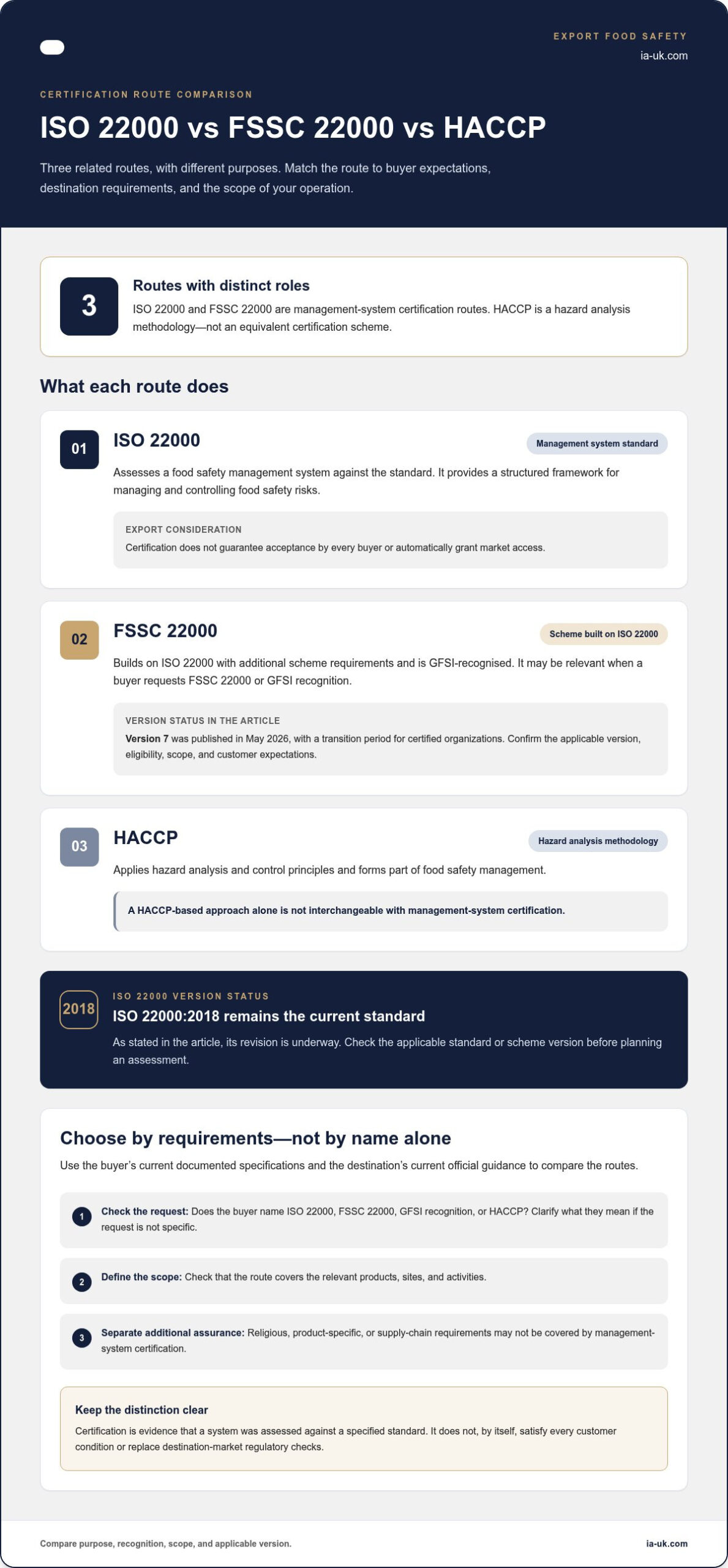
ISO 22000, FSSC 22000, and HACCP have related but distinct purposes. ISO 22000 is a food safety management system standard. FSSC 22000 is a certification scheme built on ISO 22000 with additional requirements. HACCP is a hazard analysis methodology that forms part of food safety management, not an equivalent certification scheme. The right route depends on buyer and destination requirements, as well as the products, sites, and activities in scope.
- ISO 22000: Assesses a food safety management system against the standard. It provides a structured framework, but does not guarantee acceptance by every buyer.
- FSSC 22000: Adds scheme requirements to ISO 22000 and is GFSI-recognised. This may be relevant when a buyer specifies a GFSI-recognised certification.
- HACCP: Applies hazard analysis and control principles. It is foundational to broader food safety systems, but a HACCP-based approach alone is not interchangeable with management-system certification.
Version status matters when planning an assessment. As of October 2026, ISO 22000:2018 remains the current standard while its revision is underway. FSSC 22000 Version 7 was published in May 2026, with a transition period for certified organizations. Before selecting a route, confirm the applicable scheme version, eligibility, scope, and customer recognition expectations.
When might ISO 22000 suit an exporter?
ISO 22000 may suit a business looking for a structured, auditable food safety management system across its relevant activities. It focuses on how food safety risks are managed and controlled, not on automatic approval for a particular market or buyer. International Associates provides ISO 22000 certification through independent assessment. Explore its management system certification route to learn how assessment verifies implementation against the selected standard.
How should exporters assess FSSC 22000 and HACCP expectations?
Start with the buyer’s written requirements. If a customer names FSSC 22000 or specifies GFSI recognition, check that the requested scheme and certification scope align with the products and sites involved. If HACCP is specified, establish whether the buyer means a HACCP-based food safety plan or a particular certification. These terms are not interchangeable, so compare the exact requirement rather than assuming one route satisfies another.
When can Halal certification be relevant to food exports?
Halal certification may be relevant when the product, destination, buyer, or supply-chain conditions include Halal assurance expectations. It addresses different considerations from food safety management certification, so treat it as a complementary requirement, not a replacement for ISO 22000 or another requested food safety route. FDA guidance on export certification for products regulated by the FDA also illustrates why exporters should distinguish certification requests from market-specific import expectations.
How to choose food safety certification for your export business
Choose a route using documented requirements, not assumptions about which certificate is most widely recognised. This five-step process turns your export plan into a defined certification scope and assessment plan.
- Map markets: List destination countries, product categories, shipment routes, and your role in the supply chain. Check current official guidance from the relevant destination authorities for product-specific requirements.
- Collect buyer requirements: Obtain each customer’s current specification, including any named standard, scheme, recognition status, and supplier-assurance evidence.
- Shortlist standards: Compare options against the requirements you have gathered. Keep mandatory destination requirements distinct from buyer conditions and voluntary scheme preferences.
- Check scope: Match the proposed certification scope to the organisation’s actual activities, products, and sites. An inaccurate or incomplete scope may leave relevant operations outside the assessment.
- Plan assessment: Consider implementation readiness, evidence across sites, audit arrangements, and the continuing obligations associated with the selected route.
Apply the same decision criteria to each option:
| Purpose | Relevant need | Verification required |
|---|---|---|
| Management-system certification | A structured system assessed against a defined standard | Buyer acceptance, product and site scope, implementation evidence |
| Scheme certification | A customer specifies a particular scheme or recognition status | Current scheme version, eligibility, scope, recognition expectation |
| Additional assurance | A buyer or market identifies a separate product or supply-chain condition | Exact requirement and whether it complements the food safety system |
How do destination, product, and customer requirements change the decision?
Consider an exporter supplying the same packaged product to two overseas customers. One buyer may request evidence of a management system; another may specify a named scheme or additional assurance. The destination and shipment route can also affect applicable regulatory requirements. Check current official sources for each product-market combination, then record buyer requests separately. This helps prevent one customer’s expectation from being mistaken for a universal rule.
What should exporters assess when comparing certification bodies?
Consider technical competence relevant to the selected standard and sector, the certification scope, independence of assessment, and how audit arrangements fit the organisation’s sites and activities. International Associates provides independent assessment and certification services globally, with a Glasgow head office and regional offices across Europe, Asia, and the Middle East. Review how the proposed assessment scope aligns with the relevant standard and your documented requirements.
A clear requirements map helps determine whether food safety certification for export should follow a management-system route, a buyer-specified scheme, or more than one assurance pathway. Explore ISO 22000 food safety certification when ISO 22000 aligns with your documented needs.
Prepare for a food safety certification assessment before export
Start preparing after selecting the certification route and scope. The food business establishes and implements the relevant system, then presents evidence that it operates as intended. A folder of procedures is not enough: documented procedures need records and other evidence showing they are implemented in practice.
For food safety certification for export, align preparation with the selected standard, the organisation’s actual activities, and the sites included in scope. ISO 22000 certification involves formal assessment, but stages and arrangements depend on the route. Confirm the current assessment requirements for the chosen standard rather than assuming that every scheme follows the same process.
What evidence should a food business organise?
Organise evidence so assessors can trace how responsibilities, controls, and follow-up work together. Depending on the selected standard and scope, relevant material may include:
- Controlled procedures and records showing how food safety processes are managed.
- Defined responsibilities for system oversight and operational controls.
- Records demonstrating that relevant activities are carried out as planned.
- Corrective-action evidence, including how issues are addressed and their resolution documented.
This is a starting point, not a complete audit checklist. Relevant evidence depends on the standard, products, processes, and sites being assessed. Keep records current and accessible, and make sure they reflect actual operations rather than a process that has not yet been implemented.
What happens during certification assessment and follow-up?
Some management-system certification routes use a two-stage initial assessment. Where applicable, an initial review considers system readiness and scope, followed by a more detailed assessment of implementation. Assessment may involve reviewing records and verifying operational practices. Whether verification is on-site, remote, or a combination depends on the applicable assessment model and requirements.
Findings are evaluated against the selected standard. Certification is not automatic, and no outcome should be assumed before the assessment and certification decision are complete. After initial certification, follow-up may include surveillance and recertification activities. Their timing and requirements vary by standard and scheme, so follow the current rules for your route.
International Associates provides independent assessment and certification services, including ISO 22000 Food Safety Management. To consider an ISO 22000 assessment for your organisation, explore ISO 22000 food safety certification.
Make export certification a practical next step with International Associates
Choose a certification route after mapping current destination requirements and buyer expectations. This helps separate legal market-entry conditions from customer assurance requests, then directs the assessment toward a standard and scope that reflect your operations. Certification can provide independently assessed evidence of a management system, but it does not grant export approval or guarantee buyer acceptance.
For food businesses whose requirements align with ISO 22000, International Associates Limited provides food safety management certification through independent assessment. Its global network includes a Glasgow head office and regional offices across Europe, Asia, and the Middle East. The assessment evaluates conformity against the selected standard and defined scope. It does not replace destination-specific regulatory checks.
What information helps define a suitable certification assessment?
Start with a clear description of your operation. Assessment scope and planning should reflect what the organisation does, where it does it, and which activities and products are included. Organise information about:
- Products and relevant food safety processes.
- Manufacturing, storage, or handling sites in the proposed scope.
- Activities and responsibilities managed at each site.
- Intended export markets and customer channels.
- Buyer specifications that identify a standard, scheme, or additional assurance expectation.
This information provides a practical basis for defining the assessment scope. If a site or activity is excluded, the resulting certification scope should not be assumed to cover it. The selected standard should reflect documented buyer requirements, not a general assumption about what exporters need.
How can certification support wider market-readiness planning?
An assessed management system can give customers structured evidence of how food safety responsibilities, processes, and records are managed. It can also support a consistent approach across the activities and sites included in scope. This contributes to customer assurance, while legal export requirements still need to be determined separately for each destination, product, and shipment route.
The right food safety certification for export is the route that fits verified requirements and the organisation’s actual operating scope. Use your requirements review to define the standard, sites, and activities for assessment, then plan how to demonstrate implementation. To discuss an ISO 22000 certification assessment, discuss your ISO 22000 certification assessment with International Associates Limited.
Turn your export requirements into a clear certification plan
The right food safety certification for export starts with verified destination and buyer requirements, not the assumption that one standard suits every market. Compare ISO 22000, FSSC 22000, and HACCP by purpose and the evidence customers require, then define a scope that reflects your products, sites, and activities.
Preparation matters too. A well-organised assessment shows not only that procedures are documented, but that the selected system is implemented and supported by relevant records. Certification can strengthen customer assurance, while destination-specific legal requirements must still be addressed separately.
International Associates provides ISO 22000 Food Safety Management certification through independent assessment, verification, and assurance services globally. With a Glasgow head office and regional offices across Europe, Asia, and the Middle East, the organisation supports food businesses evaluating a certification route for their operations.
If ISO 22000 aligns with your requirements, discuss your ISO 22000 certification assessment. Define the scope and prepare evidence that demonstrates how your system works in practice.
Frequently Asked Questions
Is ISO 22000 certification required to export food?
ISO 22000 is not a universal export requirement. Applicable rules depend on the destination, product, and shipment route, while importers or retailers may separately request a specific certification. Check current official guidance for the destination and product category, then compare it with each buyer’s written supplier requirements. Certification can demonstrate conformity to a standard, but it does not replace export permissions or other applicable regulatory requirements.
What is the best food safety certification for export?
The best food safety certification for export is the route that matches verified destination requirements, buyer expectations, and your organisation’s activities. ISO 22000 assesses a food safety management system; FSSC 22000 is a certification scheme with additional requirements; HACCP is a hazard analysis approach. Compare requested recognition, product and site scope, implementation readiness, and continuing audit obligations before choosing.
Can one food safety certificate cover exports to every country?
Do not assume that one certificate covers every destination, product, or customer. A management-system certificate assesses conformity to a defined standard and scope, but countries may apply different product-specific requirements, and buyers can set additional assurance conditions. Map each destination and customer separately, verify current official guidance for the relevant product and shipment route, and check that the certificate scope matches the activities and sites involved.
How does ISO 22000 differ from FSSC 22000?
ISO 22000 is an international food safety management system standard. FSSC 22000 is a certification scheme built on ISO 22000 that adds further requirements and is recognised by GFSI. This distinction matters when a buyer specifies a scheme or recognition status. Check the current scheme version, eligibility, scope, and buyer criteria rather than assuming ISO 22000 certification automatically meets an FSSC 22000 request.
Does HACCP certification meet food export requirements?
Not necessarily. HACCP is a hazard analysis methodology used within food safety systems, rather than an equivalent to management-system certification such as ISO 22000 or a scheme such as FSSC 22000. A buyer may request evidence of HACCP implementation, a particular certification, or both. Check the exact requirement and destination guidance for the product concerned. Do not assume HACCP evidence alone satisfies every regulatory or customer condition.
What happens if a buyer rejects my food safety certificate?
Ask for the specific reason and compare it with the buyer’s current written requirements. The issue may relate to the requested scheme, recognition status, certificate scope, product or site coverage, or additional supplier assurance. Identify the gap before deciding what evidence or corrective action is appropriate. Rejection does not automatically mean the assessment was invalid, but it does mean the certificate may not meet that buyer’s stated conditions.
How do I prepare for food safety certification for export?
Record your target markets, products, manufacturing sites, activities, and buyer requirements. Select a standard that fits those needs, define a scope that reflects actual operations, and implement the system before assessment. Organise controlled procedures, assigned responsibilities, operational records, and relevant corrective-action evidence. Assessment evaluates conformity, so documented processes should be supported by records showing they are followed in practice.