

An environmental audit is not passed by producing a complete set of procedures. You need evidence that environmental impacts are controlled in day-to-day operations and that performance is reviewed. That is the practical test behind ISO 14001 audit requirements in 2026, and it can be difficult to know which records and operational controls will demonstrate it.
Start by distinguishing the purpose of each audit. Internal audits help determine whether the environmental management system conforms to requirements and works as intended. Certification audits provide an independent assessment against the standard. Both examine evidence, but they serve different roles in maintaining and verifying conformity.
This guide explains what auditors may examine, how to connect environmental aspects and impacts to documented controls, and which records can support your case. It also covers how to prepare for internal and certification audits, and how to prioritise corrective action when findings arise. The aim is to help you treat readiness as a traceable process: assess risks, implement controls, retain evidence and review performance.
Key Takeaways
- Use the ISO 14001 audit requirements to connect environmental context and impacts with objectives, operational controls, monitoring and improvement.
- Trace significant environmental aspects from their assessment through workplace controls and performance records to spot evidence gaps.
- Distinguish conformity, nonconformity and improvement opportunities by comparing objective evidence with defined audit criteria.
- Prepare systematically by confirming the audit scope, reviewing obligations and aspects, sampling controls, verifying records and addressing gaps.
- Understand the certification assessment sequence so you can plan next steps and respond constructively to findings.
ISO 14001 Audit Requirements: What Is Assessed and Why?
Readiness is demonstrated through working environmental controls, not a folder of procedures alone. Auditors assess how the environmental management system (EMS) operates across the activities, sites and responsibilities within its scope, and whether records support what happens in practice. The ISO 14001 audit requirements are applied against defined criteria and scope, so the assessment will reflect the organisation and its activities rather than a universal checklist.
An ISO 14001 audit is a systematic assessment of an EMS against applicable criteria. It considers whether the organisation’s environmental policy and objectives are reflected in assigned responsibilities, operational decisions and performance evaluation. For example, an objective should relate to relevant activities and controls, with evidence showing how progress is monitored and reviewed. The ISO 14000 family of standards provides broader context for ISO 14001’s role in environmental management.
Audit readiness means showing that environmental commitments are put into practice through clear responsibilities and controls, supported by objective evidence and followed up when gaps are identified.
What does an ISO 14001 audit examine?
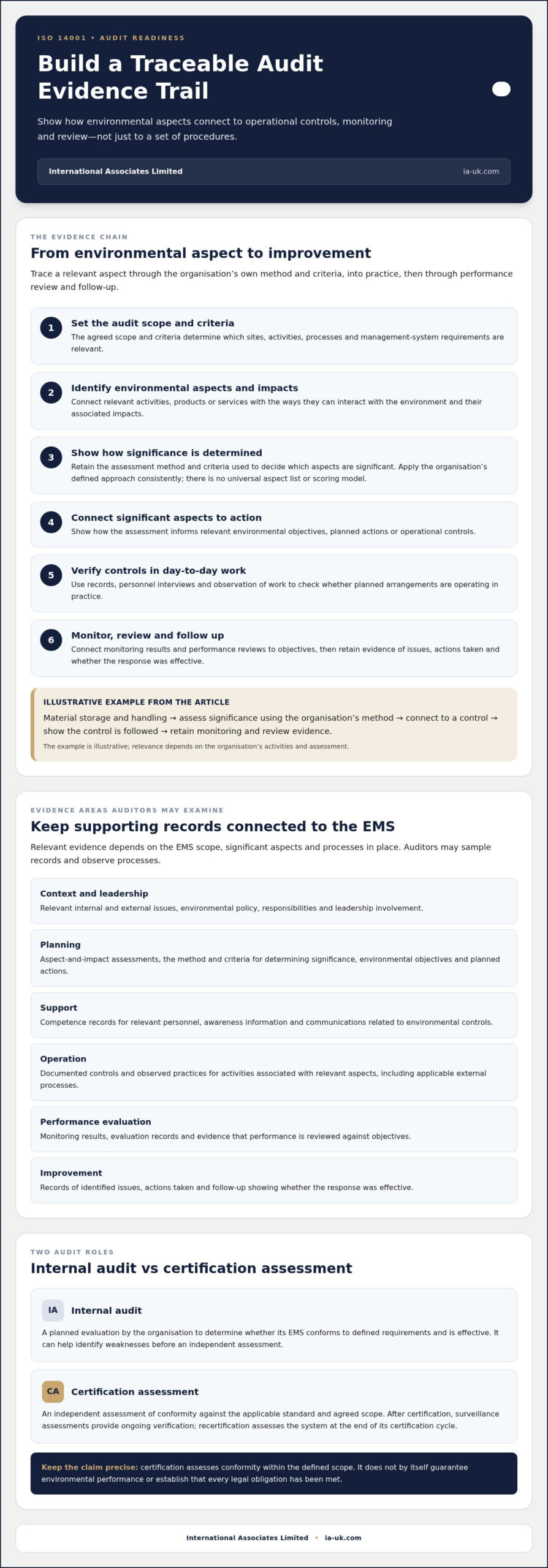
The agreed scope and criteria determine which sites, activities, processes and management-system requirements are relevant. Auditors may sample records, interview personnel and observe work to check whether planned arrangements are operating. The practical focus is whether evidence connects the EMS to actual operations, not whether every topic is assessed in the same way or every record is reviewed.
Certification provides an assessment of conformity within the defined scope. It does not, by itself, guarantee environmental performance or establish that every legal obligation has been met. Those outcomes depend on the organisation’s ongoing controls, evaluations and actions.
Internal audit versus certification audit
An internal audit is the organisation’s planned evaluation of whether its EMS conforms to defined requirements and is effective. It can help identify weaknesses before an independent assessment. A certification assessment, by contrast, independently verifies the management system against the applicable standard and agreed scope.
After certification, surveillance assessments provide ongoing verification, while recertification assesses the system at the end of its certification cycle. Each activity has a distinct purpose, but all rely on evidence of how the EMS is maintained and implemented. For the certification pathway, see management system certification.
ISO 14001 Requirements Auditors Test: Aspects, Controls, and Evidence
Auditors look for a clear connection between the organisation’s environmental context, its actions and its results. The What Is ISO 14001? overview describes the standard as a framework for an environmental management system (EMS). In practice, evidence needs to show how that system operates within the organisation’s defined scope. Prepare connected evidence, not a collection of isolated files.
How environmental aspects and impacts connect to audit evidence
Activities, products and services can interact with the environment in different ways. An organisation identifies these environmental aspects, considers their associated impacts and applies its defined method and criteria to determine which aspects are significant. The method should be applied consistently, but there is no need to assume a universal aspect list or scoring model.
For example, an organisation might identify the storage and handling of a material as an aspect, then determine its significance using its own method. The audit trail could connect that assessment to an objective or operational control, evidence that the control is followed, monitoring results and a review of performance. The example is illustrative; its relevance depends on the organisation’s activities and assessment.
For each significant aspect, show how the assessment informs a control, how you verify implementation, and how monitoring and review guide follow-up.
Which records and operational evidence may be relevant?
Evidence should reflect the EMS the organisation has implemented. Auditors may examine records and observe processes across these connected areas:
- Context and leadership: information about relevant internal and external issues, environmental policy, responsibilities and leadership involvement.
- Planning: aspect-and-impact assessments, the method and criteria used to determine significance, environmental objectives and planned actions.
- Support: competence records for relevant personnel, awareness information and communications related to environmental controls.
- Operation: documented controls and observed practices for activities associated with relevant aspects, including applicable external processes.
- Performance evaluation: monitoring results, evaluation records and evidence that performance is reviewed against objectives.
- Improvement: records of identified issues, actions taken and follow-up showing whether the response was effective.
Not every record applies to every organisation. Relevance depends on the EMS scope, significant aspects and processes in place. A practical preparation exercise is to select a significant aspect and trace it from assessment through operational practice to performance review. For the independent assessment pathway, explore environmental management system certification.
ISO 14001 Audit Findings: How to Interpret Evidence and Nonconformities
An audit conclusion should be traceable. The auditor compares objective evidence with defined criteria, then records whether the evidence supports conformity, indicates a nonconformity or suggests an opportunity to improve. Not every suggestion is a failure to meet the ISO 14001 audit requirements. The classification depends on the applicable criteria and what the evidence demonstrates.
| Finding type | How to interpret it | Practical response |
|---|---|---|
| Conformity | Available evidence supports that the relevant criterion is being met within the audit scope. | Maintain the effective process and continue to evaluate its performance. |
| Nonconformity | Objective evidence shows that a defined requirement has not been fulfilled. The finding should identify the criterion and explain the evidence supporting the conclusion. | Address the issue, determine its cause and take appropriate action through the organisation’s process. |
| Improvement opportunity | An auditor may identify a potential improvement that is not, by itself, a failure to meet a requirement. | Consider whether action would strengthen the EMS, without treating the suggestion automatically as a nonconformity. |
What makes audit evidence sufficient and relevant?
Evidence is useful when it connects an audit criterion to a process and supports the auditor’s conclusion. Interviews can show how people understand their responsibilities. Records can document planned or completed activities, while observations can show whether controls are followed in practice. Auditors may consider these sources together. No single evidence format is required in every audit, and the presence of a document alone does not prove effective implementation.
A large document set can still leave gaps if procedures do not match actual practice, records do not demonstrate the process or responsibilities are unclear. Check for consistency between what the organisation says should happen, what personnel do and what the evidence shows.
How should an organisation respond to a nonconformity?
Follow the organisation’s established process. Document the issue and correct it where appropriate. Then analyse why it occurred, consider whether similar conditions may exist elsewhere, and decide what action is proportionate to address the cause. A quick fix may resolve an immediate instance without preventing recurrence, so distinguish correction from action on the underlying cause.
Keep follow-up evidence showing that planned actions were implemented, then evaluate whether they addressed the cause and were effective. Depending on the issue, evidence may include updated process records, revised controls or subsequent monitoring results. Similar audit principles apply across management-system standards. For information on the certification pathway, see management system certification.
How to Prepare for an ISO 14001 Audit: A Practical Sequence
Prepare by reviewing how the environmental management system operates, not by simply gathering documents. Use this sequence to find weak links before an auditor tests the system in practice:
- Confirm the scope. Identify the sites, activities, processes and responsibilities included in the assessment. Ensure the people preparing evidence understand those boundaries.
- Review obligations and environmental aspects. Check that relevant obligations are evaluated and that the aspect-and-impact assessment reflects the organisation’s activities and defined significance criteria.
- Sample operational controls. Select processes connected to significant aspects and compare documented arrangements with workplace practice. Include relevant personnel and external processes where they fall within the EMS scope.
- Verify records and results. Trace selected controls to implementation evidence, monitoring results and reviews of environmental objectives or performance.
- Address gaps. Record discrepancies, make appropriate corrections and follow the organisation’s process for investigating causes and evaluating actions.
A useful readiness test is whether each priority environmental aspect links to a relevant control and evidence that the control is implemented and reviewed. Trace a sample from the initial assessment through operational practice to performance evaluation. This can reveal whether an objective has a responsible owner, staff understand the control, and monitoring information reaches the people who review results.
Build an audit-ready evidence trail
Map relevant requirements and processes to responsible roles, controls, records and monitoring results. Then speak with the people who do the work. Can they explain which controls apply to their tasks and what to do if an issue arises? Review corrective-action status too. Closed actions should have follow-up evidence showing that implementation was evaluated, rather than simply marked complete.
A readiness review is diagnostic, not a guarantee of certification. The auditor will assess objective evidence against the applicable criteria and scope. Use preparation to identify and address gaps, rather than trying to predict an outcome from a checklist alone.
Check audit competence and integrated audit planning
Internal auditors need competence appropriate to the audit scope and the processes being assessed. Relevant knowledge may include audit methods, environmental aspects and the operational controls under review. Lead auditor and internal auditor training can support competence development. For an integrated audit, coordinate shared processes such as document control or corrective action while keeping the distinct criteria of each management system clear.
Once preparation has clarified the system’s scope and evidence trail, explore environmental management system certification as the independent assessment pathway.
ISO 14001 Certification Audit: What Happens Next?
Once readiness work has established a clear scope and evidence trail, the next step is independent assessment. The certification journey typically includes application and scope definition, assessment of the environmental management system, review of any findings and a certification decision. The process verifies conformity against the applicable standard and agreed scope. It does not guarantee environmental performance or legal compliance beyond that assessment.
What to expect during certification assessment
Assessment begins with an understanding of the organisation’s activities, locations and processes within scope. The auditor reviews relevant documented information and verifies how the management system is implemented. This may involve examining records, speaking with personnel and observing operational controls. The methods and samples selected depend on the organisation and audit scope, so the assessment is not simply a check of every document or activity.
Auditors evaluate evidence against defined criteria. If findings are raised, they are communicated for the organisation to address through the applicable process. The certification body then reviews the assessment and findings before making its decision. The ISO 14001 audit requirements are assessed against relevant criteria, and the outcome depends on the evidence and decision process, not on a predicted result or fixed timeline.
How to move from readiness to independent assessment
Before proceeding, confirm that the proposed scope is defined, relevant controls are operating, supporting records are available, and identified findings have been addressed or are being managed through the organisation’s process. These checks help demonstrate that the EMS is implemented and ready for independent verification. They support preparation, but no checklist can guarantee certification.
After certification, ongoing surveillance and recertification assessments form part of maintaining certification. They provide further opportunities to verify that the system continues to conform and remains implemented within its scope. Assessment arrangements depend on the certification process and should not be assumed from a generic readiness guide.
International Associates Limited provides independent ISO 14001 certification assessment. Organisations ready to move from preparation to independent evaluation can discuss ISO 14001 certification.
Take the Next Step Toward ISO 14001 Certification
Effective audit readiness is demonstrated in practice: environmental aspects inform priorities, controls are implemented, and evidence shows how performance is monitored. An organised document set helps, but it must reflect how the environmental management system works across its defined scope.
Use internal audits to assess conformity and effectiveness, then treat findings as prompts to correct issues, address their causes and verify follow-up. Understanding the ISO 14001 audit requirements helps your organisation prepare for independent assessment with a clearer view of the evidence and processes auditors may examine.
International Associates Limited provides ISO 14001 Environmental Management System Certification through independent assessment, verification and assurance services delivered globally. If your organisation is ready to discuss the certification pathway, Discuss ISO 14001 certification. Take the next step by discussing your ISO 14001 certification assessment with International Associates Limited.
Frequently Asked Questions
What are the main ISO 14001 audit requirements?
ISO 14001 audit requirements involve assessing the environmental management system against applicable criteria, including relevant processes, controls, monitoring and supporting evidence. What auditors examine depends on the organisation’s scope and significant environmental aspects, so preparation is not a universal document checklist. Records matter, but they need to reflect how the system operates in practice. Auditors may compare documented arrangements with operational controls and results to assess whether the system works as intended.
Is an internal audit required for ISO 14001?
Yes, the standard includes an expectation for internal audits to evaluate conformity and effective implementation of the environmental management system. The organisation establishes an appropriate audit programme, including its scope, method and schedule, based on its system and processes. This is distinct from a certification audit. Internal audits are organised by the organisation to assess its own system, while certification audits provide independent assessment against the standard and defined scope.
What evidence should I prepare for an ISO 14001 audit?
Prepare evidence relevant to your system, which may include environmental aspect assessments, objectives, operational controls, monitoring results, competence records and corrective-action information. The applicable evidence depends on your organisation’s scope, significant aspects and implemented processes. Focus on traceability: show how an identified aspect informs a control, how that control is followed and what results are monitored. Documents without context are less useful than evidence that reflects actual practice.
How does an ISO 14001 auditor assess environmental aspects and impacts?
An auditor may review how the organisation identifies environmental aspects, evaluates associated impacts and determines which aspects are significant using its defined method and criteria. The auditor can compare documented assessments with operational practice, relevant controls and available records. For example, an assessment may identify an aspect that should be controlled during a particular activity. There is no universal scoring formula or mandatory list of significant aspects that applies identically to every organisation.
What happens if an ISO 14001 audit identifies a nonconformity?
A nonconformity should be supported by objective evidence and linked to the applicable audit criteria. The organisation then addresses the issue, considers its cause, determines appropriate corrective action and keeps relevant follow-up evidence. That evidence can show whether actions were implemented and evaluated. The finding and response form part of the assessment record. Any certification decision depends on the applicable assessment arrangements and the evidence reviewed, not on a general assumption about the outcome.
What is the difference between an ISO 14001 internal audit and a certification audit?
An internal audit is organised by the organisation to evaluate its own environmental management system, including conformity and implementation. A certification audit is an independent assessment against the applicable standard within a defined scope. Both may examine processes, controls and evidence, but their purposes and responsibilities differ. Internal audit findings support the organisation’s evaluation and improvement. Certification audit findings inform the independent assessment and associated certification process.
Has ISO 14001 changed in 2026, and does that affect audit requirements?
Verify the current published edition and applicable transition arrangements before changing audit plans. Avoid relying on an assumed revision date or transition deadline. Use authoritative information relevant to your certification. Audit planning should reflect the edition and arrangements that apply to your organisation, including any applicable transition requirements. Confirming the relevant basis helps ensure internal evaluations and certification assessments use the correct criteria rather than outdated or unverified assumptions.