

What if a supplier receives a strong score, yet your team can’t show why that result justified approval? A practical supplier evaluation process ISO 9001 can support isn’t a uniform questionnaire for every supplier. It matches scrutiny to supplier impact and risk, then records the evidence behind each decision.
Supplier reviews are easier to manage when teams use consistent criteria, complete records and clear next steps. Without them, it can be hard to tell which suppliers need formal evaluation, what to assess and when performance concerns require follow-up.
This guide shows how to build a repeatable, risk-based process for your organisation. You’ll learn how to group suppliers, set proportionate evaluation criteria, define decision rules, and connect initial approval with monitoring, re-evaluation and corrective action. It also explains which records help demonstrate that the process is working as intended, making supplier decisions easier to trace and evidence easier to retrieve for an ISO 9001 audit.
Key Takeaways
- Set supplier scope according to how products or services could affect organisational outputs, so evaluation effort reflects supplier influence and risk.
- Build a supplier evaluation process ISO teams can apply consistently by linking each criterion to relevant evidence.
- Choose a pass/fail review, weighted scorecard or narrative assessment based on supplier risk and the evidence available.
- Set monitoring frequency and review triggers to respond to meaningful changes in supplier performance.
- Maintain traceable records from evaluation criteria to decisions and follow-up, separate from the certification audit itself.
ISO Supplier Evaluation Process: Define Scope Before Assessing Suppliers
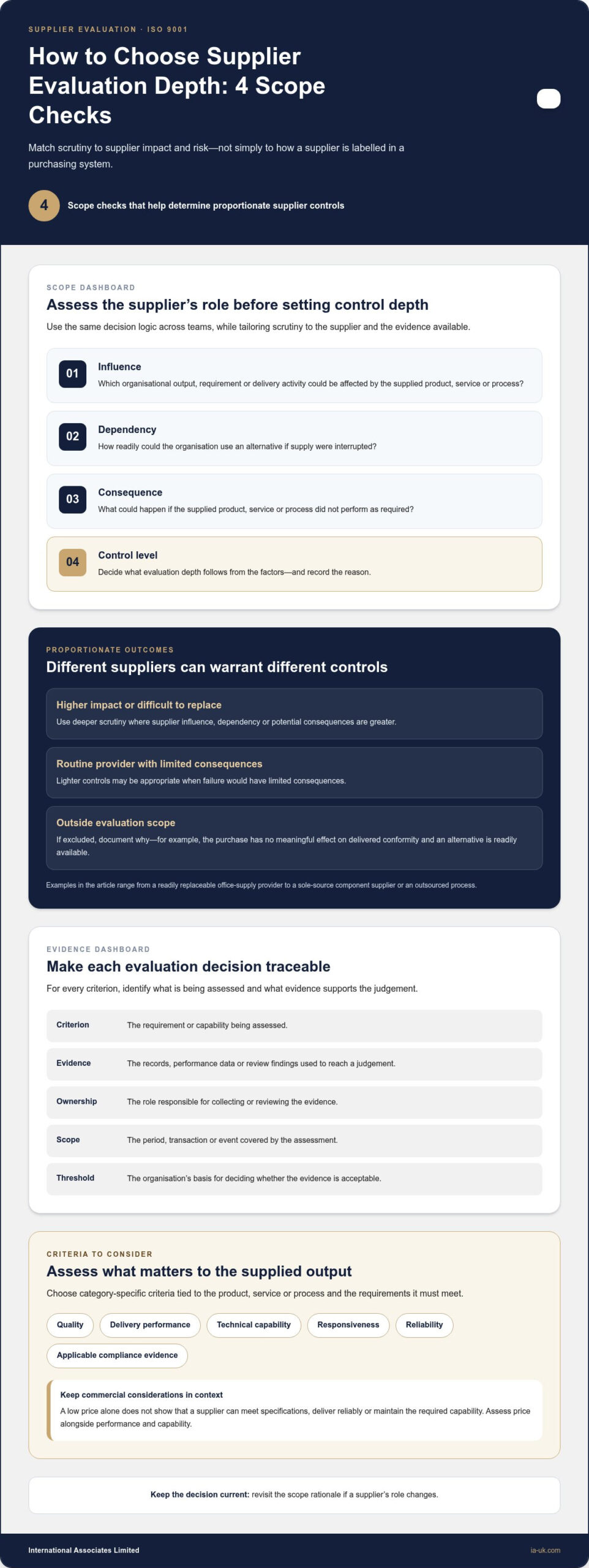
A consistent supplier evaluation process applies scrutiny in proportion to a supplier’s influence and risk. Start by mapping external products and services to the outputs your organisation delivers. Then identify relationships that could affect conformity, delivery or your ability to meet requirements. This scope-first approach keeps consequential suppliers visible without treating every purchase as equally critical.
The supplier evaluation process ISO organisations establish should reflect how suppliers work in practice, not just how they are labelled in a purchasing system. A readily replaceable office-supply provider has a different risk profile from a sole-source component supplier or a provider carrying out an outsourced process. Classification should explain that difference and guide a consistent assessment.
Which suppliers belong in the evaluation process?
Consider external providers whose products, services or processes could influence the conformity of what your organisation delivers. This may include outsourced production, critical components or services that support delivery. Start with the connection between the supplied output and your organisation’s requirements. The Supplier Evaluation Overview provides general background, but your scope should reflect your organisation’s actual operations.
For each supplier or category, record whether it receives a full evaluation, lighter controls or exclusion, and explain why. Make the rationale clear enough for someone else to follow later. For example, an exclusion might be justified when a purchase has no meaningful effect on delivered conformity and an alternative is readily available. Revisit the rationale if the supplier’s role changes.
How to make supplier evaluation proportionate
Use a small number of practical tiers rather than a detailed review for every provider. Distinguish higher-impact or difficult-to-replace suppliers from routine providers whose failure would have limited consequences. Match evaluation depth to factors such as supplier impact, dependency, technical complexity and role in delivery. These categories guide internal decisions, but do not replace consideration of the evidence relevant to each supplier.
A simple scope register makes the approach repeatable. For each supplier or category, capture:
- Influence: Which organisational output, requirement or delivery activity could be affected?
- Dependency: How readily could the organisation use an alternative if supply were interrupted?
- Consequence: What could happen if the supplied product, service or process did not perform as required?
- Control level: What evaluation depth follows from those factors, and why?
Apply the same decision logic across teams, while allowing the evidence and level of scrutiny to differ by category. This creates consistency without imposing unnecessary controls on low-impact purchases. For wider context on how supplier controls fit within a quality management system, see the management system certification overview.
ISO Supplier Evaluation Criteria: Match Requirements to Evidence
Once supplier scope is defined, set criteria that reflect what each supplier must provide and the consequences if requirements aren’t met. A concise, category-specific set is more useful than a long checklist applied indiscriminately. For each criterion, define acceptable performance and identify the evidence that will support the assessment. This makes decisions easier to explain and repeat.
There is no single criteria list or scoring weight that suits every organisation and supplier. A supplier evaluation process ISO teams can apply consistently should reflect organisational requirements, supplier role and available evidence, rather than assumed universal weightings. Define thresholds internally and record why they suit the category being assessed.
Which supplier evaluation criteria are useful?
Select criteria tied directly to the supplied product, service or process. Depending on the relationship, relevant areas may include quality, delivery performance, technical capability, responsiveness, reliability and applicable compliance evidence. Include a criterion when it helps determine whether the supplier can meet a defined requirement or support the intended outcome.
Price matters to purchasing decisions, but a low price alone doesn’t show that a supplier can meet specifications, deliver reliably or maintain the required capability. Assess commercial considerations alongside performance and capability, not instead of them.
How to make evaluation evidence verifiable
Turn each criterion into an observable question and identify evidence that can answer it. For example, assess delivery performance using recorded results over a defined review period, rather than a general impression that deliveries are usually prompt. For technical capability, document the relevant review finding and the information behind it.
Evidence expectations should fit the criterion and supplier category. A practical evaluation record can identify:
- Criterion: The requirement or capability being assessed.
- Evidence: The records, performance data or review findings used to reach a judgement.
- Ownership: The role responsible for collecting or reviewing the evidence.
- Scope: The period, transaction or event covered by the assessment.
- Threshold: The organisation’s basis for deciding whether the evidence is acceptable.
This structure helps distinguish verified performance from opinion. If evidence is missing or inconclusive, record that clearly instead of turning an assumption into a favourable score. The organisation can then decide whether further review is appropriate under its process.
Use consistent terminology across criteria and records, while keeping evidence relevant to each supplier’s role. For wider QMS context, management system certification connects supplier controls with the broader quality management system. This can help organisations preparing for ISO 9001 certification understand how documented criteria and evidence contribute to an assessable system.
How to Compare Suppliers: Choose a Consistent Evaluation Method
Different supplier categories may need different levels of analysis, but decisions should follow a clear, repeatable method. A routine purchase with straightforward requirements may suit a documented pass/fail review. A higher-impact supplier, or a decision involving several credible candidates, may need a scorecard or a written assessment that explains the evidence and trade-offs.
Choose the method according to supplier risk and the quality of the information available. A numerical result can make comparisons easier, but it can create false precision when evidence is incomplete or criteria are subjective. The supplier evaluation process ISO organisations establish should make the reasoning behind a decision visible, not simply produce a rank or score.
When is a supplier score useful?
A score is useful when criteria can be assessed consistently across candidates and the evidence supports a meaningful comparison. Before using one, define the rating scale, any criterion weightings, decision thresholds and how missing evidence will be treated. Keep critical requirements separate: a strong result in other areas shouldn’t automatically offset a serious gap in a requirement essential to the supplied output.
For example, a weighted scorecard may help compare delivery and technical capability, while a documented pass/fail review may be clearer when a specific requirement must be met. An evidence-based narrative assessment can suit a complex service where a single total would obscure important context. In each case, the score or result supports judgement; it doesn’t replace it.
How to document supplier selection decisions
Keep the decision record concise but traceable. Identify the selected supplier, assessment date, criteria applied, evidence reviewed and decision rationale. If approval has conditions or limitations, record them and state how they’ll be handled under the organisation’s process. This gives later reviewers a clear basis for understanding what was approved and why.
To support consistency across teams, use shared assessment instructions and a common record format. Reviewers should apply the same definitions for ratings and thresholds, and explain any departure from the usual method. If evidence conflicts, is incomplete or supports an exception, document how it affected the outcome rather than leaving the difference implicit.
A practical comparison record can include:
- Method: Pass/fail, weighted scorecard or narrative assessment, with a reason for its use.
- Results: Findings against each criterion, linked to evidence rather than unsupported impressions.
- Exceptions: Gaps, conditions or departures from standard decision rules, with their rationale.
- Approval: The selection decision and the role or person responsible for authorising it.
Set decision rules before reviewing candidates, not after seeing which supplier appears strongest. This reduces the risk of changing thresholds to favour a preferred option and makes comparisons more defensible. Organisations considering ISO 9001 certification should treat certification as a separate step from designing and operating their own supplier controls.
Supplier Monitoring and Re-Evaluation: Respond to Performance Changes
Supplier approval is a point-in-time decision, not evidence that performance will remain suitable. Monitoring connects that decision to what happens after approval, using relevant delivery, inspection, complaint and corrective-action information. The depth and frequency of review should reflect supplier risk and role, as well as the organisation’s operating context. A fixed interval or failure threshold won’t suit every supplier.
Routine monitoring can use existing operational records. A formal supplier audit is different: it involves a planned examination of supplier activities or controls. Monitoring may indicate that a closer review is warranted, but performance tracking alone is not an audit.
What should trigger a supplier re-evaluation?
Define triggers that matter to your supply arrangements. These may include repeated defects, a pattern of late delivery, significant performance deterioration, recurring complaints, adverse inspection findings, unresolved corrective actions or a material change to the supplied product, service or process. Review frequency can also reflect supplier risk, performance stability and the organisation’s experience with the relationship.
For each trigger, record the evidence reviewed and whether it changed the supplier’s status or control level. A single event may warrant prompt review if its impact is serious; a pattern of less severe incidents may also reveal a developing concern. Document why the issue did or did not lead to re-evaluation rather than relying on an undocumented judgement.
How to respond when supplier performance falls short
Use a defined response path so teams address issues consistently without applying an arbitrary universal threshold. Record the issue, its effect on the organisation, the person responsible for follow-up and the evidence needed to confirm progress. For recurring defects, for instance, the response might require documented corrective action and a subsequent review of relevant inspection results. For delivery problems, retain the performance records used to assess whether the response has been effective.
Proportionate actions depend on the nature and consequence of the shortfall. They may include closer monitoring, a corrective-action request, restrictions on new work or reconsideration of approval under the organisation’s documented controls. Define what evidence will demonstrate resolution and who will review it. Closing an action because a response was received is not the same as confirming that the underlying issue has been addressed.
A monitoring record should preserve a clear chain from signal to decision:
- Trigger: The performance data, complaint, inspection finding or change reviewed.
- Assessment: The impact, recurrence and significance of the issue.
- Response: The action, owner and evidence expected for follow-up.
- Outcome: The review result and any change to supplier status or monitoring.
An evidence-led supplier evaluation process ISO organisations can maintain helps make supplier status decisions explainable over time. International Associates provides ISO 9001 management system certification for organisations seeking an independent assessment of their management system.
Prepare ISO Supplier Evaluation Records for Certification Audits
Records should let a reviewer follow the decision from the supplier’s role through evaluation, approval and subsequent action. A supplier evaluation process ISO teams can demonstrate is more than a completed form: the evidence should show that documented controls are being applied and decisions are supported by relevant information.
What records help demonstrate a controlled process?
Maintain traceable records for each relevant supplier or supplier category. The evidence trail should connect scope decisions to criteria, findings, approval rationale and later monitoring. Identify the supplier, supplied output and responsible reviewer so the information can be retrieved and understood without relying on staff recollection.
Depending on the organisation’s process, the record set may include:
- Scope and rationale: The supplier or category covered, its relevance to organisational outputs and the basis for the level of control applied.
- Evaluation criteria: The requirements assessed and the evidence used to judge them.
- Decision record: Selection rationale, approval status, any conditions and the person responsible for the decision.
- Ongoing evidence: Monitoring results, re-evaluation findings, review decisions and corrective-action follow-up.
Keep the trail coherent. If a later monitoring result leads to a changed approval status, connect that decision to the performance evidence and follow-up. This supports audit readiness by showing how the process operates, not simply that procedures exist.
What to expect from IA’s certification audit process
Supplier evaluation records are part of an organisation’s own management-system evidence. They are distinct from the independent certification audit conducted by International Associates, which assesses the management system against the applicable standard. The certification audit does not implement supplier controls or replace the organisation’s responsibility for maintaining them.
The process follows three stages:
- Stage 1 (Document Review & Readiness): Evaluation of management-system documentation, policies and the operational framework.
- Stage 2 (Operational Audit): On-site or remote assessment, staff interviews and evidence gathering.
- Reporting & Certification: Delivery of the audit report and, if requirements are met, a certification decision by an independent certification decision body.
Clear supplier records can help make relevant controls and decisions traceable during the management-system assessment. The evidence considered depends on the organisation and applicable standard. Organised records help reviewers understand how the system is functioning.
International Associates provides Management System Certification services for organisations seeking an independent assessment.
Make Supplier Controls Part of Your Next QMS Review
A supplier evaluation process ISO teams can rely on should remain relevant as products, services, dependencies and operational priorities change. Treat it as a working part of the quality management system: review whether criteria still reflect actual requirements, whether assigned owners can maintain the evidence, and whether decisions remain consistent across teams.
This review is also a useful opportunity to consider how your wider management system will be assessed independently. International Associates’ certification process provides a structured assessment, with certification decisions made by an independent certification decision body. The focus is on evaluating the system, not taking over its supplier controls.
If ISO 9001 certification is a next step for your organisation, explore IA’s Management System Certification services. A clear, maintained approach to supplier decisions helps your organisation trace the evidence supporting its quality management system.
Frequently Asked Questions
Does ISO 9001 require a numerical supplier score?
A numerical score should not be assumed to be the required format. Documented evaluation and a specific scoring formula are different things: an organisation can record how it assessed supplier suitability without assigning points. Check the applicable ISO 9001 edition and its supplier-control requirements when finalising the method. If you use a score, ensure its scale reflects the evidence and doesn’t imply greater precision than the review supports.
Is supplier evaluation the same as a supplier audit?
No. Supplier evaluation is the wider process of deciding whether a provider is suitable and continues to meet organisational needs. A supplier audit is one possible evidence-gathering activity, involving a structured examination of relevant supplier processes or controls. An organisation may evaluate a supplier using purchasing, inspection or performance records without conducting an audit, reserving audits for cases where closer examination is justified.
Does ISO 9001 certification automatically prove that a supplier is suitable?
No. A supplier’s ISO 9001 certificate can be relevant evidence of its quality management system, but it doesn’t establish that the supplier meets every requirement of a particular contract or supplied output. Your organisation may also need evidence of a specific technical capability or delivery arrangement. Assess the certificate alongside supplier-specific requirements, risks and performance evidence, including the certificate’s applicable scope.
Can a supplier be approved conditionally?
Yes, if the organisation’s controls allow conditional approval and the limits are clear. Record what the supplier may provide, what remains outstanding, who owns the follow-up and what evidence will close the condition. For example, approval might be restricted to a defined activity while a capability gap is addressed. Set a review point under your process, then document whether the condition was met or the decision changed.
Can organisations use different evaluation methods for different suppliers?
Yes. A supplier evaluation process ISO 9001 organisations document can use different methods where supplier impact, complexity or available evidence differs. A routine provider may be assessed through a straightforward review, while a higher-impact supplier may need a more detailed comparison. Consistency comes from applying documented criteria and decision rules fairly, recording why a method was selected, and explaining exceptions instead of forcing every supplier into one format.
What is the difference between supplier qualification and supplier monitoring?
Supplier qualification is the initial review used to decide whether a provider is suitable for a defined supply need before or at approval. Monitoring follows that decision and considers whether performance remains acceptable during the relationship. For example, qualification may examine a supplier’s ability to meet a specification, while monitoring may track later delivery or inspection results. The activities are connected, but serve different points in the supplier relationship.