

An ISO badge alone doesn’t tell customers what was assessed, which parts of your business are covered or whether the certificate is current. Effectively leveraging ISO certification in marketing materials starts with those details, not with a broad claim that could overstate the evidence.
It’s natural to want certification to stand out on your website, in sales proposals and in tenders. An independently assessed management system can support a credible message, but it doesn’t guarantee customer trust, sales or specific outcomes. Your claim must match the certificate’s scope and status, and you must not present management-system certification as product approval.
This guide shows how to turn verified certification evidence into clear customer-facing messages. Learn which details to include, how to adapt claims for different channels and how to handle certification marks accurately. You’ll also find practical checks for keeping published content aligned with current certificate information, so customers and stakeholders can understand what certification demonstrates.
Key Takeaways
- Build each certification claim around the certificate’s scope and current status, rather than relying on a generic badge.
- Use a practical framework to match your audience, supporting evidence and wording before publishing a claim.
- Choose evidence suited to each channel, from website pages and tenders to social media and sales proposals.
- When leveraging ISO certification in marketing materials, use certification marks only in line with applicable rules.
- Assign ownership for reviewing claims so marketing, sales and procurement materials remain accurate as certification details change.
Why Leverage ISO Certification in Marketing Materials?
Present certification as evidence that a defined management system was independently assessed, not as a generic badge or a promise of superior products. Before leveraging ISO certification in marketing materials, ask what was assessed and whether the current certificate covers the activity or site you’re promoting. The answer should shape every public-facing claim.
Certification gives prospective customers a clear, verifiable point of reference when they assess suppliers. It doesn’t guarantee customer confidence, sales, product performance or a particular business outcome. Its marketing value comes from explaining the verified facts accurately and showing how they relate to a customer’s needs.
What does ISO certification demonstrate to a prospective customer?
Certification indicates that a defined management system has been assessed against a particular standard. The scope matters: it identifies the activities, services, sites or other boundaries covered, helping readers judge whether the certification is relevant to the work under consideration. The ISO 9000 series of standards provides background on quality management standards and certification. The organisation’s certificate, however, is the reference for its specific scope and status.
Keep verified facts separate from broader interpretations. A certificate may substantiate a statement that a specified management system is certified to a named standard within a stated scope. By itself, it doesn’t prove that every product is certified or that all customer expectations will be met. Don’t turn evidence about management processes into an unqualified claim about product quality, reliability or performance.
Which audiences benefit from a clear certification message?
Different readers need different details to understand what certification means for them. Customers comparing suppliers may want to know whether the certified activities relate to the product or service they’re buying. Procurement teams may need the standard, covered locations and current certificate details for supplier review. Tender evaluators may need to see a direct match between the requirement and the certificate’s scope.
Other stakeholders, including business partners, employees and investors, may focus on what certification says about the organisation’s management approach. Don’t assume every audience values the same standard or scope equally. Lead with the details most relevant to the reader, then provide enough context to support the claim.
- Customers: Does the certified scope cover the service or activity under consideration?
- Procurement teams: Which standard, sites and operations are included, and is the certificate current?
- Tender evaluators: Does the documented scope address the stated certification requirement?
- Stakeholders: What management system was assessed, and what does that evidence support?
For organisations considering certification, International Associates Limited provides independent audit, certification and assurance services, including management system certification. Whether certification is already in place or still being considered, use its scope and current status to anchor the message. This keeps claims useful to readers and avoids implying coverage or outcomes beyond the evidence.
Build an ISO Certification Message Around Scope, Evidence and Audience
A useful certification message connects three things: what was assessed, what the intended reader needs to know and what the evidence supports. That makes leveraging ISO certification in marketing materials a disciplined communication task, rather than a choice between displaying a logo and making broad claims.
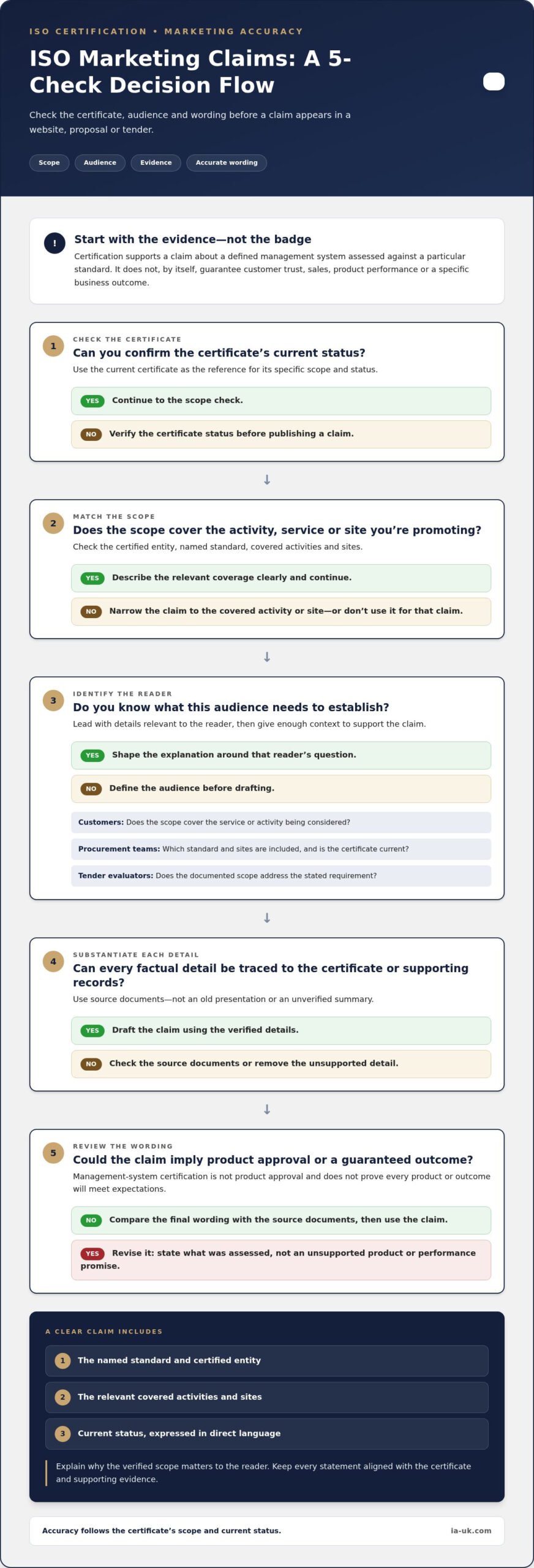
Use this five-step framework before publishing a website statement, proposal or tender response:
- Confirm the scope. Read the current certificate and identify the certified entity, named standard, covered activities and sites, and certificate status.
- Identify the audience. Decide what the reader needs to establish, such as whether the scope covers the service being proposed or a specified operation.
- Select the evidence. Use the certificate and relevant supporting records for each factual detail. Don’t rely on an old presentation or an unverified summary.
- Draft the claim. State the standard and relevant scope in direct language, then explain why that coverage matters to the reader.
- Review accuracy. Compare the final wording with the source documents and remove any implication that goes beyond them.
How to turn certificate details into a customer-facing claim
Start with the precise standard, certified entity, scope and current status. Then connect the scope to the customer’s question. If the certificate covers a defined service at a named site, describe that coverage instead of suggesting the entire organisation or every location is included. Keep the sentence concise, and make sure each factual phrase can be traced to the certificate or a supporting record.
You can translate standard language into customer relevance without turning it into a performance guarantee. Explain what the assessed management system covers in terms the reader can understand, but don’t claim that certification proves every product is defect-free, every delivery is on time or every outcome will meet expectations. Those are separate claims and require their own substantiation.
How to tailor the message for tenders and sales materials
In a tender, answer the question in the format requested and connect the certificate’s scope to the work being proposed. A brief explanation can identify the relevant certified activity or site, while the certificate provides supporting evidence. In sales materials, frame the same facts around the customer’s concern, but keep the scope and meaning consistent.
A procurement reader may need clear scope details to assess relevance, while a prospective customer may need a plain-language explanation of what the management system covers. Tailoring means changing the emphasis, not the underlying claim. For standard context, a quality-focused message can be informed by this Management System Certification service, which covers certification to internationally recognised standards. Organisations seeking certification can use the service information to understand the assessment pathway.
Before release, read the message as its intended audience would. Could a customer reasonably interpret it as certification of a product, an unlisted site or an outcome? If so, narrow the wording. An evidence-led approach makes claims clearer and more credible while respecting what the certification demonstrates.
Choose the Right Marketing Channels and Use Certification Marks Carefully
Choose channels based on where customers, procurement teams and tender evaluators assess your organisation, then match the level of detail to the space available. A website page can explain the certification in context; a short social post cannot carry the same detail. Keep the underlying claim consistent across formats. A written statement about certification is also different from displaying a certification mark or logo, which may have separate use requirements.
Where should an organisation communicate its certification?
Prioritise channels that support supplier evaluation or qualification. Use your website and company profile to explain the standard and scope; use proposals and tenders to address specific requirements. Shorter formats can direct readers to fuller information, as long as the brief claim remains accurate.
| Channel | Primary audience | Suitable evidence | Review point |
|---|---|---|---|
| Website page | Customers assessing suppliers | Scope summary and certificate details | Check scope, status and page updates |
| Company profile | Prospective customers and partners | Concise standard and certified activity | Keep wording aligned with the website |
| Proposal | Prospective customer or buyer | Relevant scope details tied to proposed work | Confirm the work falls within scope |
| Tender | Tender evaluators | Requested certificate information and supporting evidence | Match the response to the stated requirement |
| Email signature | Contacts receiving routine correspondence | Brief factual reference, if useful | Avoid implying broader coverage |
| Social media | Followers and wider audiences | Short, factual announcement | Link the claim to clear context |
| Press materials | Media, partners and stakeholders | Verified certification details and relevant scope | Review wording before publication |
This channel-based approach makes leveraging ISO certification in marketing materials more useful: readers get the detail they need without a change in meaning. For example, a tender response should connect the certified scope to the work being bid for, while a company profile can state the relevant certification more broadly, within the same boundaries.
How can organisations avoid misleading logo and certificate claims?
Before using a mark, check the current rules issued by the relevant certification body and any applicable scheme. ISO itself does not issue certificates or certification marks, and its corporate logo must not be presented as a certified company’s mark. Certification marks are issued by certification bodies, and their use is subject to applicable requirements.
Don’t place a mark on a product or its packaging in a way that suggests the product itself is certified. Certification applies to the assessed management system, not automatically to every product or service. Keep certificate references distinct from product-level claims, and don’t imply that ISO endorsed the organisation or its offerings. Review the design, wording and placement together, since an accurate sentence can still be misrepresented by a misleading logo or layout.
Keep ISO Certification Claims Accurate Across Campaigns and Updates
A certification claim can remain in circulation long after its source material changes. A campaign may be accurate when approved, but updates to the certified scope, organisational structure or certificate status can make the same wording misleading. Assign one owner to coordinate reviews across marketing, sales and procurement, and keep a record of what was published and where.
Make reviews event-driven as well as part of routine content governance. A change to the certificate or to the activities and sites described in a claim should prompt a check of affected materials, including live pages, saved proposal templates and sales documents. The aim isn’t to rewrite every reference automatically, but to identify which claims depend on the changed information and update them consistently.
What should a certification-claim review include?
Compare the standard name, certified entity, scope and status against current records. Then assess each sentence, including any stated customer benefit: does the evidence support it, and is it framed without a guarantee? Record where the claim appears, its approval date and the person responsible for updating it. This makes it easier to trace a statement to its evidence and remove outdated versions.
A central claim record can include fields such as:
- Approved wording: the exact factual statement teams may use.
- Evidence source: the current certificate or supporting record behind the claim.
- Scope notes: the covered entity, activities and sites relevant to the wording.
- Use locations: the website pages, templates, profiles and campaigns where it appears.
- Review owner: the person responsible for checking and coordinating changes.
Also record which materials display a certification mark, since mark use may have requirements separate from written claims. Review the relevant certification-body and scheme rules before approving or reusing a design.
How can teams keep certification communication consistent?
Give marketing, sales and procurement teams approved wording and the evidence that supports it. A tender response may need a precise scope statement, while a profile may use a shorter description; both should preserve the same factual boundaries. Keep one controlled source of approved claims, and make ownership clear so teams know where to find current wording and who handles updates.
Internal guidance should also distinguish an organisation’s certification from a certification body’s accreditation. Make clear that accreditation relates to the certification body; it should not be used to suggest that a client organisation holds an accreditation unless that has been established.
With this governance in place, leveraging ISO certification in marketing materials becomes a repeatable process rather than a one-time campaign task. If your organisation is considering independent assessment as a basis for accurate certification communication, explore management system certification.
Make Independent ISO Certification the Evidence Behind Your Marketing
Credible promotion begins with certification that is current, clearly scoped and described in terms that match the evidence. A certificate can substantiate a specific statement about an assessed management system; it isn’t a guarantee of sales, customer trust or business performance. The strongest message explains what was assessed and why that scope is relevant, without implying more than the certificate supports.
International Associates provides independent audit, certification and assurance services. Its management-system certification process follows three defined stages, creating a documented basis for communicating the result accurately:
- Stage 1 (Document Review & Readiness): Management-system documentation, policies and the organisation’s operational framework are reviewed to assess readiness for the next stage.
- Stage 2 (Operational Audit): The system is assessed through an operational review, which may be conducted on-site or remotely and can involve interviews and evidence gathering.
- Reporting & Certification: Findings are reported. Where requirements are met, certification follows an independent certification decision.
What does the certification process establish for marketing claims?
The assessment provides a basis for describing the management system and scope that were evaluated. It doesn’t substantiate claims about every product, service, site or business outcome unless those claims are separately supported. For marketing, identify the certified system and relevant coverage, then explain its connection to customer needs without presenting certification as an endorsement or performance guarantee.
This distinction matters when leveraging ISO certification in marketing materials. For example, a business can refer to a certified management system within its defined scope, but shouldn’t turn that statement into a claim that each product is certified or that customers will receive a guaranteed result. Independent assessment supports precise communication; it doesn’t replace evidence for other claims.
How should a business take its next step?
Begin by identifying the management-system standard relevant to your organisation and defining the activities and sites you intend to include. Prepare the core system documents, internal-governance evidence and operational records that can demonstrate how the system is established and used. A clear understanding of the intended scope helps keep the assessment focused and makes any resulting certification easier to describe accurately.
Keep the intended scope and customer-facing purpose aligned as your organisation develops its certification plans. The assessment evaluates the management system; marketing decisions come later. Claims should reflect the certificate issued and its current scope and status, grounding promotional wording in verified information rather than assumptions about what certification may deliver.
To review the assessment pathway and consider the appropriate next step for your organisation, explore International Associates’ Management System Certification service. A valid, accurately described certificate can provide a sound evidence base for marketing, while the precision of the message remains the organisation’s responsibility.
Make Your Next Certification Message Evidence-Led
Use your next planning cycle to decide what role certification should play in how your organisation presents itself to customers and business partners. Start with a clear organisational priority, such as strengthening quality management or environmental management, and consider whether certification is relevant to that direction.
Once the priority is clear, identify the management-system standard and intended scope that align with it. This gives your organisation a practical basis for deciding whether to pursue certification and how it may fit into future communications. Keep the decision tied to the system your organisation intends to assess, rather than treating certification as a marketing objective by itself.
If your organisation is considering this next step, explore Management System Certification with International Associates. A well-considered certification decision can support clear, purposeful communication as your organisation develops.
Frequently Asked Questions
Can a company use the ISO logo in its marketing materials?
A company shouldn’t use ISO’s corporate logo as its own certification badge. ISO doesn’t issue certificates or certification marks. If a certification body or scheme has issued a mark, use the approved artwork and follow the issuer’s current conditions for placement, colour, size and accompanying wording. Before production, check the rules for the specific mark and ensure the design doesn’t suggest ISO endorsement or product certification.
What should an organisation include when it says it is ISO certified?
Include enough information for readers to identify the claim and compare it with the certificate. For example: “[Entity] is certified to [standard] for [defined activities or sites], certificate status: [current status].” Use the correct legal or trading name, and don’t add subsidiaries, brands or locations that aren’t covered. This template can help teams write concise, verifiable claims when leveraging ISO certification in marketing materials.
Can a company claim that its products are ISO certified?
A management-system certificate isn’t a product certificate. Avoid product labels or catalogue entries that say “ISO certified” unless separate product-specific certification supports that wording. On a product page, keep information about the organisation’s certified management system distinct from product attributes. Support claims about performance, safety or conformity with evidence that applies to the product and the exact claim, rather than relying on the organisation’s certificate.
Is ISO certification proof that a company’s products are high quality?
No. Certification isn’t a test result for each product. Buyers assessing a particular item may need separate information relevant to that product, such as defined specifications, inspection evidence or documented test results where applicable. Present those records independently, and don’t use a management-system certificate as a substitute for product-level quality evidence or as a guarantee of a customer’s experience.
How should a business update marketing materials when its certification scope changes?
Treat published claims as controlled assets. Compare the revised certificate with wording and visuals in a content inventory, then amend affected pages, sales decks, tender templates and downloadable files. Assign an owner and record the revision date so staff can replace saved copies; archive or withdraw superseded materials. If a certification mark appears, include its current use conditions in the review before republishing.
Can a business mention ISO certification in a tender response?
Yes, if the tender requests or permits certification evidence and the certificate is relevant to the bid. Use the tender’s terminology, identify the part of the proposed work that the evidence relates to, and provide supporting documents in the specified format. Check that attachments are legible and current, and avoid uploading an older copy from a shared folder. Keep the response focused on the requirement rather than adding broad claims.