

Use an ISO certification checker online to look up a company’s certificate number and assess the issuer, scope and expiry date. The International Organization for Standardization (ISO) does not perform certification or issue certificates; external certification bodies do. Check a certificate against the issuing body’s records, where available.
A certificate number alone isn’t enough to establish that a company’s ISO 9001 certification covers the work you need. The certificate’s stated scope identifies the products, services and sites included, while its dates indicate whether it remains current. This guide explains how online certificate searches work, what to examine in the issuer’s credentials, and how to interpret scope and expiry details, including certificates issued during the transition to ISO 9001:2026.
Key Takeaways
- ISO doesn’t issue certificates, so identify the certification body responsible for the company’s claim.
- Use the certificate number to search available records, then compare the result with the certificate details.
- Assess whether the certificate’s scope covers the relevant services, products and locations, and review its expiry status.
- Understand how accreditation and MLA signatory status can inform your assessment of an issuer’s credentials.
- Learn what certification involves and when an independent ISO 9001 assessment may be the appropriate next step.
How To Check If a Company Is ISO 9001 Certified?
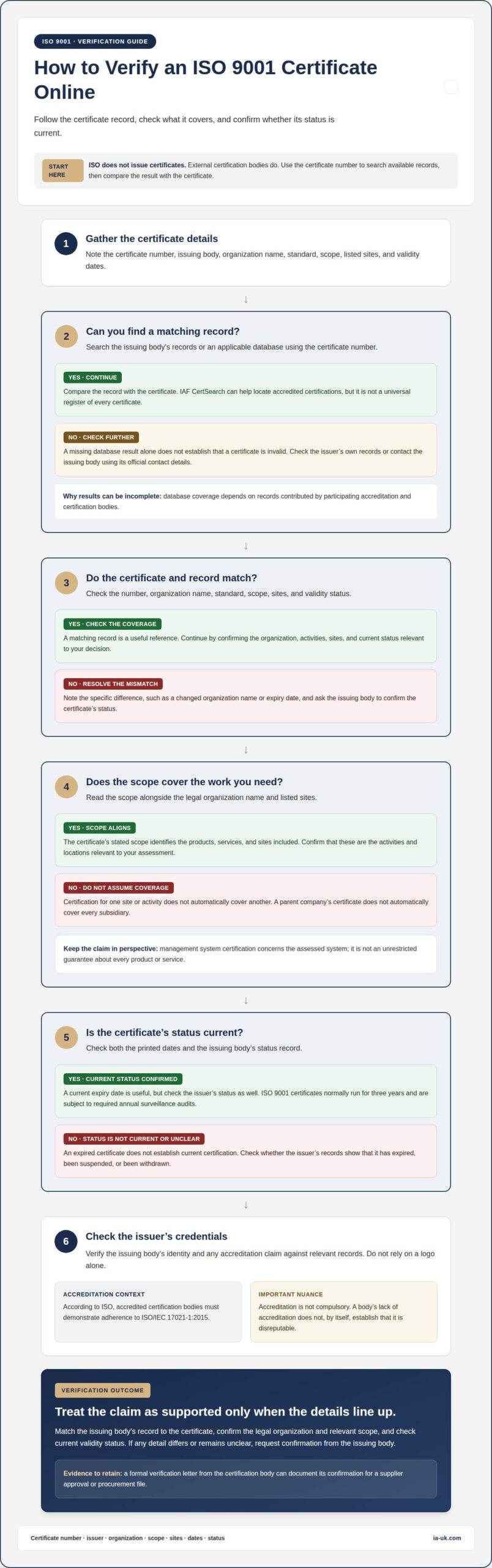
Check the issuing body, certificate number, named organization, scope and validity dates. Match these details with the issuer’s records and confirm the certificate has not expired, been suspended or withdrawn.
An ISO certification checker online can help locate certificate information, but you still need to confirm that the result matches the company and activities you’re assessing.
Checking Certificate Dates and Validity
Certificate dates show when an ISO 9001 certification was issued and when its validity ends. Check both dates against the issuing body’s records, since a certificate that has passed its expiry date doesn’t establish current certification. ISO 9001 certificates normally run for three years and are subject to required annual surveillance audits. A current expiry date is useful, but it doesn’t replace checking the issuer’s status.
Confirming Certificate Ownership
Certificate ownership means the certificate identifies the legal organization whose management system was assessed. Compare its registered or legal name with the company you’re evaluating. Allow for a trading name only when the relationship is clear. Then check whether the listed sites match the operations relevant to your decision. A certificate issued to a parent company, for example, does not automatically cover every subsidiary.
Recognizing Fake or Misleading Certificates
A certificate may be misleading if its number returns no matching record, its issuer differs from the online record, or its dates have expired. Other warning signs include a different company name, an unclear scope, or claims that go beyond the products, services or sites named on the certificate. ISO does not issue certificates. Certification is carried out by external certification bodies.
Issuer competence is another part of the assessment. According to the International Organization for Standardization, accredited certification bodies must demonstrate adherence to ISO/IEC 17021-1:2015. Accreditation provides a way to assess the body’s recognized competence, but accreditation isn’t compulsory; a body’s lack of accreditation doesn’t, by itself, establish that it’s disreputable. Check the issuer’s identity and accreditation claim against the relevant records rather than relying on a logo alone.
For an online check, search the issuer’s certification records or an applicable database using the certificate number. Compare the returned organization name, standard, scope, sites and validity status with the certificate. If details differ, contact the issuing body using its official contact details and request confirmation of the certificate’s status. A scan or logo on a company page is not independent evidence.
Scope determines what the certification actually covers. A company may hold ISO 9001 certification for one site or defined activity without covering every part of its business. Read the scope alongside the organization name and dates before treating the certificate as evidence for a particular supplier relationship. The phrase management system certification concerns the assessed system, not an unrestricted guarantee about every product or service.
How to verify an ISO certificate online
Online verification compares certificate details with records maintained by the issuer or an accreditation database. ISO does not issue certificates or operate a certificate-verification database.
For an international search, IAF CertSearch aggregates accredited certification data from accreditation bodies and certification bodies. The Global Accreditation Cooperation assumed the former roles of IAF and ILAC, and IAF’s work passed to it on 1 January 2026.
Online Certificate Verification
Online certificate verification means searching an issuer’s or database’s records using details printed on the certificate. Start with the certificate number, then compare the organization, standard and status in the result with the document. IAF CertSearch can help locate accredited certifications, but a missing result alone does not establish that a certificate is invalid. Records vary by issuer and database.
Some online searches offer free access to available records; formal written confirmation is a separate request. Check what the search result actually covers. A company name or number displayed in a result does not, by itself, establish that the certificate covers the relevant site or activity.
Checking Certificate Scope and Dates
Scope and date checks establish which operations a certificate covers and whether its stated validity period remains current. Compare the database entry with the certificate’s scope, issue date and expiry date. For example, a result covering one site is not proof that a different site is included.
Check whether the issuer’s record shows a current status, rather than relying only on an unexpired date printed on a copy. If the database entry and document differ, note the specific mismatch, such as a changed company name or different expiry date. This makes an inquiry to the issuer more precise.
Official Checker or Database Availability
There is no ISO-operated checker for confirming individual certificates because ISO develops standards but does not certify organizations. IAF CertSearch is a database for accredited certifications, not a universal register of every certificate issued worldwide. Its coverage depends on records contributed by participating accreditation and certification bodies.
If a certificate does not appear in a database, use the issuer’s records. Confirm that the issuing organization matches the certificate, then ask it to verify the certificate number and current status. A database search provides a useful independent reference, while the issuing body holds the direct record.
A formal verification letter can document the issuer’s confirmation for a supplier approval or procurement file. Request it from the certification body named on the certificate, providing the certificate number, company name and specific detail requiring confirmation. Ask the issuer to address the certificate’s status, scope and validity dates. Keep the letter with the certificate copy so the verification can be traced to its source.
Certificate scope, expiry, and surveillance audits
A certificate’s scope, expiry date and audit status show what its ISO 9001 certification covers and whether it remains current. Read these details together, because a valid certificate may apply only to particular services, products or sites.
Scope identifies the activities and locations included in the certified management system. ISO 9001:2026 Clause 4.3 requires each organization to determine its certification scope. The certificate should state the products, services and sites covered, giving a buyer a defined reference for assessing a supplier’s claim.
For example, a certificate naming one manufacturing site does not automatically cover a separate warehouse or another company location. Compare the stated scope with the specific operation relevant to your decision. A broad company name alone does not establish that every service or site is included.
Check the certificate’s issue and expiry dates, then establish whether its status remains active. An ISO 9001 certificate normally runs for three years. A certificate that has expired shouldn’t be treated as current evidence of certification, even if the organization’s website still displays it or a copy remains available online.
Edition details matter during standards transitions. Certificates to ISO 9001:2015 stay valid during the transition to ISO 9001:2026, which ends on 30 September 2029. Therefore, seeing “2015” on a certificate doesn’t by itself mean that the certification has expired. Read the edition alongside the certificate’s dates and status.
Surveillance audits are another part of ongoing certification validity. An ISO certification is valid for up to three years and is subject to required annual surveillance audits. These audits support continued assessment between certification and renewal. When reviewing a supplier, look for the current status in the issuer’s records, not just an old audit date or a certificate image.
Older references may use the name International Accreditation Forum (IAF). Its work passed to the Global Accreditation Cooperation on 1 January 2026. The former IAF aggregated data from 75 Accreditation Bodies and 1,362 Certification Bodies, so older references to an international accreditation forum may describe historical arrangements rather than the current body.
For a practical assessment, record the certificate’s exact scope, named sites, edition, issue date, expiry date and current status. Then compare those details with the supplier’s actual operations. If a certificate lists a different site, narrower activity or expired date, it may not support the specific claim being assessed.
Checking IAF MLA signatory status
Certification and accreditation describe different assessments. A certification body audits an organization’s management system and issues a certificate; an accreditation body assesses the competence of certification bodies. Checking signatory status helps establish whether an accreditation body participates in a recognized international arrangement.
The IAF Multilateral Recognition Arrangement, or MLA, was associated with the International Accreditation Forum. Its work passed to the Global Accreditation Cooperation Incorporated (Global ACI), which assumed the former roles of IAF and ILAC. Older certificates or records may therefore still refer to IAF, while current information may use Global ACI terminology.
To assess a certificate’s accreditation chain, identify the accreditation body named by the certification body. Then check whether that accreditation body is a signatory to the relevant recognition arrangement. Do not treat a certification body’s membership, logo or general claim of international recognition as proof of signatory status. The relevant evidence concerns the accreditation body and the specific accreditation it grants.
Scope matters. An accreditation body’s recognition may apply to particular standards or activities, so confirm that the scope includes management system certification relevant to ISO 9001. For example, a signatory entry covering a different accreditation activity doesn’t establish that the body’s ISO 9001 accreditation falls within that recognition. Match the listed scope with the standard and certification activity shown on the certificate.
Names also need careful matching. A certificate may identify a certification body, while its accreditation mark identifies a separate accreditation body. Search the accreditation body’s current official records using its exact legal name, then review its signatory status and scope. If the certificate uses a trading name or group brand, establish which legal entity holds the accreditation.
Global ACI’s role matters when interpreting references to IAF MLA signatory status. An older record may use IAF terminology, but that wording alone does not establish an accreditation body’s present status. Check current records under the organization responsible for the relevant recognition arrangement, and compare the named body and scope rather than relying on an archived logo or statement.
Accreditation is not compulsory, and a certification body’s lack of accreditation does not automatically establish that it lacks credibility. However, signatory status can provide a defined reference when a buyer requires accredited certification or needs confidence in cross-border recognition. Apply the requirement that matters to the transaction, then distinguish accredited certification from certification without accreditation.
For a supplier review, record the accreditation body, its signatory status and the relevant scope. Keep those details alongside the certification body’s name and the certificate’s standard. This creates a traceable basis for comparing an international supplier’s credential with procurement requirements, rather than relying on a standalone claim of global recognition.
Checking certificate numbers online
A certificate number gives an online search a precise reference, but the number alone does not prove current certification. Use it to locate a record, then compare that record with the certificate and the company’s claim. The issuing certification body’s records and an applicable accreditation database offer different verification routes.
Enter the full number exactly as printed, including letters, punctuation and leading zeroes. If a search returns no match, check for transcription errors before drawing conclusions. Then search the certification body’s own records or use IAF CertSearch, which aggregates data for accredited certifications from accreditation bodies and certification bodies.
A result is useful only when its details align. Compare the certificate number in the record with the document, then check the organization name, applicable standard, scope, sites and current status. For example, a matching number paired with a different legal entity needs further examination. A number copied from another company’s certificate does not verify the supplier you’re assessing.
Search results may distinguish current records from certificates that have expired, been suspended or withdrawn. Read the status wording carefully and compare it with the certificate’s issue and expiry dates. If a database shows a different date or status, treat it as a discrepancy to resolve with the issuing certification body, not as a detail to overlook.
IAF CertSearch is relevant when a certificate claims accredited certification. Its records aggregate information from accreditation bodies and certification bodies, but coverage depends on available database records. A missing result is not, by itself, proof that a certificate is false. The certification body can confirm whether it issued the number and explain its current status.
Keep a clear audit trail for supplier approval. Record the search date, database or issuer consulted, number entered and result shown. Save the certificate copy and any formal confirmation with that record. If a supplier later presents an updated certificate, compare the new number and status rather than assuming an earlier search still applies.
For a procurement decision, the strongest conclusion comes from matching the number on the certificate with an authoritative record, then confirming scope and status. If the issuer’s online record is unavailable or incomplete, request written verification directly from that certification body. This gives your review a traceable source rather than relying only on a document supplied by the organization being assessed.
Accreditation information can help clarify the assurance framework behind certification. Review accreditation information as part of understanding how certification bodies are assessed.
International Associates Limited: ISO 9001 Quality Management System Certification
International Associates Limited provides ISO 9001 Quality Management System Certification for organizations seeking independent assessment against the standard. Turn to this service when your organization needs a formal evaluation of its quality management system, rather than verification of another company’s certificate.
The certification process includes formal stage 1 and stage 2 audits to assess whether the organization meets the requirements of the applicable international standard. The assessment examines the management system against ISO 9001 requirements and supports a certification decision based on audit findings. International Associates Limited also provides ISO 14001 Environmental Management System Certification, ISO 45001 Occupational Health and Safety, and Social Accountability Audits for organizations with related assurance needs.
Contact International Associates Limited to discuss ISO 9001 certification for your organization.
Make verification part of your next decision
Build certificate review into supplier approval so evidence is considered alongside the needs of the specific business relationship. An ISO certification checker online can support that review, while procurement records preserve the basis for decisions and future reassessment.
If your own organization is pursuing independent certification, International Associates Limited offers ISO 9001 Quality Management System Certification and ISO 14001 Environmental Management System Certification. Social Accountability Audits are also available when social accountability forms part of your assurance priorities. These services address distinct assessment needs, so select the route that aligns with your organization’s objectives.
Share the standard and assessment requirement relevant to your organization to begin a focused discussion. Discuss your certification requirements with International Associates Limited, and take the next step with a clear basis for planning.
Frequently Asked Questions
How can I verify an ISO certificate online?
Search the certificate number in the issuing certification body’s records or an applicable accredited-certification database. Compare the result with the certificate and the organization’s claim, especially if the document is being used for a tender or supplier approval. Treat a search result as evidence to assess, not a substitute for checking that the named organization and certified activity match the business relationship under review.
How do I check whether an ISO certification body is accredited?
Identify the accreditation body named on the certificate or by the certification body, then check that body’s official records for the certification body and relevant standard. Accreditation relates to a certification body’s competence within a defined scope, so a general accreditation claim may not cover every standard. For a purchasing decision, retain the relevant scope information with the certificate review.
How can I verify an ISO certificate number, scope, and expiration date?
Search the full certificate number, preserving letters and punctuation, and compare the result with the document. For a multi-site supplier, confirm that the sites and activities important to your contract fall within the listed scope. Record any difference in the number, scope or expiry date, then seek clarification from the issuing certification body before relying on the certificate for that decision.
Which accreditation databases list legitimate ISO certification bodies in the United States?
IAF CertSearch provides records for accredited certifications and draws information from accreditation bodies and certification bodies. It is not a complete register of every certificate or certification body in the United States. Check the accreditation body’s own records for its certification bodies and the applicable standard scope. The Global Accreditation Cooperation Incorporated now carries forward the former IAF and ILAC roles.
What should I do if an ISO certificate cannot be verified online?
First, check the certificate number for transcription errors and search the issuing body’s records. If the record remains unavailable, contact the certification body using independently sourced contact details and request written confirmation of the status. Keep the response with the certificate and note any differences in company name or scope. Until the discrepancy is resolved, do not treat the document alone as proof for a procurement decision.