
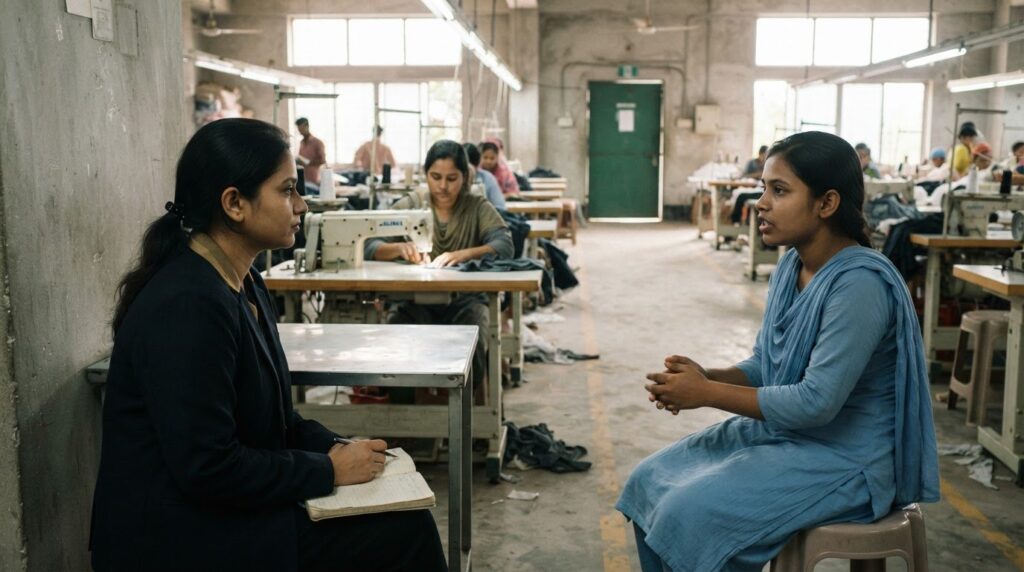
Findings often arise when workplace records, written procedures and conditions observed on site do not align. Effective social compliance audit preparation brings these elements into view before the audit, especially payroll and working-hours records, health and safety practices, and workers’ accounts of their experience. The issue may not be a missing document; it may be a gap between documented processes and how work is actually carried out.
Preparing for an audit can feel demanding because auditors assess both evidence and actual workplace conditions. Understanding the audit scope and on-site process helps organisations focus on areas likely to reveal gaps, rather than treating preparation as a paperwork exercise.
This article explains why audits produce findings, what auditors assess, and how internal, supplier, third-party and certification audits differ. It also covers what happens after the visit, including how reports record issues and how corrective actions are followed up.
Key Takeaways
- Learn how audit findings are recorded and how corrective actions can be tracked through follow-up.
- Identify which payroll and workplace records help auditors assess whether documented procedures match practice.
- Understand how audit scope affects the workplace areas reviewed, from labor standards to health and safety.
- Distinguish internal, supplier, third-party and certification audits so you can interpret their purpose and outcomes.
- See what an on-site audit involves, including how workplace conditions and worker perspectives inform the assessment.
Audit reports, non-conformities, and corrective action plans
An audit report records evidence, findings and required responses from a workplace assessment. Its value depends on whether each issue is traceable to a specific observation or record.
Audit Reports and Non-Conformities
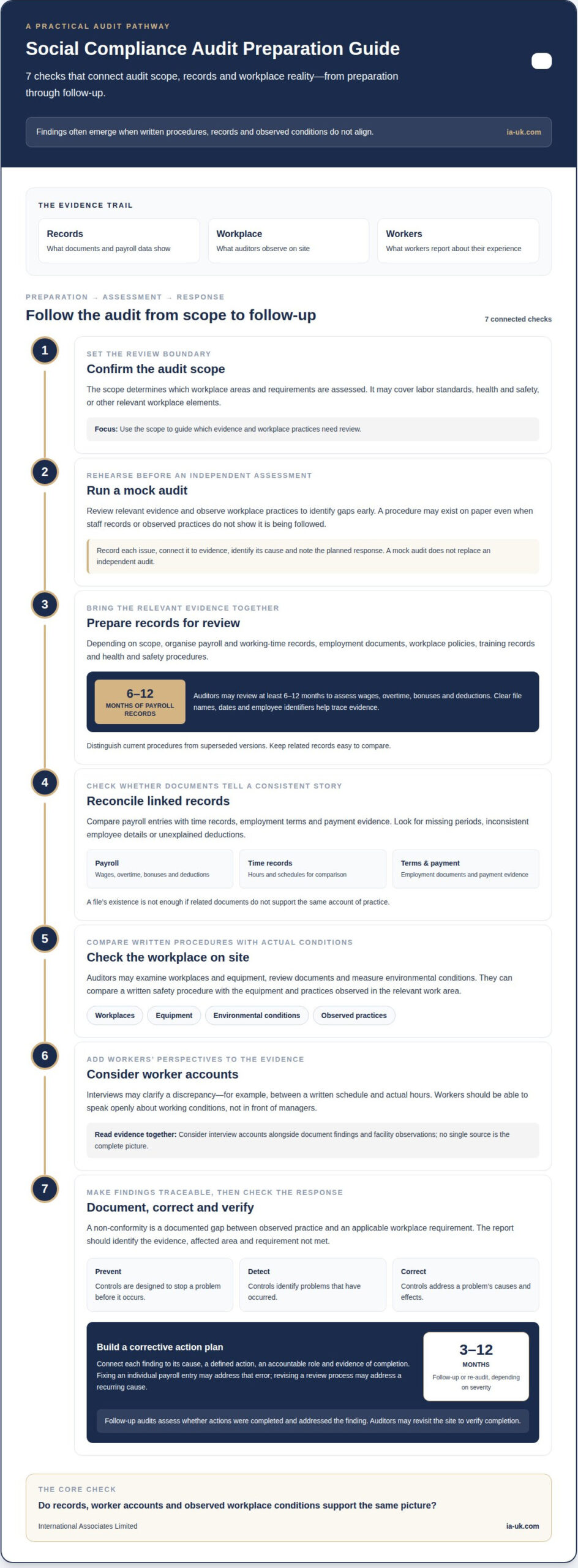
A non-conformity is a documented gap between observed practice and an applicable workplace requirement. The report should describe the evidence, identify the affected area and explain which requirement was not met. For example, a payroll record that does not support a recorded overtime payment gives the finding a clear basis.
Specific findings help management distinguish an isolated record error from a broader process failure. They also make it possible to assign responsibility and track an appropriate corrective action. According to the International Labour Organization, the ILO Equal Remuneration Convention, 1951 (No. 100), sets out equal pay for work of equal value. A report can therefore focus attention on whether pay practices support that principle.
Preventative, Detective, and Corrective Controls
Preventative controls are designed to stop a problem before it occurs, detective controls identify problems that have occurred, and corrective controls address their causes and effects. In a payroll example, a documented approval process may prevent an unauthorised deduction, a reconciliation may detect a discrepancy, and a corrected payment may address the immediate error.
These controls differ in timing and purpose, so a workplace needs to understand what each demonstrates. A finding may persist if the immediate issue is fixed but the underlying process remains unchanged. Recording each control, its owner and the evidence it produces helps show whether the response addresses both the specific case and its cause.
Corrective Action Plans and Follow-Up Audits
A corrective action plan sets out steps to address problems or compliance gaps recorded in the audit report. A useful plan connects each finding to its cause, a defined action, an accountable role and evidence of completion. For example, correcting a payroll entry may resolve an individual error, while revising a review process may address its recurring cause.
Follow-up audits assess whether the proposed actions were completed and whether they addressed the finding. Social compliance audits commonly verify corrective actions through a follow-up or re-audit within 3-12 months, depending on severity. Auditors may revisit the site to verify completion. Keeping records of each action and its evidence supports a clearer review at that stage.
Mock Audits and Corrective Actions
A mock audit is an internal rehearsal that uses relevant evidence and workplace observations to identify gaps before an independent assessment. It can reveal, for example, that a written procedure exists but staff records or observed practices do not show it being followed. Recording these gaps gives the organisation a basis for corrective action.
To make the exercise useful, follow the report trail: connect each issue to evidence, identify its cause, then record the planned response. A mock audit does not replace an independent audit, but it can help organise records and clarify how the workplace will demonstrate completed actions.
For organisations working across regulatory requirements, regulatory compliance assessment can help connect applicable obligations with audit evidence and corrective action records.
What is the most common reason a social compliance audit produces findings?
A frequent source of findings is a mismatch between documents, worker accounts and conditions observed at the facility. Payroll may show one schedule while time records or worker interviews indicate another. Social compliance audit preparation should connect written evidence with actual workplace practices, rather than treating document collection as the whole task.
Auditors may review at least 6-12 months of payroll records to assess wages, overtime, bonuses and deductions. The review can compare payroll entries with time records, employment terms and payment evidence. A missing period, inconsistent employee details or unexplained deduction can make it difficult to verify whether records reflect practice. The issue is not simply whether a file exists, but whether related documents tell a consistent story.
For audit day, organise relevant documents so the facility can present a coherent record of its practices. Depending on the audit scope, this may include payroll and working-time records, employment documents, workplace policies, training records and health and safety procedures. Clear file names, dates and employee identifiers help auditors trace evidence across records. If a procedure has changed, distinguish the current version from superseded documents to avoid confusion.
Auditors consider document review alongside on-site inspection. They may examine workplaces and equipment, review payroll and other documents, and measure environmental conditions. For example, they can compare a written safety procedure with the equipment and practices observed in the relevant work area. Documenting who maintains each record and how updates are approved also helps show whether a process is monitored consistently.
Worker interviews provide another form of evidence. Effective social audits conduct interviews where workers feel safe speaking openly about working conditions, not in front of managers. A worker’s account may help clarify a discrepancy between a written schedule and actual hours. Interview notes and document findings can then be considered alongside facility observations, without treating any single source as the complete picture.
Falsified records can undermine the reliability of audit evidence and lead to more serious findings. Retaliation can discourage workers from sharing accurate information, while unresolved noncompliance can leave workplace risks unaddressed and affect business relationships. When records conflict, preserve the original evidence, document the discrepancy and identify the process responsible. Correcting the record alone does not explain why it differed from other evidence.
A structured social accountability audit assessment brings document review, facility observations and worker evidence into one evaluation. That joined-up view helps distinguish an isolated recordkeeping error from a process that needs broader attention.
Audit scope and assessed workplace elements
Audit scope defines which workplace activities and requirements an assessment covers. Applying that scope to actual facility operations helps prevent departments or processes from being overlooked.
Audit Scope and Purpose
Set the scope around the facilities, activities and workforce groups the assessment is intended to examine. A site boundary should reflect how work is organised, including relevant production areas and supporting functions. This gives the assessment a practical purpose: evaluating operations within its defined limits.
For a facility with separate production lines, map each line to its activities and responsible teams. If a process is outsourced or shared between locations, clarify how it relates to the assessment boundary. These distinctions show what the audit covers and where its conclusions apply, rather than assuming a site-wide review automatically includes every connected operation.
Workplace Practices and Assessment Areas
Assessment areas translate selected requirements into workplace practices that can be evaluated. Working hours, for example, should be considered in relation to the roles, shifts and operating patterns within scope. Policies should also match the activities they govern; a policy covering production staff may not address a separate warehouse function.
Build an internal map connecting each relevant activity with its responsible function and applicable policy. This helps reveal where responsibilities overlap or a work area falls outside existing procedures. A facility with multiple departments can use the map to distinguish common requirements from controls specific to particular tasks. The result is a clearer view of how requirements relate to day-to-day operations.
Understanding Audit Requirements
Understanding requirements means interpreting each applicable criterion in the context of the facility’s work. Identify the teams, processes and locations it affects, then determine what practical evidence would show how it is applied.
For example, consider a working-hours requirement against the facility’s actual shift arrangements and the roles covered by the assessment. A workplace-conduct requirement may relate to different functions across the same site. Mapping each criterion to the relevant operation helps prevent a narrow interpretation that overlooks a department or work pattern.
Where requirements overlap, record how the facility addresses the shared issue and which function owns each part. This clarifies responsibilities and helps distinguish a site-wide process from department-specific practice. Scope decisions should also account for operational changes, such as a new production activity, so the assessment remains aligned with the work actually performed.
Internal, supplier, third-party, and certification audits
Social audits may be conducted by internal, external or independent auditors. The audit’s purpose and relationship to the organisation affect how findings are used.
Types of Social Compliance Audits
An internal audit is conducted within the organisation, while a supplier audit assesses a supplier’s workplace practices. A third-party audit uses an external assessor, and a certification audit evaluates conformity against a specified standard. These approaches serve different needs, from internal monitoring to buyer assurance or certification assessment.
Buyer companies often request supplier workplace social audits, sometimes as a condition of continued business. For a supplier, the requested scope and audit criteria shape which evidence is reviewed. An internal review can identify issues before an external assessment, but it does not replace independent verification when a buyer or certification process requires it.
Auditor Workspaces and Confidential Interviews
A dedicated auditor workspace supports document review, while private interview settings help protect the independence of worker accounts. The workspace should allow orderly access to requested records without disrupting facility operations. Interview arrangements should keep workers out of hearing range of managers and supervisors.
Effective social audits include worker interviews in a location where workers feel safe speaking openly about working conditions. Workers should not be interviewed in front of managers, because fear of reprisals can limit what they report. Confidential conversations can help auditors understand workplace practices that written records alone may not reveal.
Worker Interviews and Staff Briefings
Worker interviews provide direct evidence about working conditions, while staff briefings explain the audit process and practical arrangements. A briefing can clarify who coordinates access to records, which areas are included, and how normal operations will continue during the visit. It must not script workers’ answers or influence their accounts.
Managers can prepare staff by explaining the audit’s scope and where questions should be directed. Workers need space to describe their own experience without coaching or supervisors’ observation. This distinction helps the auditor assess conformity and compare interview evidence with facility observations and records.
Mock Audits and Internal Reviews
A mock audit is an internal review that uses audit criteria to identify possible gaps before an external assessment. It can test whether records are accessible, staff understand relevant policies, and health and safety practices align with documented procedures.
Internal reviewers should record findings and investigate their causes, rather than correcting only visible symptoms. For example, repeated gaps in safety training records may point to a weakness in documenting completed training. The organisation can then assign an owner, retain evidence of action and review whether the process works. Independent auditors provide a separate assessment of conformity.
On-site social compliance audit
An on-site audit compares workplace conditions with the applicable code, national requirements and supply chain expectations. Its value comes from observing how work is conducted during ordinary operations, not just reviewing written policies.
Audit arrangements can be scheduled or unannounced, depending on the programme and its requirements. Social compliance audits are generally scheduled semi-announced within an agreed window of 2 to 3 weeks. This approach gives the facility a defined period while limiting the opportunity to stage conditions for a particular visit. The audit’s timing and access arrangements shape what the assessor can observe.
Audit duration depends on facility size, scope and site complexity. A small facility’s simple two-pillar audit can usually be completed in one day. A larger site or multiple sites may require two to four days or more. The assessment may include workplace inspections, records review and confidential worker interviews, with the sequence adjusted to the site and audit scope.
During a walk-through, auditors examine work areas, equipment and conditions relevant to the selected criteria. They may compare observed practices with records and staff explanations. For example, a written procedure may describe safe equipment use, while the on-site assessment shows whether it is followed during production. This comparison can reveal differences between documented expectations and normal practice.
Timing also affects the evidence available. Audits should be conducted regularly and scheduled for periods when code violations are most likely, such as harvest time in agriculture or maximum production in manufacturing. An assessment during peak activity can show whether working practices remain consistent under operational pressure. The relevant season or production cycle depends on the facility’s activities.
Local knowledge can support an accurate assessment across different workplaces. Local auditors may understand the country’s culture, language and customs, helping them interpret communication and site practices in context. Audit professionals should also be trained to handle sensitive situations involving children and adult victims of exploitation. Procedures should direct potential victims to immediate care from qualified people or organisations.
An on-site audit has limits. Social audits can fail to identify severe forced labour abuses associated with repressive government regimes or state-imposed forced labour programmes. Audit evidence is therefore one part of responsible supply chain oversight, not proof that every risk has been eliminated. Clear scope, appropriate timing and careful conduct strengthen the assessment while preserving that distinction.
For an independent assessment of workplace practices, arrange a social accountability audit suited to the applicable scope and site conditions.
International Associates Limited: Social Accountability Audits
International Associates Limited provides Social Accountability Audits for organisations seeking an independent assessment of workplace practices against applicable social requirements. Turn to an audit when buyer expectations, supply chain requirements or internal oversight call for a structured review of working conditions and related evidence.
The assessment can help identify where documented policies and workplace practices differ, giving your organisation a clearer basis for addressing findings. Its scope should reflect the applicable framework and the sites being assessed, so the review remains relevant to your operational context. Where broader management-system certification is also relevant, International Associates Limited offers ISO 9001, ISO 14001 and ISO 45001 certification.
Contact International Associates Limited to discuss a Social Accountability Audit for your organisation.
Make the Next Audit Part of Ongoing Oversight
Use the next stage of social compliance audit preparation to connect assessment outcomes with routine oversight. Rather than treating an audit as a single event, consider how responsibilities, evidence and review processes can remain clear between assessments. This forward-looking approach helps keep social compliance connected to operational decisions, supplier relationships and workplace expectations.
International Associates Limited provides Social Accountability Audits, alongside ISO 9001 Quality Management System Certification and ISO 14001 Environmental Management System Certification. These services address different assessment needs, so the relevant next step depends on whether your priority is workplace accountability or a wider management system certification.
A focused discussion can help establish the assessment scope that fits your organisation and its supply chain requirements. Contact International Associates Limited to discuss your audit needs and identify a practical next step for continued improvement.
Frequently Asked Questions
Do wage and hour records only need to cover the most recent pay period?
No. Auditors may review at least 6-12 months of payroll records to assess wages, overtime, bonuses and deductions. The period allows them to compare patterns across pay cycles rather than rely on a single snapshot. Keep related timekeeping and payment records organised alongside payroll, so differences between recorded hours, amounts paid and deductions can be assessed consistently.
Should workers be told what to say during interviews?
No. Workers should not be coached or given scripted answers, because interviews need to reflect their own experiences. Staff can be told the interview’s purpose and that they may speak openly, but managers should not direct their responses or attend confidential discussions. For example, explaining where an interview will happen is logistical preparation; rehearsing a preferred answer compromises the independence of the evidence.
What are the key components and main elements?
Key components include defined assessment criteria, evidence gathering, findings and a response process. The criteria establish what the audit evaluates; evidence can include records, workplace observations and worker accounts. Findings document gaps against those criteria, while corrective actions address identified issues. For example, a working-hours concern may require reviewing records and workplace practices together before deciding whether the issue is isolated or procedural.
What happens during an on-site factory audit?
Auditors assess the facility by examining relevant work areas, reviewing records and speaking with workers. They may compare a written procedure with actual production practices, then document findings against the audit scope. The visit can also include discussions with responsible staff to understand how workplace processes operate. The sequence depends on the facility and assessment scope, while access to workers and relevant areas supports a complete review.
What should a supplier prepare before an audit?
A supplier should organise records relevant to the audit scope, including payroll, working-time information, employment documents, workplace policies, training records and health and safety procedures. Assigning a coordinator to locate records can reduce delays during document review. The supplier should also make relevant work areas accessible and arrange private space for worker interviews. These arrangements support evidence gathering without scripting staff responses or unnecessarily disrupting normal operations.
What violations are typically found during walkthroughs?
Walkthrough findings can include unsafe equipment conditions, inadequate protective measures, blocked access routes, poor housekeeping or workplace practices that differ from written procedures. The applicable audit criteria determine whether an observation becomes a finding. For example, auditors may note that a safety policy requires a particular control while the relevant production area shows it is not being followed. They document the observation and assess it against the defined requirement.
Which core elements are assessed?
Core elements commonly include human rights, labor rights and workplace health and safety, with environmental responsibilities included where the audit scope requires them. Specific criteria depend on the selected framework. For example, a standard multi-pillar assessment scope covers labor standards and health and safety; extended scopes may also cover environmental assessment and business ethics. The scope tells the facility which requirements shape the assessment.
What is a social compliance audit and what standards does it cover?
A social compliance audit assesses workplace practices against applicable laws, codes of conduct or standards relating to human rights, labor rights and environmental responsibilities. It may use a structured methodology or assess a specific framework such as SA8000, depending on the required outcome. These approaches help organizations verify that their supply chains operate ethically and consistently meet international labor expectations.