
A certificate that looks official can still make claims its scope doesn’t support. Before reporting a company, identify what the certificate claims, distinguish the issuer’s role from a regulator’s, and keep a clear record of the concern. These steps help you decide how to report a company with a fake certificate through an appropriate channel without presenting an allegation as a proven fact.
It’s reasonable to want your report to be clear and useful. This guide explains how to identify the relevant agency, organise evidence, and consider anonymity before submitting a complaint. It also explains when independent certification is relevant to your own organisation, rather than a way to investigate another company.
Key Takeaways
- Look for inconsistencies in the certificate and its claims before deciding how to raise a concern.
- Identify which government agency oversees the relevant certificate type so your report reaches the appropriate channel.
- Keep clear records of the certificate and the company’s related claims to support a factual complaint.
- Consider how anonymity and identity disclosure may affect the reporting process before submitting your complaint.
- Learn how to file a complaint with the Better Business Bureau and share your concern on social media responsibly.
How can I verify whether a company certificate is fake in the United States?
Start by identifying who issued the certificate and what it claims to verify. It may refer to a voluntary standard, an industry credential, or a legal requirement, and those are different claims. Record the certificate title, issuing organisation, holder’s legal name, scope, and validity dates. Then contact the issuer using contact details found independently, not links in a suspicious email. Ask whether the certificate number and stated scope match its records.
Check whether the certificate covers the company, product, site, or activity being promoted. A valid certificate for one facility, for example, does not establish that every company location is covered. Compare the holder’s name and scope with the company’s public claim. A mismatch could reflect an outdated document or a misleading claim, so assess the exact wording before drawing conclusions.
- Confirm the issuer: Find the organization’s identity independently and ask whether it issued the document.
- Match the holder: Compare the certificate’s legal entity with the company making the claim.
- Read the scope: Check the named products, services, sites, or processes covered.
- Review dates and identifiers: Ask the issuer to confirm the certificate number and validity details.
- Separate certification from law: Verify any claimed legal requirement with the relevant government authority.
Pay particular attention when a message uses a standard number to support an urgent legal threat. A suspicious AAA-themed email claimed a federal rule would take effect on July 1, 2026, requiring passenger vehicles to carry a certified emergency rescue tool. It warned of a $200 fine per occurrence and described a 60-second compliance check. These precise claims do not establish that the cited requirement exists.
The email cited NHTSA FMVSS 571.220. That standard covers school bus rollover protection, not a requirement for everyday passenger vehicles to carry an emergency rescue tool. AAA confirmed it did not send the suspicious email and warned that it could be malicious. This example shows why a standard number, official-sounding language, or a branded message should not be treated as proof by itself.
If the issuer cannot validate a document, preserve the certificate and the company’s exact claim. Keep the message, screenshots, and any response from the issuer together. Separate what you confirmed from what remains an allegation. This record will help you explain your concern accurately when deciding how to report a company with a fake certificate.
Which government agency regulates the type of certificate the company claims to hold?
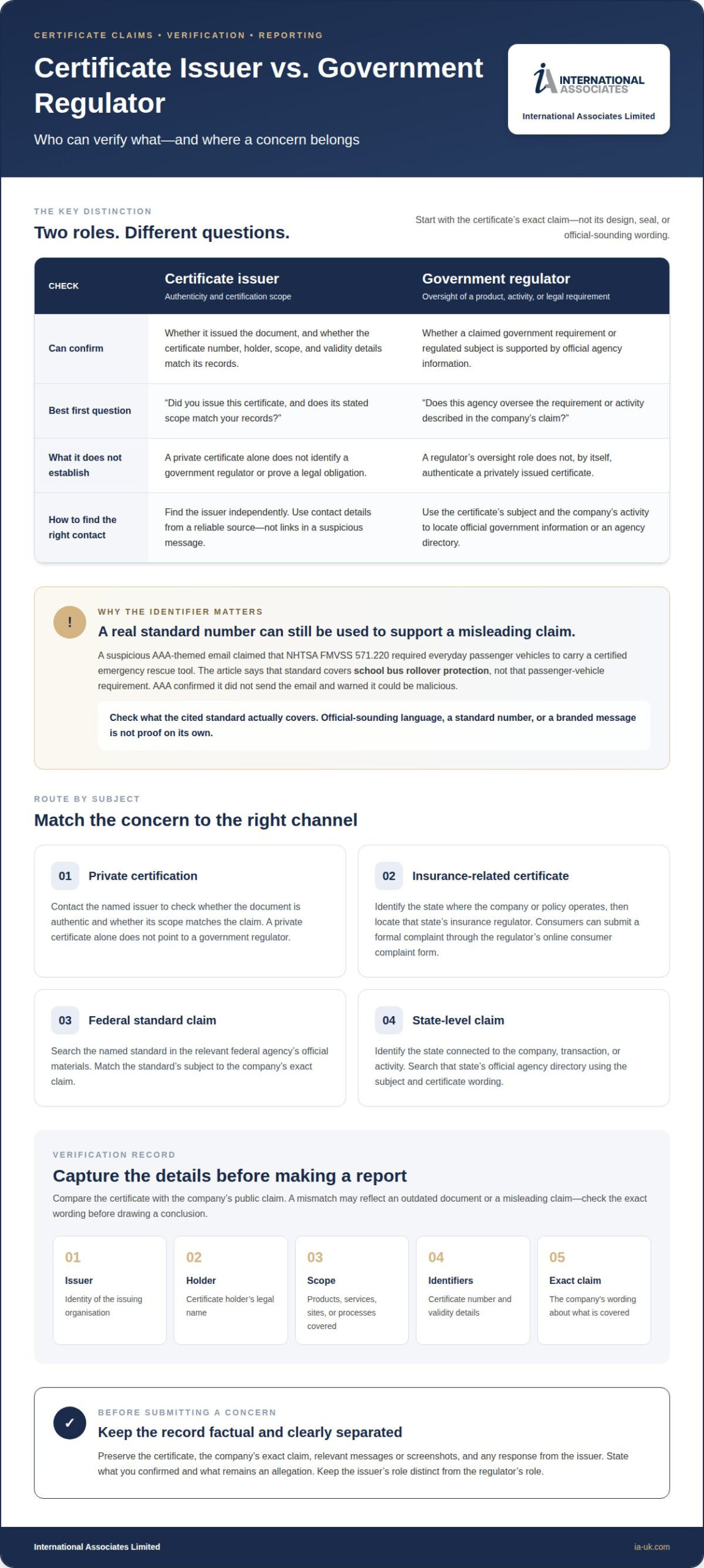
Start with the exact claim, not the certificate’s design. A certificate may document a private standard, an industry credential, or compliance with a government requirement. Those categories can involve different organizations. The issuing body can confirm whether it created the document, while a government agency may oversee the underlying product or activity. One role does not automatically establish the other.
Use the certificate’s title and stated purpose to identify the relevant oversight area. Note whether it concerns insurance, workplace safety, a product, an environmental claim, or a management system. Then look for official government information about that subject. Don’t choose an agency solely because its name, seal, or standard number appears on the certificate.
- For an insurance-related certificate: Identify the state where the company or policy operates, then locate that state’s insurance regulator. Consumers can submit a formal complaint about an insurance company through the regulator’s online consumer complaint form.
- For a federal standard claim: Search the named standard in the relevant federal agency’s official materials. For example, NHTSA FMVSS 571.220 concerns school bus rollover protection.
- For a state-level claim: Identify the state connected to the company, transaction, or activity. Then search that state’s official agency directory using the subject and certificate wording.
- For a private certification: Contact the named issuer about authenticity and scope. A private certificate alone does not identify a government regulator.
The NHTSA example shows why the identifier matters. A document can cite a real standard while misrepresenting what it covers. Match the certificate’s claim to the standard’s subject, then determine whether it concerns a government requirement or private certification. If a company links a certificate to a legal obligation, look for that obligation in government materials covering the same activity.
For an insurance complaint, the relevant state regulator may ask for your name and contact information, the agent or broker’s name, policy and membership numbers, any claim number, and details of your concern. These details help distinguish a complaint about an insurer from a concern about a certificate issued under another programme. A report sent to an unrelated agency may not address the issue.
In your report, distinguish the agency’s role from the issuer’s. State what the certificate claims, who issued it, and why you believe the claim falls under a particular oversight area. If you’re unsure which regulator is responsible, use the certificate’s subject and the company’s business activity to narrow your search before submitting a complaint.
How to report a company for using a fake certificate
Send the report to the agency responsible for the certificate’s subject. A concern about an insurance certificate differs from a claim involving a federal vehicle standard. Describe the company’s precise statement, identify the certificate, and explain why its use appears misleading. Focus on observable details rather than conclusions about intent.
For an insurance-company complaint, use the state insurance regulator’s online consumer complaint form. It may ask for your name and contact information, the agent or broker’s name, policy and membership numbers, any claim number, and details of your concern. Explain how the certificate relates to the policy or insurance representation. This helps distinguish a document issue from a complaint about another service.
For a certificate tied to a federal standard, identify the agency associated with that standard. For example, the suspicious vehicle email discussed earlier cited NHTSA FMVSS 571.220. That standard covers school bus rollover protection, not an everyday passenger-vehicle emergency-tool requirement. A report about that email should describe the cited identifier and the claim made alongside it. Don’t present the citation alone as proof of wrongdoing.
Organise the complaint so the agency can understand the issue without piecing together scattered screenshots. Include:
- The company’s legal or trading name and the relevant location.
- The certificate title, issuer, identifier, and stated scope.
- The company’s exact wording, with the date and place it appeared.
- Any response from the named issuer about the document.
- A concise explanation connecting the evidence to the agency’s area of oversight.
Use the agency’s designated complaint channel and keep a copy of everything you submit. If the form requests supporting documents, provide legible copies and label each file by its contents. For example, identify a screenshot as the company’s online certificate claim instead of submitting several unnamed images. Keep original messages and files intact.
Separate direct evidence from your interpretation. Write, “The company’s product page displays this certificate,” if that is what the screenshot shows. Then explain the discrepancy, such as a different company name or a scope that does not cover the advertised activity. Don’t state that the document is fraudulent unless the issuer or relevant authority has confirmed that finding.
For a suspicious message bearing AAA branding, AAA advises members to contact the organisation directly rather than click suspicious links. AAA confirmed it did not send the email described earlier and warned that it could be malicious. Preserve the message, avoid its links, and report the specific claim through the appropriate agency channel.
What evidence should I collect before reporting a company for a fake certificate
Build a record showing the certificate and the company’s exact claim. Save the certificate as received, including every page and attachment. Capture the webpage, advertisement, product listing, or email where the company used it. Include the visible company name and surrounding text. The certificate image alone may not show what the company claimed it proved.
Preserve the context. Record where you saw the claim and when you accessed it. For a webpage, capture the page title and full visible address. For an email, retain the original message, sender details, and attachments. Don’t rely only on a cropped image, which may remove details needed to understand the claim.
Keep the certificate’s identifying information legible. Record its title, issuing organisation, certificate number, holder name, scope, and validity dates. Note any difference between the certificate holder and the company using it. For example, a certificate naming one legal entity may be displayed by a different business. Describe the mismatch without assuming why it happened.
- Original document: Keep the file as received, plus a readable copy for review.
- Company claim: Save the exact wording beside the certificate image or document.
- Issuer response: Retain written confirmation or correspondence about issuance and scope.
- Timeline: Note when you found the claim and when relevant communications occurred.
- Related records: Keep contracts, receipts, or product details that explain your connection.
A company might advertise a certificate for a product line, for example, while the document names only a specific site or activity. Save both the advertising claim and the certificate page describing its scope. This comparison helps the agency understand the precise discrepancy and avoids turning a limited scope difference into a broader allegation.
Keep a simple evidence log. Give each file a descriptive name, such as “product-page-certificate-claim” or “issuer-email-response,” and add a short note explaining what it shows. Store originals separately from working copies, and don’t edit screenshots or messages. If you need to mark a section, annotate a duplicate instead.
Submit only material relevant to your concern, and redact unrelated personal details from copies where appropriate. Keep unaltered originals in case the agency requests them. Separate what the evidence directly shows from your interpretation. A clear record lets the recipient assess the certificate, the claim, and their relationship without relying on unsupported conclusions.
Can I report a company anonymously, and will my identity be disclosed
Anonymous reporting depends on the agency and complaint channel. A form that requires your name or contact details cannot ordinarily be completed anonymously. Confidentiality is different: it concerns how an agency handles information after submission. Don’t assume an anonymous option exists or that your identity will remain undisclosed.
For insurance complaints, the state regulator’s consumer form may ask for your name and contact information, the agent or broker’s name, policy and membership numbers, any claim number, and details of your concern. Required identity fields indicate that the form requests information about the complainant. Read the form’s instructions and privacy notice before submitting personal details. If its wording is unclear, contact the regulator through its official channel.
Separate what the form asks from what may happen afterward. A form can collect identifying information without explaining in the same field who may later see it. Read any notice about confidentiality, information sharing, or complaint handling. If the notice leaves a point unclear, ask the agency before filing. Don’t assume the process is the same as another state’s or another agency’s.
- For an anonymous report: Check whether the agency’s official channel accepts reports without a name or contact details.
- For a confidential complaint: Read the agency’s notice and determine how it describes identity handling.
- For an insurance complaint: Expect the state form may request personal and policy information.
- For a report with evidence: Remove unrelated personal details from copies, while preserving original records.
Consider the practical trade-off before choosing a channel. A report without contact information may limit the agency’s ability to ask follow-up questions. A named complaint gives you a way to clarify details, but it includes identifying information. The agency’s own form and privacy notice are the relevant sources for understanding these choices.
For example, if a state insurance form requests your name, policy number, and claim number, prepare those details before deciding whether to proceed. If you’re reporting a certificate claim to another agency, review its reporting channel separately. Don’t submit false contact details or assume a social media post offers the same privacy as an official complaint process. Keep a copy of the submitted form and note which channel you used.
International Associates Limited
International Associates Limited provides independent assessment and certification for organisations seeking to demonstrate conformity with recognised standards. If your concern relates to a company’s claims about its own management systems or social practices, independent certification can help establish a clear basis for assessing those claims. Its services include ISO 9001 Quality Management System Certification, ISO 14001 Environmental Management System Certification, ISO 45001 Occupational Health and Safety, and Social Accountability Audits.
These services are separate from investigating or reporting another organisation’s alleged certificate misuse. For suspected misuse, use the relevant issuer’s or regulator’s complaint process. For your organisation’s certification or social accountability assessment needs, contact International Associates Limited to discuss the appropriate next step.
Turn certificate concerns into stronger assurance
A concern about another company’s certificate can also prompt a review of how your own organisation presents its credentials. Clear, accurate claims help customers and partners understand what a certificate covers and which activities or sites fall within its scope. Keep certification records aligned with your organisation’s public statements.
Knowing how to report a company with a fake certificate is one part of responsible oversight. Your organisation’s next step may be to assess whether its own claims are precise, current, and supported by appropriate certification. Independent assessment can help establish a reliable basis for demonstrating conformity, while keeping your assurance needs separate from another company’s alleged misuse.
For support with your organisation’s certification requirements, contact International Associates Limited. A considered approach to assurance helps build confidence through evidence, clarity, and consistent practice.
Frequently Asked Questions
How do I report a company using a fake safety, inspection, or product compliance certificate?
To report a company with a fake certificate, send a factual complaint to the government agency overseeing the product or activity, and notify the certificate’s issuer separately. For a safety claim, describe the specific hazard or product representation rather than relying only on the certificate’s appearance. For an inspection document, identify the inspection date and the activity it supposedly covered. If there’s an immediate safety risk, prioritise reporting it through the relevant official channel.
What legal risks are there in publicly accusing a company of using a fake certificate?
Describe the concern using observable evidence, not as a proven allegation. Don’t call the certificate fraudulent unless the issuer or relevant authority has confirmed that finding.