

A measurable target can still be the wrong quality objective if it tracks activity without supporting the quality policy or business strategy. Knowing how to set quality objectives starts with linking the intended result to customer needs, organisational priorities and the processes that influence it.
It is tempting to focus first on the metric: without a clear measure, progress is difficult to assess. But a measure is useful only when the objective also has a relevant target, an owner, a timeframe and a way to monitor results. This guide explains what quality objectives are, how to align them with policy and business strategy, and how to choose indicators and targets that reflect real priorities. It also covers how to review progress, decide what action is needed and keep objectives relevant as organisational needs change.
Key Takeaways
- Connect each quality objective to a commitment in the quality policy and a business priority, so measures support meaningful outcomes.
- Choose indicators that show performance against a baseline, then set a clear target and timeframe.
- Document each objective with an owner, planned actions, resources and a method for evaluating results.
- Use management reviews to assess progress, understand missed targets and determine whether actions or objectives need to change.
- Apply ISO 9001 requirements across relevant functions and processes, while accounting for applicable sector-specific requirements.
What Are Quality Objectives?
A quality objective is a result an organisation intends to achieve in relation to quality. In practice, it turns a policy commitment into an outcome that can be assessed. If a policy commits to reliable service, an objective might focus on reducing unresolved customer issues. If it prioritises product conformity, an objective could track defects in a production process.
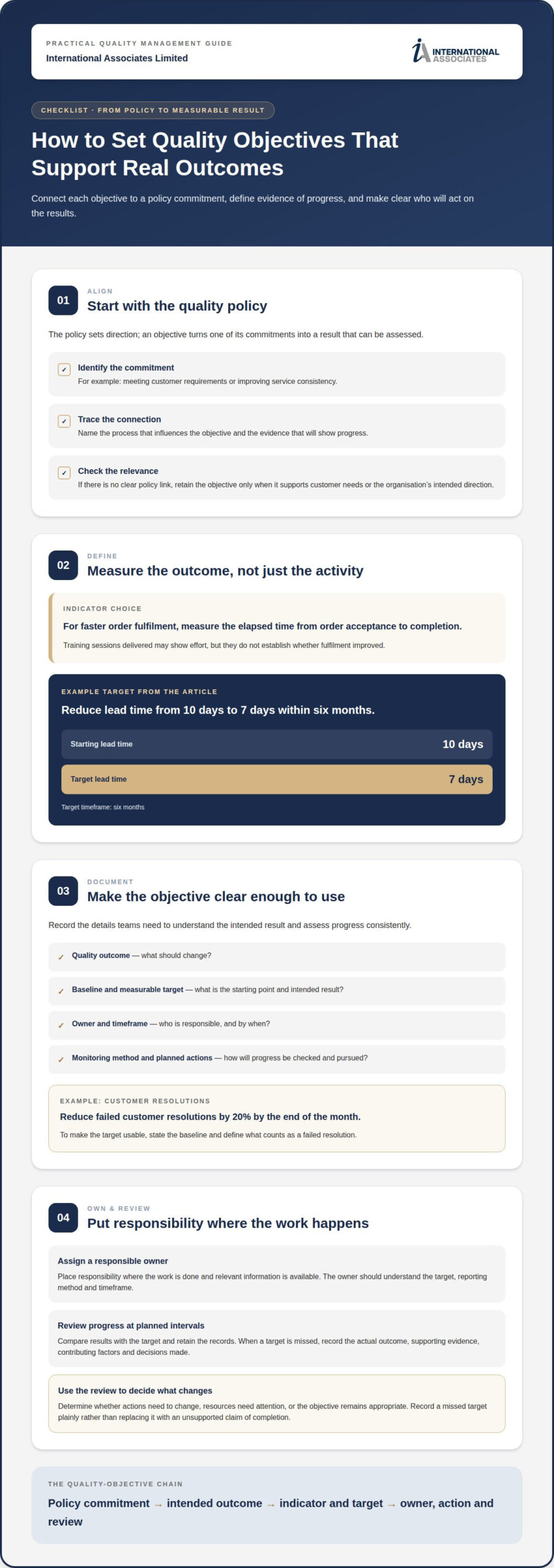
Objectives can apply across the organization or to a department, process, team or project. Their scope should match the operation they are intended to improve. For example, a customer-service team could aim to decrease failed customer resolutions by 20% by the end of the month. That target becomes usable when the organization defines what counts as a failed resolution and identifies the records used to measure it.
Assign responsibility where the work is done and the relevant information is available. A process owner may coordinate the objective, while team members carry out actions and record results. The responsible person should understand the target, reporting method and timeframe. Involving employees who perform the work can also reveal operational causes that a high-level measure may miss.
Document each objective so that its meaning and progress can be understood internally. A useful record identifies the quality outcome, baseline, measurable target, owner, timeframe, monitoring method and planned actions. For example, “reduce failed customer resolutions by 20% by the end of the month” needs a stated baseline and a consistent definition of resolution failure. Without these details, different teams may report results that cannot be compared.
Review performance against the target at planned intervals and retain the results. If an objective is missed, record the actual outcome, supporting evidence, contributing factors and decisions made. Management can then determine whether actions need to change, resources need attention or the objective remains appropriate. Record a missed target plainly rather than replacing it with an unsupported claim of completion.
Sector context also matters. The European Union states that Regulation (EU) 2017/746, the EU IVDR, addresses quality objectives for in vitro diagnostic devices. Organizations in this field should consider objectives within the relevant quality management system and document how progress is assessed. Clear ownership and records help connect intended quality outcomes with day-to-day operation.
Linking objectives to the quality policy
A quality policy sets the organisation’s direction and commitments; objectives turn those commitments into measurable results. Each objective should support at least one policy commitment. If the policy prioritises consistent service, an objective could address on-time completion or customer feedback. If it emphasises conformity, an objective could focus on preventing defects in a defined process.
To check the connection, trace each proposed objective back to the policy. Identify the commitment it supports, the process that influences it and the evidence that will show progress. An objective with no clear policy link may reflect a local task rather than a quality priority. Retain it only if it also supports customer needs or the organisation’s intended direction.
- Identify the commitment. Select a clear policy statement, such as meeting customer requirements or improving service consistency.
- Choose an outcome. Define what should change, such as fewer repeat service issues or more consistent product conformity.
- Set a measure. Select evidence that reflects the outcome, such as complaint-resolution records or inspection results.
- Plan action and review. Assign ownership, determine how progress will be reviewed, and record decisions when results fall short.
For example, a policy commitment to improve customer satisfaction could support an objective to reduce unresolved complaints. A useful measure would track complaints that remain open after the organisation’s defined resolution process. The policy sets the direction; the objective specifies the result and the action needed to pursue it.
Review the policy alongside performance, customer requirements, process results and relevant changes in the organisation’s context. Ask whether its commitments still reflect the organisation’s purpose and direction, then assess whether current objectives show progress. If the policy changes, revisit each linked objective and revise its scope, measure or actions wherever the connection no longer holds.
Objectives should also remain consistent with the policy as work is delegated across functions. For example, a company-wide commitment to reliable delivery may require operations to monitor fulfilment performance and customer service to analyse delivery-related feedback. The measures differ, but both should support the same policy direction. Checklists can help reviewers confirm that each objective has a policy link, a defined outcome, measurable evidence and planned action.
Sector-specific policies provide another alignment test. ISO 22000:2018 requires measurable food safety objectives that support the food safety policy. In practice, an organization should connect each food safety objective to a relevant commitment, operational activity and review method. This makes policy review a decision point, not simply a document update.
Choosing performance indicators and targets
When deciding how to set quality objectives, choose indicators that measure the intended outcome, not just the effort invested. If the goal is faster order fulfilment, measure elapsed time from order acceptance to completion. One example target reduces lead time from 10 days to 7 days within six months. Training sessions delivered may show activity, but they don’t establish whether fulfilment improved.
Start with a reliable baseline and a consistent collection method. Define what counts in the measure before assessing results. A defect indicator, for example, should state which outputs count as defective and the total outputs assessed. One final-assembly example uses a 2.5% defect-rate baseline and a target below 1.5% for Q1-Q4 2025. These details make performance comparable.
Choose a target that fits the process context. Review past results, resources, customer requirements and known constraints. The target should encourage improvement without making accurate reporting difficult. If results vary widely between periods, investigate the causes before setting a fixed target. This helps distinguish normal process performance from unusual conditions.
Match the timeframe and measurement method to the intended result. For example, reducing critical equipment downtime by 20% within two quarters requires a consistent definition of downtime and comparable records. Assign responsibility for compiling data, identifying reporting intervals and explaining exceptions. This makes trends easier to interpret during review.
Before approving an indicator and target, assess these practical tests:
- Relevance: Does the indicator measure an outcome such as customer satisfaction or product conformity?
- Clarity: Can employees use the same definition when recording results?
- Evidence: Are source records available, such as inspection results or order timestamps?
- Responsibility: Is an owner assigned to monitor results and coordinate action?
- Timing: Does the review interval allow action before the target period ends?
Paired measures can reveal trade-offs. A team aiming to improve delivery speed should also monitor errors or complaints, so faster completion does not conceal a drop in quality. An objective may need one or more indicators. Choose measures that inform decisions, reveal improvement opportunities or flag trends that need attention.
Finally, explain the target to people who record or influence results. If an indicator changes, document why and preserve a clear comparison between methods. For example, a customer satisfaction objective could track movement from 85% to 90% within one year, provided the survey method remains consistent. Applying this principle to how to set quality objectives helps distinguish genuine performance changes from changes in measurement.
Aligning quality objectives with business strategy
Strategic objectives should advance the organization’s intended direction, while quality objectives address the processes that influence those results. For example, increasing repeat customers by 15% is a company-level strategic objective. Quality measures can focus on product conformity, dependable delivery or service resolution, where those outcomes affect customer retention.
Quality objectives align with an organisation’s quality policy by translating its commitments into measurable results. They align with strategy when those results support business priorities and address the processes that can influence them.
Integration works best as a clear cascade from strategic direction to operational performance:
- Define the business priority. Identify a strategic outcome, such as increasing repeat customers by 15%, and clarify the customer or operational result behind it.
- Map the influencing processes. Identify where product quality, delivery, customer support or supplier performance can affect that outcome. Focus on processes with a direct connection.
- Set supporting objectives. Assign each relevant function an objective within its influence. For example, customer support could monitor recurring service issues, while operations tracks delivery performance.
- Connect measures to decisions. Select indicators that show whether process performance supports the strategic outcome. Define who reviews results and what action follows a concerning trend.
This cascade distinguishes strategic, tactical and operational objectives. A strategic objective sets the organisation-wide direction. A tactical objective translates it into a functional result, while an operational objective guides routine process control. For instance, a strategic focus on customer retention may lead to a tactical priority for dependable fulfilment and an operational measure of delivery performance.
ISO 9001:2015 requires measurable quality objectives aligned with the quality policy and applicable across relevant functions. This supports integration, rather than treating quality as a separate programme. Each objective should have a traceable connection to a business priority, and each function should understand its contribution. If a process cannot influence the strategic outcome, its objective may need a different justification.
Bring strategic goals, supporting objectives and key process indicators into management review or an existing business review. Examine whether results support the intended direction, whether dependencies between functions affect performance, and whether planned actions remain appropriate. Test every proposed objective with two questions: which strategic priority does it support, and which process can influence its result? If either answer is unclear, revise the objective before assigning it.
What does ISO 9001 require for quality objectives?
ISO 9001:2015 requires an organization to establish quality objectives at relevant functions, levels and processes. It provides a framework for how to set quality objectives: they must be measurable, consistent with the quality policy, and relevant to product or service conformity and customer satisfaction. Objectives should also consider applicable customer and other requirements. A single high-level goal may not address every process that affects quality.
For example, a company-wide objective to improve customer satisfaction can be supported by objectives for order fulfilment and complaint handling. Each should connect to a relevant process and show how its results contribute to the broader outcome. An objective unrelated to conformity or customer satisfaction may not address the standard’s stated focus.
ISO 9001:2015 also requires organizations to plan how objectives will be achieved. That planning includes determining:
- Actions: the work needed to pursue each objective.
- Resources: what is required to complete the planned work.
- Responsibility: who will coordinate actions and monitor progress.
- Timing: when actions should be completed.
- Evaluation: how results will be assessed.
For an order-fulfilment objective, planned actions might address process hand-offs or record accuracy. Identify the resources and responsible roles needed, set completion timing, and decide how results will be evaluated. These planning details support implementation and help management assess progress consistently.
Objectives must be available as documented information. Records should identify each objective and preserve enough detail to support communication and evaluation. For example, a record could state the process outcome, target, timeframe, owner and measurement method. This gives employees a clear reference and enables management to review performance using comparable information.
Relevant people need to understand objectives connected to their work, such as production employees monitoring conformity or service staff tracking complaint resolution. Update objectives as appropriate when business priorities, customer requirements or process conditions change. Any revised target should remain connected to the quality policy and relevant outcomes.
In practice, assess each objective against ISO 9001:2015 requirements for relevance, measurability, documented information, planned actions and evaluation. Then confirm that it applies at the appropriate function or process level. This makes quality management system objectives actionable and reviewable, rather than isolated statements.
International Associates Limited: ISO 9001 Quality Management System Certification
International Associates Limited provides ISO 9001 Quality Management System Certification for organizations seeking independent assessment against the standard. It is a relevant next step when a quality management system is established and the organization is preparing to demonstrate conformity through formal certification audits.
Certification is distinct from setting objectives or advising on how to achieve them. Your organisation remains responsible for defining its quality policy, objectives, measures and improvement actions. An assessment verifies whether the management system meets the requirements of the applicable standard. This distinction helps organisations decide whether they need independent verification or internal work to develop and operate their system.
ISO 9001 certification may be relevant when customers, business partners or other stakeholders require evidence of a quality management system. It can also suit organizations seeking a structured assessment of how their processes address quality and customer requirements. Before pursuing certification, ensure objectives are documented, responsibilities are understood, and performance information is available for review. These records help demonstrate how the system operates, rather than presenting objectives as statements without supporting evidence.
International Associates Limited also provides certification for other management system standards where the organization’s priorities extend beyond quality. ISO 14001 Environmental Management System Certification addresses environmental management, while ISO 45001 Occupational Health and Safety concerns occupational health and safety management. Social Accountability Audits provide an assessment focused on social accountability. The appropriate route depends on the management system or accountability area the organization needs assessed, not simply on having several objectives in place.
For organizations pursuing ISO 9001, the formal assessment includes stage 1 and stage 2 audits. These stages are used to verify whether the organization meets the requirements of the specific international standard. The audit process provides an independent assessment, while responsibility for operating the system and maintaining its objectives remains with the organization. Further detail on management system certification can help clarify how this assessment fits the organization’s needs.
Consider certification assessment when the management system is ready for external assessment or stakeholders require certification evidence. If the system is still being developed, first focus on defining responsibilities, maintaining records and implementing planned processes. Certification assessment is not a substitute for that internal work.
To discuss ISO 9001 certification, contact International Associates Limited.
Frequently Asked Questions
How Do I Create SMART Objectives?
Write objectives that are specific, measurable, achievable, relevant and time-bound. State the intended result, how evidence will be assessed and the deadline. For example, a business continuity objective could aim to restore system operation within six hours after a disaster. Identify which system counts, what evidence confirms restoration and who records the result. These details make the objective assessable rather than aspirational.
How Do I Develop An Objectives Management Program?
Create a shared register that brings objectives, owners, indicators, planned actions and progress records together. Group objectives by function or process, then set review points that match how quickly each result can change. For instance, operational measures may need more frequent attention than a long-term strategic outcome. Use management reviews to examine trends, resource needs and unresolved barriers, and record decisions so follow-up responsibilities are clear.
How Do I Establish An Action Plan For Each Objective?
Translate the target into tasks, resources, accountable roles, completion timing and a method for evaluating results. For a disaster-recovery objective, actions could include defining the recovery procedure, assigning test responsibilities and recording the recovery time achieved. A planned disaster-recovery test can be conducted annually or bi-annually. Compare the result with the objective, document gaps and assign follow-up actions to the relevant owner.
How Do I Establish The Performance Indicators?
Start with the outcome, then identify evidence that shows whether it occurred. Define the data source, calculation and reporting responsibility before collecting results. For example, an indicator could measure the percentage of work requests completed within the agreed deadline, with a target of 95%. Specify which requests count and how completion is recorded. Consistent definitions help teams compare results and identify where process performance needs attention.
What Are Performance Targets?
Set a performance target at the level an indicator must reach within a defined period or operating condition. Use it to judge progress and decide when corrective action is needed. For example, a target could be to keep system downtime below 5% during working hours. Define how the indicator measures downtime, then compare recorded performance with the threshold to determine whether the result is acceptable and what action, if any, is required.
How Should You Apply Quality Objectives in a Quality Management System?
Use quality objectives to guide decisions about products, services, processes or customer satisfaction, and connect them to the quality management system’s purpose. Choose objectives that reflect the outcomes your organisation needs to achieve, then use them to direct work and assess results. For example, a service organisation might focus on resolving customer issues effectively, while a manufacturer might track product conformity. Review the evidence to determine whether planned quality outcomes are being achieved and where action is needed.
How do you set measurable quality objectives step by step?
First, choose a quality outcome tied to customer needs or a process concern. Identify evidence that can demonstrate the result and establish how it will be assessed. Set a target and timeframe, then assign responsibility for actions and progress records. Finally, review results against the intended outcome and document decisions. This sequence helps prevent objectives from becoming broad statements without a way to evaluate them.
What are examples of SMART quality objectives for different industries?
Examples should reflect each operation’s actual quality risks and priorities. A food business might establish measurable food safety objectives that support its food safety policy, as required by ISO 22000:2018. A continuity-focused organization could target system recovery within six hours after a disaster. A workforce objective could require at least three people trained for every task in a process. Define each measure and evidence within its operating context.