

Your training scope shapes the certification work, facility needs, and budget from the outset. Becoming a GWO-certified training provider involves an audit by a third-party certification body against GWO’s Requirements for Training, rather than certification issued directly by GWO. If you’re assessing how to become a GWO certified training provider, start by defining the courses your organisation intends to deliver.
An audit is only one part of the investment. Your training site also needs suitable facilities, equipment, qualified instructors, and management processes for the GWO standards you plan to cover. This guide outlines the approval steps, requirements, and cost categories to consider. It also explains how course scope and delivery format affect the resources you will need, helping you assess whether your organisation is ready to proceed.
Key Takeaways
- Certification is completed through an audit by a third-party certification body against GWO’s Requirements for Training, rather than being issued directly by GWO.
- Plan for both the annual GWO licensing fee and audit costs, which are agreed commercially with the certification body.
- Define your course scope early so you can plan the required instructors, facilities, equipment, and supporting processes around the training standards you intend to deliver.
- Build WINDA registration and training-record management into your operating processes, not as tasks to address only after an audit.
- Use the decision guide to assess which training scope fits your organisation’s capabilities and how to manage the certification timeline.
Becoming a GWO-Certified Training Provider
If your organisation is deciding how to become a GWO certified training provider, first define the courses and training sites you intend to include. Certification is conducted by an independent third-party certification body, not by GWO itself.
-
Begin the Provider Certification Process
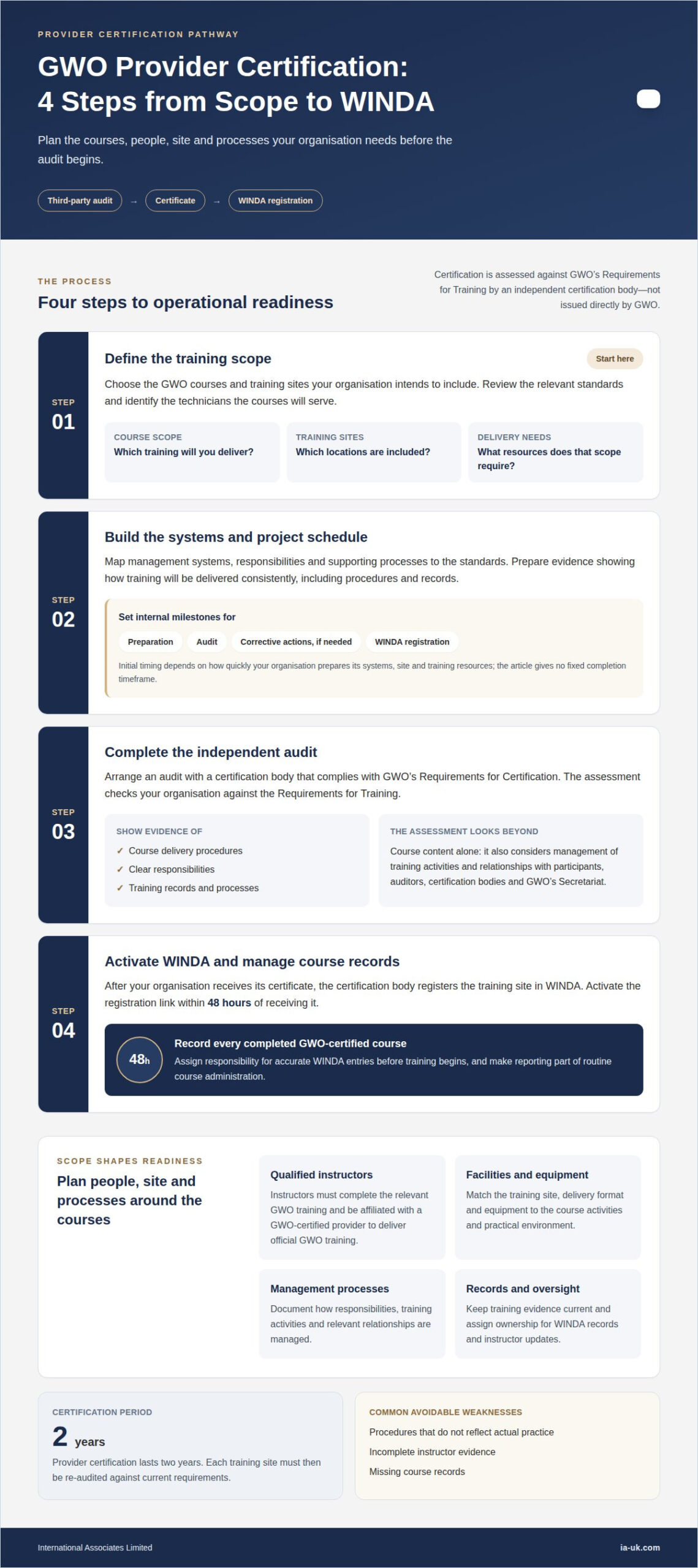
Identify the GWO courses your organisation plans to deliver and the technicians they will serve. Review the relevant GWO training standards, then map the management systems and supporting processes needed for delivery. The certification assessment covers more than course content. It also considers how your organisation manages training activities and its relationships with participants, auditors, certification bodies, and GWO’s Secretariat.
-
Estimate the Certification Timeline
Build a project schedule covering preparation, the audit, corrective actions if needed, and WINDA registration. Provider certification lasts for two years, but the initial process duration depends on how quickly your organisation prepares its systems, site, and training resources. Set internal milestones for each activity rather than assuming a fixed timeframe. Allow time to address audit findings before registration is completed.
- Arrange an audit with a certification body that complies with GWO’s Requirements for Certification. The audit assesses your organisation against the Requirements for Training. Prepare evidence showing how courses will be delivered consistently, including relevant procedures, responsibilities, and records. The assessment is intended to establish operational readiness, not simply an intention to offer courses.
- Complete the WINDA steps after the audit. Once your organisation receives its certificate, the certification body registers the training site in WINDA. Activate the registration link within 48 hours of receiving it. Then upload a WINDA record for every completed GWO-certified training course. Assign responsibility for these records before delivery begins, making reporting part of routine course administration.
GWO Certification Requirements
Use the requirements to align each course, instructor, training site, and recordkeeping process with the scope you intend to certify.
- Work from the current Requirements for Training. GWO published Version 15 on 1 April 2025. It defines provider governance, including relationships with participants, auditors, certification bodies, and GWO’s Secretariat. Map responsibilities and procedures to these requirements, then keep evidence showing how each process operates.
- Qualify instructors for the courses they will deliver. Instructors must complete the relevant GWO training themselves and be affiliated with a GWO-certified provider to deliver official GWO training. Instructor assessments may include theoretical knowledge and practical teaching demonstrations. Instructor certifications are usually valid for two years before recertification is required.
- Match the training scope to wind-turbine skills and the applicable standards. Basic Safety Training covers First Aid, Manual Handling, Fire Awareness, and Working at Heights. Basic Technical Training develops mechanical, electrical, and hydraulic skills. Its installation training is divided into BTTI Mechanical and BTTI Electrical. Providers can deliver courses within their certified scope.
- Maintain training records as part of course delivery. A provider must upload a WINDA record for every completed GWO-certified course. Assign clear responsibility for accurate entries and retain supporting course information. Missing records or unclear responsibilities can weaken evidence that training was delivered and administered consistently.
- Prepare each site for assessment against the current requirements. Provider certification lasts for two years, after which each training site must be re-audited against current requirements. Common avoidable weaknesses include procedures that do not reflect actual practice, incomplete instructor evidence, and missing course records. Address these gaps before the audit rather than relying on informal processes.
Registration is another part of provider setup. From 6th September 2021, new GWO training providers have been required to register on WINDA through their associated auditor and certification body. Keep this registration route aligned with the provider’s certification process, so responsibilities for the required WINDA activity are clear.
Instructor readiness extends beyond initial qualification. GWO instructors are responsible for keeping training aligned with current guidelines and staying informed about course updates. Where applicable, instructors may need GWO course certification in Advanced Rescue Training (ART). Include relevant updates and any applicable certification in instructor oversight, alongside evidence that instructors are prepared to teach within the provider’s certified scope.
Provider Facilities, Equipment, and Support
Plan facilities around the GWO courses you intend to deliver. The training format, practical activities, equipment, and instructor support need to work together across your renewable energy training operation.
- Select a delivery format before committing to a site. GWO’s Requirements for Training defines acceptable environments, including fixed facilities, mobile facilities, on-site training, and digital training. Match the format to the course activities and where technicians will learn. A mobile setup may support delivery at a suitable worksite, while digital delivery must suit the planned learning activities.
- Map each course to its practical environment and equipment needs. Use the applicable GWO standard to identify course requirements rather than assuming one training space suits every module. For example, a course involving practical turbine-related activities needs an environment that supports them. Tie equipment selection to the course scope and avoid purchasing equipment before defining that scope.
- Assess how learners and instructors will use each facility. Consider access to the training area, movement between learning spaces, equipment storage, and separation of practical and classroom activities. For on-site delivery, plan how the setup will work within the host location. A clear site layout helps instructors deliver consistently and allows auditors to assess the actual training environment.
- Establish processes for equipment readiness and course delivery. Assign responsibility for preparing, maintaining, and storing training equipment, and complete checks before each course. Keep the instructor’s course materials aligned with the applicable GWO standard. Reliable scheduling and support also help prevent practical sessions from being disrupted by unavailable equipment or an unsuitable training area.
- Review the complete setup against your intended operating model. A provider serving the wind industry across different locations may use fixed facilities, mobile delivery, or suitable on-site arrangements. Each location still needs to support its approved course scope. Consider how instructors, equipment, and course materials will be coordinated between sites, then include those operating needs in the facility plan.
Use the applicable GWO course requirements to plan facilities and equipment for the skills learners must practice.
Certification Fees and Budgeting
Separate GWO’s annual licensing fee from certification and operational costs. This gives your global wind training budget a clearer structure.
- Include the annual GWO licensing fee as a recurring budget item. The fee is €650 annually. Keep it separate from the audit charges, since the licensing fee and certification body’s audit costs are distinct expenses. Your forecast should account for the annual period, rather than treating the licence as a one-time certification payment.
- Budget for the formal stage 1 and stage 2 audits required to verify that your organisation meets the applicable standard. Certification and audit costs are agreed commercially between the training provider and the third-party certification body. The amount depends on the certification scope and audit work. Treat this as a separate cost line from GWO’s licensing fee.
- Estimate costs against the modules you intend to deliver. A broader course scope can require more preparation across instructors, training environments, and equipment. For example, a provider planning both Basic Safety Training and Basic Technical Training should account for the different delivery requirements of each. Avoid budgeting for a single course while planning to offer a wider wind-turbine training portfolio.
- Include facility and equipment expenditure in your operating budget. The required setup depends on whether you use fixed facilities, mobile facilities, on-site training, or digital training. Identify the format first, then map its equipment and support needs to each course. This helps distinguish certification expenses from the investment required to deliver training.
- Build ongoing administration into the financial plan. Each completed GWO-certified course requires a WINDA record, and the provider needs processes that support compliant delivery. Allocate staff time for course administration, recordkeeping, and instructor coordination. These tasks continue after the initial audit and belong in the budget alongside recurring licence and audit costs.
How to Choose the Right GWO Certification Path
Choose a certification scope that matches the courses your organisation can deliver and the technicians it intends to serve. Defining this scope is a practical first step when considering how to become a GWO certified training provider.
- Identify the wind-industry roles and work activities your courses will support. Safety-focused and technical courses address different learning needs, so use the intended outcomes to guide your selection. Review the applicable GWO standards before setting the scope. A focused choice gives your organisation a clear basis for planning its training offer.
- Match the selected courses to available instructors, facilities, and equipment. Practical training, for example, requires a suitable environment and instructors prepared to deliver the course. If your current setup supports one course more effectively than another, reflect that difference in the initial scope instead of assuming every module is equally feasible.
- Assess the full investment for each option. Include audit charges alongside course-specific equipment, instructor preparation, facility needs, and ongoing administration. A module involving practical activities may require different resources from digital or classroom-based delivery. This comparison connects the certification scope to its operational demands.
- Choose a delivery format that fits your locations and learners. GWO’s Requirements for Training recognises fixed facilities, mobile facilities, on-site training, and digital training. Consider how instructors, course materials, and equipment will be coordinated across planned sites. The chosen format affects resource planning and how your organisation develops its delivery model.
- Use operational readiness to decide whether to expand the scope. When planning how to become a GWO certified training provider, select courses your organisation can support with appropriate facilities, instructors, and processes. Add modules as the required expertise and resources become available. This staged approach aligns investment with capability and keeps certification planning grounded in practical delivery.
How Long Does GWO Provider Certification Take?
GWO’s requirements do not set a single completion duration. Build a project schedule around preparation, audit activity, corrective work if required, and WINDA registration. These stages show where your organisation can manage progress and where audit outcomes may affect the sequence.
- Start by reviewing the current Requirements for Training and defining the intended course scope. Record which management processes, instructors, facilities, and equipment are ready. List the work still needed before an audit can assess the training site. This readiness review gives your schedule practical milestones instead of an unsupported overall duration.
- Plan preparation around specific deliverables. Assign owners for procedures, instructor evidence, site arrangements, and training records. Set internal completion dates for each item, then review progress against them. A scope involving several modules may require more preparation than a narrower one, particularly if facilities or equipment need development.
- Coordinate the audit stage with the certification body. The organisation must be audited against GWO’s Requirements for Training, so schedule the assessment once key evidence and site arrangements are ready. Allow time for the audit and for addressing any findings. The audit date is not the certification completion date, because registration follows the audit and certificate.
- Track post-audit actions separately. Once the audit is complete and the certificate is received, the certification body registers the training site in WINDA. The new provider must activate its WINDA registration link within 48 hours of receiving it. Assign a responsible person before this stage, so activation is not delayed by unclear ownership.
- Keep certification maintenance on the calendar after approval. Provider certification lasts for two years, and each training site must be re-audited against current requirements after its certification period ends. Set reminders for the next audit cycle and review processes during normal operations. This avoids leaving renewal planning until the current certificate is nearing expiry.
International Associates Limited: Lead Auditor Training
International Associates Limited offers Lead Auditor Training for organisations seeking to strengthen internal audit capability. This training is a separate development step, not a substitute for the independent third-party audit required for GWO training provider certification. It can help staff understand audit planning, evidence review, and the assessment of processes against defined requirements.
Consider this training when employees will help prepare or maintain audit evidence for a training operation. Staff responsible for procedures, records, or site coordination, for example, may benefit from a structured approach to reviewing those processes. Its practical value depends on the person’s role: it is most relevant when audit responsibilities form part of their work, rather than when the organisation only needs to complete a single certification audit.
Lead Auditor Training can also support broader audit responsibilities beyond a GWO provider application. An organisation managing several standards may need staff who can follow audit processes across different requirements. International Associates Limited also provides ISO 9001 Quality Management System Certification and ISO 14001 Environmental Management System Certification. These are distinct certification services, not prerequisites for GWO training provider certification.
Before choosing this step, identify who will maintain audit evidence and how they will use the training. A quality manager may focus on controlled procedures, while a training-site coordinator may need to organise course and site records. Match the role to the learning need, then consider whether Lead Auditor Training fits that responsibility. The GWO provider audit remains part of the independent certification process, while training supports your organisation’s internal capability.
For information about this training, contact International Associates Limited.
Frequently Asked Questions
What are the costs?
Budget for the annual GWO licensing fee, certification body audit charges, and the resources needed to deliver your selected courses. The licensing fee is €650 annually. Audit costs are agreed commercially between the training provider and the certification body, while facility, equipment, instructor, and administration costs depend on your planned scope. Separate these items in your budget so recurring fees are distinguishable from setup and course-delivery expenditure.
What is the GWO certification process for a training provider?
A training provider establishes processes against GWO’s Requirements for Training, completes an audit by a third-party certification body, and proceeds to site registration in WINDA after receiving its certificate. An organisation planning a new training site, for example, should prepare its procedures, course delivery arrangements, and site evidence. The certification body assesses the provider; GWO does not certify training providers directly.
What are GWO’s requirements for training providers and facilities?
Providers need management systems and supporting processes to deliver courses to GWO Standards and Frameworks. Facilities must suit the training format and course activities. GWO’s Requirements for Training recognises fixed facilities, mobile facilities, on-site training, and digital training. Align the chosen environment with the course scope, including the practical activities and equipment needed for the relevant training.
How do you apply for GWO training provider certification?
Start by defining the courses and sites you intend to include, then prepare the processes and evidence needed for assessment against the Requirements for Training. Arrange an audit with a certification body that complies with GWO’s Requirements for Certification. After the audit and certificate, the certification body registers the training site in WINDA. Activate the registration link within 48 hours of receiving it.
What documents and quality management systems are required for GWO certification?
GWO’s framework requires management systems and supporting processes, not one universal document set for every provider. Prepare controlled procedures and records that demonstrate how your organisation manages training, responsibilities, participant relationships, and course administration. Evidence should show, for example, how completed courses are recorded in WINDA. The audit evaluates these arrangements against the applicable Requirements for Training.
How much does GWO training provider certification cost, including audits and annual fees?
The annual GWO licensing fee is €650 annually. Certification and audit costs are agreed commercially between the training provider and its third-party certification body, so they are separate from the licensing fee. Budget also for delivery resources, such as facilities, equipment, instructor preparation, and records administration. The selected course scope and audit work determine the relevant cost components; no single total applies to every provider.
How does GWO certify instructors and assess their qualifications?
GWO provider certification and instructor qualification are separate matters. Instructors must complete the relevant GWO training before teaching those courses, and they must work for or be affiliated with a GWO-certified training provider to deliver GWO training officially. Instructor assessments can include theoretical knowledge and practical teaching demonstrations. Instructor certifications are usually valid for two years before recertification is required.
What are the requirements for GWO training equipment, safety, and class sizes?
Equipment and the training environment need to match the course activities and applicable GWO standard. Practical course delivery, for example, requires an appropriate setting and the equipment identified for that training scope. GWO standards are designed to equip wind-energy workers with skills for safe work in turbines and related facilities. Use the relevant course requirements to plan delivery; no universal class-size figure is specified here.