

What separates a useful auditor course from one you’re ready to apply? ISO 45001 internal auditor training has no formal prerequisites, but a sound understanding of the standard is recommended so you can connect its requirements to workplace risks and audit evidence.
It’s reasonable to ask whether you need prior audit experience before enrolling. For internal auditor training, the focus is on learning to plan, prepare for, conduct and report an audit; lead auditor training is a different route, with more demanding entry expectations, including higher education and prior knowledge of occupational health and safety management concepts.
This guide explains how to prepare for training, organise internal audits and understand an auditor’s responsibilities. It also compares public, in-house and virtual formats, helping you choose an option that fits your role, team and operational needs.
Key Takeaways
- Assess whether internal auditor or lead auditor training better matches your responsibilities and existing knowledge.
- Learn how audit planning, preparation, checklists and reporting fit together in a practical internal audit.
- Understand how an occupational health and safety management system is assessed against ISO 45001 requirements.
- Clarify how internal auditors, lead auditors and audit teams contribute to a consistent audit process.
- Compare public, in-house and virtual course formats, including the practical terms that can affect your choice.
Are there any prerequisites for ISO 45001 internal or lead auditor training?
ISO 45001 internal auditor training has no formal prerequisites. A working understanding of ISO 45001 is recommended, because learners must connect requirements with evidence from an organization’s safety management system. People responsible for scheduling audits can benefit alongside those who perform them. The course builds on that foundation rather than assuming prior auditor credentials.
Lead auditor training has more demanding entry expectations. Participants are expected to have a higher education qualification and prior knowledge of the PDCA cycle, management-system elements, occupational health and safety concepts, and relevant national and local requirements. Attendance at ISO 45001:2018 awareness or introduction training is also required. These expectations suit people preparing to lead audit teams, rather than only conduct internal audits.
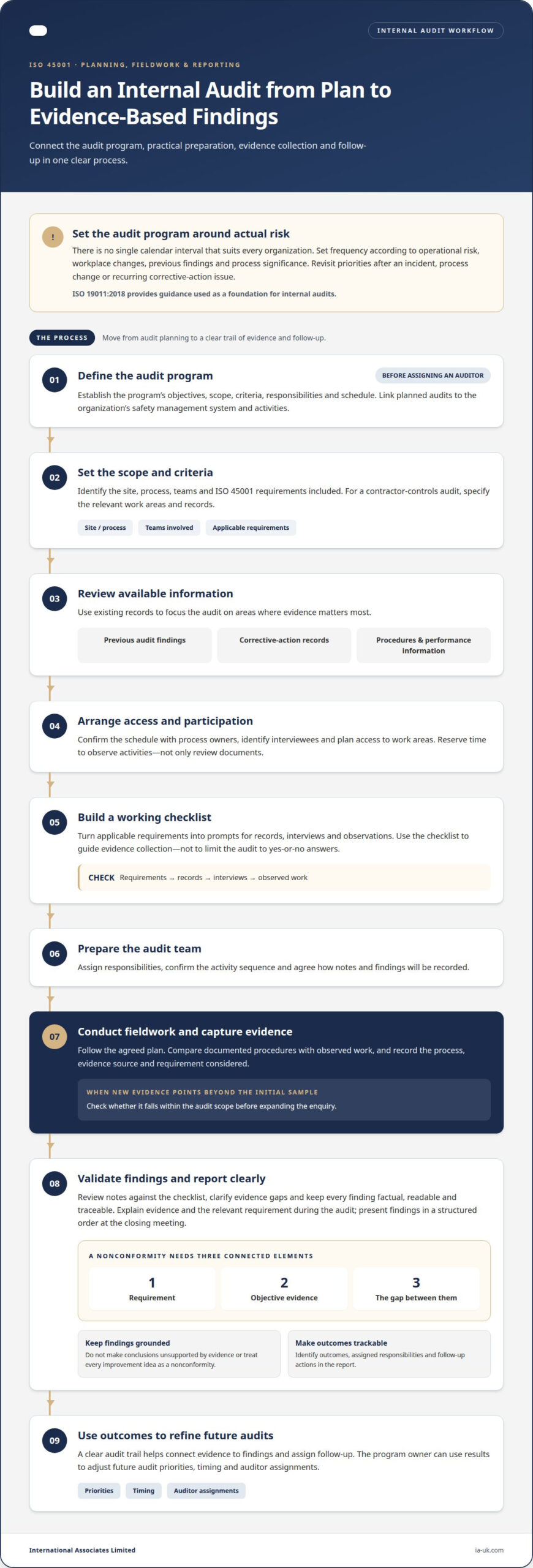
Reporting begins with clear communication during the audit. Explain the evidence and relevant ISO 45001 requirement behind each finding, then give the responsible representative an opportunity to understand the issue. At the closing meeting, present findings in a structured order, distinguish nonconformities from observations, and explain the next steps. This reduces surprises in the final report and supports a shared understanding of the outcome.
Write each nonconformity using three elements: the requirement, objective evidence and the gap between them. Identify the documented requirement, describe the records or observed practice reviewed, and state precisely what did not meet it. Avoid conclusions unsupported by evidence. A value-added audit remains impartial while identifying useful opportunities, such as improving how corrective actions are recorded, without presenting recommendations as requirements.
Prepare reporting before fieldwork by confirming the audit scope, criteria, schedule, records and interview plan. During the audit, record evidence against the relevant checklist items and note who supplied each record or explanation. Afterward, check that findings are factual, readable and linked to evidence. The report should identify outcomes, assigned responsibilities and follow-up actions, allowing the organization to track corrective action and verify whether it addressed the issue.
What credentials do trainees receive? The lead auditor course description states that successful completion grants an ISO 45001 certification validating the ability to perform audits and lead audit teams. This training credential is distinct from certification of an organization’s safety management system. Course details and training formats are available through professional auditor training.
Auditors should watch for incomplete records, unclear evidence and conclusions based on assumptions rather than observed facts. They should also avoid overlooking worker input or treating every improvement idea as a nonconformity. Following ISO 19011:2018 guidance and keeping findings tied to specific requirements helps maintain consistent reporting and credible follow-up.
Internal audit planning and preparation
Start with an audit program that connects planned audits to the organization’s safety management system. Define the program’s objectives, scope, criteria, responsibilities and schedule before assigning an auditor. ISO 19011:2018 provides guidance used as a foundation for internal audits. Apply that guidance to the organization’s activities, processes and operational risks, rather than treating every area identically.
How often should organizations conduct ISO 45001 internal audits? There is no single calendar interval that suits every organization. Set the audit frequency in the program according to operational risk, workplace changes, previous findings and the significance of each process. Revisit the schedule when an incident, process change or recurring corrective-action issue suggests an area needs earlier attention.
Before each audit, the responsible auditor should:
- Set the scope and criteria. Identify the site, process, teams and ISO 45001 requirements included. For example, an audit of contractor controls should specify the relevant work areas and records.
- Review available information. Examine previous audit findings, corrective-action records, procedures and relevant performance information. Use these records to focus the audit on areas needing evidence.
- Arrange access and participation. Confirm the schedule with process owners, identify interviewees and plan access to work areas. Include time to observe activities, not only review documents.
- Develop a working checklist. Convert applicable requirements into prompts for records, interviews and observations. A checklist should guide evidence collection, not restrict auditors to yes-or-no answers.
- Prepare the audit team. Assign responsibilities, confirm the sequence of activities and agree how notes and findings will be recorded. An instructor-led auditor training course can develop these planning skills through structured practice.
Follow the agreed plan during the audit, while allowing relevant evidence to guide further enquiry. Compare documented procedures with observed work, then record the process, evidence source and requirement considered. If an interview points to a relevant record or activity outside the initial sample, assess whether it falls within scope before expanding the enquiry.
At the end of fieldwork, review your notes against the checklist and identify any gaps that need clarification. A clear audit trail helps connect evidence to findings and assign follow-up actions in the report. The program owner can then use the outcomes to adjust future audit priorities, timing and auditor assignments.
Occupational health and safety management systems
An occupational health and safety management system connects safety responsibilities with an organization’s routine processes. It provides a structured way to address workplace hazards, control risks and review performance. For example, a maintenance process can include equipment checks, worker responsibilities and records of corrective action. Auditors examine how these elements work together, rather than treating safety as a separate policy document.
According to the International Organization for Standardization (ISO), ISO 45001 specifies requirements for an occupational health and safety management system intended to improve the safety and health of employees and other personnel. The requirements give organizations a framework for managing occupational health and safety through defined processes. They do not replace the need to understand how work is actually performed at each site.
Management system concepts help auditors trace how decisions become operational controls. An auditor can follow a process from planning through implementation, monitoring and improvement. For example, a review of equipment maintenance might examine assigned responsibilities, inspection records, reported defects and follow-up actions. This process-based view helps reveal whether documented arrangements are reflected in daily work.
Internal auditing evaluates evidence against the requirements of ISO 45001 and the organization’s own arrangements. Auditors can consider how these system elements connect:
- Responsibilities: Are roles for safety management understood by the people performing the work?
- Operational controls: Do procedures address relevant hazards in the process being examined?
- Communication: Can employees explain how safety information reaches the teams affected?
- Performance review: Do records show how the organization evaluates issues and follows up?
These prompts guide enquiry, but do not replace objective evidence. An interview about a procedure, for instance, can be considered alongside the procedure itself and a relevant work record. Differences may point to a gap between the intended management system and its implementation. The auditor should record the evidence and assess it against the applicable criterion, rather than draw conclusions from a single comment.
Foundational knowledge also includes recognizing how management-system processes interact. A change to work equipment may affect training, maintenance arrangements and operational controls. Auditing those connections helps assess whether the organization’s safety management approach remains coherent as work changes. ISO 45001 internal auditor training prepares learners to examine these relationships systematically, apply standard requirements to organizational processes and report evidence-based conclusions.
Internal auditor roles and responsibilities
Internal auditors assess how the organization applies ISO 45001 requirements, while lead auditors coordinate audit teams and their work. The appropriate training depends on whether participants will conduct internal audits or lead broader audit activities.
Internal Auditor Responsibilities
An internal auditor reviews evidence against audit criteria, then records findings clearly and impartially. For example, they may compare a work instruction with observed practice and relevant records. Their skills should include asking focused questions, listening carefully and distinguishing evidence from assumptions. Auditors also protect confidentiality and communicate findings to responsible process owners through the agreed reporting process.
How does internal auditor training differ from lead auditor training? Internal training typically lasts 15 hours, while lead auditor training lasts 5 days. The former develops practical capability for in-house audits; the latter prepares participants for broader audit leadership, including coordinating an audit team.
Audit Team Responsibilities
An audit team divides work according to the audit scope, process knowledge and individual competence. Members coordinate interviews, document reviews and workplace observations, then compare their evidence before presenting findings. The lead auditor manages the schedule, assigns responsibilities and resolves inconsistencies in team notes. For instance, if two auditors review contractor controls, they should align their evidence before reaching a shared conclusion.
The lead auditor is responsible for maintaining a coherent audit process from preparation through reporting. This includes clarifying objectives, confirming criteria, coordinating team activities and presenting findings at the closing meeting. A lead auditor also ensures that conclusions reflect the available evidence, rather than one team member’s interpretation. These responsibilities require sound knowledge of ISO 45001 and effective communication with both auditors and process representatives.
When choosing a course, distinguish an introduction to internal audit practice from preparation for lead responsibilities. Consider whether the learning develops skills needed for your assigned role, such as sampling evidence, writing findings or coordinating team members. A course should also connect standard requirements with realistic audit activities, so you can apply what you learn to organizational processes.
Clear roles support consistent audit outcomes. Before an audit begins, the lead auditor and team should agree who reviews each process, how evidence will be recorded and how concerns will be raised. During the closing discussion, the lead auditor presents consolidated findings, while team members clarify the evidence behind their assigned areas. This division keeps reporting orderly and responsibilities clear.
How to Choose ISO 45001 Internal Auditor Training
Choose a course by matching its learning outcomes to your audit responsibilities, preferred format and assessment needs. For example, an auditor preparing to review one site needs practical internal audit skills, while a team seeking consistent processes may prefer in-house delivery.
Which ISO 45001 internal auditor courses are accredited or recognized? Recognition depends on the course and its awarding or accrediting body, so assess the stated recognition and its scope. A course completion credential is not the same as certification of an organization’s management system.
Public courses offer a scheduled learning environment with participants from different organizations. They can suit individuals who need a defined course structure without arranging a dedicated group. In-house training is delivered to one organization and can use its processes, terminology and audit examples. It is worth considering when several employees need consistent preparation. For organizations seeking practical, workforce-wide instruction, specialist providers such as You Can Do It Training Ltd deliver accredited health and safety training tailored to workplace risks and regulatory responsibilities.
Virtual training removes the need to attend a classroom, but participation still depends on suitable technology. You need reliable computer and internet access; high-speed broadband such as LAN, cable or DSL is recommended. Each participant must use an individual device for participation and assessment. Sharing a device is not permitted under the stated course requirements.
Review course content before choosing a format. A suitable internal auditor course covers ISO 45001:2018 requirements and practical audit activities, including planning, checklist use, evidence gathering and reporting. Check that the assessment reflects the intended skills, rather than focusing only on standard terminology. An instructor-led course can provide structured explanations and opportunities to apply audit principles.
Duration depends on the course type. ISO 45001 internal auditor training typically lasts 15 hours, while lead auditor training lasts 5 days. These formats serve different learning objectives, so compare the intended role and assessment before treating duration as the main selection factor. Training cost depends on course format, scope, assessment and materials; a price is provided after a quote request.
Cancellation and transfer terms can affect scheduling decisions. Under the stated terms, requests received at least 30 calendar days before the course starts can receive a full refund or transfer. Course transfers are not allowed within nine calendar days before the course starts. Review these dates alongside staff availability and operational commitments before selecting a session.
International Associates Limited: ISO 45001 Occupational Health and Safety
International Associates Limited provides ISO 45001 Occupational Health and Safety certification for organizations seeking independent assessment against the standard. Consider this offering when your organization has established its occupational health and safety management system and needs formal verification of whether it meets ISO 45001 requirements. Certification assessment is distinct from internal auditing: it examines the management system against the standard rather than developing your internal audit capability.
The formal certification process includes stage 1 and stage 2 audits. These audits are used to verify whether an organization meets the requirements of a specific international standard. For ISO 45001, that means assessment of the occupational health and safety management system against applicable requirements. The stages provide a structured route from reviewing the system to assessing its implementation, with findings based on audit evidence.
This distinction helps clarify the right next step. If your immediate need is to build internal audit skills, training is relevant. If your organization is seeking independent verification of its system against ISO 45001, certification assessment is the pertinent service. International Associates Limited also offers Lead Auditor Training for professionals developing competence to lead audits. That training supports a different objective from obtaining certification for an organization’s management system.
Before an assessment, define the organizational scope and identify the activities covered by the safety management system. Ensure that relevant processes, responsibilities and records are available for audit. A clear scope establishes what the assessment covers, while accessible records support an evidence-based review. These preparations also help the organization understand how documented arrangements relate to work performed across the defined scope.
ISO 45001 may also sit alongside other management system standards in an organization’s wider certification needs. International Associates Limited offers ISO 9001 Quality Management System Certification, as well as Social Accountability Audits. These are distinct offerings with separate purposes; they should be considered only when they match the organization’s own requirements. The appropriate next step depends on whether the priority is occupational health and safety certification, auditor development or another assessment need.
Frequently Asked Questions
How long does ISO 45001 training take, and what formats are available?
Internal auditor training typically takes 15 hours, while lead auditor training typically takes 5 days. Public, in-house and virtual formats are available. For scheduling, account for assessment time and participants’ work patterns, especially where employees cover different shifts. Public sessions can suit individuals; an in-house course can bring a team together, while virtual delivery supports remote participation across locations.
What topics does an internal auditor course cover?
The course addresses ISO 45001 requirements and their application to audit work. Learning can include how to frame questions around a process, identify relevant evidence and assess whether evidence supports a conclusion. For instance, participants might review a sample procedure and decide which records would help establish how it is implemented. This practical application helps connect standard terminology with audit decisions.
What preparation is recommended before internal auditor training?
There are no formal prerequisites for internal auditor training, although understanding ISO 45001 beforehand is recommended. Lead auditor training has additional entry expectations, including a higher education qualification and prior knowledge of management-system and occupational health and safety concepts. To prepare, review the standard’s terminology and bring a copy for reference during practical exercises. This can help participants locate relevant requirements while working through course examples.
How many hours does the internal auditor course usually take?
The internal auditor course typically lasts 15 hours. Use the scheduled duration to assess whether participants can attend the full course and complete its assessment without conflicting work commitments. For a team covering several shifts, consider how attendance will be organised so that learning is not interrupted by operational duties. Course length describes the training session, not the time an organization needs to conduct its own audit.
What determines the cost of training in the United States?
Training prices are provided after a quote request, and the amount depends on the course and its scope. Relevant cost factors include delivery format, assessment requirements and course materials. These determine the training package rather than a universal United States rate. Keep this separate from certification assessment costs, which relate to verifying an organization’s management system and are not fees for individual training.
Is the training available online and in person?
Virtual and classroom-based formats are available, including public and in-house sessions. For virtual attendance, Chrome, Edge, Safari and Firefox are supported browsers. Participants are encouraged to keep their video and microphone enabled throughout the session to support participation in instructor-led activities. Choose a format based on how participants can engage with exercises and assessment, as well as their access to a suitable device and internet connection.
What steps are involved in an ISO 45001 internal audit?
An internal audit moves from defining its scope to examining evidence, documenting conclusions and following up on findings. For example, an auditor reviewing a process can compare a relevant record with an interview account, then note any inconsistency for further examination. The final report should make the basis for each finding clear. Follow-up then tracks whether the organization has addressed the finding and recorded the action taken.