

Over 400,000 organizations worldwide now face a critical 36-month window to align their environmental management systems with the ISO 14001:2026 standard published on April 15, 2026. It’s understandable if the transition from the 2015 version feels daunting, especially when you’re faced with an overwhelming volume of technical documentation and the pressure of an initial audit. You likely recognize that maintaining a valid certificate isn’t just about fulfilling a checklist; it’s about ensuring your operational resilience within a complex global supply chain.
Certification is applicable to any organization, regardless of its size, sector, or geographic location. While heavy industrial and manufacturing sectors traditionally lead adoption, service-based industries are increasingly seeking certification to satisfy ESG (Environmental, Social, and Governance) reporting requirements. The framework is inherently scalable. For small businesses, it provides a structured path to manage resource efficiency; for multinational corporations, it serves as a unifying global standard that ensures consistency across international branches. Achieving these iso 14001 certification requirements signals a high level of institutional maturity and a proactive approach to risk management, which is often enhanced in the food sector by specialized partners like Shilux Food Safety.
This guide will help you master the mandatory iso 14001 certification requirements and the strategic framework needed to achieve certification while enhancing your environmental performance. We’ll examine the new focus on climate resilience, clarify which documents are strictly required, and provide a clear roadmap to align your environmental goals with your broader business strategy. This methodical approach ensures your organization moves beyond simple compliance toward a state of verified environmental excellence and long-term stability.
Key Takeaways
- Understand the structural evolution of the 2026 standard and the mandatory requirements defined within the Harmonized Structure.
- Differentiate between mandatory documentation, such as the EMS scope and policy, and optional records to prevent technical documentation overload.
- Master the iso 14001 certification requirements through a structured Plan-Do-Check-Act cycle that aligns environmental goals with global business strategy.
- Utilize a rigorous gap analysis to identify compliance shortfalls and mitigate the risk of failing your initial certification audit.
- Learn how independent, third-party verification provides a reliable bridge between complex international regulations and your organization’s operational growth.
Understanding ISO 14001:2026 and the Modern EMS Framework
ISO 14001 stands as the premier international standard for establishing a robust Environmental Management System (EMS). It belongs to the broader ISO 14000 family of standards, which provides organizations with the tools to manage environmental responsibilities systematically. The latest iteration, ISO 14001:2026, was published on April 15, 2026; it represents a significant refinement of the previous 2015 framework. This standard doesn’t just demand compliance. It requires a strategic balance between environmental protection and the complex socio-economic needs of a modern enterprise.
In the current global market, environmental accountability has shifted from a voluntary initiative to a mandatory prerequisite for supply chain participation. Large-scale procurement processes and international trade agreements increasingly mandate that partners demonstrate a verified commitment to sustainability. Meeting the iso 14001 certification requirements ensures that an organization can provide objective evidence of its environmental performance to stakeholders, investors, and regulatory bodies alike. With over 400,000 organizations globally already holding certification as of April 2026, the standard has become a universal language for corporate environmental responsibility.
The Evolution of the 2026 Standard
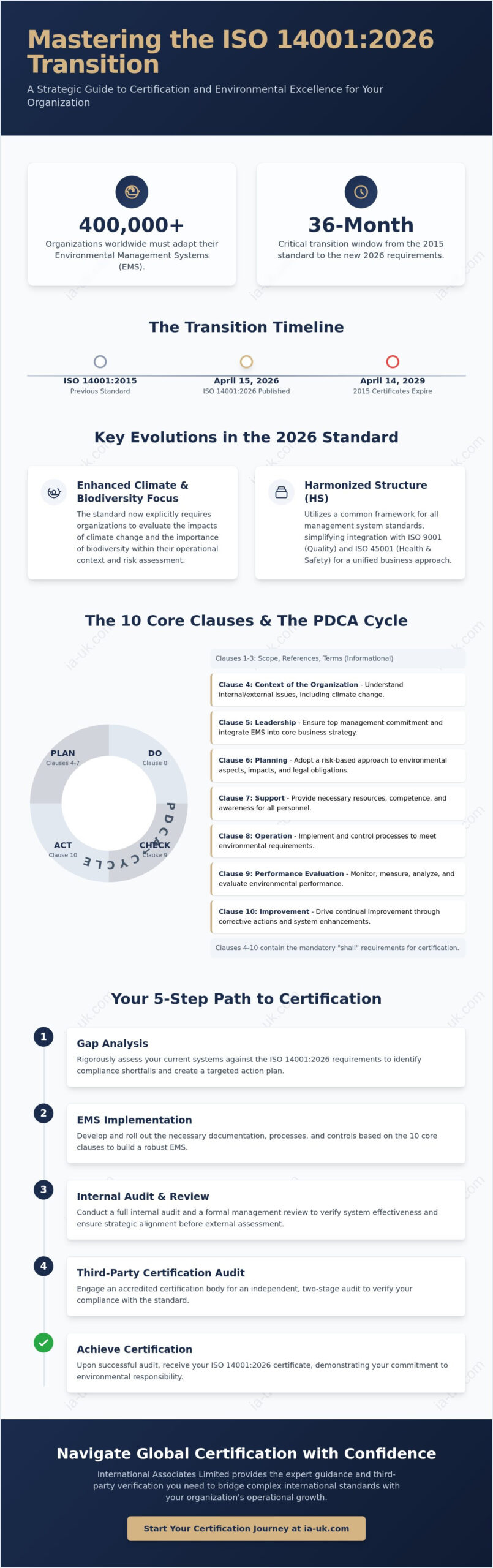
The 2026 revision introduces a more intuitive structure designed to facilitate easier navigation, particularly for multi-site organizations operating across diverse jurisdictions. A primary thematic shift is the explicit requirement for organizations to consider the impacts of climate change and biodiversity within their operational context. For those currently holding ISO 14001:2015 certificates, a 36-month transition period is in effect. All existing 2015 certificates will cease to be valid after April 14, 2029. This timeline necessitates a prompt evaluation of current systems to ensure alignment with the updated criteria.
Who Needs ISO 14001 Certification?
Certification is applicable to any organization, regardless of its size, sector, or geographic location. While heavy industrial and manufacturing sectors traditionally lead adoption, service-based industries are increasingly seeking certification to satisfy ESG (Environmental, Social, and Governance) reporting requirements. The framework is inherently scalable. For small businesses, it provides a structured path to manage resource efficiency; for multinational corporations, it serves as a unifying global standard that ensures consistency across international branches. Achieving these iso 14001 certification requirements signals a high level of institutional maturity and a proactive approach to risk management.
The 10 Core Clauses: Structural Requirements for Certification
The 2026 standard utilizes the Harmonized Structure (HS), formerly known as Annex SL. This framework provides a common architecture for all management system standards, facilitating seamless integration for firms that already maintain ISO 9001 or ISO 45001 certificates. Adhering to the iso 14001 certification requirements involves satisfying the “shalls” found in clauses 4 through 10. These clauses represent the mandatory criteria that auditors will verify during an assessment to ensure the system’s integrity and effectiveness.
Clause 4 requires an organization to define its context by identifying internal and external issues that affect its environmental goals. In the ISO 14001:2026 Environmental Management Systems framework, this specifically includes evaluating the impact of climate change, biodiversity, and resource availability on operations. Clause 5 shifts the burden of responsibility to top management. Leadership isn’t merely a supervisory role; it’s a commitment to ensuring the EMS is integrated into the organization’s core business processes and strategic direction. Management must demonstrate that they’re directly involved in the system’s success rather than delegating accountability to a single representative.
Planning and Support (Clauses 6 & 7)
Clause 6 introduces a risk-based approach to planning. Organizations must identify environmental aspects, which are the elements of activities that interact with the environment, and their resulting impacts. A significant 2026 update involves maintaining a robust registry of legal and compliance obligations that reflects current international regulations. Clause 7 focuses on support, ensuring that personnel possess the necessary competence and awareness to uphold the system. It’s not enough to have a plan; the organization must provide the resources and training required to execute it effectively across all global sites.
Operation, Evaluation, and Improvement (Clauses 8, 9, & 10)
Operation (Clause 8) now places a greater emphasis on the lifecycle perspective, requiring control over externally provided processes, products, and services. Evaluation (Clause 9) demands rigorous monitoring and measurement of performance data to ensure objectives are met. This includes the internal audit process, which serves as a critical self-assessment tool before a formal certification audit. Finally, Clause 10 outlines the pathway for continuous improvement through the systematic management of non-conformities. For organizations seeking to validate these systems, engaging with a global partner for ISO 14001 Environmental Management System Certification provides the necessary institutional weight and impartiality to succeed in a competitive landscape.
Mandatory Documentation and Evidence of Compliance
Achieving compliance requires a precise distinction between the strategic documents that define the system and the operational records that prove its performance. While the 2026 standard allows for flexibility in the format of documented information, the necessity for objective evidence remains absolute. During the assessment process, auditors distinguish between the “design” of the system, verified during a Stage 1 audit, and the “implementation” of the system, which is the focus of a Stage 2 audit. Adhering to the iso 14001 certification requirements mandates that certain documents, such as the EMS scope, environmental policy, and objectives, are not only established but also maintained as current versions.
The Scope of the EMS serves as the primary boundary-setting document. It must clearly delineate the physical locations, organizational units, and activities included under the certification. This is particularly vital for global organizations where certain regional offices might be excluded from the initial certification cycle. A comprehensive understanding of environmental management systems reveals that auditors prioritize the link between an organization’s stated policy and its actual environmental impacts. In a digital-first environment, managing this technical documentation through centralized, version-controlled platforms is recommended to ensure that all global sites access the most recent procedures without friction.
The Environmental Policy: More Than a Statement
The environmental policy must be a living document that reflects the organization’s unique operational context and its commitment to the protection of the environment, including pollution prevention and climate resilience. It’s not enough for the policy to exist in a manual; it must be actively communicated to all personnel and made available to interested parties. Auditors will seek evidence that the policy provides the framework for setting environmental objectives and that it’s endorsed by top management to demonstrate high-level accountability.
Operational Controls and Emergency Response
Operational controls are the procedures established to manage significant environmental aspects and ensure iso 14001 certification requirements are met daily. This includes documented procedures for emergency preparedness and response, which must be tested through periodic drills. Auditors require records of evidence, such as training logs that verify staff competence and calibration records for monitoring equipment. These records serve as the objective proof that the organization’s environmental management system is functioning as intended and is capable of responding to unforeseen environmental incidents.
The Path to Certification: A Strategic Implementation Framework
Implementation of a management system requires a methodical transition from theoretical planning to operational reality. The standard utilizes the Plan-Do-Check-Act (PDCA) cycle as the fundamental engine for this process. This iterative framework ensures that environmental performance isn’t static but evolves alongside the organization’s growth. Before beginning the formal process, a comprehensive Gap Analysis is essential to identify specific compliance shortfalls against the iso 14001 certification requirements. This initial assessment provides a clear roadmap, highlighting where existing controls are sufficient and where new procedures must be established to meet the 2026 criteria.
The external certification process is conducted in two distinct stages. Stage 1 involves a rigorous review of documented information to verify that the system’s design meets the standard’s criteria. Once the auditor confirms the system’s adequacy, the organization proceeds to Stage 2. This second phase involves on-site verification to ensure that the documented procedures are effectively implemented and understood by personnel across all operational levels. Successfully passing these stages demonstrates a high level of institutional maturity and a verified commitment to global environmental standards.
Implementing Life Cycle Assessment (LCA)
The 2026 standard emphasizes a life cycle perspective, requiring organizations to consider environmental impacts beyond their immediate operational boundaries. This perspective extends from raw material acquisition and design through to transportation, end-of-life treatment, and final disposal. Life Cycle Assessment is a tool for evaluating the environmental impact of a product throughout its entire lifespan. By integrating LCA into the identification of environmental aspects, organizations can make informed decisions regarding product development and supplier selection, thereby reducing their overall environmental footprint. These insights directly inform the setting of environmental objectives and the refinement of operational controls.
The Internal Audit and Management Review
A robust internal audit is a mandatory prerequisite for certification. This process must be conducted by objective, independent auditors who can provide an impartial assessment of the system’s effectiveness. The internal audit identifies non-conformities before the external certification body arrives, allowing for corrective actions that address the root cause of issues. Following the audit, top management must conduct a formal review to evaluate the system’s continued suitability and effectiveness. This review drives the ‘Act’ phase of the PDCA cycle, ensuring that the EMS remains aligned with the organization’s strategic direction. Organizations ready to finalize their compliance journey can apply for ISO 14001 Environmental Management System Certification to secure their status as an environmentally responsible global entity.
Navigating Global Certification with International Associates Limited
International Associates Limited operates as an independent certification and auditing body, bridging the gap between international standards and operational execution. Headquartered in Glasgow, the firm utilizes an expansive network of international offices to provide local expertise on a global scale. This dual presence allows for a nuanced understanding of regional regulatory nuances while maintaining the institutional weight of a centralized administrative base. Organizations seeking to meet iso 14001 certification requirements benefit from a partner that prioritizes technical precision and procedural integrity throughout the assessment process. This global-local duality ensures that audits are conducted with an understanding of specific regional environmental laws while upholding the rigorous expectations of the international community.
Efficiency is often achieved through the integration of multiple standards. By combining ISO 14001 with ISO 9001 quality management, organizations can eliminate redundant documentation and streamline their auditing schedules. International Associates Limited utilizes an advanced IT infrastructure to support this integration, facilitating real-time data access and accelerated certificate turnaround times. This technological foundation ensures that the assessment process remains methodical and transparent, regardless of the organization’s geographic distribution or industrial complexity. Our digital-first approach reduces the administrative burden on your staff, allowing for a more focused and effective evaluation of your environmental management system.
Why Choose an Independent Global Audit Body?
Independence is the cornerstone of trust in the auditing industry. Maintaining impartiality ensures that certification serves as a reliable marker of environmental performance for international stakeholders and investors. International Associates Limited possesses specialized expertise in high-stakes industrial sectors where regulatory adherence is critical. We also provide comprehensive Social Accountability Audits alongside environmental standards. This allows businesses to address holistic ESG requirements through a single, ethical partner, building stability and confidence in complex global markets.
Getting Started with Your ISO 14001 Journey
The path toward certification begins with an initial assessment where our auditors evaluate your system’s alignment with the iso 14001 certification requirements. This process is predictable and professional, moving from a Stage 1 documentation review to a Stage 2 implementation audit. Once achieved, certification enters a three-year cycle consisting of annual surveillance audits and a full recertification in the third year. This structured sequence ensures continuous adherence to the 2026 standard and supports long-term environmental excellence. To initiate your professional inspection, contact International Associates Limited for a formal ISO 14001 assessment quote.
Securing Your Organization’s Environmental Legacy
Aligning your environmental management system with the 2026 revision is a strategic necessity for maintaining global supply chain relevance. It isn’t just about compliance; it’s about building a framework that adapts to shifting climate risks and biodiversity priorities. International Associates Limited serves as a meticulous bridge between these complex regulations and your operational growth. As an independent global certification body with a central base in Glasgow and a vast international network, we provide the stability needed for high-stakes verification.
Our specialists excel in integrated management systems, ensuring your transition satisfies all iso 14001 certification requirements without unnecessary friction. This methodical approach allows your business to demonstrate measurable environmental performance to stakeholders worldwide. You can Request a Quote for ISO 14001 Certification Assessment to begin your formal verification process with confidence. Establishing a robust environmental framework today secures your organization’s position as a leader in the global transition toward a sustainable future.
Frequently Asked Questions
What are the mandatory documents required for ISO 14001:2026?
The standard mandates a specific set of documented information to ensure system integrity. Key requirements include the defined scope of the EMS, the environmental policy, and established environmental objectives. Additionally, organizations must maintain records of environmental aspects and their associated impacts, evidence of compliance obligations, and documented procedures for operational control and emergency response.
How long does it typically take to achieve ISO 14001 certification?
The timeline for achieving certification varies based on the organization’s initial maturity and operational scale. Most entities complete the implementation and assessment process within six to twelve months. This duration accounts for the initial gap analysis, the establishment of the management system, and the mandatory internal audit before the two-stage external certification assessment begins.
Is ISO 14001 certification mandatory for UK businesses?
Certification to ISO 14001 isn’t a legal requirement for businesses in the United Kingdom. However, it’s frequently a prerequisite for participating in public sector tenders and large-scale private supply chains. Many organizations adopt the standard to demonstrate compliance with environmental regulations and to satisfy the ESG expectations of international stakeholders and investors.
Can we integrate ISO 14001 with ISO 45001?
Integration is highly efficient because both standards utilize the Harmonized Structure. This common framework allows organizations to combine environmental management with ISO 45001 occupational health and safety systems. By unifying these management systems, firms reduce documentation redundancy and streamline the auditing process through a single, coordinated assessment cycle.
What is the difference between an environmental aspect and an environmental impact?
An environmental aspect is an element of an organization’s activities, products, or services that interacts with the environment. In contrast, an environmental impact is the actual change to the environment resulting from that aspect. For example, the discharge of wastewater is an aspect, while the resulting degradation of local water quality represents the impact.
How much does ISO 14001 certification cost for a global organisation?
The total investment for certification depends on the number of operational sites, the complexity of industrial processes, and the total employee headcount. Audit fees are typically calculated based on the number of days required to verify the iso 14001 certification requirements across all locations. Organizations should also account for internal resource allocation and the costs associated with surveillance audits over a three-year cycle.
What happens if we fail our Stage 2 certification audit?
If an auditor identifies non-conformities during a Stage 2 audit, the organization must implement corrective actions before certification is granted. A major non-conformity requires a follow-up assessment to verify that the issue is resolved. Minor non-conformities won’t necessarily prevent certification but must be addressed through a documented action plan that the auditor reviews during the subsequent surveillance visit.
How often are surveillance audits conducted after initial certification?
Surveillance audits are conducted annually following the initial certification to ensure the management system remains effective and continues to meet iso 14001 certification requirements. These visits occur in years one and two of the three-year certification cycle. In the third year, a full recertification audit is required to evaluate the entire system and issue a new certificate for the following triennial period.