

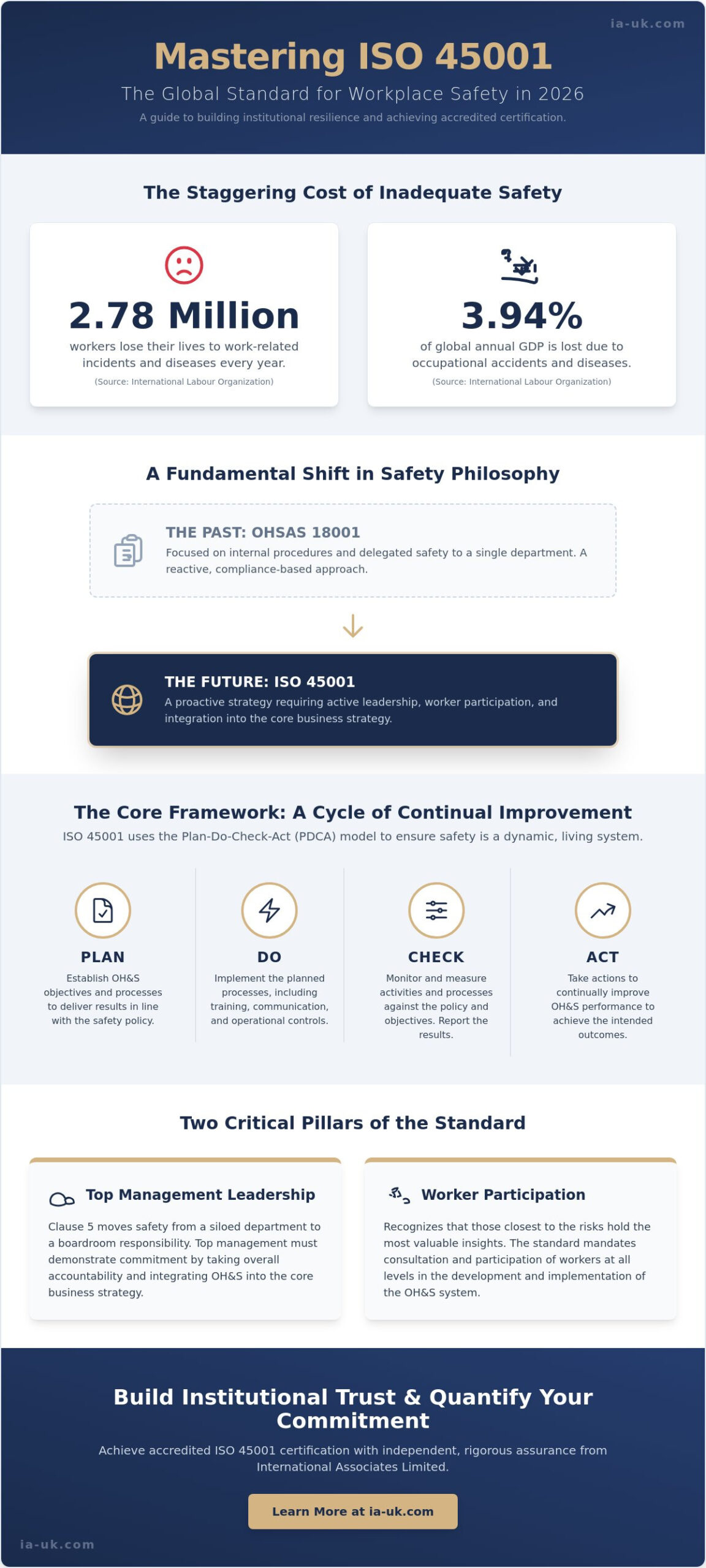
The International Labour Organization reports that 2.78 million workers lose their lives to work-related accidents and diseases every year, a figure that highlights the fatal inadequacy of passive safety protocols. You recognize that managing safety across complex, multi-site global operations requires more than simple checklists; it demands a culture of accountability that starts with leadership engagement. Successfully implementing iso 45001 is the most effective way to transition from reactive incident management to a proactive framework of institutional resilience. By adopting this international standard, you don’t just follow rules; you quantify your commitment to social responsibility.
This definitive guide will help you master the complexities of the global standard for workplace safety in 2026. You’ll learn the specific requirements for the framework and how to achieve accredited certification for your organization. We’ll preview the auditing process, explore strategies for reducing workplace injuries, and show you how to enhance institutional trust with your global stakeholders through rigorous, independent assurance.
Key Takeaways
- Understand how the global benchmark for Occupational Health and Safety serves as an active framework for resilience rather than a static safety manual.
- Master the core requirements of the Plan-Do-Check-Act cycle to move safety leadership from administrative departments into the boardroom.
- Learn the strategic logic of an Integrated Management System by aligning iso 45001 with your existing quality and environmental standards for global efficiency.
- Navigate the technical stages of the certification process, from performing a rigorous gap analysis to passing the Stage 1 documentation review.
- Discover how independent, accredited certification quantifies your commitment to social responsibility and builds institutional trust with international stakeholders.
What is ISO 45001? The Global Benchmark for Workplace Safety
ISO 45001:2018 represents the first truly global framework for Occupational Health and Safety (OH&S), providing a structured methodology for organizations to minimize risk and improve worker wellbeing. By 2026, this standard has become the definitive requirement for companies seeking to demonstrate a principled approach to human capital management. The ISO 45001 international standard replaced various national codes, creating a unified language for safety that transcends borders and specific legal jurisdictions. It utilizes the High-Level Structure (HLS) common to other management standards, allowing for seamless integration into existing corporate governance models.
The primary objective of the standard is the prevention of work-related injuries and ill health. This scope extends beyond immediate physical hazards to encompass mental health and long-term occupational diseases. In 2024, the International Labour Organization estimated that occupational accidents and diseases cost the global economy approximately 3.94% of annual GDP. By implementing iso 45001, organizations transition from reactive fixes to a proactive culture of resilience. You don’t simply react to accidents; you identify hazards and assess risks before they manifest as incidents, ensuring the management system remains an active tool for organizational protection.
Who Needs ISO 45001 Certification?
Certification is applicable across every sector, regardless of the perceived risk level. While high-risk industries like construction or heavy manufacturing face immediate physical hazards, professional services and technology firms use the standard to manage ergonomics and psychological safety in hybrid work environments. Global corporations increasingly require this certification from 100% of their Tier 1 supply chain partners to mitigate reputational and operational risks. It serves as a core pillar of ESG (Environmental, Social, and Governance) reporting, quantifying social accountability for institutional investors who prioritize long-term stability and ethical operations.
ISO 45001 vs OHSAS 18001: The Evolution
The transition from OHSAS standard 18001, which was officially withdrawn in September 2021, marked a fundamental change in safety philosophy. While the previous standard focused on internal procedures, iso 45001 emphasizes the “context of the organisation,” requiring leaders to consider external stakeholders and the broader regulatory landscape. It demands active leadership engagement rather than delegating safety to a single department. Worker participation is now a mandatory requirement, ensuring that those closest to the risks have a direct voice in mitigation strategies. This evolution ensures the management system is an integrated part of the business strategy, not a secondary administrative function.
Core Requirements: The Pillars of an Effective OH&S Management System
The architecture of iso 45001 relies on the Plan-Do-Check-Act (PDCA) cycle, an iterative four-stage process that ensures safety is managed with the same rigor as financial or operational performance. In the Planning phase, organizations establish objectives and processes necessary to deliver results in accordance with the OH&S policy. The Doing phase involves implementation, while the Checking phase requires monitoring and measuring activities against the established policy. Finally, the Acting phase focuses on taking actions to continually improve OH&S performance. This cycle transforms safety from a static document into a dynamic, living system that evolves with the organization’s needs.
Leadership and worker participation represent the most critical shift in this standard, moving safety responsibilities from the HR office directly into the boardroom. Clause 5 requires top management to demonstrate leadership and commitment by taking overall responsibility for the prevention of work-related injury. This isn’t a passive endorsement; it involves ensuring the OH&S policy and objectives are compatible with the strategic direction of the business. Simultaneously, the standard mandates the consultation and participation of workers at all levels, recognizing that those performing the tasks often possess the most accurate insights into operational hazards. Our team at International Associates Limited provides the independent audit services needed to validate these core pillars through methodical assessment.
Annex SL: The High-Level Structure
One of the most significant technical advantages of the standard is its alignment with Annex SL, which provides a common 10-clause structure shared across all modern ISO management systems. This uniformity allows global organizations to streamline their documentation by using identical definitions and core requirements for quality, environmental, and safety systems. It reduces the administrative burden of maintaining separate manuals and simplifies the auditing process for multi-site operations. Annex SL is the universal framework for all modern ISO management systems.
Operational Planning and Control
Effective operational control requires a disciplined approach to managing change, ensuring that new processes or equipment don’t introduce unforeseen hazards. Organizations must establish, implement, and maintain processes for the elimination of hazards and the reduction of OH&S risks using a hierarchy of controls. This includes rigorous emergency preparedness and response protocols that are tested through regular drills. Furthermore, the standard emphasizes procurement and contractor management, requiring businesses to verify that external partners adhere to the same stringent safety criteria as the internal workforce. By quantifying these controls, you ensure the management system provides a reliable shield against operational disruption.
Strategic Integration: Aligning Safety with Quality and Environment
Organizations operating at a global scale often struggle with fragmented management systems that create conflicting priorities and duplicated efforts. An Integrated Management System (IMS) provides a unified framework where iso 45001 works in tandem with ISO 9001 and ISO 14001. This alignment ensures that safety, quality, and environmental objectives are harmonized within a single strategic plan. By standardizing safety language across diverse international offices, you eliminate the confusion caused by localized terminology. This consistency is vital for maintaining institutional trust across 100% of your global operations, ensuring that a safety protocol in London carries the same weight and clarity as one in Singapore.
Combined assessments significantly reduce the administrative burden on your internal teams. Instead of preparing for three separate audits, an integrated approach allows for a single, comprehensive review of your management systems. This reduction in audit fatigue can lower administrative overhead by as much as 25% for complex multi-site organizations according to industry benchmarks. It ensures that the management system remains an active tool for resilience rather than a source of bureaucratic friction. When you align these standards, you create a culture where safety is inseparable from operational excellence and environmental stewardship.
Shared Clauses and Documentation
The common structure provided by Annex SL means that Clause 9.2 (Internal Audit) and Clause 9.3 (Management Review) are identical across these standards. You can establish a single, robust policy that addresses safety, quality, and environmental goals simultaneously. Utilizing advanced IT infrastructure to centralize this documentation ensures that all stakeholders have real-time access to the latest compliance data. This centralized approach simplifies the verification process during external audits and ensures that your internal reviews are thorough and evidence-based.
The Role of Social Accountability
Worker well-being isn’t just a safety metric; it’s a core component of ethical auditing that links directly to international social accountability standards. Integrating iso 45001 with frameworks like SA8000 creates a holistic view of your organization’s ethical impact. This comprehensive approach builds significant trust with international stakeholders and investors who increasingly use ESG metrics to evaluate corporate health. For organizations expanding into high-growth markets, pairing this commitment with recognized market-access credentials — such as halal certification for global businesses entering Muslim-majority territories — further strengthens your position as a principled worldwide partner. By quantifying your commitment to both physical safety and social equity, you position your brand as a principled leader in the global market. It demonstrates that you value integrity as much as technical accuracy, reinforcing your status as a sophisticated worldwide partner.
The Path to Certification: Navigating the Audit and Assessment Process
The journey toward accredited iso 45001 certification begins with a rigorous gap analysis to map your current state against the standard’s requirements. This internal review serves as a technical baseline, ensuring that your documentation is not just present but fully functional across all 10 clauses of the framework. Most global organizations spend between 6 to 12 months preparing their management system before requesting a formal assessment. This preparation phase is the foundation of institutional trust, demonstrating to stakeholders that your commitment to safety is grounded in evidence and methodical planning.
An assessment follows a structured two-stage methodology to ensure total compliance. The Stage 1 audit acts as a technical readiness review where your auditor evaluates the design of your system and verifies that all mandatory documentation exists. If the auditor identifies critical omissions, these must be resolved before proceeding. Stage 2 focuses on implementation through on-site or remote verification. During this phase, the auditor gathers evidence through worker interviews and record reviews to confirm the system is effective. Following the audit, a separate technical review committee evaluates the findings before the final certification decision is made. This independent oversight ensures that every certificate issued meets the highest standards of integrity.
If you’re ready to begin this process, you can request a formal audit quote from our technical team to establish your assessment timeline.
Stage 1 vs Stage 2 Audits: What to Expect
Stage 1 is about ensuring the framework is in place; it’s a technical review of the “Plan” part of your cycle. In contrast, Stage 2 gathers evidence that the system is active, reflecting the “Do” and “Check” phases. Common non-conformities during initial assessments often involve Clause 6.1.2 regarding Hazard Identification or Clause 5.4 regarding the Consultation and Participation of Workers. You can avoid these by ensuring that risk assessments are comprehensive and that frontline employees are actively involved in safety discussions rather than just receiving top-down instructions.
Surveillance and Recertification
Certification isn’t a one-time event but a three-year cycle of continual improvement and surveillance. After the initial certificate is issued, annual surveillance audits ensure that the system remains effective and compliant as your organization grows. These audits focus on specific areas of the system rather than a full re-assessment, providing a steady check on your safety performance. In the third year, a full recertification audit takes place to renew the certificate for another three-year term. This methodical cycle prevents the management system from becoming stagnant, ensuring that safety remains a top priority for the boardroom.
Beyond Compliance: Building Institutional Trust with International Associates
Selecting an independent, accredited certification body is a critical decision that determines the global recognition and validity of your management system. International Associates Limited operates as an expert guardian, providing the impartial assurance necessary to put global organizations at ease regarding their safety and compliance standards. We maintain a high degree of professionalism, ensuring that your iso 45001 certification is more than a badge; it’s a verified testament to your organization’s resilience. Our methodical approach focuses on reliability and independence, positioning us as a peer to the technical and executive departments of the global corporations we serve.
Headquartered in Glasgow, our reach extends across diverse international markets with dedicated regional expertise in Europe, Asia, and the Middle East. This global scale allows us to provide the cultural intelligence required to audit multi-site operations effectively while maintaining a unified methodology. We understand that time is a critical resource for your business, so we utilize a modern IT infrastructure to ensure a quick turnaround for certificates. This efficiency never compromises regulatory standards, as our process remains grounded in the rigorous requirements of international law and technical compliance.
Expert Guardianship in Auditing
Our auditors act as gatekeepers of quality and safety, meticulously verifying that your management system functions as an active framework for worker protection. By quantifying the ethical impact of your safety certification, we help you demonstrate a commitment to social responsibility that aligns with global investor expectations. We distinguish our services through a specific focus on the Authorised Representative role, adding a layer of legal guardianship that general consultancy firms don’t provide. This principled approach ensures that your organization doesn’t just meet the minimum requirements but sets a benchmark for industry excellence.
Next Steps for Your Organisation
Transitioning to a certified iso 45001 management system requires a partner that values integrity as much as technical accuracy. You can begin this process by requesting a formal quote for assessment fees, which provides a transparent view of the certification journey. To support your internal teams, we also offer accredited lead auditor and internal auditor training courses designed to build long-term institutional knowledge. These programs ensure your staff possesses the professional skills to maintain and improve your safety framework effectively. To secure your organization’s future and build lasting trust with your stakeholders, Enquire about ISO 45001 certification with International Associates today.
Advancing Your Global Safety Strategy
Achieving iso 45001 certification is a definitive step toward securing your organization’s operational future and protecting its most valuable asset: its people. By moving safety from an administrative task to a boardroom priority, you establish a culture of accountability that resonates across your entire global supply chain. This standard doesn’t just manage risks; it builds a foundation for long-term institutional resilience and stakeholder trust.
As a UKAS accredited certification body, International Associates Limited provides the independent assurance you need to validate your health and safety performance. We leverage our global network across Europe, Asia, and the Middle East to deliver methodical audits that reflect our deep expertise in social accountability and technical standards. Our auditors act as expert guardians, ensuring your management system meets the highest levels of integrity while providing the cultural intelligence required for diverse international markets.
Take the next step in quantifying your commitment to workplace safety. You can contact our Glasgow head office for an ISO 45001 certification quote to begin your assessment journey. We look forward to partnering with your organization to achieve excellence in occupational health and safety.
Frequently Asked Questions
Is ISO 45001 certification mandatory for UK businesses?
Certification is not a legal requirement in the United Kingdom; however, maintaining a safe workplace is a statutory duty under the Health and Safety at Work etc. Act 1974. Organizations use the standard to demonstrate they have met these legal obligations through a recognized international framework. It provides independent assurance to the Health and Safety Executive (HSE) and other regulators that you are proactively managing risks and quantifying your safety performance.
How long does it take to achieve ISO 45001 certification?
Achieving certification typically requires 6 to 12 months depending on the maturity of your existing management system and the size of your workforce. This timeline includes the initial gap analysis, system implementation, and the two-stage audit process. Larger organizations with multiple sites may require additional time to ensure consistent application of the framework across all regional offices before the final assessment occurs.
What is the difference between ISO 45001 and OHSAS 18001?
The primary difference lies in the proactive focus on organizational context and leadership engagement found in the modern standard. While OHSAS standard 18001 was largely procedure-based, iso 45001 integrates safety into the core business strategy and requires active worker participation. The previous standard was officially withdrawn on September 30, 2021, making the current international standard the only valid path for accredited certification today.
Can ISO 45001 be audited remotely?
Remote auditing is permitted and governed by the International Accreditation Forum (IAF) MD 4 document. We utilize secure IT infrastructure to conduct document reviews and worker interviews through video conferencing platforms. While some high-risk sectors may still require on-site verification for specific physical hazards, remote assessments offer a flexible and efficient solution for professional services and low-risk environments without compromising the audit’s integrity.
How much does ISO 45001 certification cost?
The cost of certification is determined by the number of employees, the complexity of your operations, and the number of sites included in the scope. These factors are calculated using the IAF MD 5 mandatory document, which specifies the required audit duration for all accredited certification bodies globally. We provide transparent quotes based on these international guidelines to ensure total financial clarity for your management team.
What are the main benefits of ISO 45001 for small businesses?
Small businesses benefit primarily from enhanced access to global supply chains and government tenders that mandate iso 45001 as a pre-qualification requirement. It levels the playing field by providing a recognized badge of quality and safety. Additionally, small firms often see improved employee retention and lower insurance premiums due to a quantified reduction in workplace incidents and demonstrated legal compliance.
Does ISO 45001 cover mental health and psychological well-being?
Mental health and psychological well-being are explicitly included within the definition of health under Clause 3.18 of the standard. It requires organizations to identify psychosocial hazards, such as excessive workload or workplace stress, just as they would physical hazards. For organizations seeking deeper implementation, the ISO 45003 guidance standard provides specific tools for managing psychological risks within the existing OH&S management system.
How often do surveillance audits occur for ISO 45001?
Surveillance audits occur annually to ensure the management system remains effective and compliant between the three-year recertification cycles. These audits focus on specific elements of the system, such as internal audits and management reviews, rather than a full re-assessment of every clause. This methodical approach ensures that your safety culture doesn’t stagnate and continues to deliver measurable improvements in worker protection and organizational resilience.