

A certification is only as valuable as the international recognition of the body that issues it. With over one million organizations globally adhering to the ISO 9001 standard, the distinction between a certificate that facilitates market entry and one that is dismissed by foreign partners often rests on a single selection. Many businesses rightfully fear investing in compliance only to find their documentation isn’t recognized by sophisticated global clients. Identifying the right partner requires a rigorous set of questions to ask a certification body before any formal agreement is finalized. You likely agree that an audit shouldn’t be a mere administrative checklist; it must serve as a mechanism for institutional stability and continuous improvement.
The global cost of a data breach is projected to reach approximately $4.44 million in 2026, a figure that underscores the necessity of robust, verified management systems. Organizations frequently encounter frustration when auditors lack industry-specific technical expertise or when fee structures remain opaque. This guide will equip your business with the essential vetting questions to ensure your chosen certification body provides globally recognized, accredited, and value-driven audits. We provide a structured framework to verify accreditation status, confirm international trade portability, and ensure that the audit process delivers meaningful feedback for organizational growth.
Key Takeaways
- Verify that the provider is accredited by an IAF member under ISO/IEC 17021 to ensure the global portability and acceptance of your certification.
- Evaluate the technical competence of auditors within your specific sector to guarantee that findings result in genuine operational improvements.
- Utilize specific questions to ask a certification body regarding their IT infrastructure and certificate turnaround times to avoid administrative bottlenecks.
- Calculate the total cost of ownership over the full three-year certification cycle to identify hidden fees beyond the initial daily audit rate.
- Prioritize partners that offer a global-local duality, combining centralized administrative reliability with an expansive network of international offices.
Is the Certification Body Accredited by an IAF Member?
Accreditation is frequently described as the “certification of the certification body.” It is a formal recognition governed by the international standard ISO/IEC 17021, which sets the requirements for bodies providing audit and certification of management systems. Understanding what accreditation means is vital for any organization seeking a legitimate mark of quality. Without this independent oversight, a certificate is simply a private document that carries no regulatory weight or institutional trust. It represents a statement of compliance that has not been verified by an impartial third party.
The International Accreditation Forum (IAF) manages the Multilateral Recognition Arrangement (MLA), which ensures that certificates issued by an accredited body in one country are recognized as equivalent in another. In the United Kingdom, UKAS serves as the sole national accreditation body. When participating in international tenders, procurement officers specifically look for the IAF mark. Certificates from non-accredited bodies are often rejected outright because they lack the verified rigorousness required for global trade. This lack of recognition can stall market entry and invalidate years of internal process development.
How to verify accreditation status in 2026
Verification has become highly centralized and transparent. The IAF CertSearch global database is the definitive tool for confirming a body’s legitimacy. One of the first questions to ask a certification body is whether their current accreditation status is active and searchable on this portal. It’s not enough to verify the organization name; you must also examine the specific scope of accreditation. A provider might be accredited for ISO 9001 but lack the credentials for specialized sectors like ISO 13485 for medical devices. Be cautious of “self-accredited” organizations that use official-sounding terminology to mask a lack of independent oversight.
The risk of unaccredited “Gold Plated” certificates
Some providers offer “Gold Plated” or unaccredited certificates that promise a path of least resistance. If an organization guarantees a certificate with no on-site audit time or a suspiciously short timeline, it’s a major red flag for regulators. These “easy” audits fail to identify systemic risks, leaving your business vulnerable to operational failures. The long-term cost of losing a contract due to non-recognized certification far outweighs any initial savings. IAF-recognised accreditation provides a global passport for your products, ensuring that a single audit enables seamless market access across international borders.
What is Your Technical Competence in Our Specific Industry?
Technical proficiency is the cornerstone of a value-driven audit. One of the most vital questions to ask a certification body involves the specific sector experience of the assigned audit team. An auditor who lacks “boots on the ground” experience in your niche cannot accurately assess risk or provide the technical insights necessary for improvement. Verification of these credentials ensures the audit serves as a strategic asset rather than a procedural hurdle. Official resources from the International Organization for Standardization offer a framework on how to choose a certification body that prioritizes technical depth. Beyond the site visit, it’s also necessary to inquire about the internal technical review process. This secondary verification by a separate technical team ensures the audit’s findings are objective and technically sound before any certification decision is made.
Vetting for Medical Device and Regulatory Standards
High-stakes sectors require specialized knowledge that goes beyond general management system principles. For instance, achieving ISO 13485 certification demands an understanding of complex Technical Documentation Reviews and alignment with MDR or UKCA requirements. You should ask about the specific qualifications of the auditing team, including whether they’ve undergone formal ISO 13485 lead auditor training. A certification body that understands the Glasgow and wider UK regulatory landscape is essential for navigating local compliance while maintaining global portability.
Social Accountability and Ethical Auditing Experience
Ethical auditing requires a distinct set of competencies focused on human rights and labor standards. When evaluating a provider for SA8000 Social Accountability, WRAP, or SEDEX audits, the body’s ability to manage sensitive international supply chains is paramount. You must verify their global network’s capacity to conduct impartial inspections in diverse cultural and legal environments. Impartiality represents the foundation of trust in social audits; therefore, vetting the auditing team’s history of ethical conduct is a prerequisite for a reliable partnership. For organizations requiring this level of specialized oversight, International Associates Limited provides a bridge between complex global standards and regional operational realities.
How Efficient is Your Audit Lifecycle and IT Infrastructure?
Modern IT infrastructure serves as the backbone of a reliable auditing process. It ensures that data remains secure and that reporting is both accurate and timely. When evaluating a potential partner, specific questions to ask a certification body should focus on their digital reporting portals. Does the platform allow for the immediate upload of evidence and real-time tracking of non-conformities? You must also confirm the average certificate turnaround time. This is the period between the final audit closing meeting and the formal issuance of the certificate. Delays in this administrative phase can prevent your organization from meeting tender deadlines or fulfilling international shipping requirements.
The post-2025 landscape has seen a stabilization in the ratio of remote to on-site auditing. You should verify how the body utilizes hybrid models to maintain the technical rigor of the assessment while optimizing logistical costs. Proactive administrative support is another critical factor. A high-performing body provides dedicated account management to assist with the complexities of annual surveillance and recertification. This support ensures that all regulatory documentation is submitted correctly and that the audit schedule aligns with your internal resource availability.
The logistics of switching certification bodies
Transitioning an existing accredited certificate is a strategic move often necessitated by a lack of service or industry expertise from a current provider. To ensure a seamless migration, you should ask if the body performs a gap analysis of your current management system before the transfer. It’s essential to confirm that there will be no lapse in certification status during this process. Inquire about the specific fee structure for transfers, as some bodies may waive initial assessment fees for organizations with a clean audit history. This transparency prevents unexpected costs and ensures that your global trade operations remain uninterrupted by administrative transitions.
Surveillance and Recertification Management
Reliable certification bodies implement automated notification systems to alert you of upcoming surveillance requirements well in advance of certificate expiry. This proactive approach allows for the flexibility needed to schedule audits during periods that minimize business disruption. The standard certification process operates on a mandatory three-year cycle consisting of an initial two-stage audit followed by annual surveillance visits and a recertification assessment in the final year. By understanding these milestones, your organization can better allocate the technical and financial resources required to maintain long-term compliance.
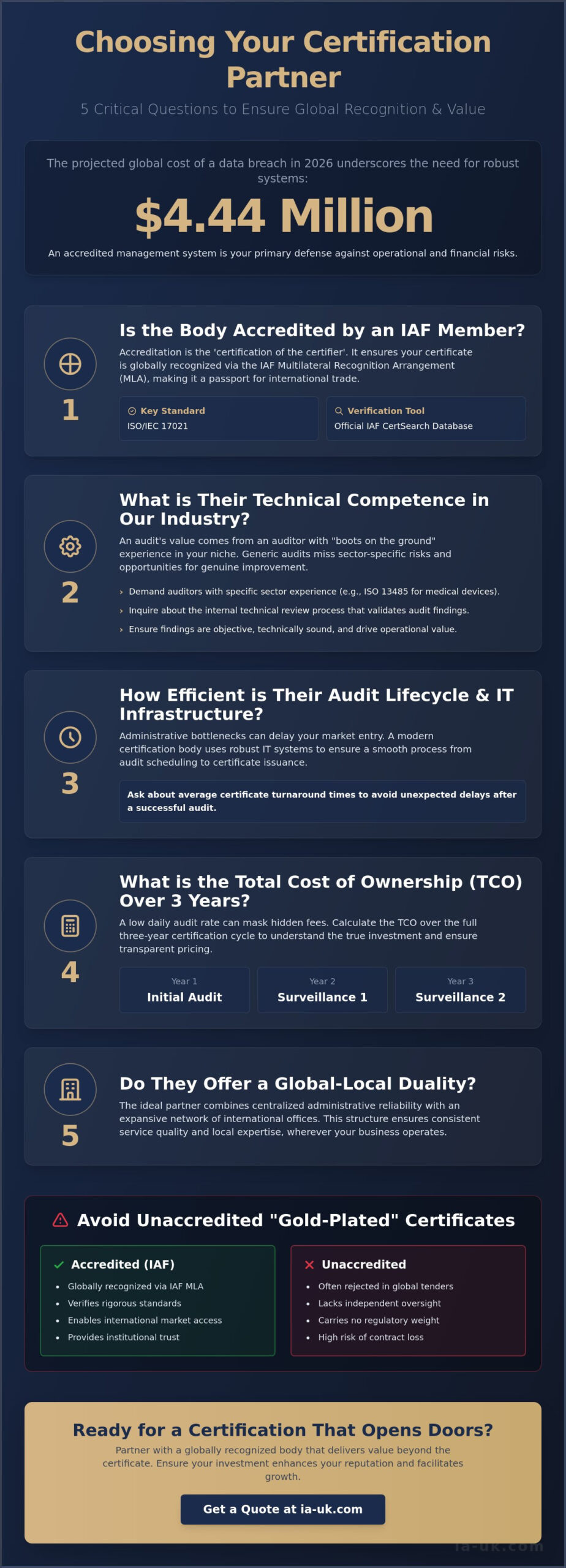
What is the Total Cost of Ownership (TCO) Over Three Years?
Certification represents a long-term strategic investment. It should not be evaluated solely on the initial day rate. One of the most essential questions to ask a certification body relates to the full financial commitment required across the mandatory three-year cycle. A low initial quote can often mask a series of administrative and technical fees that accumulate over time. These might include separate charges for certificate issuance, technical review, and annual file maintenance. Organizations must request a transparent breakdown that encompasses the initial assessment, surveillance audits, and the final recertification process.
Travel and subsistence costs are another variable that significantly impacts the TCO. A body with a truly global-local presence can deploy auditors from regional offices to minimize these expenses. If a provider lacks local expertise, your business may be liable for substantial international travel costs. Additionally, the financial implications of non-conformities must be clarified. Minor non-conformities are typically addressed through a review of corrective actions, whereas major non-conformities may necessitate a follow-up on-site audit. Understanding the specific costs associated with these follow-up visits allows for better budgetary planning and risk management.
Uncovering Hidden Fees in the Proposal
Transparency in the proposal phase prevents unexpected financial friction. For organizations in the medical device sector, it is vital to ask for a specific breakdown of technical file review fees. These reviews are technically demanding and often billed separately from the on-site audit time. You should also inquire about “registry” fees or annual maintenance charges used to keep your certification active in global databases. Clarifying the costs for future scope changes or adding additional sites ensures that your certification can grow alongside your business without punitive administrative penalties.
The Value of Auditor Professionalism
A higher initial investment in a professional, accredited body often yields a superior return on investment through risk mitigation. The market access gained through verified standards like ISO 9001 or ISO 45001 facilitates entry into highly regulated international markets. Professional auditors identify systemic weaknesses that, if left unaddressed, could lead to costly operational failures or legal liabilities. For a detailed assessment of your certification needs, you may contact our regional offices for a comprehensive, transparent quotation. Access to high-level Lead Auditor Training further ensures that your internal teams remain competent and prepared for every stage of the audit lifecycle.
Selecting a Global Partner for Sustainable Growth
A strategic partnership with a certification body must evolve alongside your organization’s international trajectory. Selecting a partner that demonstrates a “Global-Local” duality ensures that you benefit from centralized administrative stability while maintaining access to regional technical expertise. International Associates Limited exemplifies this model by balancing its Glasgow-based administrative core with an expansive network of international offices. This structure allows for a nuanced understanding of local regulatory shifts, such as post-Brexit UKCA requirements, while ensuring that your certification remains a recognized asset in global trade. The ability to bridge the gap between complex international frameworks and regional operational realities is a hallmark of a reliable auditing partner.
When evaluating long-term suitability, the questions to ask a certification body should probe their capacity to support expansion into emerging markets. Does the provider possess the necessary accreditations to facilitate entry into specific geographic regions without the need for redundant assessments? A partner that stays ahead of shifting international standards acts as a steady hand in the world of corporate compliance, reducing the friction associated with cross-border commerce. This proactive alignment with global regulations ensures that your management systems remain resilient against future legal or technical changes, providing the institutional weight required for high-stakes industrial sectors.
The International Associates Advantage
International Associates Limited maintains a fundamentally independent and objective approach to verification and assurance. Our advanced IT infrastructure is specifically designed to facilitate quick certificate turnaround times, ensuring that your operations aren’t delayed by administrative bottlenecks. Beyond standard ISO certifications, we offer specialized expertise in high-stakes sectors, including social accountability audits and Halal certification. This breadth of capability allows us to support complex global supply chains with the technical rigor required for sensitive and highly regulated industrial sectors, maintaining a unique blend of institutional reliability and worldwide operational capacity.
Final Checklist for Decision Makers
Before finalizing a contract, ensure you have addressed these critical questions to ask a certification body to confirm their suitability for your long-term goals:
- Can you confirm your accreditation status via the IAF CertSearch database for our specific industry scope?
- What is the verified industry experience of the auditors assigned to our technical sector?
- What is the total cost of ownership across the full three-year cycle, including all technical review and registry fees?
- How do you manage the transition process to ensure there is no gap in our certification status during a transfer?
- Can you provide a sample audit plan to demonstrate your technical approach and professional methodology?
Requesting a sample audit plan is a practical way to gauge the depth of a provider’s methodology before committing financial resources. This transparency allows decision-makers to verify that the audit process will be methodical, organized, and supportive of international growth. For organizations seeking a partner that combines institutional reliability with worldwide operational capacity, you can contact International Associates Limited for a transparent, accredited certification quote.
Securing Your Organization’s Global Regulatory Future
Selecting a certification body is a strategic decision that directly impacts your organization’s market access and operational stability. By utilizing the specific questions to ask a certification body outlined in this guide, businesses can verify accreditation status and ensure auditors possess the technical depth required for high-stakes sectors. This methodical vetting process mitigates the risk of non-recognition in international tenders and provides a clear understanding of the total financial commitment over the three-year audit cycle.
International Associates Limited provides this essential blend of institutional reliability and worldwide operational capacity. As specialists in ISO 13485 and Social Accountability, our firm is accredited by globally recognized bodies to provide rigorous, independent verification. We operate from a Glasgow-based head office while maintaining a global reach through our expansive network of professional auditors. Request a Professional Certification Quote from International Associates Limited to ensure your management systems are supported by ethical, technical experts. Achieving accredited certification is a decisive step toward sustainable international growth and improved quality culture.
Frequently Asked Questions
What is the difference between an accreditation body and a certification body?
An accreditation body provides formal recognition that a certification body is competent to perform specific audit tasks under international standards like ISO/IEC 17021. While certification bodies assess your organization’s management systems, accreditation bodies verify that the auditors themselves follow rigorous protocols. This hierarchical structure ensures that every certificate issued carries institutional weight and is backed by independent, high-level oversight.
Can I use a certification body that is not accredited?
You can technically use an unaccredited provider; however, the resulting certificate often lacks international recognition and is frequently rejected in global tenders. Most procurement officers and regulatory agencies require proof of accreditation through the IAF Multilateral Recognition Arrangement to ensure validity. Choosing a non-accredited path often leads to higher long-term costs when you are forced to repeat the audit with a legitimate provider.
How long does the certification process usually take from the first inquiry?
The duration of the certification process varies based on your organization’s size, complexity, and current level of compliance. Typically, the journey from initial inquiry to certificate issuance takes between three and six months. This timeframe includes the Stage 1 readiness review, the Stage 2 certification audit, and the subsequent technical review of the auditor’s findings before the final certificate is formally released.
What happens if our auditor finds a non-conformity during the assessment?
If an auditor identifies a non-conformity, your organization must implement a corrective action plan to address the root cause of the issue. Minor non-conformities usually require evidence of resolution before the next surveillance visit. Major non-conformities are more serious; they may necessitate a follow-up audit to verify that the systemic failure has been fully corrected before certification can be granted or maintained.
Is it possible to switch my certification body mid-cycle?
It’s entirely possible to switch your provider mid-cycle through a formal transfer process. This procedure involves a review of your current certification status and previous audit reports by the new body to ensure continuity. One of the key questions to ask a certification body during this transition is how they manage the transfer to ensure your certification remains active without any administrative gaps.
Are ISO certificates issued in the UK recognised in the EU and Asia?
ISO certificates issued by an accredited body in the UK are fully recognized in the EU, Asia, and other global markets. This recognition is facilitated by the International Accreditation Forum (IAF) through its Multilateral Recognition Arrangement. As long as the certification body is an accredited signatory to this arrangement, your certification acts as a global passport for international trade and regulatory adherence.
How often will our management system need to be audited after the initial certificate is issued?
Your management system will undergo annual surveillance audits following the initial certification to ensure ongoing compliance. These visits verify that your processes continue to meet the required standards and that improvements are being maintained. Every three years, a more comprehensive recertification audit is conducted to renew the certificate for another cycle, providing a continuous loop of professional verification and assurance.
What qualifications should I look for in an individual lead auditor?
An individual lead auditor should possess formal training qualifications, such as a certified Lead Auditor course recognized by IRCA or CQI. You should also verify their specific technical experience within your industrial sector to ensure they understand your operational risks. Effective auditors combine deep knowledge of international standards with practical experience to provide meaningful feedback that drives institutional stability and performance.