

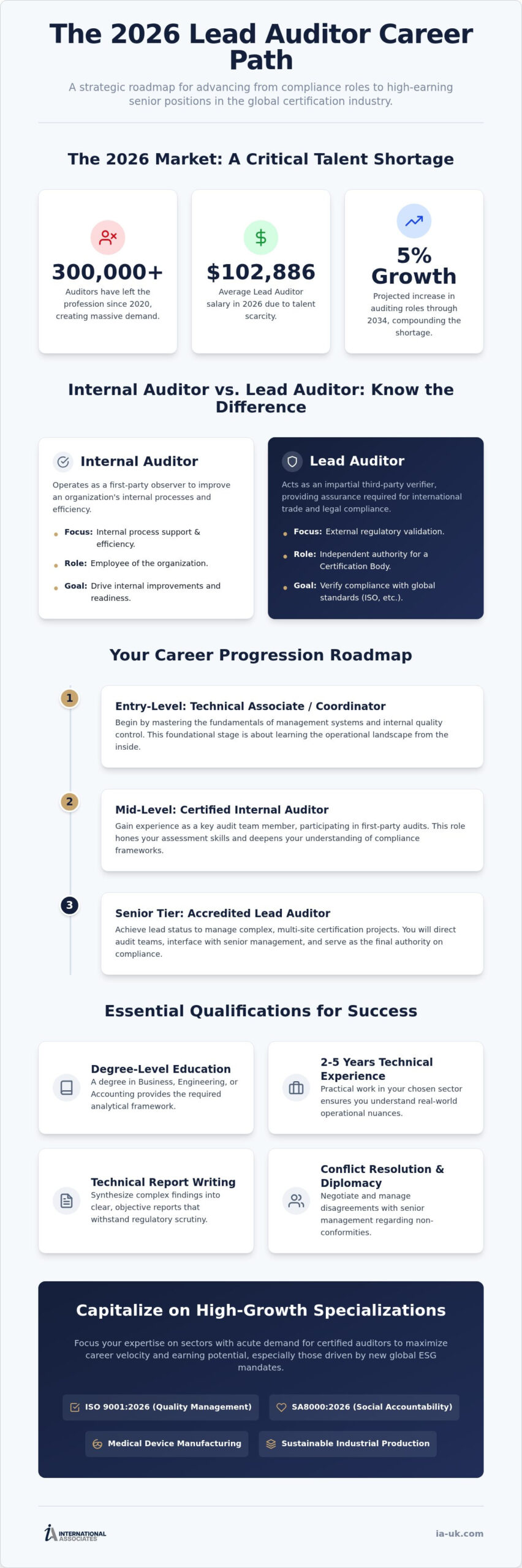
With more than 300,000 auditors leaving the profession since 2020, a critical talent shortage has emerged, driving the average Lead Auditor salary to $102,886 in 2026. You’re likely aware that a lead auditor career path offers a secure route to high-level governance, but the distinction between internal auditing and third-party certification often remains unclear. The complexity of choosing between various certification bodies and determining the true ROI of specific training programs can hinder professional progression. This article provides the definitive roadmap for advancing from entry-level compliance roles to a senior Lead Auditor position within the global certification industry.
We’ll clarify the transition from internal oversight to independent verification and identify which regulatory frameworks, such as the revised ISO 9001:2026 or SA8000:2026, yield the highest professional value. You’ll gain a structured timeline for career advancement and actionable steps to achieve accredited certification. This methodical approach ensures you’re equipped to navigate the rigorous standards of international regulatory adherence with confidence and precision.
Key Takeaways
- Distinguish between internal auditing and third-party certification roles to strategically select the trajectory that aligns with your long-term seniority goals.
- Accelerate your lead auditor career path by securing IRCA-accredited training in high-demand standards like ISO 9001:2026 or SA8000:2026.
- Align your existing industry experience with high-growth sectors, such as medical devices or social accountability, to capitalize on emerging global ESG mandates.
- Evaluate the practical transition from entry-level compliance to high-earning positions by leveraging degree-level foundations and financial literacy.
- Understand the shift toward independent day-rate models and senior management roles to maximize your professional earning potential in the 2026 labor market.
Mapping the Lead Auditor Career Path in 2026
A Lead Auditor serves as the definitive authority within the global certification framework. They’re responsible for directing audit teams and conducting high-stakes assessments on behalf of independent certification bodies. This role differs significantly from that of an internal auditor. While internal auditors operate as first-party observers to improve organizational efficiency, lead auditors act as third-party verifiers. They provide the impartial assurance required for international trade and legal adherence. It’s a transition from internal process support to external regulatory validation.
The 2026 labor market is characterized by a structural talent scarcity that favors those on a lead auditor career path. Since 2020, the profession has lost over 300,000 auditors due to retirements and shifting career priorities. This supply problem, combined with a 5% projected growth in auditing roles through 2034, has elevated the value of specialized expertise. Organizations face intense pressure for supply chain transparency, particularly within high-stakes sectors. Demand is most acute in medical device manufacturing, sustainable industrial production, and information security. These fields require auditors who can bridge the gap between complex local operations and international standards.
The Progression: From Junior Auditor to Lead
Professional advancement in this field follows a logical, hierarchical sequence. Entry-level candidates often begin as technical associates or internal quality coordinators where they master the fundamentals of management systems. Mid-level professionals typically progress to become certified internal auditors, gaining experience as audit team members. The senior tier is reached when a professional achieves lead status. At this stage, they manage complex, multi-site certification projects and lead cross-functional teams of technical experts. Successful progression along the lead auditor career path requires a blend of field experience and formal accredited training.
Why the Lead Auditor Role is a Strategic Asset
Modern lead auditors aren’t viewed as simple checklist administrators; they’re strategic assets essential for regulatory compliance on a global scale. By verifying that organizations meet rigorous ISO or social accountability standards, these professionals act as the final gatekeepers for market access. The industry has shifted toward risk-based governance. This means auditors must evaluate how an organization identifies and mitigates operational threats rather than just reviewing documentation. Leveraging Glasgow-based expertise with a global reach ensures that certification provides genuine institutional stability. This evolution ensures that the audit process supports sustainable international growth and protects brand integrity in a highly regulated global economy.
Essential Qualifications: From Accounting Foundations to IRCA Certification
Securing a position at the top of the compliance hierarchy requires a specific blend of academic rigor and field-based expertise. Most global certification bodies prioritize candidates with degree-level education in business, engineering, or accounting, as these disciplines develop the necessary analytical framework. According to the Essential Qualifications for a Lead Auditor, a candidate must also demonstrate between two and five years of technical work experience within their chosen sector. This practical history ensures that the auditor understands the operational nuances of the industry they are evaluating, moving beyond theoretical knowledge to real-world application.
Technical report writing and conflict resolution are equally critical competencies for long-term success. A lead auditor must synthesize complex findings into clear, objective reports that can withstand legal and regulatory scrutiny. During the assessment process, negotiation skills are often required to manage disagreements regarding non-conformities with senior site management. Mastering these interpersonal dynamics is a prerequisite for anyone advancing along the lead auditor career path, as the role demands both technical precision and professional diplomacy.
Bridging the Gap: Accounting to Auditing
Professionals with an associate degree in accounting possess a distinct advantage when transitioning into management system certification. Financial literacy allows an auditor to evaluate the integrity of organizational records with greater depth and understand the P&L implications of compliance budgets. This background in data analysis facilitates a more thorough review of resource allocation, ensuring that an organization’s commitment to standards is backed by sufficient financial and operational support. It transforms the audit from a simple checklist into a strategic evaluation of corporate health.
The Certification Gold Standards
Formal accreditation remains the final requirement for professional recognition. The International Register of Certificated Auditors (IRCA) is the globally accepted benchmark for lead auditor status. Achieving this requires completing intensive training for specific standards, such as ISO 9001 for quality or SA8000 for social accountability. International Associates Limited provides accredited lead auditor training that acts as the essential bridge to these senior roles. Choosing a provider with global reach ensures that your credentials are respected by international trade bodies and regulatory agencies alike, providing the necessary mobility for a worldwide career.
Step-by-Step Guide: Transitioning to a Lead Auditor Role
Transitioning to a senior auditing position requires a methodical approach that combines theoretical mastery with documented field experience. The first step involves identifying a niche standard that aligns with your technical background. If your experience lies in medical device manufacturing, ISO 13485 is the logical choice; for those in general industrial sectors, ISO 9001 remains the foundational standard. Once your niche is established, you must complete an IRCA-accredited 5-day training course. This intensive program covers the principles of management system auditing and prepares you for the rigorous final examination. This structured progression is essential for anyone navigating the lead auditor career path in a competitive global market.
After certification, you’ll need to gain practical experience through observer audits with an accredited certification body. This phase allows you to witness live audit scenarios and understand how senior auditors manage complex site visits. You’ll then build an audit log to document the minimum hours required for full registration. This log serves as objective evidence of your competence in planning, conducting, and reporting on audits. Finally, you’ll apply for formal registration with a global register, such as IRCA, to solidify your professional standing. Achieving this status is a primary factor in Maximizing Your Career Potential and Salary within the compliance sector.
Step 2: Choosing the Right Training Provider
Selecting an accredited provider is critical for ensuring your credentials carry weight internationally. You should evaluate factors such as tutor experience and post-course support rather than just the lowest price. International Associates Limited offers Glasgow-based Lead Auditor training that leverages a global network of expertise. In 2026, while online formats offer flexibility, many professionals find that classroom-based training delivers superior exam results due to the immersive nature of the workshops. The interactive environment allows for immediate feedback on complex technical interpretations.
Step 4: Navigating the Audit Log Requirements
Finding shadowing opportunities requires proactive engagement with established certification bodies. Most organizations expect trainees to participate in a specific number of “full” audit days, typically defined as eight hours of on-site or remote assessment activity. During these sessions, you’ll practice managing non-conformity reports (NCRs) under the supervision of a qualified lead. It’s vital to record every hour accurately, as these logs are scrutinized during the final registration process. This hands-on experience ensures you can apply the lead auditor career path principles to real-world regulatory challenges without ambiguity.
High-Growth Specializations: ISO 9001, SA8000, and Medical Devices
Strategic specialization is the primary driver of seniority on the lead auditor career path. While ISO 9001 serves as the foundational quality management framework for most professionals, the 2026 market rewards those who bridge the gap between technical standards and specific regulatory mandates. Identifying these high-growth corridors early allows you to capitalize on sectors where the supply of qualified auditors is historically low but demand remains structurally high.
The Social Accountability Path
ESG mandates have transformed social accountability audits from voluntary disclosures into essential trade requirements. Organizations now face intense scrutiny regarding labor rights and ethical sourcing across their entire supply chain. The SA8000 standard represents the most rigorous, certifiable framework for these assessments. Unlike non-certifiable reporting methodologies used by some supply chain platforms, SA8000 provides a formal third-party certification that carries significant weight with international regulators and institutional investors. You can evaluate the technical differences and transition requirements in our SA8000 Social Accountability Audit guide.
Medical Device Auditing (ISO 13485)
Auditing within the medical device sector involves navigating the high-stakes intersection of ISO 13485, the EU Medical Device Regulation (MDR), and the UKCA framework. This path requires a profound level of technical documentation review, as auditors must verify that clinical evidence and risk management files meet exacting legal standards. The complexity of these requirements creates a high barrier to entry, which in turn sustains premium professional value for those who master the discipline. Detailed competency requirements and training pathways are available in our ISO 13485 Lead Auditor Training resource.
Beyond these sectors, ISO 27001 for information security and ISO 22301 for business continuity are emerging as critical specializations. These standards are increasingly integrated into broader corporate governance frameworks as organizations seek to mitigate cybersecurity and operational risks. Selecting a niche that aligns with your technical background is a critical decision. You should explore accredited Lead Auditor training through International Associates Limited to identify the most viable specialization for your professional goals.
Maximizing Your Career Potential and Salary in 2026
The final stage of a lead auditor career path involves transitioning into senior governance or high-yield independent consultancy. As of July 2026, the average annual salary for a Lead Auditor in the United States has reached $102,886, while senior professionals in the 75th percentile earn upwards of $132,500. These figures reflect a talent market characterized by structural constraints and a 5% projected growth rate through 2034. While Associate Auditors often start near the $80,500 mark, moving into a Certification Manager role allows for oversight of global portfolios and significantly higher institutional influence.
Many senior professionals opt for the independent “day rate” model rather than traditional salaried employment. This approach allows auditors to contract their expertise to multiple certification bodies, maximizing earnings based on technical specialization and audit volume. To maintain this status, you must prioritize Continuing Professional Development (CPD). Keeping your IRCA or equivalent registration active requires documented proof of ongoing training and a consistent audit log. It’s the only way to ensure your expertise remains current as standards like ISO 9001:2026 and SA8000:2026 become the new industry benchmarks. Consistent participation in industry forums and technical committees also provides the networking necessary to secure high-value contracts.
Global Mobility and Remote Auditing
Advanced IT infrastructure has fundamentally shifted the auditing landscape toward hybrid and remote models. This digital transition allows UK-certified auditors to service high-growth markets in Asia and the Middle East without the logistical burdens of permanent relocation. There’s a distinct global preference for auditors trained under rigorous Glasgow-based frameworks, as these credentials signal a commitment to institutional reliability. Leveraging the global network provided by International Associates Limited offers a unique bridge for professionals seeking worldwide operational capacity while maintaining a central administrative base. This model is particularly effective in sectors where on-site presence can be supplemented by secure digital document reviews and remote interviews.
Selecting Your Final Certification Body
Your choice of certification body is a strategic decision that defines your professional reputation. Associating with a firm that holds broad accreditations adds immediate weight to your resume and signals to the market that you operate under the highest levels of oversight. When preparing for a final interview with a Technical Manager, focus on your ability to handle complex non-conformities and your understanding of risk-based governance. Selecting the right partner ensures your career trajectory remains on an upward curve. For a detailed comparison of available pathways, refer to our Best Lead Auditor Training 2026 guide to ensure you select the course that aligns with your long-term objectives.
Securing Your Future in Global Governance
Navigating the 2026 compliance landscape requires more than just technical knowledge; it demands a strategic commitment to recognized accreditation. Success on a lead auditor career path is built on the ability to interpret complex regulatory shifts and apply them to high-stakes industrial scenarios. By focusing on high-barrier niches like medical devices or ethical sourcing, you’ll ensure your expertise remains a critical asset for international trade. These specializations provide the mobility and security needed to thrive in a structurally constrained labor market.
Advancing to the top of the profession requires a training partner with established global credentials. International Associates Limited has operated as a reliable certification body since 2005, offering the institutional weight necessary to validate your professional standing. Our IRCA-accredited training courses are led by expert tutors who bring real-world auditing experience directly into the classroom. This practical focus ensures you’re prepared for the rigors of third-party certification from day one. Book your accredited Lead Auditor training with International Associates Limited today to secure your position at the forefront of global compliance.
Frequently Asked Questions
What is the difference between an Internal Auditor and a Lead Auditor?
Internal auditors perform first-party assessments to improve their own organization’s efficiency and internal controls. Lead auditors conduct third-party verifications on behalf of independent certification bodies and lead multi-disciplinary teams during the assessment process. This distinction is foundational for the lead auditor career path, as lead status requires independent authority and international accreditation.
How long does it take to become a Lead Auditor in 2026?
Professional progression typically requires two to five years of relevant technical experience within a specific industry sector. This timeline includes the completion of an IRCA-accredited training course and the fulfillment of mandatory audit log hours through shadowing established lead auditors. The exact duration depends on your ability to secure observation opportunities with an accredited certification body.
Can I become a Lead Auditor with an associates in accounting?
An associate degree in accounting serves as an excellent foundation for a career in auditing. Financial literacy and data analysis capabilities are essential for verifying organizational records and assessing compliance budgets effectively. Candidates with this background are often well-suited for risk-based governance and the oversight of complex management systems.
What is the most in-demand ISO certification for auditors right now?
ISO 9001:2026 remains the most widely recognized foundational standard for quality management professionals globally. However, specialized standards like SA8000:2026 for social accountability and ISO 13485 for medical devices are experiencing significant growth due to emerging ESG mandates. Specializing in these high-growth sectors can significantly accelerate your lead auditor career path.
Do I need to be an engineer to audit ISO 9001 systems?
Engineering qualifications aren’t a mandatory requirement for auditing ISO 9001 quality management systems. Auditors must demonstrate a thorough understanding of management system principles and the ability to evaluate process effectiveness against the standard’s requirements. Relevant industry experience and analytical skills are often more critical than a specific technical degree.
How much does a Lead Auditor training course typically cost?
Fees for accredited training programs vary based on the specific standard, the provider’s global reputation, and the delivery format. You should consult with individual certification bodies to confirm current pricing for their programs. It’s essential to prioritize IRCA-accredited providers to ensure your qualifications are recognized by international regulatory authorities and certification registers.
What is the IRCA exam format for 2026?
The 2026 IRCA exam format typically utilizes computer-based testing with options for remote invigilation or in-person assessment. These examinations emphasize the practical application of standards through complex case studies and scenario-based questions. They’re designed to verify a candidate’s competence in identifying non-conformities and managing a professional audit team under pressure.
Can I perform audits remotely as a Lead Auditor?
Remote auditing is a standard practice in 2026, supported by advanced Information and Communication Technology (ICT) frameworks. Many certification bodies utilize hybrid models where site tours and document reviews are conducted through secure digital platforms. This approach enables global mobility and allows auditors to service international markets while maintaining procedural integrity.