

When aligning multiple ISO management systems, the key decision is how to coordinate shared processes without overlooking each standard’s unique requirements. Annex SL provides a common framework to help teams do that, but it does not make the requirements interchangeable.
That common framework matters when an organisation uses more than one management system. It helps teams identify overlapping processes and coordinate audits, while keeping each standard’s distinct requirements in view. The structure has ten clauses, from Scope through Improvement, and also guides the development and revision of management system standards.
This guide explains why Annex SL was introduced, how its shared structure shapes standards and revisions, and what it means for integrated system audits. You’ll learn where requirements align, where they remain specific to each standard, and why a common structure can improve audit coordination without automatically reducing costs.
Key Takeaways
- Use the shared structure to identify where management systems may align, while preserving each standard’s specific requirements.
- Integrated audits can coordinate overlapping processes, but the structure alone doesn’t determine audit effort or cost.
- Understand how Annex SL shapes standard development and why revision cycles can affect alignment between standards.
- Apply common management-system elements across environmental, information security and occupational health and safety systems without treating them as interchangeable.
- When independent verification is the next step, match the certification audit to the specific standard your organisation is implementing.
Does Adopting Annex SL Make Integrated System Audits Cheaper?
Annex SL can help coordinate audit work by aligning common management system requirements. It may reduce duplicated effort, but shared clauses alone do not determine audit costs. Understanding Annex SL and the high-level structure of ISO standards helps organisations see where audit activities can overlap and where separate assessment remains necessary.
Harmonized Structure of ISO Management Standards
The harmonized structure gives ISO management system standards a common clause sequence, core text and shared terms. This helps organizations locate overlapping requirements instead of treating each standard as an entirely separate system. According to the International Organization for Standardization, ISO 9001:2015 is a quality management systems standard that uses Annex SL.
The high-level structure has ten clauses, from Scope to Improvement, with topics such as context, leadership, planning and performance evaluation. Management system standards set requirements or provide guidance for managing a defined area, such as quality management or occupational health. For official guidance, consult Annex SL in ISO/IEC Directives Part 1; ISO’s published catalogue identifies current standard editions.
Integrating Multiple Management System Standards
Integration means managing the requirements of multiple standards through coordinated processes, responsibilities and records. An organization using ISO 9001 for quality alongside ISO 14001 for environmental management can align shared activities while retaining each standard’s distinct controls and objectives.
In practice, organisations apply Annex SL by mapping each standard’s requirements to common management processes, then identifying topic-specific additions. For example, a shared process for setting objectives can support quality and environmental goals, but the evidence must still address each standard’s requirements. This reveals areas of overlap without treating standards as interchangeable.
Benefits of Integrated Management Systems
An integrated management system can reduce duplicated documentation and clarify responsibilities across departments. If a leadership review considers quality, environmental performance and occupational health together, managers can assess related priorities through one coordinated process.
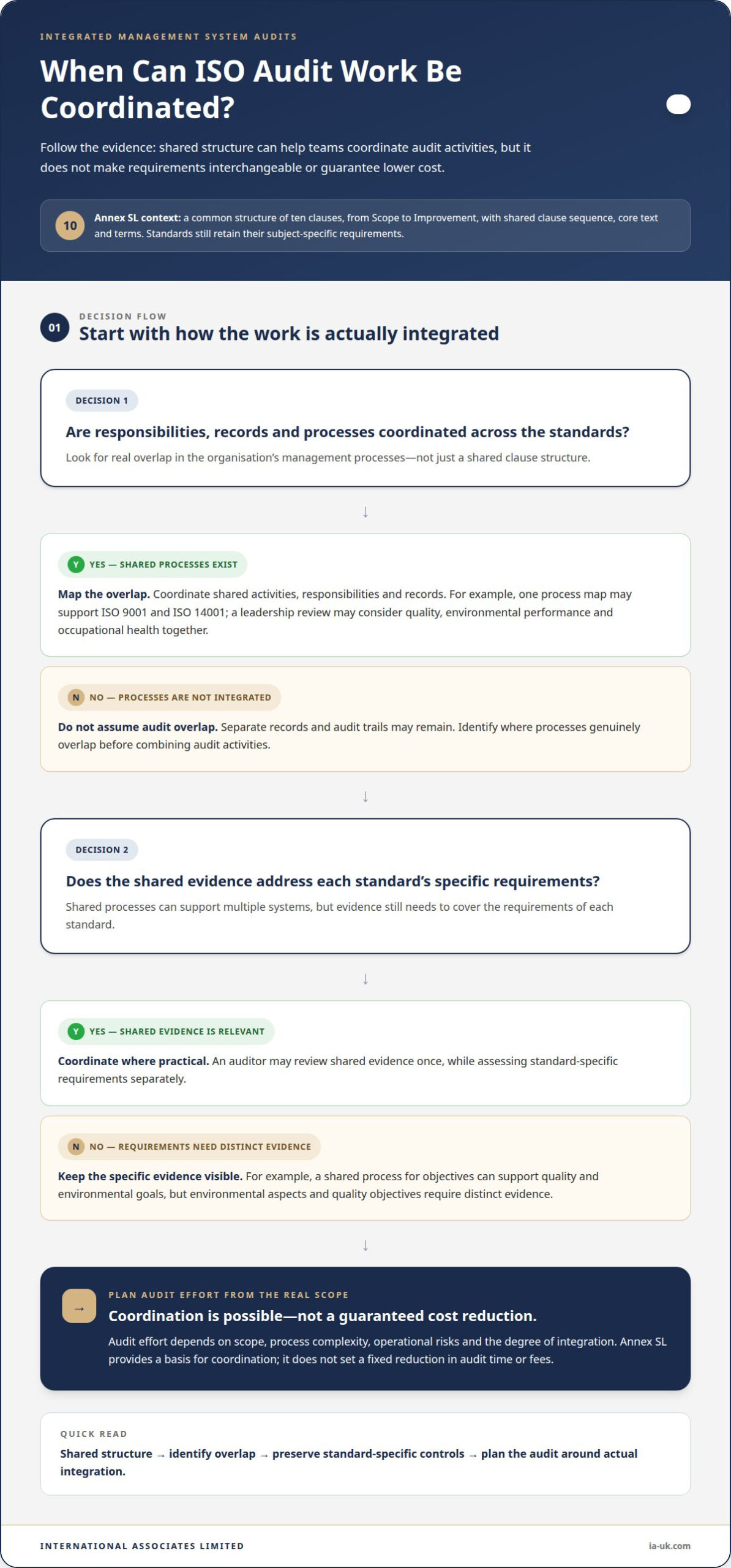
In an integrated audit, an auditor may be able to review shared evidence once and assess standard-specific requirements separately. The effort depends on scope, process complexity, operational risks and the degree of integration. Annex SL and the high-level structure of ISO standards provide a basis for coordination, not a fixed reduction in audit time or fees.
Audit planning should distinguish common requirements from separate controls before combining activities. For example, one process map may support ISO 9001 and ISO 14001, while environmental aspects and quality objectives require distinct evidence. A combined audit can be more efficient when responsibilities, records and processes genuinely overlap.
By contrast, adding standards without integrating processes can leave duplicated records and separate audit trails. The practical question is whether shared governance and evidence exist, not simply whether the standards use the same clause structure. Understanding Annex SL and the high-level structure of ISO standards helps teams identify where coordination is practical while keeping each standard’s requirements visible.
Annex SL’s Purpose and Origin
Annex SL was developed to bring greater consistency to ISO management system standards. Its history explains why organizations encounter shared structures across standards addressing different management needs.
Purpose of Annex SL
Annex SL provides a common framework for writing ISO management system standards, helping standards committees align structure, core text and terminology. This matters to organizations because shared requirements can be recognized across systems without removing each standard’s subject-specific obligations.
Before 2012, management system standards were written in different ways. The common framework helps committees develop new standards and revise existing ones with a more consistent approach. For an organization managing quality and environmental requirements, that consistency makes it easier to distinguish shared management processes from controls unique to each subject.
The purpose is not to make every ISO management system identical. Each standard still addresses its own management discipline, such as environmental or quality management. Annex SL gives committees a shared starting point, so common management principles can be expressed consistently while specialised requirements remain relevant to their intended use.
Scope and Origin of Annex SL
ISO first published Annex SL in 2012 as a generic structure for new and revised management system standards. Its scope covers how these standards are written, including common requirements and terminology, rather than prescribing one operating system for every organization.
ISO’s Joint Technical Coordination Group, established in 2007, is responsible for Annex SL of the ISO/IEC Directives Part 1. Its role connects the framework with the committees developing ISO management standards, supporting consistency across separate technical subjects.
The framework is intended for management system standards developed by ISO. Its use supports organisations in different sectors, allowing standards to address distinct purposes while following a shared drafting model. For example, an environmental standard and a quality standard can use common management concepts without sharing every technical requirement.
In practice, an organisation can use Annex SL as a reference when interpreting how ISO standards relate. It can identify shared management system elements, then map discipline-specific needs separately. This distinction supports implementation planning and helps teams align systems without assuming one set of controls satisfies every standard.
What Is Annex SL and Why Is It Important for ISO Standards?
Annex SL provides a common structure, identical core text, and shared terms and definitions for ISO management system standards. This alignment helps organizations compare requirements across disciplines, rather than interpreting each standard as an entirely separate framework. ISO 9001 and ISO 45001:2018, for example, address quality and occupational health and safety through distinct requirements within a harmonized approach.
Shared terminology gives standards committees a consistent foundation for describing management system concepts. Terms such as “organisation,” “policy,” “objective” and “documented information” can be used consistently across standards, helping teams recognise familiar requirements when implementing another system. The common text also gives auditors and managers a clearer basis for mapping related processes without assuming the standards have identical technical goals.
Annex SL does not prescribe an organisation’s specific processes or require a universal set of procedures. Each management system standard defines its own requirements for documented information; under the general approach to documented information, management system procedures are not mandatory. Organisations determine suitable processes and records based on applicable requirements and how they operate.
The main benefit is alignment: an organization can identify common leadership, planning, and improvement activities, then address requirements unique to each standard. For example, a shared review process might consider quality objectives under ISO 9001 and occupational health and safety performance under ISO 45001. Teams can coordinate responsibilities and evidence while retaining separate criteria for evaluating each discipline.
Problems can arise when a common framework is applied too mechanically. A template copied across standards may obscure important differences, such as the distinct risks and controls relevant to product quality and workplace health and safety. The structure supports consistency, but it cannot replace subject-specific analysis or determine which controls are effective in a particular organisation.
Implementation challenges include interpreting shared clauses consistently, assigning clear process ownership and keeping standard-specific obligations visible. A practical approach is to map each requirement to an accountable role, relevant process and suitable evidence, then identify where separate controls are needed. This reduces the risk of treating shared wording as proof that every requirement has been met.
For example, an organization integrating ISO 9001 with an occupational health and safety system can coordinate objectives and management reviews. It must still evaluate quality and workplace risks against the relevant standard’s requirements. Annex SL makes the relationship between systems easier to analyze; the organization remains responsible for applying each requirement to its own activities.
Annex SL and the High-Level Structure in Practice
Annex SL and the high-level structure of ISO standards support implementation by giving management systems a shared framework for organising responsibilities. This helps teams coordinate common governance activities while retaining controls specific to each discipline. For example, an organisation can align leadership reviews across environmental management and information security management, then assess the evidence required for each standard separately.
Consider ISO 14001:2015 and ISO/IEC 27001:2022. Both use the harmonized structure, allowing teams to organize context, leadership, planning, support and performance evaluation in a consistent way. Their technical focus remains distinct: environmental management addresses environmental aspects, while information security management addresses information security risks. A shared structure helps teams map responsibilities without treating these different risks as equivalent.
Implementation can begin by assigning each shared management-system topic to an accountable role. Under Clause 4, teams consider organizational context and interested parties; Clause 6 addresses planning. An organization can coordinate these activities across systems, then record separate environmental objectives and information security risks. This makes overlapping governance visible while preserving the decisions each standard requires.
ISO 45001:2018 applies the common structure to occupational health and safety management. For example, leadership review and performance evaluation may be coordinated with other management systems. The organization must still evaluate workplace hazards and address applicable safety requirements through relevant controls and evidence. One combined review meeting does not, by itself, demonstrate that every standard’s requirements have been met.
A useful implementation method is to map shared clauses to existing processes, owners and records, then identify requirements that need separate treatment. A common objective-setting process might support environmental, information security and safety systems. Keep objectives, risks and evidence identifiable by discipline, so integration does not obscure ownership or leave a requirement unaddressed.
The practical takeaway is that Annex SL and the high-level structure of ISO standards enable coordinated system design, not interchangeable requirements. Organizations can integrate shared governance, reviews and records, then evaluate each standard’s technical requirements independently. This distinction helps an integrated system operate coherently while keeping evidence clear for ISO 14001, ISO/IEC 27001 and ISO 45001.
Transition of Standards During Revision Cycles
Annex SL alignment is introduced as ISO management system standards are developed or revised. A revision can update technical requirements while bringing a standard’s structure and terminology into closer alignment with other management system standards. Organisations therefore need to distinguish structural alignment from changes to a standard’s subject-specific requirements.
The term itself has also changed. In 2021, the ISO/IEC Directives replaced “High-Level Structure” with “Harmonized Structure.” This was a change in terminology in the Directives; it does not, by itself, establish that every standard’s technical requirements changed. In practice, readers should identify the edition they use and assess its actual clauses, rather than relying on the label alone.
Revision cycles do not mean that every sector-specific standard immediately adopts the shared structure. ISO 13485:2016, which sets medical-device quality management requirements for regulatory purposes, and ISO/IEC 27701:2019, a privacy information management extension related to ISO/IEC 27001, are identified as not yet revised in accordance with Annex SL. Their sector-specific purpose matters when organizations assess how they relate to other standards.
For example, ISO 14001:2015 uses Annex SL, while ISO 13485:2016 addresses medical-device quality requirements. An organization using both should map shared management processes separately from technical controls serving medical-device regulatory needs. The common structure can support coordinated responsibilities, but it does not make the standards’ scopes or evidence requirements interchangeable.
Compared with older ISO high-level structure terminology, the 2021 change is from “High-Level Structure” to “Harmonized Structure” in the ISO/IEC Directives. The shared approach provides common structure, text and terms; the renamed term reflects the Directives’ wording. Organizations should still check the edition and clauses applicable to each standard, because revision status and sector requirements differ.
Revisions can improve efficiency by aligning recurring management system elements, including leadership, planning and performance evaluation. For a business with environmental and safety management systems, clearer alignment may make it easier to coordinate reviews and responsibilities. The benefit depends on the revised standard’s actual content and how its requirements apply to the organisation’s operations.
A practical transition review has three steps: identify each standard’s edition, compare revised clauses with current processes, and separate shared requirements from technical or sector-specific changes. For example, compare ISO 14001’s environmental requirements with a safety management standard’s controls before updating integrated procedures. This prevents structural consistency from obscuring new or distinct obligations.
International Associates Limited
International Associates Limited provides independent assessment, verification and assurance for organisations working toward recognised management system standards. Once you understand how Annex SL aligns standards, the practical next step may be an external certification assessment against a specific standard. This is useful when an organisation needs an independent evaluation of its management system, rather than just an internal comparison of shared clauses.
The appropriate standard depends on the management system’s purpose. For quality management, ISO 9001 Quality Management System Certification provides assessment against ISO 9001 requirements. Organizations addressing environmental management may consider ISO 14001 Environmental Management System Certification, while ISO 45001 Occupational Health and Safety applies to occupational health and safety management. Each assessment focuses on its respective standard, even when processes are integrated.
Integration does not remove the need to demonstrate conformity with each applicable standard. An organisation with shared governance processes can use common procedures and responsibilities, while evidence is assessed against the relevant quality, environmental or safety requirements. International Associates Limited provides independent assessment to evaluate whether a system meets the requirements of the standard being assessed.
Organisations can turn to International Associates Limited when preparing for external certification, seeking assessment of an existing management system or considering certification across integrated systems. Social Accountability Audits are also available for organisations focused on evaluating social accountability. The appropriate assessment depends on the standard and scope the organisation intends to address.
Certification is a formal assessment of conformity, not a substitute for integrating processes effectively. Annex SL can help an organisation recognise common requirements, but evidence and conclusions must still relate to the selected standard. For example, shared review arrangements may support several systems, while quality, environmental, and occupational health and safety performance remain distinct areas of assessment.
International Associates Limited’s management system certification supports organizations seeking independent verification against applicable requirements. The assessment is focused on the selected standard, so an integrated system can be evaluated without treating its distinct obligations as interchangeable. This offers a clear next step when an organization is ready to pursue certification rather than only understand the shared structure.
Contact International Associates Limited to discuss management system certification.
Frequently Asked Questions
How Do You Benefit from Annex SL?
Organisations can use Annex SL to coordinate responsibilities and internal review planning across management systems. One practical benefit is assigning a single owner to a shared governance activity while recording which standards and requirements it covers. This gives managers a clearer basis for planning internal audits and tracking findings, without assuming common administration replaces the separate evidence each standard requires.
What Is the Annex SL Structure?
Annex SL is the framework used to organise ISO management system standards, with a ten-clause sequence from Scope to Improvement. Treat the clause headings as a navigation aid, not a complete implementation checklist. When preparing an internal audit, use the relevant standard’s requirements under each clause to define audit criteria and select evidence that reflects the organisation’s actual activities.
What Do You Need to Know About the High-Level Structure?
The high-level structure describes how management system standards are organised, not a universal operating model for every organisation. This distinction matters when teams use templates: a clause heading can help locate a subject, but it does not tell an organisation which controls suit its operations. Read the chosen standard’s requirements and apply them to the organisation’s scope, processes and risks.
What Is Annex SL in ISO Standards?
Annex SL is part of the ISO/IEC Directives Part 1 and sets out a common framework for drafting ISO management system standards. Organizations encounter its influence through the structure and shared wording used in aligned standards. It is useful when comparing standards or organizing an integrated system, but it is not itself a certification standard. Certification assessment is against the requirements of the selected standard.
What Is the ISO Harmonized Structure, Formerly Called the High-Level Structure?
“Harmonized Structure” is the current term in the ISO/IEC Directives, replacing “High-Level Structure” in 2021. The naming change helps readers interpret newer ISO materials alongside older documents that use the previous term. When reviewing a management system standard, rely on its published edition and requirements rather than assuming that a terminology update changed that standard’s technical content.
What Are the 10 Clauses in the ISO Harmonized Structure?
The clauses are Scope; Normative references; Terms and definitions; Context of the organization; Leadership; Planning; Support; Operation; Performance evaluation; and Improvement. For document control, organisations can use these headings to classify policies, records and audit findings. The clause number alone does not establish what documentation is necessary; the applicable standard’s requirements and the organisation’s operational needs determine the relevant documented information.
Which ISO Management System Standards Use Annex SL or the Harmonized Structure?
Examples include ISO 22301:2019 for business continuity, ISO 50001:2018 for energy management and ISO 21001:2018 for educational organizations. These examples show that the structure spans different management subjects. Edition identifiers are important when comparing requirements, since a standard’s title alone does not identify the edition or establish whether its revision follows the harmonized framework.
How Does Annex SL Improve Integration of Multiple Management Systems?
Annex SL can help organisations coordinate governance tasks, such as assigning responsibility for review schedules and maintaining a consolidated audit calendar. To keep the plan useful, identify the standards and requirements covered by each activity, and record findings against the relevant criteria. This helps prevent a shared meeting or record from obscuring a missed requirement or an issue specific to one management system.