

A calendar that stays fixed while operations change can leave important controls unexamined. An audit schedule for integrated systems should be reviewed as risks shift, with new regulations, incidents and key risk indicators considered during a monthly review. This helps teams adjust audit priorities rather than relying on a plan that no longer reflects the organisation’s risk profile.
Combining multiple management system standards in one schedule can make planning more coherent, but the scope, timing and ownership still need to be clear. The schedule should state what will be audited, how fieldwork will be conducted, when findings will be reported and how corrective actions will be followed up.
This article explains how changes in risk inform audit-plan updates, and how planning, fieldwork, reporting and follow-up fit together. It also covers the standards an integrated audit may address and the practical details to include in a schedule template, helping you keep the plan relevant as organisational priorities evolve.
Key Takeaways
- Revisit audit priorities when risks, incidents or regulatory changes affect the systems in scope.
- Make the plan traceable by linking audit objectives and fieldwork to reporting, corrective actions and follow-up.
- Use the distinct scopes of ISO 9001, ISO 14001 and ISO 45001 to coordinate coverage without overlooking standard-specific controls.
- Set audit frequency according to risk, operational change and previous findings, then capture the rationale in the schedule.
- Use a structured template to assign scope, timing, responsibilities and follow-up, and consider Social Accountability Audits when workforce practices are part of your assurance needs.
How to Update an Integrated Audit Schedule as Risks and Regulations Change
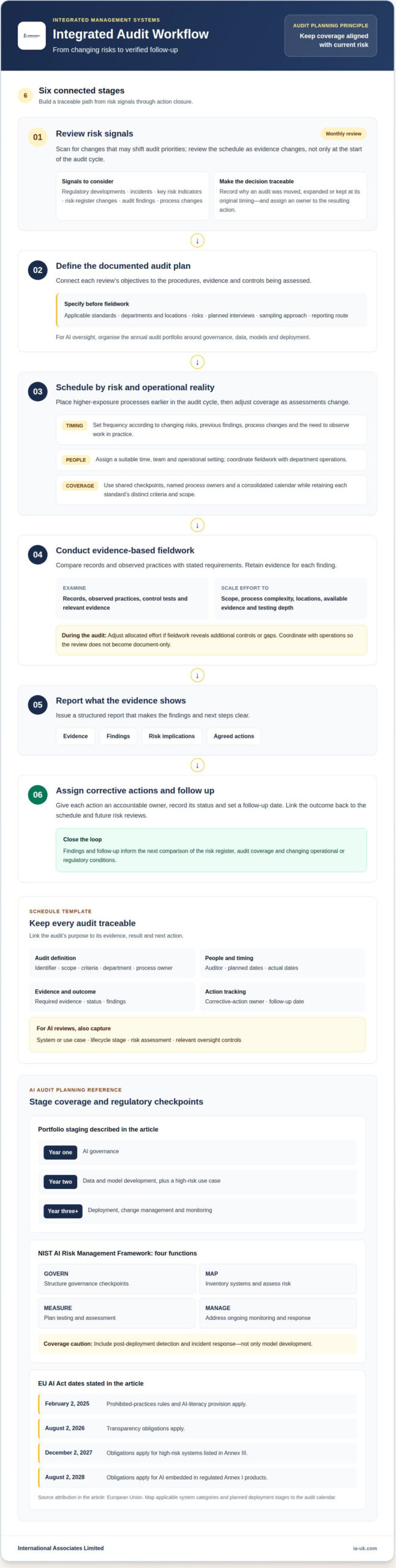
Review the schedule as evidence changes, not only at the beginning of the audit cycle. A regular scan of regulations, incidents and key risk indicators can show where internal audit coverage needs to shift.
Risk-Based Audit Sequencing
Risk-based sequencing places higher-exposure processes earlier in the audit cycle, then adjusts coverage as assessments change. This directs audit effort toward emerging threats instead of leaving the schedule untouched. For example, a new AI deployment, security incident or recurring control finding may prompt an earlier checkpoint for governance, data controls or deployment monitoring.
Coordinating Standards and Departments
Coordination aligns shared processes across standards and teams while preserving each audit’s distinct criteria. Unlike separate ISO schedules, an integrated plan can combine overlapping process reviews, but it must still record standard-specific scope and evidence. Internal audit programs for ISO 9001, ISO 14001 and ISO 45001 should be organised around defined objectives, coverage, findings and follow-up. Coordinate departments through shared checkpoints, named process owners and a consolidated calendar; avoid scheduling only by department or overlooking a standard-specific control.
At each checkpoint, compare the risk register with audit findings, process changes and regulatory developments. Record why an audit was moved, expanded or kept at its original timing, and assign an owner to the resulting action. This creates a traceable link between risk management and the audit plan.
The European Union states that the EU AI Act’s prohibited-practices rules and AI-literacy provision have applied since February 2, 2025. The European Union states that EU AI Act transparency obligations apply from August 2, 2026. These dates warrant scheduled reviews of relevant governance, user training and transparency controls.
For high-risk systems listed in Annex III, obligations apply from December 2, 2027. Map affected models and planned deployment stages to the audit calendar, allowing time to assess controls and document findings before that date. The schedule should distinguish applicable requirements from broader AI risk reviews.
For AI audits, the NIST AI Risk Management Framework sets out four functions: govern, map, measure and manage. Use them to structure checkpoints for system inventory, risk assessment, testing and ongoing monitoring. A common scheduling mistake is to audit model development but overlook post-deployment detection and incident response.
Link the regulatory assessment to regulatory compliance controls and assign each checkpoint to the relevant department. Review the integrated schedule when a new system enters scope, a process changes, or findings show that planned coverage no longer addresses the highest risks.
How to Plan, Conduct, Report, and Follow Up on Integrated Audits
Use a documented plan to link audit objectives with evidence, control testing and follow-up. For AI oversight, organise the annual audit portfolio around governance, data, models and deployment.
Documented Audit Plans
A documented audit plan sets out the scope, objectives, procedures and evidence required for each review. It helps auditors and process owners understand how testing supports assurance and which controls are being assessed. Record the applicable standards, departments, locations, risks, planned interviews, sampling approach and reporting route. During fieldwork, compare records and observed practices with stated requirements, then retain evidence for each finding.
Auditor hours depend on scope, process complexity, locations, available evidence and testing depth. Allocate effort by task and risk, then adjust it if fieldwork reveals additional controls or gaps. A spreadsheet template can include fields such as scope, criteria, owner, dates, evidence, findings and action status.
Audit Deployment and Frequency
Audit deployment assigns each planned review to a suitable time, team and operational setting. Set frequency according to changing risks, previous findings, process changes and the need to observe work in practice. For example, schedule a focused review after a significant system change while maintaining routine coverage for stable processes. Coordinate fieldwork with department operations so auditors can examine evidence without reducing the audit to a document review. For international site visits or cross-border supplier assessments, planning logistical details such as mobile connectivity with Atlas eSIM ensures auditors remain connected without having to swap physical SIM cards.
For a developing AI audit function, a portfolio approach can stage coverage: year one for AI governance, year two for data and model development plus a high-risk use case, and year three and beyond for deployment, change management and monitoring. Tie EU AI Act planning to applicable system categories and milestones. Schedule preparation for high-risk systems listed in Annex III, whose obligations apply from December 2, 2027; obligations for AI embedded in regulated Annex I products apply from August 2, 2028, according to the European Union.
Schedule Template Contents
A useful template links each audit to its purpose and subsequent action. Include the audit identifier, scope, criteria, department, process owner, auditor, planned and actual dates, required evidence, status, findings, corrective-action owner and follow-up date. For AI reviews, add the system or use case, lifecycle stage, risk assessment and relevant oversight controls.
After fieldwork, issue a structured report that separates evidence, findings, risk implications and agreed actions. Assign each action an accountable owner and tracking status, then record evidence of closure during follow-up. This helps the organisation monitor unresolved issues and feed results into the next risk assessment.
Which Standards Can an Integrated Systems Audit Cover?
An integrated audit can assess multiple management system standards through coordinated evidence gathering. ISO 9001, ISO 14001 and ISO 45001 are often considered together because quality, environmental management and occupational health and safety can intersect in shared processes.
Each standard has a distinct focus, so combined audit coverage should preserve its individual criteria:
- ISO 9001: Examines the quality management system, including how an organisation controls processes and meets customer and applicable requirements. For example, an audit might trace a customer complaint through corrective action and review.
- ISO 14001: Focuses on the environmental management system, including how environmental aspects are identified and managed. An audit might examine operational controls for waste handling or energy use.
- ISO 45001: Addresses the occupational health and safety management system. An audit might review how workplace hazards are identified, controlled and considered when work practices change.
The practical advantage is shared process coverage. For example, a review of purchasing could consider supplier quality under ISO 9001, environmental criteria under ISO 14001, and safety-related requirements under ISO 45001. One coordinated audit can reduce duplicated interviews and document requests, while separate findings remain mapped to the relevant standard. This keeps the evidence efficient without treating the standards as interchangeable.
Scope depends on the organisation’s management systems, activities and audit objectives. A manufacturing site might integrate production controls, waste processes and machine-safety practices. A service organisation might focus on customer feedback, resource use and office health and safety. In either case, identify shared processes in the audit plan while keeping the criteria, evidence and findings distinct for each applicable standard.
Other standards may be added where they fit the organisation’s risks and operational scope. ISO/IEC 42001, published in December 2023, sets requirements for an AI management system. An organisation using AI could consider whether AI governance and controls belong in its broader audit programme, while keeping the standard’s specific scope visible.
Use a coordinated management system certification approach when the relevant systems share processes or evidence. The schedule should still show which standard each audit activity addresses, who owns the process, and how findings will be reported. That distinction makes combined coverage easier to follow and prevents a strong result in one area from obscuring a gap in another.
How Often Should You Audit an Integrated Management System?
Set audit frequency according to process risk and evidence, rather than applying the same interval to every department. A regular review of incidents, regulatory changes and key risk indicators can identify areas that need earlier coverage. This risk review informs the audit calendar, but does not mean every process needs a monthly audit.
An audit schedule for integrated systems should reflect each process’s relative exposure and operational importance. Apply consistent factors to decide whether an audit should happen sooner or receive deeper coverage. For example, a production process with repeat quality findings and recent equipment changes may need an earlier review than a stable administrative process. Consider:
- Recent nonconformities, complaints, incidents and overdue corrective actions.
- Changes to processes, equipment, suppliers, staffing or operational controls.
- The importance of the process to quality, environmental management or worker safety.
- Whether previous audits produced reliable evidence and effective corrective action.
These factors help distinguish routine coverage from a risk-triggered audit. If an ISO 9001 review finds recurring errors in order processing, bring that process forward and test corrective actions. If an ISO 14001 review identifies changed waste-handling practices, schedule evidence checks after implementation. For ISO 45001, workplace incidents or altered tasks can justify earlier examination of hazard controls.
Integrated coverage can make use of shared audit time where processes overlap, but the relevant criteria for each standard still need attention. A purchasing audit might examine supplier quality, environmental considerations and safety-related controls in one visit. Keep findings separate by standard, then set follow-up timing according to each finding’s significance and the action required.
Distinguish the planned audit cycle from event-triggered reviews. A scheduled internal audit provides planned coverage; a major process change, incident or repeated finding may prompt an additional focused review. Record why timing changed, which process was affected and what evidence will support closure. This makes schedule adjustments easier to explain during management review.
For an AI-enabled process, consider its risk and lifecycle stage when setting audit coverage. A new model entering deployment may warrant a review of governance, testing and monitoring controls before reliance expands. A mature system with stable performance still needs planned oversight, while incidents or material changes may trigger an earlier assessment. Regular risk scanning helps identify these scheduling signals.
Use the audit schedule for integrated systems to balance coverage across sites, departments and standards. Avoid clustering all audits during an operational peak or repeatedly auditing accessible teams while leaving complex processes untouched. At each planning review, compare remaining coverage with findings and current risks, then document the next audit date and its rationale.
What to Include in an Integrated Systems Audit Schedule Template
A practical template links each audit activity to its scope, timing, evidence and follow-up. Use a separate record for each audit so coverage across standards, departments and locations remains traceable.
Start with fields that identify the audit and define its boundaries. Record the audit title, unique reference, department or site, process owner, applicable standard, scope, criteria and objectives. For example, a purchasing audit can identify supplier controls and map evidence to each relevant standard without merging distinct requirements.
- Risk basis: Capture the risk assessment, previous findings, incidents or process changes that informed scheduling.
- Timing: Record planned dates, actual dates, status and any reason for rescheduling.
- People and access: Name the audit lead, participants, process contacts and locations involved.
- Evidence and methods: Note records, interviews, observations and control tests planned for fieldwork.
- Results and actions: Track findings, action owners, due dates, progress and closure evidence.
These fields make the schedule useful for operational planning, not just calendar management. If an equipment change moves a production audit, retain the revised date and reason. If the audit identifies a control gap, link the finding to its action owner and follow-up status. A consolidated view can then show overdue work alongside upcoming audits.
Include standard-specific scope even when one visit covers several systems. An ISO 9001 review might examine process controls, while ISO 14001 coverage addresses environmental controls within the same operation. ISO 45001 may require separate attention to workplace hazard controls. The template should show which criteria apply to each activity, preventing a shared audit from obscuring a gap.
For AI-related coverage, identify the system or use case, lifecycle stage, data sources, and model development and deployment controls. Record assessments of data governance, architecture, user access, cybersecurity, processing controls and third parties. These fields help distinguish a review of model development from checks on operational monitoring.
A security entry can identify applicable control areas and evidence. For privacy-related reviews, the checklist may reference GDPR Articles 5.1.f, 25 and 32 for security. Record the evidence examined and the responsible process owner, rather than writing only “security reviewed.” This makes the audit trail specific and supports clear reporting.
Include a change log and version date for the template. When the schedule is revised following a new risk assessment, record what changed and why. This simple control helps readers distinguish current plans from superseded dates and supports consistent internal reporting across departments.
International Associates Limited: Social Accountability Audits
International Associates Limited provides Social Accountability Audits for organisations seeking an independent assessment of their social accountability practices. This service can be relevant when internal audit findings, stakeholder expectations or supply-chain requirements make workplace accountability a priority. The audit reviews applicable criteria and supports evidence-based reporting on the areas assessed.
Use the audit schedule for integrated systems to show where social accountability fits alongside management system reviews. Identify relevant sites, activities, records and process owners, then coordinate timing with operational demands. If a finding concerns a particular process, record its owner, required action and evidence for review in the follow-up plan. This connects audit outcomes to the organisation’s wider assurance programme.
The scope and evidence depend on the audit criteria and the organisation’s context. A review may examine relevant policies, records and practices, using interviews or other evidence-gathering methods where appropriate. Clear boundaries help distinguish social accountability coverage from quality or environmental management system criteria.
Related offerings may suit different objectives:
- Social Accountability Audits provide independent assessment when an organisation needs external review of social accountability practices.
- Ethical Workplace Assurance reviews may be relevant when the organisation’s assurance objective is tied to worker welfare and ethical supply chain programmes.
- ISO 9001 Quality Management System Certification or ISO 14001 Environmental Management System Certification address separate management system certification objectives.
- Lead Auditor Training supports people developing audit knowledge and competence for their professional responsibilities.
Choose the right route by first identifying the assurance need. An organisation seeking an external examination of social accountability practices can consider a Social Accountability Audit. An organisation pursuing certification against a quality or environmental management system standard should define that scope separately, even when some processes overlap.
For an initial discussion, prepare the audit objective, relevant sites or operations, applicable criteria and any existing findings. These details help define the scope and show how the audit fits into the organisation’s wider audit schedule for integrated systems. They also clarify whether a Social Accountability Audit, management system certification or auditor training best suits the requirement.
Contact International Associates Limited to discuss Social Accountability Audits and the appropriate next step for your organisation.
Frequently Asked Questions
What is an integrated management system audit schedule?
An audit schedule for integrated systems coordinates planned reviews across management standards, processes and organisational units. It can prevent teams from auditing the same evidence independently while another process receives no attention. For example, a shared document-control review can examine records used by quality and environmental processes while noting the distinct criteria for each system. The schedule also gives process owners a clear view of upcoming audit activity.
How do you create an annual integrated audit schedule?
To create an annual audit schedule for integrated systems, map applicable standards to organisational processes and locations. Then assign audit owners, define the purpose of each review and plan activities around operational constraints. For example, a seasonal business can schedule a process audit while the relevant work is active and records are available. Allow for risk-triggered reviews, and document changes so the approved plan can be distinguished from earlier versions.
How do risk and previous audit results determine audit frequency and scope?
Risk and previous results influence both the timing and depth of each audit. A recurring finding in supplier approvals may justify examining approval decisions, retained records and corrective-action effectiveness. A stable process with resolved findings may remain in routine coverage. New equipment, a changed supplier or a serious incident can alter the risk assessment and prompt a focused review of affected controls instead of repeating the full audit scope.
What are the requirements for internal audit programs under ISO 9001, ISO 14001, and ISO 45001?
Organise audit programmes around defined objectives, coverage, findings and follow-up, while preserving the distinct scope and evidence required by each standard.
Where can I find a free integrated management system audit schedule template?
You can build a free template in a spreadsheet, with fields for scope, criteria, owner, dates, evidence, findings, and action status.
How many auditor hours should be allocated to an integrated systems audit?
Allocate auditor hours according to the audit’s scope, process complexity, locations, available evidence and testing depth. Assign effort by task and risk, then adjust it if fieldwork reveals additional controls or gaps.