
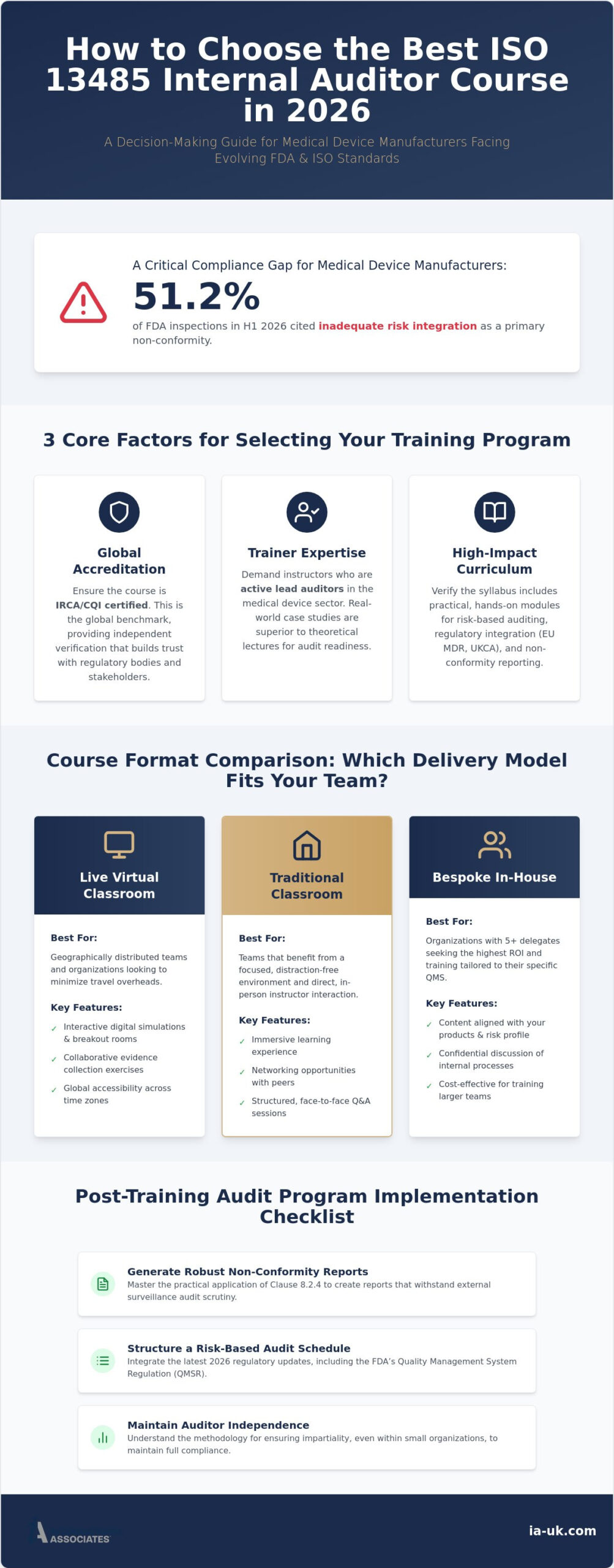
Early FDA inspection data from the first half of 2026 reveals that 51.2% of inspections cited inadequate risk integration as a primary non-conformity. For medical device manufacturers, this statistic highlights a critical gap between theoretical knowledge and the practical execution of a risk-based audit. You’ve likely felt the weight of these evolving requirements, particularly as the industry navigates the full implementation of the FDA’s QMSR and the impending updates to the ISO standard itself. Investing in an internal auditor course for iso 13485 that fails to address these real-world complexities is a risk your budget and your compliance status can’t afford.
We understand the necessity of maintaining a robust quality management system that satisfies both notified bodies and global regulators. This article provides a methodical framework for selecting a training program that ensures your team is competent, confident, and ready for formal surveillance. You’ll discover the specific decision factors required to bridge the gap between regulatory theory and audit readiness, ensuring your organization remains a stable leader in a highly regulated global market.
Key Takeaways
- Identify the critical necessity of global accreditation and industry-specific trainer expertise to ensure your internal certification is recognized by international regulatory bodies.
- Evaluate the strategic advantages of various delivery formats to select the most effective internal auditor course for iso 13485 based on your team’s specific operational requirements.
- Master the practical application of Clause 8.2.4 to generate robust non-conformity reports that withstand the scrutiny of external surveillance audits.
- Discover how to structure a risk-based audit schedule that integrates the latest 2026 regulatory updates, including the FDA’s Quality Management System Regulation.
- Understand the methodology for maintaining auditor independence within small organizations while ensuring full compliance with management system certification standards.
How to Choose the Best ISO 13485 Internal Auditor Course in 2026
Identifying the right internal auditor course for iso 13485 is a strategic decision that directly impacts your organization’s ability to maintain compliance. In 2026, the medical device sector faces unique challenges, including the full implementation of the FDA’s Quality Management System Regulation (QMSR). Organizations require training that bridges the gap between theoretical knowledge and the practical rigour demanded by notified bodies. A course should not merely recite clauses; it must provide the tools to execute a risk-based audit that withstands professional scrutiny.
Accreditation and Global Recognition
Professional auditors recognize IRCA/CQI certified courses as the global benchmark for competence. These certifications provide independent verification of the training material, ensuring it meets standardized quality criteria. This builds essential trust with stakeholders and regulatory authorities. When a training program carries this level of accreditation, it demonstrates a commitment to international excellence. You can evaluate how these credentials support your regulatory goals by reviewing our accreditations, which reflect the institutional reliability required in high-stakes sectors.
Trainer Expertise and Real-World Application
The value of an ISO 13485 training program is tied to the instructor’s technical background. Active lead auditors make the most effective trainers because they bring real-world experience from the medical device manufacturing sector. Case-study-driven learning is far superior to theoretical slide decks, as it allows participants to practice identifying non-conformities in a controlled environment. Before committing to a provider, ask specific questions about the trainer’s history with sensitive technical sectors and their experience with successful certification audits.
A high-quality curriculum must also address the following critical elements:
- Risk-Based Auditing: The course must integrate risk management principles throughout the audit process, as required by the 2016 standard.
- Regulatory Integration: Check for specific modules covering the relationship between the quality management system and external requirements like EU MDR and UKCA.
- Practical Workshops: Ensure the training includes hands-on exercises for writing non-conformity reports and evaluating corrective actions.
By focusing on these decision factors, you ensure that your investment results in a competent audit team. This methodical approach to selection reduces the risk of oversight during formal inspections. It transforms the internal audit from a simple checklist exercise into a robust tool for continuous improvement and global market access.
Comparison of Course Formats: Online vs. Classroom vs. In-House
Selecting an internal auditor course for iso 13485 requires an evaluation of more than just the syllabus. You must consider the logistical impact on your operations. While traditional classroom settings offer focused environments, modern digital platforms provide global accessibility without travel overheads. The choice between these formats often hinges on the size of your team and the complexity of your product risk profile. Each delivery model serves a specific strategic purpose in building a competent audit team.
The Rise of Live Virtual Classrooms
Live virtual training has matured into a robust alternative to physical attendance. Success in this format depends on a stable IT infrastructure and the use of interactive digital audit simulations. Modern platforms utilize breakout rooms to mirror real-world auditing scenarios. This allows delegates to practice evidence collection and interview techniques in a collaborative environment. It’s particularly effective for teams distributed across different time zones or regional offices. Digital engagement ensures that the core principles of verification and objective evidence remain the priority.
When to Choose Bespoke In-House Training
For organizations with five or more delegates, in-house training often provides the highest return on investment. This format allows for the alignment of course content with your specific regulatory compliance needs. It offers a confidential space to discuss internal non-conformities and product-specific risk profiles. Crucially, in-house sessions can be tailored to address the nuances of the Quality Management System Regulation (QMSR) as it applies to your unique device portfolio. This targeted approach ensures that the training is not just educational but immediately applicable to your QMS maintenance.
Travel expenses and lost productivity can significantly inflate the total cost of training. Digital platforms eliminate these secondary costs while maintaining high engagement levels through real-time instructor feedback. However, the traditional classroom environment still holds value for networking and removing daily workplace distractions. If your priority is a deep dive into specific organizational hurdles, the customized nature of in-house delivery is often the most logical choice for maintaining global standards. You can evaluate our current lead auditor and internal auditor training options to determine which delivery method aligns with your 2026 compliance strategy.
Key Features of a High-Impact ISO 13485 Audit Course
A high-impact internal auditor course for iso 13485 must transcend basic clause interpretation. It should focus on the synergy between Clause 8.2.4 and the Corrective and Preventive Action (CAPA) system. When an audit identifies a non-conformity, it serves as the primary input for the CAPA process; therefore, training must emphasize how to document findings that are both objective and actionable. Practical workshops are essential for this development. They allow delegates to practice writing reports that can withstand the rigorous examination of a notified body or national authority. This level of precision is what separates a routine check from a value-added professional assessment.
The shift toward a “Process Approach” is a fundamental requirement for modern auditing. Rather than following a static checklist, auditors should evaluate the inputs, activities, and outputs of each departmental process. This methodology ensures that the quality management system functions as a cohesive unit rather than a collection of isolated documents. It’s particularly relevant when auditing the Technical File and Clinical Evaluation requirements, which are critical for maintaining the legal right to sell medical devices in the European Union and other global markets. Training should provide clear guidance on how to verify that these files are not only present but also technically sound and up to date.
Auditing for Risk Management (ISO 14971)
Internal auditor courses must integrate risk management principles as a core competency. Auditors need to verify that risk controls identified during the design phase are effectively implemented in production and post-production stages. The integration of ISO 14971 risk management within the ISO 13485 framework is the definitive indicator of an auditor’s ability to assess product safety and efficacy. This ensures that every audit finding is viewed through the lens of patient safety and regulatory risk.
MDR and UKCA Specific Modules
Generic training often fails to address the specific nuances of the Medical Device Regulation (EU 2017/745) and the UKCA framework. A high-impact course provides clarity on navigating these overlapping requirements, including the critical role of the UK Responsible Person (UKRP) in the audit context. This includes verifying that the UKRP has access to the necessary technical documentation and that post-market surveillance (PMS) data is being utilized to update risk files. Auditors must understand how to inspect the link between PMS reports and the broader QMS to ensure ongoing regulatory compliance. By addressing these specific legal roles, the training prepares your team for the complexities of the modern international marketplace.
Implementing Your Internal Audit Programme Post-Training
Successfully completing an internal auditor course for iso 13485 is only the initial stage in establishing a resilient quality management system. The true value of the training is realized when the auditor applies those principles to a live operational environment. A common error is treating the audit as a static checklist rather than a dynamic tool for verification. To maintain management system certification, the audit programme must be proactive, risk-based, and capable of identifying systemic weaknesses before they result in product non-conformities.
Independence remains a significant hurdle for smaller organizations where personnel often hold multiple responsibilities. The standard is clear: auditors must not audit their own work. In small teams, this requires a methodical cross-departmental approach. For instance, a quality manager might audit the production line, while a senior engineer assesses the quality control processes. This ensures objectivity and impartiality, which are foundational to a reliable audit result. Organizations that outgrow their internal capacity often transition their key personnel to more advanced lead auditor training to manage more complex, multi-site audit programmes.
Creating an Audit Schedule
A risk-based audit schedule prioritizes areas with the highest impact on patient safety and product efficacy. You should allocate more frequent assessments to processes with a history of non-conformities or those involving critical suppliers. While high-risk areas require closer scrutiny, the schedule must ensure full coverage of the entire QMS over the certification cycle. Many firms now utilize software solutions to track audit findings, automate reminders, and ensure the timely closure of findings. This methodical tracking prevents the accumulation of overdue actions that often trigger major non-conformities during external surveillance.
Reporting and Corrective Actions
Effective reporting distinguishes between a simple correction and a comprehensive corrective action. A correction addresses the immediate issue, such as updating a single document. A corrective action identifies the root cause to prevent recurrence across the entire system. When presenting results to senior management, focus on data-driven insights that highlight process trends rather than isolated incidents. This approach fosters a culture of continuous improvement and ensures that internal auditing remains a strategic asset rather than a mere compliance burden. You can enhance your team’s professional development by enrolling them in our structured internal auditor training sessions designed for the 2026 regulatory landscape.
Why International Associates Limited is the Logical Choice for ISO 13485 Training
Selecting a training provider requires a careful assessment of their institutional weight and regulatory immersion. International Associates Limited occupies a unique position as both an accredited certification body and a professional training organization. This dual perspective ensures that every internal auditor course for iso 13485 we deliver is grounded in the practical realities of formal verification. Our curriculum is not merely an educational exercise; it’s a rigorous preparation for the 2026 regulatory environment, including the nuances of the FDA’s QMSR and the evolving EU MDR requirements. We provide the stability and confidence necessary for businesses to navigate these high-stakes technical sectors without unnecessary ambiguity.
Expertise Born from Auditing
Our training programmes are developed by professionals who conduct high-stakes audits daily. This direct experience allows us to provide real-world insights into the specific areas notified bodies prioritize during surveillance. We maintain a strict commitment to impartiality, ensuring that our professional development services provide a clear, objective understanding of the standard. This expertise helps your team identify systemic risks that generic training providers often overlook. By learning from active lead auditors, your staff gains the technical confidence to defend their audit findings under external scrutiny.
Global Reach with Local Technical Support
Operating from our Glasgow administrative base and supported by an expansive network of international offices, International Associates Limited provides consistent training standards across the globe. This global-local duality is essential for manufacturers navigating the complexities of ISO 13485 certification across different jurisdictions. We act as a sophisticated bridge between complex regulations and your business objectives. Whether you’re a multi-site manufacturer or a medical device startup, our technical experts provide the steady hand needed for corporate compliance.
The transition from establishing auditor competency through an internal auditor course for iso 13485 to achieving full certification support should be seamless and methodical. Our role is to support your international growth by ensuring your internal audit team is a robust pillar of your QMS. We invite you to contact our technical team for a bespoke training proposal tailored to your medical device startup or established manufacturing facility. Secure your market access in 2026 with a partner that understands the depth of global regulatory adherence.
Mastering Medical Device Compliance through Expert Training
The landscape of medical device compliance in 2026 demands more than just a certificate; it requires a deep technical understanding of how risk management integrates with quality systems. Selecting an internal auditor course for iso 13485 that offers both global accreditation and the practical insights of active lead auditors is the most effective way to ensure your organization remains audit-ready. We’ve examined how the right training format must align with your specific product risk profile to satisfy both notified bodies and international regulators.
International Associates Limited provides this essential bridge between complex global regulations and your business objectives. Based in our Glasgow headquarters with an expansive global operational capacity, we specialize in high-stakes medical device compliance. Our programmes are accredited by major global bodies, ensuring your team’s competence is recognized internationally. You can take the next step in securing your market access and maintaining a robust QMS today. View our Accredited ISO 13485 Training Courses to begin your professional development journey. We’re here to support your international growth with steady, expert guidance.
Frequently Asked Questions
Is an ISO 13485 internal auditor certificate mandatory for medical device manufacturers?
ISO 13485 requires personnel performing audits to be competent based on appropriate education, training, skills, and experience. While the standard’s text doesn’t explicitly name a specific certificate as a legal requirement, notified bodies and external auditors expect documented proof of this competence. Completing a professional internal auditor course for iso 13485 provides the objective evidence necessary to satisfy regulatory scrutiny during formal certification and surveillance inspections.
How long does a typical ISO 13485 internal auditor course take to complete?
A professional instructor-led course typically spans two to three days of intensive technical instruction. This timeframe allows for the comprehensive coverage of the standard’s clauses and the execution of practical audit simulations. Self-paced digital formats may vary in duration; however, the volume of technical content remains consistent with established international training benchmarks. The goal is to ensure the auditor can execute a risk-based assessment effectively.
Can I audit my own work if I am the only quality professional in a startup?
Independence is a fundamental requirement of the auditing process; therefore, you cannot audit your own work. In small startups where internal resources are limited, organizations must utilize cross-functional personnel from other departments or engage an independent third-party provider. This ensures the impartiality and objectivity required to maintain a compliant quality management system. Failure to maintain this independence often results in major non-conformities during formal audits.
What is the difference between an internal auditor course and a lead auditor course?
An internal auditor course focuses on verifying the effectiveness of an organization’s own quality management system. In contrast, a lead auditor course is designed for individuals managing audit teams or performing third-party assessments on behalf of certification bodies. Lead auditor training typically requires five days of study and covers advanced management and coordination skills. It’s the logical progression for senior quality professionals managing multi-site programmes, and you can find a detailed breakdown of the pathway in our guide on how to become a lead auditor.
How often should internal auditors undergo refresher training?
Auditors should ideally undergo refresher training every three years or immediately following a significant revision to the standard. With a potential update to the standard expected in late 2026, timely retraining is critical to ensure your team understands new regulatory expectations. Regular updates help maintain the high level of technical proficiency required for sensitive industrial sectors. It’s a proactive measure to prevent the erosion of audit quality over time.
Does this course cover the requirements for the UKCA mark?
High-impact training programmes specifically address the relationship between the quality management system and the UKCA regulatory framework. This includes the technical documentation requirements and the specific legal roles, such as the UK Responsible Person. Ensuring your internal auditor course for iso 13485 includes these modules is vital for manufacturers targeting the UK market. It provides the technical clarity needed to navigate the specific post-market surveillance requirements of the region.
What happens if I fail the exam at the end of the course?
Most accredited training providers offer a structured retake process for delegates who don’t achieve the required passing score. While a certificate of attendance might be issued, a certificate of achievement is only granted upon successful completion of the assessment. This rigorous approach ensures that only competent individuals are verified to perform internal audits in highly regulated sectors. It maintains the integrity of the professional qualification within the global medical device industry. To ensure the security of these high-stakes digital evaluations, institutions can explore Usage-based exam security session fees to mitigate the risk of AI-assisted cheating.
Can this training be used for ISO 9001 auditing as well?
ISO 13485 is a standalone standard specifically designed for the medical device sector; however, it shares a foundational structure with ISO 9001. While the auditing techniques are transferable, an ISO 13485 course focuses on technical requirements that aren’t present in generic quality standards. Auditors trained in the medical standard possess a specialized skillset that exceeds ISO 9001 requirements. This makes them highly capable of auditing simpler quality management systems if required.