

Selecting the wrong ISO 13485 certification body in 2026 is no longer just a minor administrative delay; it’s a strategic risk that can stall global market entry for years. With the FDA’s Quality Management System Regulation (QMSR) having officially replaced the old QSR on February 2, 2026, the global alignment with ISO 13485:2016 is now absolute. You likely recognize the frustration of managing overlapping requirements for MDR and UKCA while facing unpredictable audit schedules. It’s a complex landscape where the line between compliance and commercial delay is increasingly thin.
This guide offers a professional decision-making framework to help you select a reliable partner capable of navigating these global regulatory shifts. We’ll outline how to evaluate a provider’s technical expertise and their ability to create synergy between international standards. By focusing on practical selection factors rather than generic metrics, you’ll gain the clarity needed to secure a seamless certification cycle. Our analysis covers the essential criteria for choosing an auditing body that acts as a steady hand for your international growth.
Key Takeaways
- Identify how your choice of partner directly impacts market access in the EU, UK, and US following the 2026 FDA regulatory shifts.
- Learn to evaluate an ISO 13485 certification body based on technical competence and auditor availability to avoid costly delays in the certification cycle.
- Understand the operational differences between legacy institutions and specialized global auditors to determine which model best supports your growth.
- Access a practical decision-making framework for audit preparation, including gap analysis against ISO 13485:2016 and MDR requirements.
- Discover how to achieve regulatory synergy across multiple jurisdictions by selecting a provider with specialized expertise in high-stakes industrial sectors.
Selecting an ISO 13485 Certification Body: Why Your Choice Dictates Global Market Access
A certification body serves as an independent third party tasked with verifying that your Quality Management System (QMS) adheres strictly to the ISO 13485:2016 requirements. While many organizations view this as a procedural formality, the selection of an ISO 13485 certification body is a high-stakes commercial decision. It dictates whether your medical devices can legally cross borders into the European Union, the United Kingdom, and the United States. Since the FDA’s transition to the Quality Management System Regulation (QMSR) on February 2, 2026, this standard has become the universal language of medical device quality. It serves as the structural spine for MDR and UKCA compliance, making it the most critical certification for any manufacturer with international ambitions.
Choosing a partner without proper credentials introduces the risk of “empty” certificates. These are documents issued by bodies lacking the necessary accreditation to satisfy national regulators. If a certificate isn’t recognized by the relevant authorities, it can lead to immediate product recalls or costly customs rejections. These failures don’t just stop shipments; they damage your brand’s reputation for safety and reliability. A meticulous approach to selection ensures that your certification remains a valid passport for global trade.
The Role of Accreditation in 2026
Reliability is established through a clear hierarchy of trust. The International Accreditation Forum (IAF) provides the global framework, while national accreditation bodies, such as UKAS, oversee individual certification entities. For global exporters, mutual recognition arrangements (MLA/MRA) are considered non-negotiable. These agreements ensure that your certification is accepted across multiple jurisdictions without the need for repetitive testing. When you evaluate an ISO 13485 certification body, you must confirm they hold the specific technical scope for your device’s clinical application. A generic accreditation is often insufficient for high-risk medical hardware.
Regulatory Synergy: ISO 13485, MDR, and UKCA
Modern manufacturers prioritize regulatory synergy to minimize operational friction. A single, well-executed audit can support requirements for the EU MDR, UKCA, and ISO 13485 simultaneously. This approach prevents the duplication of efforts and significantly reduces the time your team spends on administrative compliance. Technical documentation review expertise is a vital component of this process. An auditing body with deep technical roots can identify gaps in your documentation before they become regulatory roadblocks. This level of oversight is a cornerstone of professional regulatory compliance services, ensuring your business remains agile in a complex global market.
Key Factors for Evaluating ISO 13485 Registrars in 2026
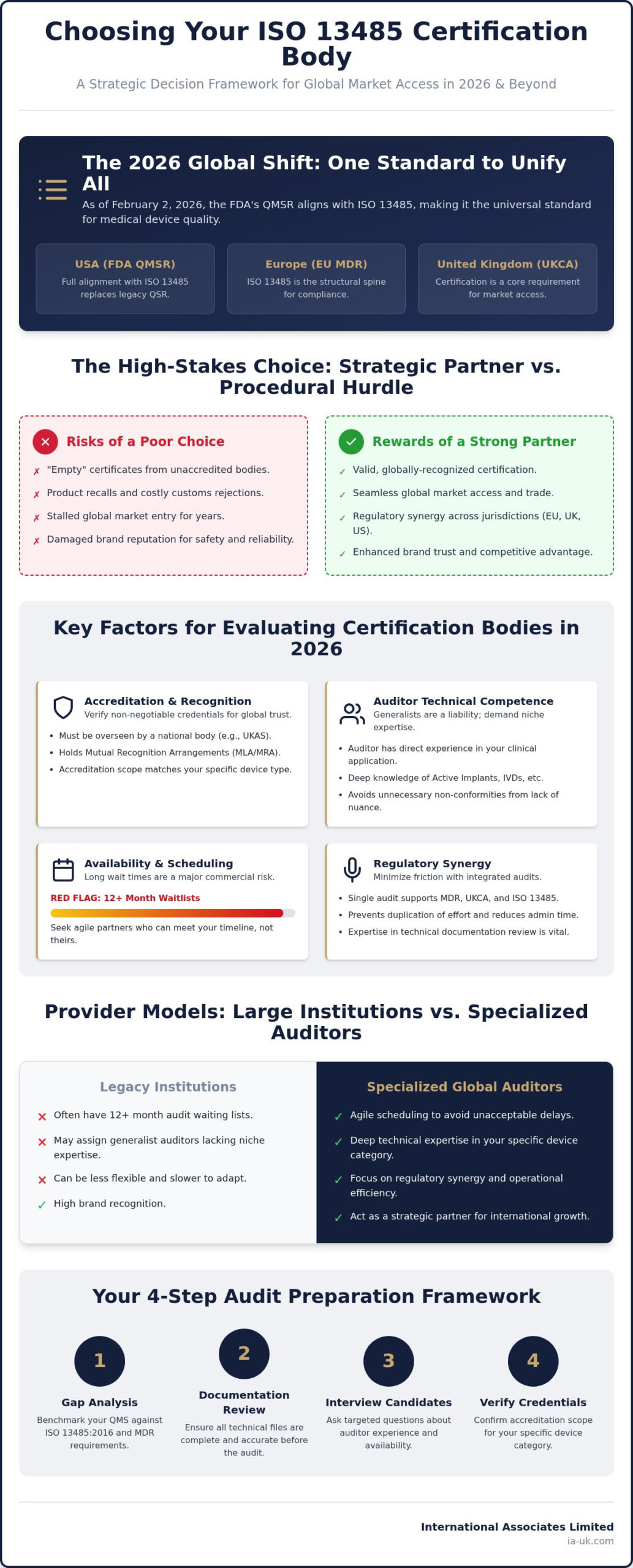
Evaluating an ISO 13485 certification body requires more than a superficial review of their accreditation status. In 2026, the technical competence of the specific auditor assigned to your file is the primary determinant of audit success. Manufacturers must verify if the auditor possesses direct experience in their device’s clinical application. A generalist auditor often lacks the nuance required to evaluate active implants or In Vitro Diagnostics (IVDs). This lack of specialization frequently leads to unnecessary non-conformities that delay market entry and increase operational costs.
Auditor availability has become a critical bottleneck in the medical device industry. Many legacy bodies now operate with 12-month waiting lists for Stage 1 audits, which is an unacceptable timeframe for agile manufacturers. A reliable registrar must demonstrate a balance between global reach and local expertise. This ensures they can audit international supply chains effectively while maintaining a deep understanding of regional regulatory nuances. It’s vital that the body possesses the infrastructure to support audits across multiple time zones without sacrificing the precision of the technical review process.
Assessing Auditor Expertise and Niche Knowledge
When interviewing a potential ISO 13485 certification body, specific questions regarding their niche knowledge are essential. You should inquire about the auditor’s background in your specific device category. For instance, do they understand the specific sterilization requirements or software validation protocols for your hardware? To ensure your staff is prepared for these technical benchmarks, you may visit Mbawine Consultant Services for specialized training in sterile processing. The value of a body extends to their grasp of the official ISO 13485 standard alongside the 2026 updates to ISO 14971. Risk management is no longer a siloed activity; it’s integrated into every clause of the quality system, and your auditor must reflect this sophisticated understanding.
Administrative friction can stall a product launch even after a successful audit. You should evaluate how quickly a body issues certificates post-audit and their use of digital tools for technical file reviews. Advanced IT infrastructure allows for faster data processing and secure, immediate certificate issuance. This modernization reduces the “dead time” between the closing meeting and the final certification decision. If you’re seeking a streamlined path to compliance, you can discover our management system certification approach. Our focus remains on providing a steady, professional hand through the complexities of international standards. Partnering with an expert ISO 13485 certification body ensures your regulatory timeline remains on track and your global operations remain secure. For manufacturers seeking to maintain safety across all facets of their operations, you can learn more about BioSafe Waste Management for specialized clinical waste disposal.
Comparing Certification Bodies: Large Institutions vs. Specialized Global Auditors
Choosing between a massive legacy institution and a specialized global ISO 13485 certification body requires a clear understanding of your organizational goals. Large legacy bodies often provide high brand recognition, which some stakeholders perceive as a form of prestige. However, this scale frequently introduces significant bureaucracy and rigid scheduling. For many manufacturers, the priority is practical market access and efficiency rather than a specific brand name on a certificate. You must decide if your primary objective is a recognizable logo or a streamlined path to global compliance.
Specialized global bodies focus on high technical expertise and agile scheduling. They often provide a more personalized service, which is critical for navigating the FDA Quality Management System Regulation (QMSR) effectively. This regulation, effective since February 2, 2026, emphasizes the need for auditors who understand the risk-based nuances of ISO 13485. When evaluating costs, compare initial assessment fees against long-term surveillance and recertification expenses. Large institutions may have lower entry prices but higher hidden costs in the form of administrative fees or travel surcharges. You can find a deeper analysis of these financial dynamics in our Cost of ISO 9001 Certification UK: 2026 Pricing & ROI Guide, which outlines the return on investment for robust quality management systems.
Service Level Expectations and Communication
Small-to-medium medical device firms often find themselves lost in the automated systems of the world’s largest registrars. The benefit of a specialized ISO 13485 certification body is found in direct access to a dedicated technical contact. This individual facilitates document reviews and provides clear, consistent feedback. Professional communication prevents the gaps that lead to audit failures. It ensures that your technical file remains a priority throughout the certification cycle.
Global Network and Regional Office Advantages
A Glasgow-based head office paired with global regional branches offers a strategic global-local duality. This structure ensures institutional reliability while providing local auditors who understand regional cultural nuances. Local auditors also significantly reduce travel costs and improve turnaround times for certificates in key markets like Asia and the Middle East. This operational model provides a steady hand for businesses seeking to expand without unnecessary friction or ambiguity. It allows for a predictable and professional assessment process regardless of your physical location.
How to Prepare for Your ISO 13485 Audit: A Practical Decision Framework
Preparation for a successful audit begins with a rigorous gap analysis. You must evaluate your existing Quality Management System against the ISO 13485:2016 standard while simultaneously addressing relevant MDR or UKCA requirements. This internal review identifies vulnerabilities before they’re surfaced by an external auditor. Once gaps are closed, you should shortlist a potential ISO 13485 certification body based on three critical metrics: valid accreditation, specific technical scope for your device class, and current lead times for Stage 1 and Stage 2 audits.
The selection process should move beyond a simple price comparison. Request a formal quote that outlines all costs across the three-year certification cycle to avoid hidden administrative fees. It’s also professional practice to interview the proposed lead auditor. This conversation allows you to verify their technical expertise and ensure their communication style aligns with your team’s expectations. For startups or firms entering a new product category, executing a pre-assessment is highly recommended. This optional “dry run” provides a steady baseline and identifies any remaining non-conformities without risking your formal certification status.
Preparing Your Technical Documentation
Your technical files must be organized to support an efficient Stage 1 documentation review. Auditors don’t just look for the existence of documents; they verify the logical links between risk management, clinical evaluation, and design controls. Data should be structured in a way that allows the auditor to trace the product lifecycle from initial concept to post-market surveillance. For a deeper look at these requirements, you can consult our ISO 13485 Certification: The Definitive Guide to Medical Device Quality in 2026. Clear documentation reduces audit duration and minimizes the risk of technical queries that can stall the certification process.
Transferring Your Certificate to a New Body
If your current registrar is plagued by long wait times, excessive fee increases, or a lack of technical expertise, you can initiate a “Transfer Audit.” This process allows you to switch to a more reliable ISO 13485 certification body without losing your existing certification status. The new body will review your previous audit reports and current QMS standing to ensure a seamless transition. This is a common strategic move for firms seeking better service levels or regional expertise in new target markets. You can find more details on evaluating local providers in our ISO 13485 Certification Body UK: 2026 Comparison and Selection Guide. If you’re ready to secure a more efficient audit partner, contact us today to discuss your certification needs.
Strategic Compliance: Why International Associates is the Preferred ISO 13485 Partner
International Associates Limited operates as a sophisticated bridge between complex global regulations and manufacturers seeking international growth. As a specialized ISO 13485 certification body, we provide independent verification that prioritizes technical precision and operational speed. Our global-local duality allows us to maintain institutional reliability from our Glasgow head office while deploying local expertise through an expansive network of regional branches. This structure ensures that your audit process remains consistent regardless of where your manufacturing facilities are located. We act as the steady hand in the world of corporate compliance, supporting your business through every stage of the certification cycle.
Our expertise is deeply rooted in high-stakes technical sectors, with a specific focus on medical devices and social accountability. We integrate ISO 13485 certification with specialized legal functions, including UK Responsible Person and EU Authorised Representative roles. This holistic approach eliminates the friction often found when dealing with multiple service providers. By aligning your quality system with these representative functions, we ensure your technical documentation remains compliant across the UK and European markets simultaneously. We specialize in the technical documentation review required for MDR and UKCA; we provide a level of technical depth that generalist bodies cannot match.
A Modern Approach to Auditing
We utilize an advanced IT infrastructure to ensure that your sensitive technical data is handled with the highest levels of security and efficiency. This digital framework supports a modern auditing process, allowing for faster certificate issuance and seamless document reviews. Our reporting style is structured and declarative. It provides clear, actionable guidance on non-conformities without the ambiguity often found in legacy audit reports. This organized sequence mirrors a professional assessment process, moving from the identification of regulatory needs to the final achievement of certification. If your team requires deeper technical knowledge to manage these systems, you can learn about our professional training and workshops to strengthen your internal compliance capabilities.
Building Stakeholder Trust Globally
An International Associates certificate serves as a globally recognized passport for your medical devices. It signals to regulators and healthcare providers that your products meet the most rigorous international standards for safety and quality. Our commitment to ethical auditing and social accountability provides an additional layer of security for your brand’s reputation. We believe that rigorous standards are the foundation of international trade. For organizations looking to expand their compliance framework into labor standards and supply chain ethics, we recommend reviewing our Social Accountability Audits: The Definitive Global Guide for 2026. This integrated perspective on compliance ensures your business is prepared for the high-stakes demands of the 2026 regulatory landscape.
Securing Global Market Access Through Strategic Certification
The 2026 regulatory landscape has reached a point of absolute harmonization with the FDA’s shift to the Quality Management System Regulation. Navigating this environment requires more than a standard audit; it demands a partnership with an ISO 13485 certification body that provides technical documentation expertise for MDR and UKCA. Success is defined by selecting a registrar that offers global reliability alongside the agile scheduling necessary to avoid commercial delays.
International Associates Limited serves as the steady hand for manufacturers seeking to bridge the gap between complex regulations and international growth. With our head office in Glasgow and over 20 years of expertise, we offer specialized technical reviews and hold accreditations from major global bodies. We prioritize efficiency and precision to ensure your quality system remains a valid passport for trade in every major jurisdiction. Request a Strategic ISO 13485 Quote from International Associates to begin your path toward seamless global compliance. Your commitment to quality is the foundation of patient safety and business stability.
Frequently Asked Questions
How do I choose the best ISO 13485 certification body for a startup?
Startups should prioritize technical competence and auditor lead times over brand prestige. It’s essential to select a partner that understands your specific device category to avoid costly Stage 1 failures. Selecting an agile ISO 13485 certification body that offers pre-assessment services can identify critical gaps early. This proactive approach ensures that the formal audit process doesn’t become a bottleneck for venture capital milestones or initial market entry goals.
What is the average cost of ISO 13485 certification in 2026?
Industry data for 2026 indicates that small companies with fewer than 30 employees typically face total certification costs between $15,000 and $40,000. Mid-size organizations can expect ranges from $70,000 to $190,000; while large, multi-site entities often exceed $100,000. These figures represent industry averages for the full implementation and audit cycle. Actual fees depend on device risk classification and the complexity of the technical documentation review required for your specific hardware.
Can I use the same certification body for ISO 13485 and ISO 9001?
Organizations frequently use the same ISO 13485 certification body for their ISO 9001 requirements to achieve operational synergy. Combining these audits reduces total audit days and administrative overhead. Since ISO 13485:2016 is based on the same high-level structure as other management standards, a unified assessment process ensures consistency across your quality management system. This approach is particularly effective for firms serving both medical and general industrial sectors simultaneously.
How long does the ISO 13485 certification process typically take?
The certification process generally requires six to twelve months from the initial application to the issuance of the certificate. This timeline includes the Stage 1 documentation review and the Stage 2 on-site audit. Factors such as the maturity of your management system and the current availability of technical auditors significantly impact this duration. Manufacturers should engage a body early to secure audit dates that align with their planned commercial launch schedules.
What happens if our certification body loses its accreditation?
If a certification body loses its accreditation, your certificate may no longer be recognized by regulatory authorities like the MHRA or FDA. You must initiate a transfer to an accredited registrar immediately to maintain legal market access. Regulators typically provide a grace period for this transition, but failure to act can result in product seizures or customs rejections. It’s vital to verify a body’s accreditation status through the IAF database regularly.
Is ISO 13485 mandatory for medical device sales in the UK?
While the UK Medical Devices Regulations 2002 don’t explicitly name the standard as mandatory, it’s the recognized route for demonstrating compliance with QMS requirements. Adhering to ISO 13485:2016 provides a “presumption of conformity” for UKCA marking. Most manufacturers find it impossible to satisfy technical file requirements or secure an Approved Body without a certified quality system. It remains the global baseline for safety and reliability in the British market.
Can a certification body also provide consultancy on how to pass the audit?
A certification body is strictly prohibited from providing consultancy services to its audit clients. International standards require a clear separation between auditing and consulting to maintain impartiality and prevent conflicts of interest. An auditor can identify non-conformities but cannot tell you specifically how to fix them. Organizations requiring implementation support should engage independent consultants before contacting their chosen auditing body for the formal assessment process.
How often are surveillance audits required for ISO 13485?
Surveillance audits are required annually following the initial certification. The standard certification cycle lasts three years; it consists of the initial assessment in year one, followed by surveillance audits in years two and three. At the end of this three-year period, a full recertification audit is conducted to renew the certificate for another cycle. This consistent monitoring ensures that the quality management system remains effective and adapts to any new regulatory changes.