

Continuity plans are only as useful as the priorities behind them. A business impact analysis for ISO 22301 identifies the activities, dependencies and resources an organisation needs to protect, then assesses how disruption could affect its products and services. Clause 8.2.2 identifies business impact analysis as a foundational requirement.
The analysis and risk assessment serve related but distinct purposes: a business impact analysis examines the operational consequences of disruption, while a risk assessment evaluates potential threats and vulnerabilities. Used together, they help organisations prioritise critical functions, focus continuity planning, and identify dependencies that may create avoidable exposure.
This article explains how the analysis supports ISO 22301, how critical processes are identified, and how the findings inform risk assessment and continuity planning. It also outlines the practical benefits and the considerations that help make the analysis relevant to an organisation’s operations.
Key Takeaways
- Use disruption impacts to set recovery priorities and clarify how quickly important activities need to resume.
- Distinguish operational impact analysis from threat assessment so continuity planning addresses both consequences and causes.
- Map activity owners, dependencies, and minimum resource needs to identify where disruption could affect connected processes.
- Apply stakeholder insight to shape continuity strategies that reflect how your organisation actually operates.
- Understand how independent ISO 22301 certification can assess your business continuity management system.
Business Impact Analysis Definitions and Purpose
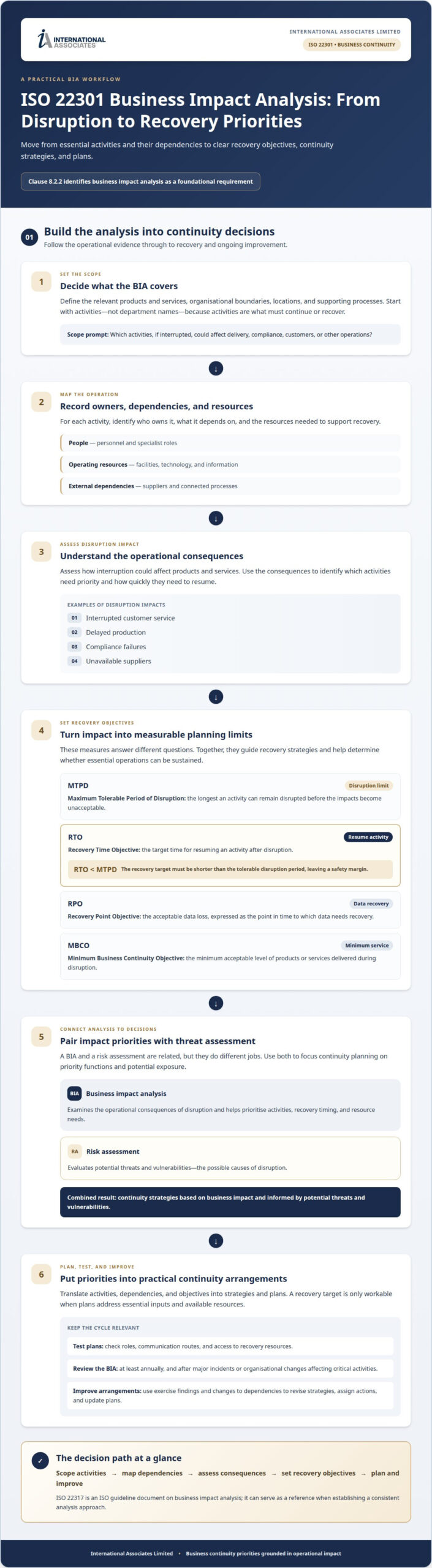
A business impact analysis (BIA) identifies activities that deliver an organisation’s products and services, then assesses the consequences of disruption. For business impact analysis under ISO 22301, the purpose is to establish which activities need priority, how quickly they must resume, and which resources support their recovery. ISO 22301 identifies BIA as a foundational requirement in Clause 8.2.2.
A business impact analysis turns operational dependencies into continuity priorities. It considers effects such as interrupted customer service, delayed production, compliance failures, or unavailable suppliers. Its findings inform a risk assessment, but the BIA focuses on consequences rather than the likelihood and severity of threats. Together, the processes help organisations develop continuity strategies based on business impact.
- Maximum Tolerable Period of Disruption (MTPD): the longest period an activity can remain disrupted before the resulting impacts become unacceptable.
- Recovery Time Objective (RTO): the target time for resuming an activity after disruption. The RTO must be shorter than the MTPD, leaving a safety margin.
- Recovery Point Objective (RPO): the objective for acceptable data loss, expressed through the point in time to which data needs recovery.
- Minimum Business Continuity Objective (MBCO): the minimum acceptable level of products or services delivered during a disruption.
These measures answer different planning questions. An activity might need to resume before disruption reaches the MTPD, while the RPO clarifies how much recent data the organisation can afford to lose. The MBCO describes the minimum service level to maintain. Together, these objectives guide recovery strategies and help assess whether they can sustain essential operations.
Scope determines which organisational activities the BIA examines. Define the relevant products and services, organisational boundaries, locations, and supporting processes. Then identify activities whose interruption could affect delivery, compliance, customers, or other operations. A comprehensive scope also captures dependencies on personnel, facilities, technology, information, and suppliers.
ISO 22317 is a guideline document on business impact analysis, according to the International Organization for Standardization (ISO). Its subject provides a useful reference point when establishing a consistent analysis approach. A clearly scoped BIA gives decision-makers a structured basis for setting priorities and developing continuity arrangements for incidents.
ISO 22301 and Business Continuity Management Systems
ISO 22301 provides a framework for establishing and maintaining a business continuity management system (BCMS). BIA findings give the system operational priorities for continuity strategies, recovery arrangements, and plans.
The Business Continuity Management System
A BCMS is a structured management system for preparing for disruption, maintaining continuity, and improving recovery arrangements. It connects responsibilities, processes, and documented plans so continuity is managed as part of organisational operations. A plan alone cannot define how decisions are made or resources coordinated. The BCMS provides that wider structure, linking operational priorities to objectives and response arrangements.
Turning BIA Results into Continuity Plans
BIA results translate priority activities, dependencies, and recovery objectives into practical continuity strategies and plans. For example, if a service relies on a particular system and specialist personnel, its strategy needs to address both dependencies. A recovery target cannot be met if a plan omits essential inputs. The analysis also helps align recovery arrangements with available resources and acceptable service levels.
The MBCO defines the minimum level of products or services an organisation aims to provide during disruption. A continuity plan can use it to distinguish essential output from normal operations. For example, a business might maintain a reduced service while restoring full capacity. The specific objective should reflect the activity’s impact, customer needs, dependencies, and resources available during disruption.
Plans need to be tested and reviewed to keep their assumptions relevant. An exercise can reveal whether staff understand their roles, communication routes work, and recovery resources are accessible. Use the findings to revise strategies, assign actions, and update plans. Review the BIA at least annually, as well as after major incidents or organisational changes that affect critical activities.
Continual improvement is integrated into the framework: ISO 22301 Clause 10 focuses on continual improvement within an organisation. Review findings, exercise outcomes, and changes to dependencies can therefore inform the next cycle of BCMS decisions. Organisations aligning continuity with wider controls can explore how management system certification fits their assurance priorities.
Identifying Critical Business Functions and Processes
A business impact analysis for ISO 22301 starts with activities, not department names, because activities are what must continue or recover. The activity register shows ownership, dependencies, and resource needs across operations.
Business Activities and Process Owners
Business activities are the tasks that produce or support an organisation’s products and services. Identify them by tracing a service from customer request through delivery, including supporting work such as order processing. Record each activity separately instead of treating an entire department as one recovery unit. This makes priorities more precise when disruption affects only part of a department’s operations.
Assign each registered activity to a process owner who understands its operation and impact. Department heads, continuity managers, and senior leadership can contribute alongside process owners. Record the activity’s purpose, outputs, owner, and the information needed to assess disruption. For example, an order-processing activity should identify who maintains it and which teams rely on its output.
Dependencies and Minimum Resources
Dependencies are the people, facilities, technology, information, and suppliers needed to perform an activity. Map each dependency to the activity it supports, then identify whether other processes rely on the same resource. This reveals shared points of failure. A customer order process, for example, may depend on staff access to an order system and current product information.
The activity register should record the minimum resources needed to maintain or recover each priority activity. Specify essential roles, systems, work locations, data, and supplier inputs, rather than listing every resource used in normal operations. This keeps continuity planning focused on what supports acceptable service during disruption and highlights gaps that could delay recovery.
Once activities and dependencies are registered, assess threats that could interrupt them. Natural disasters may affect facilities, cyber-attacks may disrupt technology or information, and supply chain disruptions may limit essential inputs. A risk assessment considers threats and vulnerabilities; the activity analysis shows which operations each threat could affect. Prioritise attention based on disruption consequences, dependencies, and the resources required for recovery.
Keep the register useful by involving people who understand day-to-day work. Process owners can explain operational dependencies, while department heads can identify shared resources and competing demands. Continuity managers can consolidate these inputs, and senior leadership can check that priorities align with business continuity objectives. The result is a practical record to guide decisions about which activities need protection first.
Benefits of Business Impact Analysis and Risk Assessment
A business impact analysis (BIA) and risk assessment answer different questions, then combine to guide business continuity decisions. The BIA evaluates operational consequences; the risk assessment identifies threats and vulnerabilities that could affect functions. Together, their findings help direct resources towards disruptions with the greatest potential impact.
What steps are involved in an ISO 22301 business impact analysis? Define the scope, identify activities and owners, assess disruption impacts over time, and record dependencies, resources, and recovery priorities. Then use the results alongside risk assessment findings to shape continuity strategies and plans.
The distinction matters in practice. A BIA may show that an order-processing activity depends on a particular system and supplier. A risk assessment considers threats, such as a cyber-attack or supplier disruption, that could affect those dependencies. Combining the findings supports decisions about alternative resources, recovery arrangements, and which activities need priority attention.
These assessments can also reveal opportunities to reduce concentration risk. If several critical functions rely on one supplier, identifying that dependency can prompt consideration of alternative sourcing. Their value extends beyond incident response: clearer resource requirements help organisations focus continuity planning on essential operations instead of applying the same controls everywhere.
What are common business impact analysis mistakes and risks? Treating departments as recovery units can obscure individual activities, while omitting supplier or technology dependencies can leave continuity plans incomplete. Untested assumptions may also lead to inaccurate estimates of resource needs or acceptable disruption.
ISO 22301 Clause 8.2 calls for organizations to continually improve their business impact analysis and risk assessment processes. Reviews can use incident findings, exercise outcomes, and operational changes to update priorities and strengthen plans. Performance assessment then considers whether recovery arrangements meet objectives, whether assigned resources are available, and whether identified gaps receive corrective action.
For example, if an exercise shows that a critical activity cannot resume with the listed resources, revise the analysis and continuity plan. Record the finding, assign an action, and review its completion to make improvement traceable. The BIA and risk assessment are working inputs to business continuity, not static documents completed once.
How to Choose BIA Priorities for Your Organization
Prioritise activities according to the consequences of interruption, not department size or visibility. A process supporting customer delivery, regulatory compliance, or essential revenue may need earlier recovery attention than work with fewer immediate operational effects.
Start by defining the BIA scope around products, services, locations, and supporting operations. Then assess how disruption affects each activity over time, using intervals such as one hour, one day, and one week. This shows when impacts become unacceptable and helps distinguish urgent recovery needs from activities that can tolerate a longer interruption.
Compare activities against practical decision factors:
- Disruption impact: Consider effects on customers, finances, reputation, compliance, and the delivery of products or services.
- Dependencies: Identify processes, suppliers, facilities, technology, information, and personnel that support the activity or rely on its output.
- Recovery requirements: Assess the time available before impacts become unacceptable, alongside the minimum resources needed to resume operations.
Dependencies can change the priority order. A support activity may appear secondary, for example, but an unavailable system could prevent several customer-facing processes from operating. Record these links so the assessment captures consequences across connected functions instead of judging each activity in isolation.
Resource requirements also shape realistic priorities. An activity may have severe disruption impacts but depend on specialist personnel, a particular facility, or a supplier with limited alternatives. Record the minimum inputs needed to maintain or recover it, then consider whether continuity arrangements can make those inputs available. This exposes gaps between recovery objectives and operational capability.
Use process owners and department heads to explain daily workflows, hand-offs, and bottlenecks. Senior leadership can weigh competing priorities against organisational objectives, while continuity managers consolidate findings across departments. This input reduces the risk of prioritising only visible activities or overlooking an internal dependency.
Finally, document why each activity received its priority and what evidence informed the decision. Review those judgements after significant organisational changes, incidents, or the introduction of critical activities. A traceable rationale keeps the BIA aligned with current operations and gives continuity planning a clear basis for allocating attention and resources.
Applying ISO 22301 Business Impact Analysis in Practice
In practice, an analysis connects ISO 22301 with operational decisions. Stakeholder evidence helps an organization evaluate dependencies and select resilience strategies that reflect service priorities.
BIA in the ISO 22301 Context
ISO 22301:2019 provides a framework for establishing, implementing, and maintaining a business continuity management system. The BIA identifies priority activities and recovery needs, while risk assessment considers threats that could disrupt them. A business impact analysis for ISO 22301 informs resilience strategies by showing which activities and dependencies need continuity arrangements. For example, a service reliant on one supplier may need an alternative sourcing strategy.
Stakeholder input makes the assessment operational. Process owners can explain workarounds and hand-offs, while IT teams identify system dependencies. Finance, operations, and suppliers can clarify resource constraints or delivery impacts. Comparing these perspectives helps establish whether a documented dependency could prevent an activity from operating and what response would support continuity.
Costs of BIA and Certification
In the United States, the cost of conducting a BIA or pursuing ISO 22301 certification depends on the organisation’s circumstances. Factors include the scope of activities, operational complexity, locations, and maturity of existing continuity arrangements. Formal stage 1 and stage 2 audit charges are provided after a quote request; these audits verify whether an organisation meets the requirements of the standard.
A BIA and certification are distinct activities, so their resource needs differ. Internal time for stakeholder interviews, documenting dependencies, and reviewing plans affects the effort involved in the analysis. Audit scope and the management system being assessed shape certification arrangements. Defining the scope helps organisations plan resources without confusing analysis with a certification audit.
Tools and Templates for Conducting a BIA
A structured questionnaire or activity register can capture consistent information from process owners. Templates can record activity outputs, disruption impacts, dependencies, minimum resources, and recovery objectives. A shared spreadsheet or data-collection tool can consolidate responses, while a consistent interview format helps compare information across teams. Choose tools that support clear records and practical review.
For example, stakeholders can trace a customer service activity from request to fulfilment, noting its reliance on staff, technology, and supplier inputs. Reviewing the record together may reveal gaps between the proposed recovery strategy and actual dependencies. A maintained register also supports resilience reviews after incidents or operational changes, keeping continuity arrangements connected to how the organisation works.
International Associates Limited: ISO 22301 Business Continuity
International Associates Limited provides ISO 22301 Business Continuity certification for organisations seeking independent assessment of their business continuity management system. This is a relevant next step when an organisation has established its system and wants verification against the standard’s requirements. Certification assessment examines whether the system meets those requirements; it does not replace the organisation’s responsibility for maintaining continuity arrangements.
Organisations may consider certification when customers, stakeholders, or internal governance processes require evidence of a structured approach to business continuity. Assessment also provides an opportunity to demonstrate how continuity priorities, risk assessment, and recovery planning are managed. The appropriate timing depends on whether the organisation has implemented its system and can present evidence for evaluation.
Formal certification includes stage 1 and stage 2 audits. These stages are used to verify whether an organisation meets the requirements of the specific international standard. They provide a structured assessment of the management system and its conformity, rather than a business impact analysis service or a promise that every disruption can be prevented. The organisation remains responsible for its operational decisions and continuity plans.
Before seeking assessment, an organisation can define the boundaries of its management system and organise relevant records, including the BIA, risk assessment, continuity strategies, and plans. These materials help show how identified priorities inform the system. Clear activity ownership and documented review arrangements also support an orderly assessment of how the system is maintained.
International Associates Limited’s ISO 22301 Business Continuity offering is intended for organisations seeking certification assessment, not management system consultancy. It may be a suitable next step when continuity arrangements are in place and independent verification is required. Organisations still developing their approach can use the principles in this article to clarify priorities and system scope before pursuing formal assessment.
Put Your Continuity Priorities into Practice
The next step is to turn continuity priorities into a management decision: determine whether your organisation is ready for independent assessment, or whether its scope and evidence need further development. A well-scoped business impact analysis for ISO 22301 can give leadership a clear basis for that decision and help keep resilience planning connected to operational change.
International Associates Limited provides ISO 22301 Business Continuity certification. Its other assurance offerings include Social Accountability Audits, ISO 9001 Quality Management System Certification, and ISO 14001 Environmental Management System Certification. These services address distinct organisational requirements, so the appropriate assessment depends on the standard or audit relevant to your objectives.
If your continuity management system is ready for independent assessment, contact International Associates Limited to discuss the next step. A considered approach can help your organisation move forward with greater clarity and confidence.
Frequently Asked Questions
How detailed should the activity list be?
Make each entry specific enough for its owner to explain what starts the activity, what output it produces, and what could stop it. For example, “approve supplier invoices” is more useful than “finance” because it identifies a discrete output and responsible process. Split activities when they have different owners, inputs, or disruption consequences; combine them when recovery decisions would be the same.
What is business continuity management ISO 22301?
It refers to using ISO 22301 as the framework for an organisation’s business continuity management system. In operation, that system assigns responsibility for continuity decisions, keeps relevant plans controlled, and connects reviews to management oversight. For example, a change in a key service can trigger review of affected plans and ownership. The standard gives organisations a consistent management approach rather than a ready-made continuity plan.
What is the difference between RTO and MTPD?
The MTPD marks the point beyond which disruption impacts become unacceptable; the RTO is the planned resumption target. Treat the MTPD as a tolerance boundary and the RTO as an operational recovery target. For instance, if disruption to a service becomes unacceptable after a defined period, the recovery target must allow enough time to restore it before that boundary is reached.
What is a business impact analysis (BIA) under ISO 22301?
A business impact analysis assesses how disruption to activities supporting an organisation’s products and services affects operations. Its practical output helps managers decide which services need continuity arrangements and what those arrangements must support. For a payment process, the analysis could examine how unavailable transaction records affect customer service, reconciliation, and the organisation’s ability to resume normal processing.
What does ISO 22301 require for conducting a business impact analysis?
ISO 22301 identifies business impact analysis in Clause 8.2.2. In practice, the analysis should produce information that supports continuity priorities and recovery planning. Organisations can document their method, scope, assumptions, findings, and review responsibilities so decisions can be understood later. The method may use interviews, workshops, or structured records, provided it captures relevant operational impacts and supports the business continuity management system.
How do you identify and prioritize activities, products, and services in a BIA?
Begin with the products and services within the analysis scope, then trace the activities that enable each one. Confirm the activity list with the people responsible for delivery, and record which outputs customers or other teams need. Prioritisation should reflect the consequences of interruption and how activities connect. If one internal output supports several services, its role across those services should inform its priority.
How do you determine maximum tolerable period of disruption (MTPD) and recovery time objectives (RTOs)?
Set the MTPD by identifying when disruption impacts would exceed the organisation’s tolerance, using operational evidence and relevant stakeholder input. Then establish an RTO that allows recovery before that threshold. Process owners can explain practical recovery constraints, while managers consider customer, operational, and compliance effects. Review assumptions against available recovery arrangements so the target reflects what the continuity plan is intended to achieve.
How do you assess financial and non-financial impacts over time in a BIA?
Assess impacts at successive points after an activity stops, recording how each consequence changes. Financial effects may include delayed revenue or additional operating costs; non-financial effects may include reduced service quality, customer dissatisfaction, reputational harm, or compliance concerns. For example, a delayed product shipment could first create customer service demands, then affect contractual or regulatory commitments if disruption continues. Record evidence and assumptions separately.