

Before choosing a competency certificate, check whether its assessments verify the skills you need and whether its status stays current. Unlike certificates based only on course completion, competency certificates reflect demonstrated mastery rather than time spent in a class or term.
That distinction matters when judging what a certificate demonstrates and whether it remains current. A certificate may provide evidence of learning, while a professional certification can validate knowledge or skills related to a job role. The terms are not interchangeable in every context.
This guide explains how competency-based programs assess skills, what may be required to earn a certificate, and how issuance, renewal, and revocation affect its status. It also covers why assessment methods and ongoing maintenance matter when a credential informs workplace or business decisions. The aim is to clarify what a certificate confirms, how its standing is maintained, and what to consider when evaluating one.
Key Takeaways
- Choose a certificate by matching its assessment and requirements to the skill, role, or business purpose you need it to support.
- Understand how issuance, renewal, and revocation affect whether a credential remains valid and can be relied on.
- Distinguish a Certificate of Competency from other credentials by considering what it assesses and what decision it is intended to inform.
- Check how a certification maintains relevance over time, including the renewal conditions set by its program.
- For organizational certification needs, identify the applicable standard and assessment scope before selecting a certification service.
How to Choose the Right Competency Certificate
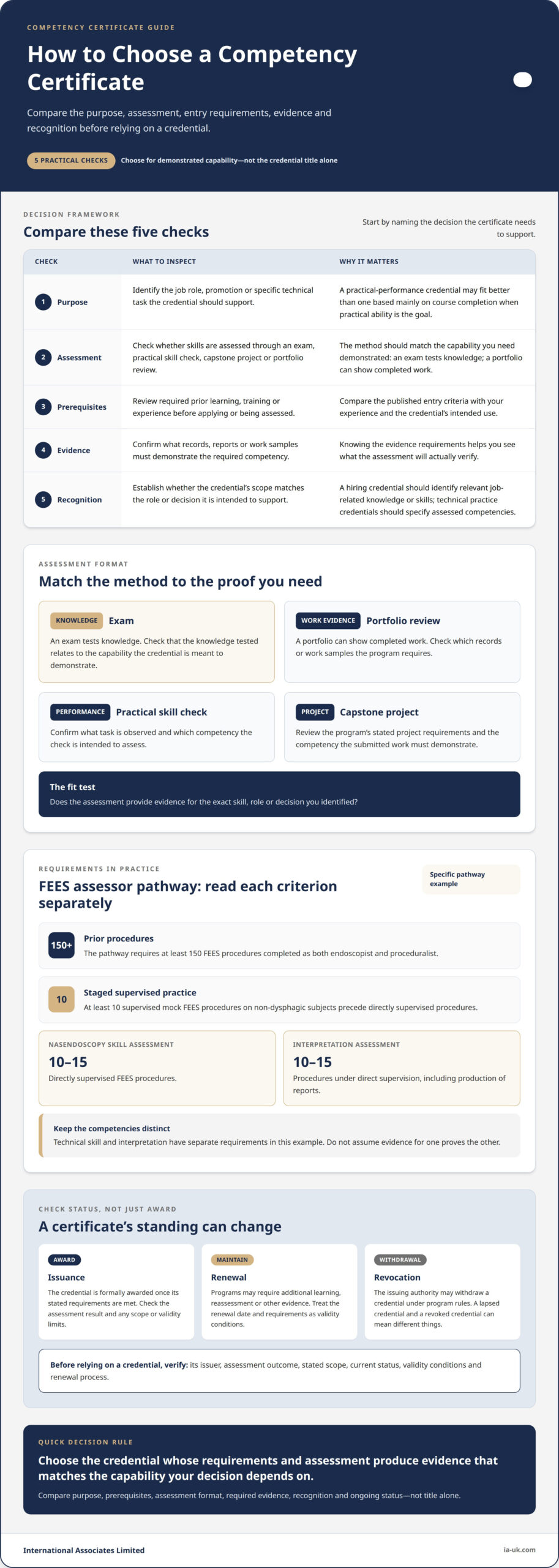
A purpose match means choosing a certificate that demonstrates the capability relevant to your next decision. First identify whether you need evidence for a job role, promotion, or specific technical task. A credential focused on practical performance, for example, may be a better fit than one based mainly on course completion. Write down the decision the certificate needs to support before comparing programs.
An assessment method is how a program confirms that a learner can perform the required work. Check whether it uses a proctored exam, practical skill check, capstone project, or portfolio review. Each method provides different evidence: an exam tests knowledge, while a portfolio can show completed work. Choose a method that matches the capability you need demonstrated.
Entry requirements are the conditions applicants must meet before assessment or certification. Review each program’s published criteria, including prerequisites and required evidence. Then compare them with your experience and the intended use of the credential.
- Prerequisites: Identify required prior learning, training, or experience before applying.
- Assessment: Confirm whether mastery is assessed through exams, skill checks, projects, or portfolios.
- Evidence: Check what records or work samples must demonstrate the required competency.
- Recognition: Establish whether the credential’s scope matches the role or decision it must support.
A FEES assessor pathway illustrates why requirements should be read precisely. The pathway described requires an assessor to have completed at least 150 FEES procedures as both endoscopist and proceduralist. It also sets staged practice expectations: at least 10 supervised mock FEES procedures on non-dysphagic subjects precede directly supervised procedures. For nasendoscopy skill assessment, the stated range is 10-15 directly supervised FEES procedures.
Interpretation requirements can be separate from technical skill requirements. In the same FEES example, interpretation is assessed through 10-15 procedures performed under direct supervision, including production of reports. This distinction helps applicants identify what the certificate assesses, rather than assuming one competency proves another. Compare each stated criterion with the evidence you can provide, and note any assessment stage that remains unmet.
Finally, check whether the certificate’s scope is clear enough for its intended audience. A credential used in hiring should identify relevant job-related knowledge or skills; one supporting technical practice should specify the competencies assessed. Compare purpose, prerequisites, assessment format, and required evidence to choose competency certificates based on practical fit, not title alone.
Certificate issuance, renewal, and revocation
Certificate issuance is the formal award of a credential once its stated requirements are met. A successful assessment may confirm technical ability through an exam, observed task, or documented evidence. The issuing body records the result and applies the program’s conditions, including any limits on scope or continued validity.
How long does it take to earn a competency certificate? There is no single timeline. Completion depends on the assessment format, evidence requirements, and review process. A timed exam may take a different route from a program requiring supervised practice or a portfolio, so follow the published steps to understand the expected sequence.
Renewal is the process of maintaining a credential after it is awarded. Certification programs generally require maintenance and renewal to show that knowledge and skills remain relevant as a profession changes. Conditions may specify additional learning, reassessment, or other evidence; the credential’s rules define what applies. Treat the renewal date and required evidence as part of the certificate’s validity conditions, not optional administrative details.
Revocation is the withdrawal of a credential by its issuing authority. Program rules define the grounds and procedures, which may address failure to meet ongoing conditions or inaccurate evidence. Since requirements differ, interpret a certificate alongside its current status and governing terms. A lapsed credential and a revoked credential can have different meanings under individual program rules.
The U.S. Certificate of Competency (COC) illustrates a separate, procurement-specific process. According to the U.S. Electronic Code of Federal Regulations, an offeror must qualify as a small business under the applicable size standard in 13 CFR part 121 to be eligible for a U.S. COC. The COC concerns a small business’s responsibility for a federal contract, not a general professional skills credential.
For that federal process, timing applies to the contract award decision. According to the U.S. Small Business Administration, a U.S. federal contracting officer must withhold contract award for 15 business days after the appropriate SBA Area Office receives a complete referral concerning a small business offeror’s responsibility. This period is not a standard certificate-earning timeline; it relates to the COC referral and award process.
Before relying on a credential, identify its issuer, assessment outcome, validity conditions, and renewal process. For a technical role, confirm that the certificate’s scope matches the ability being claimed. In U.S. federal procurement, distinguish the COC’s responsibility determination from certificates that document professional competence.
For cryptographic credentials, consult NIST SP 800-57 Key Management when evaluating lifecycle practices such as issuance, renewal, and revocation.
Certificate of Competency definition and purpose
A Certificate of Competency recognizes demonstrated knowledge or skills in a defined area. It gives employers or other decision-makers evidence that a person has met stated assessment criteria. For example, a credential might document capability in a specific job-related task rather than completion of a general course.
In the United States, “Certificate of Competency” can also refer to the Small Business Administration’s COC program. It addresses whether a small business is responsible for performing a federal contract, not whether an individual has mastered a professional skill. The shared wording can obscure these different purposes, so interpret the certificate by its issuer and assessment scope.
Competency certificates, licenses, certifications, and degrees serve different functions. A certificate records learning or demonstrated competence; a certification validates knowledge or skills related to a job role. A license authorizes a person to perform an activity under applicable rules, while a degree recognizes completion of an academic program. The issuer and intended use determine what each credential demonstrates.
Are competency certificates required for specific jobs or regulated professions? Requirements depend on the role and applicable rules. An employer may use a certificate as evidence, while a regulated profession may require a specific license or qualification. The certificate title alone does not establish that it is legally required.
To verify a certificate’s legitimacy, identify the issuer, credential name, scope, and assessment method, then compare them with the issuer’s official records. Accreditation is a separate assurance: third parties accredit certification programs to support adherence to assessment standards and best practices. Confirm that accreditation applies to the relevant program and assessment rather than relying on a logo alone.
An unrecognized or fraudulent credential is one whose claimed issuer, assessment, or recognition cannot be substantiated. Using one may lead an employer to discount the evidence, misjudge someone’s capability, or make a decision based on inaccurate claims. Evaluate it by comparing the stated competencies with the actual role and the evidence behind the award.
For example, an employer evaluating a technical applicant can distinguish a course-completion certificate from a competency award by reviewing the assessment record. The first may show learning; the second should identify demonstrated skills. This helps clarify what the document proves without treating every certificate as equivalent to a license, certification, or degree.
Check that the certificate’s stated competencies match the role and that the supporting assessment evidence is verifiable.
Certification duration and renewal
Certification duration is the period a credential remains valid under its program’s rules. There is no universal expiry period across professions or issuers. One credential may remain current until a stated expiry date, while another requires ongoing evidence of competence. The issuing program defines the applicable validity conditions.
An expiry date marks when a credential stops being current unless renewal requirements are met. Check the certificate and its governing terms for the date, renewal window, and conditions for continued recognition. Even without a visible expiry date, interpret the certificate according to the issuer’s current rules rather than assuming it lasts indefinitely.
Renewal maintains or extends a credential by meeting the program’s conditions. Certification programs generally require maintenance and renewal to show that knowledge and skills remain relevant as a profession changes. A technical role may involve revised practices, for example, so a program might require updated evidence or reassessment. The specific method depends on the credential.
- Review: Identify the issuer’s renewal date and applicable conditions.
- Prepare: Gather required learning records, work evidence, or other documentation.
- Submit: Complete the stated renewal assessment or review process.
- Confirm: Check the updated status and validity period after a successful renewal.
Maintenance means meeting requirements that apply between assessments or renewal points. Depending on the scheme, these may include continued learning, updated records, or demonstrated practice. Keep relevant evidence together, such as training records or assessment outcomes, so you can present it when required. This supports a clear record of continuing competence.
Late renewal can affect whether a credential is recognized as current. Some programs may provide a route to restore status, while others may require a new assessment; the issuer’s rules determine the process. Do not treat a lapsed certificate as equivalent to an active one. For hiring or compliance decisions, use the credential’s current status and stated scope.
Before relying on a certification, make three checks: confirm the issuer, read the validity conditions, and note the renewal steps. For a regulated or technical role, establish whether the relevant employer or authority requires current status. Planning for renewal helps maintain credible evidence instead of leaving it until expiry.
How competency-based certificates work
Competency-based learning progresses as learners demonstrate mastery of defined skills. Unlike traditional certificates, which generally follow course and term schedules, these programs assess progress against learning outcomes. A learner who has already mastered a skill may demonstrate it directly; another may need further practice before assessment.
Mastery means demonstrating the ability to meet a program’s stated performance criteria. Those criteria specify what the learner must know or do, such as completing a technical task accurately. The program evaluates evidence against them rather than relying only on attendance or time in class.
An assessment is a structured way to check whether a learner meets a competency standard. Many programs use proctored exams or practical skill checks; some also require capstone projects or portfolio reviews. An exam can test applied knowledge, while a portfolio can show completed work. The format depends on the competency being assessed.
The review process evaluates submitted evidence and assessment results. In practice, it can follow these steps:
- Define: Establish the competencies and performance criteria the certificate covers.
- Assess: Complete the required exam, skill check, project, or portfolio submission.
- Review: Compare results and evidence with the stated criteria.
- Decide: Award the certificate when the required mastery has been demonstrated.
For example, a technical support program could assess whether a learner can diagnose a defined system issue. A practical check might require following a documented process and explaining the result. Alternatively, a portfolio review could assess prior work against the same stated outcomes. The evidence must demonstrate the competency, not merely describe it.
Successful completion means the learner has met the program’s assessment requirements. If the evidence falls short, the program may identify criteria that need further demonstration. The program sets the reassessment process, so learners should understand the rules before beginning an assessment.
After issuance, the certificate communicates its scope and the competencies assessed. Employers can use this information to evaluate fit for a role, but the credential does not establish ability beyond its scope. Evidence of one technical task, for instance, should not be treated as proof of every related responsibility.
For a useful review, compare the certificate’s stated outcomes with the work it is intended to support. Check that the assessment method produced relevant evidence and that the award reflects demonstrated mastery. This makes the credential easier to interpret for training, hiring, or professional development decisions.
International Associates Limited
International Associates Limited assesses whether organisations’ management systems meet the requirements of recognised standards. This can be relevant when a business needs independent verification for customer, stakeholder, or operational purposes. It is distinct from an individual competency certificate: the assessment concerns an organisation’s system and its conformity with a defined standard.
The appropriate route depends on the organisation’s objective. A business strengthening quality management may consider ISO 9001 Quality Management System Certification. An organisation focused on environmental management may consider ISO 14001 Environmental Management System Certification. For occupational health and safety management, ISO 45001 Occupational Health and Safety may be relevant. Each option relates to a different management-system scope.
Assessment is based on the requirements of the selected standard and the organisation’s scope. The formal process includes Stage 1 and Stage 2 audits to verify whether an organisation meets the requirements of a specific international standard. This evidence-based approach helps distinguish an independently assessed management system from a course certificate or an individual’s job-related credential.
Social accountability is another area where external assessment can support an organisation. International Associates Limited provides Social Accountability Audits for organisations seeking an independent review. This suits an organisational need, not an individual seeking proof of technical skills. Start by identifying what the organisation needs to demonstrate and which standard or audit scope applies.
Consider the business outcome before choosing an assessment. A manufacturer seeking formal verification of its quality management system, for example, has a different objective from a company seeking environmental management system certification. Identifying the relevant scope helps align the assessment with operational requirements and the evidence stakeholders need.
- Quality management: ISO 9001 Quality Management System Certification.
- Environmental management: ISO 14001 Environmental Management System Certification.
- Occupational health and safety: ISO 45001 Occupational Health and Safety.
- Social accountability: Social Accountability Audits.
These services support organisational verification; they do not replace a personal credential when a role requires proof of individual competence. Keeping that distinction clear helps businesses choose an assessment that fits their purpose.
To discuss an organisational certification requirement, contact International Associates Limited.
Frequently Asked Questions
What are competency-based certificate programs and how do they work?
Learners can address a defined capability gap by linking learning outcomes to a work goal. Before enrolling, compare the program’s stated outcomes with the tasks you need to perform. For example, a supervisor supporting an employee’s development can identify a specific responsibility and assess whether the program addresses it. This makes the credential’s relevance easier to judge before committing time to study.
What is a competency certificate?
Use a credential as evidence for the specific capability it names, not as a broad claim about your qualifications. When listing it on a résumé or application, reproduce the exact certificate title and issuer, then explain how its scope relates to the role. This helps employers interpret competency certificates accurately and avoids implying that they cover duties or expertise beyond their stated purpose.
Who issues competency certificates and are they nationally recognized?
The organization administering a program issues its certificate, but national recognition depends on the intended use and relevant jurisdiction. If recognition matters for an application, identify the qualification framework or professional requirement named by the employer or authority. Compare the credential’s exact title and level with that requirement. Acceptance in one sector or location does not automatically establish acceptance elsewhere.
How do I apply for and obtain a competency certificate?
Identify the organization administering the specific program, then follow its application process. Read the entry information before submitting materials so you can distinguish required evidence from optional background. Keep a copy of your application and submitted records. If applying through an employer, align the chosen program with the development objective agreed for your role.
How long are competency certificates valid, and how do I renew them?
Use the issuer’s stated status and validity information when presenting a certificate for a job application, audit, or professional review. Keep the award record available and provide relevant renewal evidence when requested. If an employer relies on a credential for a specific responsibility, make its current status clear rather than assuming the original award document answers every question about continued recognition.