

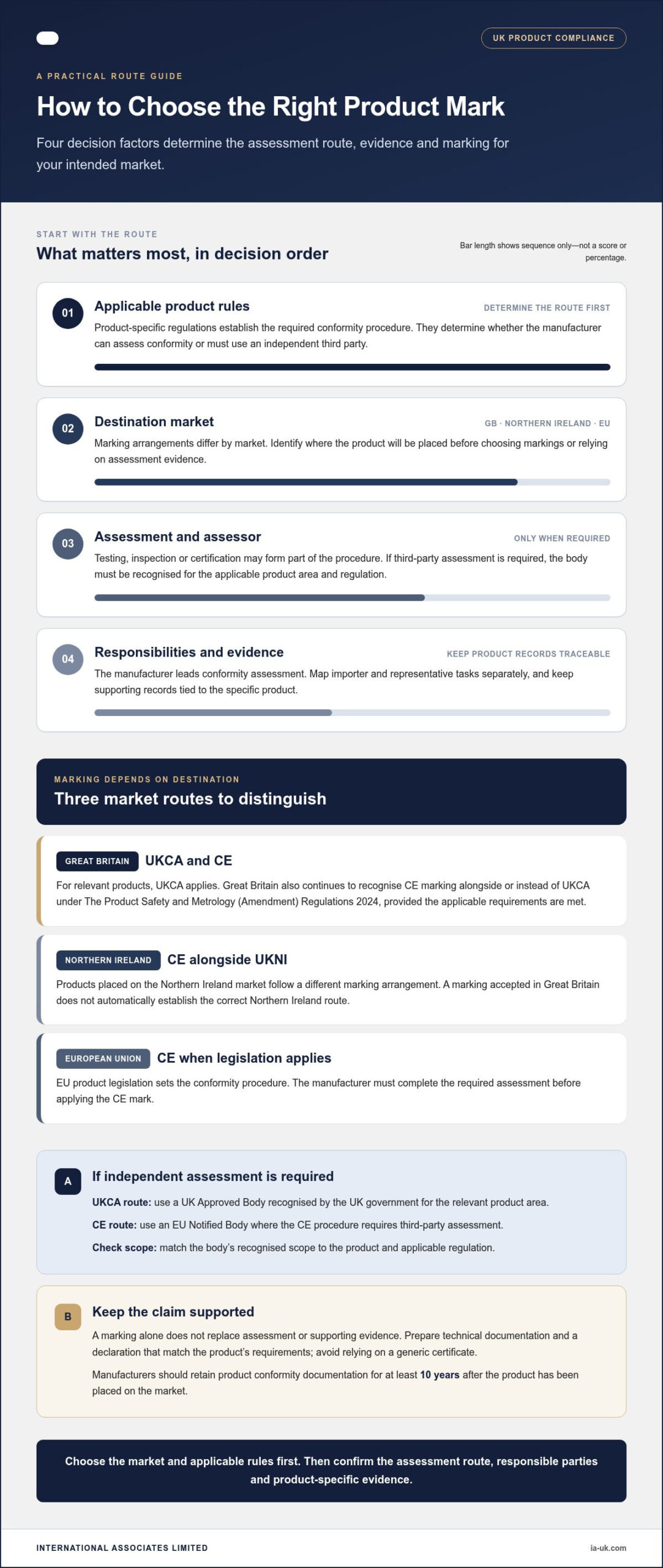
The product mark is not the first decision; the destination market and applicable rules determine the route. The manufacturer carries out the assessment, with a conformity assessment body involved when required. In Great Britain, CE marking continues to be recognised alongside or instead of UKCA marking under The Product Safety and Metrology (Amendment) Regulations 2024, according to the UK Government.
Because requirements vary by product and destination market, businesses need to match the applicable conformity assessment procedures UK rules require with clear responsibilities, evidence and documentation. This guide explains how the process works, who is responsible, what records support a conformity claim and where sector-specific requirements differ. It also covers how UK and EU market routes affect compliance planning.
Key Takeaways
- Identify the product’s applicable regulations first; they determine whether self-assessment is permitted or independent assessment is required.
- Map responsibilities across the manufacturer, importer, and any authorised representative so required records and market-facing details are accounted for.
- Prepare technical evidence and a declaration that correspond to the product’s requirements, rather than relying on a generic certificate.
- Allow for sector and destination differences, particularly when a product is intended for both Great Britain and the EU.
What is a Conformity Assessment Procedure?
A conformity assessment procedure is the method used to demonstrate that a product meets the requirements that apply before it is placed on the market. In the UK, product-specific regulations determine the route, from manufacturer assessment to required third-party involvement.
UKCA and CE Marking Options
UKCA and CE markings indicate that a product has followed the conformity route required for its intended market. The applicable rules, not a preferred mark, determine which route and evidence are needed.
Great Britain continues to recognise CE marking alongside or instead of UKCA marking under The Product Safety and Metrology (Amendment) Regulations 2024, according to the UK Government. This means businesses may use the mark accepted for their product and market, provided the relevant requirements have been met. A marking alone does not replace assessment or supporting evidence.
For the EU market, product legislation sets the conformity procedure. Products such as toys, electronics, machinery, batteries, PPE, medical devices, measuring instruments and gas appliances may fall under CE-marking legislation. The manufacturer must complete the required assessment before applying the CE mark.
Great Britain and Northern Ireland Rules
Great Britain and Northern Ireland have different marking arrangements, so destination affects the compliance route. Great Britain comprises England, Scotland and Wales, where UKCA applies to relevant products, while CE marking is also recognised under the 2024 amendment.
For products placed on the Northern Ireland market, CE marking still applies alongside UKNI marking. Businesses supplying both regions should identify the destination before selecting markings and assessment evidence. A marking accepted in Great Britain does not automatically establish the correct route for Northern Ireland.
Product Testing and Approved Body Assessments
Product testing may form part of conformity assessment, alongside inspection and certification where the applicable procedure requires them. The relevant legislation determines whether the manufacturer can assess conformity or must involve a third party.
A UK Approved Body must assess a product when the relevant UK regulations require third-party assessment. For UKCA assessment, the body must be recognised by the UK government for the relevant product area. Where CE assessment requires a third party, an EU Notified Body is used. Match the body’s recognised scope to the product and applicable regulation.
Testing and assessment costs depend on factors such as product design, applicable requirements, test scope and whether third-party assessment is required. There is no single cost across product categories because the regulatory route determines the work involved.
Selling a product without meeting applicable requirements creates a practical risk: it may not qualify for placement on its intended market. Consequences depend on the product rules and the nature of the non-compliance. A marking without supporting evidence, or an incomplete assessment, does not establish conformity.
Manufacturer and economic-operator responsibilities
Responsibility depends on each business’s role in bringing a product to market. Manufacturers, importers and authorised representatives need clear records of their respective tasks, particularly when a product crosses borders or its supply chain changes. Mapping these roles early helps teams apply UK conformity assessment procedures to the right products and records.
Manufacturer responsibility
The manufacturer is responsible for carrying out the conformity assessment and ensuring the evidence supports the product’s compliance. The manufacturer therefore leads decisions about the product’s design, applicable requirements and assessment route. For multiple product lines, separate records help prevent evidence for one model from being applied to another.
Manufacturers should retain product conformity documentation for at least 10 years after the product has been placed on the market. A technical file should remain traceable to the specific product, its assessment and the evidence used to demonstrate conformity. If a design or supplier changes, the manufacturer needs to consider whether the existing evidence still reflects the product being supplied.
Marking is another practical control. The manufacturer should ensure UKCA marking is visible, legible and indelible, and meets applicable size and format requirements. Before release, a production review can compare the product, packaging or accompanying document with the selected marking method.
Importer and UK Responsible Person roles
Importers should identify the manufacturer and product associated with each shipment and retain documents that make the relationship traceable. For medical devices, retailers are advised to check the UKCA or CE mark and the correct manufacturer or importer contact details before accepting goods. These checks can reveal missing or inconsistent information at receipt.
A manufacturer based outside the UK must appoint a UK Responsible Person for Great Britain. This establishes a UK-based representative connection but does not remove the manufacturer’s responsibility for the product. For high-risk devices, the manufacturer or its UK Responsible Person must register with the MHRA before placing products on the UK market.
Record importer and representative responsibilities separately from the manufacturer’s assessment work. A role allocation can identify who holds technical records, maintains market-facing contact details and handles registration where required. This is especially useful when a product moves from an overseas manufacturer through an importer to a retailer.
For example, a retailer receiving a medical device can compare its marking and contact details with supplier documents. The importer can preserve shipment and supplier records, while the manufacturer maintains the product’s conformity evidence. Clear assignments help each economic operator demonstrate which records and actions sit within its role under UK conformity assessment procedures, while wider regulatory compliance obligations can inform how those responsibilities are documented.
Technical documentation and declarations of conformity
Technical documentation connects a product’s assessment with the manufacturer’s formal conformity claim. The applicable regulations determine which records and declarations are required, while consistent product identification makes the evidence easier to follow.
Self-declaration of Conformity
Self-declaration means the manufacturer assesses the product and declares that it meets applicable requirements without a required third-party assessment. The manufacturer remains responsible for both the claim and its supporting evidence.
The route depends on product legislation, not a general preference for self-assessment. The Medical Devices Regulations 2002 permit self-declaration for some Class I devices under the UKCA regime, according to the UK Government. Other products or device classes may require a conformity assessment body, so the records should reflect the product’s classification and applicable route.
Declarations of Conformity and Performance
A Declaration of Conformity records the manufacturer’s claim that a product meets applicable legislation. A Declaration of Performance has a different purpose for construction products: it records the performance declared for the product. Use the correct document because each communicates a distinct compliance statement.
An EU Declaration of Conformity should identify the product, applicable legislation, manufacturer or authorised representative, any notified body, and relevant harmonised standards or other normative documents. These references link the declaration to the assessment and supporting records. If the model reference differs from the technical file, it may be unclear which product the declaration covers.
A UK Declaration of Conformity is a legally binding document declaring that a product meets relevant UK regulations. The manufacturer or its authorised representative draws it up as part of the assessment. Keep it controlled alongside the technical records, with the product description and legislative references aligned to the evidence. If product or assessment details change, review whether the declaration remains accurate.
For a medical device, technical documentation can link its intended purpose and classification to applicable safety and performance requirements, the assessment route and supporting evidence. Documentation for UK authorities or conformity assessment bodies should be available in English. This helps reviewers follow how the manufacturer evaluated the device against the requirements.
Under the EU MDR and IVDR, Annex IX is a conformity assessment route requiring a complete quality management system certified according to ISO 13485 and the relevant annex. For manufacturers preparing this quality-system element, ISO 13485 Medical Devices Certification relates directly to the standard named in that route; device-specific evidence must still support the wider conformity assessment.
Technical files and supporting evidence
A technical file brings product information and assessment evidence together in a traceable record. Its contents depend on the product, applicable regulations and conformity route, so a medical device file will differ from one for electrical equipment.
Organise records so a reviewer can link each item to the product model and the requirement it supports. For example, a file for electrical equipment could group design information, risk analysis, test reports, production controls, labelling and instructions. These records show how the product was assessed, rather than simply repeating the conformity claim.
Useful evidence may include:
- Product descriptions, intended use and technical specifications that identify the model being assessed.
- Risk assessments linking identified hazards with design controls and supporting test results.
- Inspection or testing reports that state which product configuration was examined.
- Production and supplier records showing how assessed designs relate to supplied products.
- Labels, instructions and declarations that match the product and its destination market.
This is a practical filing structure, not a universal checklist. The regulations and assessment procedure determine which evidence applies. A conformity assessment body may need to trace the link between a requirement, the evidence addressing it and the product version covered.
Traceability matters when components or production arrangements change. If a manufacturer replaces a component, for example, the change record should identify the affected model and show whether existing test evidence still represents its configuration. This helps prevent outdated reports from being used as evidence for a materially different product.
Keep version control clear. Record the date and reason for a design revision, along with its associated assessment evidence. If a test report refers to one model code but the label names another, the evidence may be difficult to interpret. Consistent identifiers help manufacturers, importers and notified bodies work from the same product record.
For Great Britain, product compliance documentation is typically kept for 10 years after each individual product is placed on the market. The retention period makes accessible storage and reliable product identification important, especially where product models or suppliers change over time.
For products supplied in both Great Britain and European markets, keep evidence for each regulatory framework distinct while making shared technical records identifiable. A test report may support more than one assessment, but the file should show which requirements and product versions it covers. This helps prevent an EU reference from being mistaken for evidence of UK compliance, or vice versa.
A well-structured file works as an evidence map: it records the product identity, applicable requirements, assessment records and the links between them. Organising it around the product and its regulatory route makes gaps easier to identify and gives reviewers a clear path through the supporting material.
Brexit sectoral guidance
Brexit changed how product rules apply across Great Britain, Northern Ireland and the EU. The applicable legislation still depends on product type and destination, so one route may not cover every market a business serves.
Start by separating the destinations and identifying each product’s sector rules. The UK’s Electrical Equipment (Safety) Regulations 2016, Toys (Safety) Regulations 2011 and Medical Devices Regulations 2002 illustrate how requirements are set through sector-specific legislation. Product classification and destination then determine which conformity route and markings apply.
For most sectors, UKCA marking may be placed on a product label or accompanying document in Great Britain until 11pm on 31 December 2027. This transition detail affects where the marking appears, not the need to meet applicable requirements. Businesses should distinguish marking arrangements from the assessment and evidence supporting compliance.
Medical devices require particular attention to classification. UK planning should account for classes I, IIa, IIb and III, because higher-class devices require third-party conformity assessment. The Medical Devices Regulations 2002 provide the UK framework, while manufacturers supplying the EU must consider the EU MDR and IVDR. A route in one market should not be assumed to satisfy the other.
Construction products show why sector changes need careful tracking. The UK indefinitely extended recognition of CE marks for construction products after previously planning to end recognition after June 2025. That policy change illustrates why businesses should use current government guidance for their product sector, rather than relying on an older transition plan. For organisations operating across the built environment that also require property-level energy compliance, specialist assessors such as energysmartworld.co.uk provide domestic and commercial energy performance certificate assessments.
UK-EU trade arrangements do not create a general shortcut for product assessment. Chapter 4, Articles 88 to 100 of the UK-EU Trade and Cooperation Agreement covers conformity assessments and related procedures. Article 93 addresses common use of accreditation in principle, but provides no mutual recognition. Sellers serving both markets may therefore need two conformity tests, one against British rules and another against EU rules, even where requirements are identical.
Market surveillance also remains part of the compliance picture. Conformity assessment and surveillance complement each other, while Regulation (EU) 2019/1020 addresses EU market surveillance and product compliance. This means supporting records must remain aligned with the product supplied and the destination market, not only the initial assessment.
For a practical review, map each product against its destination, sector regulation, marking route, assessment body requirements and evidence. Then record any separate UK and EU requirements. Organisations assessing regulatory obligations across product markets can use regulatory compliance support to inform their next steps.
International Associates Limited: Social Accountability Audits
International Associates Limited provides Social Accountability Audits for organisations assessing workplace practices and social accountability in their operations or supply chains. These audits address social accountability, while product conformity assessment determines whether goods meet applicable market requirements. They serve different compliance needs.
Consider a Social Accountability Audit when you need an independent assessment of social accountability practices. For related management-system priorities, International Associates Limited also provides ISO 9001 Quality Management System Certification, ISO 14001 Environmental Management System Certification and ISO 45001 Occupational Health and Safety.
Explore Social Accountability Audits to learn more. You’re welcome to visit ia-uk.com or contact International Associates Limited to discuss your requirements.
Make compliance part of product governance
Product compliance works best as an ongoing governance responsibility, not a document exercise completed once before launch. Assign responsibility for reviewing product changes, supplier updates and destination markets, then link each change to the relevant assessment records. This gives teams a defined way to determine whether existing evidence still reflects the product they intend to supply.
Use the UK’s conformity assessment procedures to guide wider product decisions: set a clear approval point before market entry, make responsibilities visible across teams, and include regulatory review in design and sourcing discussions. This helps keep compliance decisions connected to day-to-day operational choices.
If your organisation also needs independent assurance or certification against broader standards, International Associates Limited can discuss its audit and certification services. Contact the team to discuss your organisation’s priorities and the appropriate next step.
Contact International Associates Limited to discuss your requirements. A considered, well-owned process puts your team in a stronger position to move forward with confidence.
Frequently Asked Questions
How does it work in practice?
In practice, a manufacturer matches the product and destination market to the applicable rules, then follows the assessment route those rules specify. For example, a product supplied in both Great Britain and the EU may need separate UK and EU conformity evidence, even when requirements are similar. The process links product classification, assessment evidence, technical records and the relevant marking before the product is placed on each market.
What is conformity assessment in the UK?
UK conformity assessment is the process of demonstrating that a product meets the requirements for its intended market. The route depends on the product and its regulations, not simply on the manufacturer’s location. Intended use, design and product category help identify the relevant rules. Depending on those rules, the manufacturer may assess conformity itself or involve an independent assessment body.
Which UK products require conformity assessment?
Products covered by UK product safety regulations require the assessment specified for their category before market placement. Examples include electrical equipment, toys, personal protective equipment, radio equipment and medical devices. Machinery, batteries, measuring instruments and gas appliances are also subject to product legislation. The deciding factor is whether product-specific rules apply, so products used in similar settings may follow different routes.
What are the UKCA and CE marking rules in Great Britain?
Great Britain recognises CE marking alongside or instead of UKCA marking under The Product Safety and Metrology (Amendment) Regulations 2024, according to the UK Government. The applicable product rules determine which marking route can be used. For most sectors, UKCA marking may appear on a product label or accompanying document until 11pm on 31 December 2027. This placement rule does not replace the required conformity assessment.
When is UKCA marking required instead of CE marking?
UKCA marking is relevant for products placed on the Great Britain market when their applicable UK regulations provide for that route. It isn’t a blanket replacement for CE marking: Great Britain continues to recognise CE marking under the 2024 amendment. A product intended for the EU follows EU requirements, while Northern Ireland uses CE marking alongside UKNI marking. Decide by destination and product legislation, rather than by one universal rule.
What conformity assessment procedures apply to different product categories in the UK?
The product regulations set the available procedures, which range from manufacturer self-assessment to third-party assessment by a UK Approved Body. For example, UKCA self-declaration is available for electrical equipment under the Electrical Equipment (Safety) Regulations 2016. Medical-device routes depend on classification, while other categories have their own rules. The product’s category and classification determine the appropriate route and whether independent assessment is required.
What are the steps to complete UK conformity assessment and affix a product mark?
Complete the assessment before applying the relevant product marking. The sequence is:
- Identify the product, destination market and applicable regulations.
- Determine its classification and permitted assessment route.
- Complete required testing, inspection or third-party assessment.
- Compile supporting technical records and the declaration.
- Apply the marking allowed by the relevant rules.
Keep the product description and model references consistent across these records.
What technical documentation and declarations of conformity are required in the UK?
The file must support the product’s conformity claim under its applicable regulations. It commonly brings together product identification, technical specifications, risk information and relevant assessment evidence. A UK Declaration of Conformity is a legally binding statement that the product meets relevant UK regulations. Medical-device documentation for UK authorities or assessment bodies should be available in English. Great Britain product compliance records are typically kept for 10 years after each product is placed on the market.