

What if the perceived hidden fees of quality management were actually a result of choosing the wrong certification path? It’s common to feel hesitant when faced with a lack of transparency around audit fees or the technical distinction between UKAS-accredited and non-accredited bodies. You need to ensure your investment builds a foundation for global growth rather than just adding an opaque line item to your balance sheet.
This guide provides a professional breakdown of the cost of ISO 9001 certification for small business UK, ensuring you can budget effectively for the full three-year cycle. We’ll examine the structural differences between accredited and non-accredited routes, the internal time-costs of implementation, and how to identify a reliable certification body that supports your long-term stability. By understanding these variables, you can transform a complex regulatory requirement into a predictable strategic asset for your firm’s international reputation. Following the transition to the ISO 9001:2026 standard, maintaining a clear view of your compliance budget is essential for sustainable growth.
Key Takeaways
- Understand that certification is a strategic three-year investment cycle consisting of an initial assessment followed by mandatory annual surveillance audits.
- Identify the specific variables, such as headcount and process complexity, that dictate the total cost of ISO 9001 certification for small business UK.
- Recognize the regulatory necessity of separating management system consultancy from independent third-party verification to maintain institutional impartiality.
- Evaluate how multi-site operational requirements and specialized industrial sectors impact the calculation of mandatory audit days for your organization.
- Learn how leveraging a certification body with advanced IT infrastructure and global reach can enhance operational efficiency and provide a higher return on investment.
What Comprises the Cost of ISO 9001 Certification in the UK?
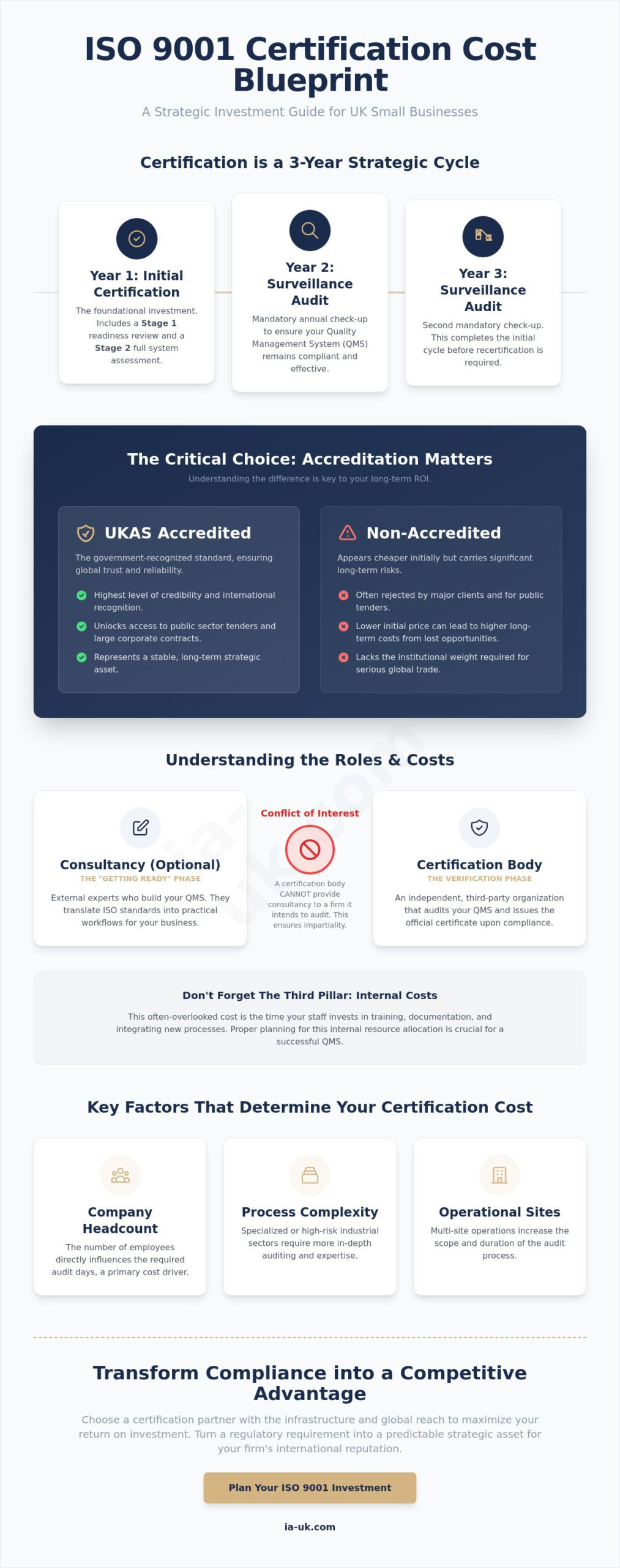
ISO 9001 certification isn’t a static purchase; it’s a strategic multi-year investment cycle. For a small business in the UK, the financial commitment covers a three-year period, starting with the initial assessment and continuing through annual surveillance. The ISO 9000 family of standards requires rigorous verification, which separates costs into two distinct categories: internal preparation and external verification. Recognizing this distinction is vital for accurate budgeting and long-term planning.
Small businesses often benefit from more streamlined pricing models than global enterprises. This is primarily because certification bodies calculate fees based on audit days, which are determined by headcount, the complexity of the industry, and the number of operational sites. While a multinational might require weeks of auditing across several continents, a UK-based SME usually sees a more concentrated schedule. The initial certification process itself is split into Stage 1, a readiness review of documentation, and Stage 2, a full assessment of the system’s practical application. Each stage requires a specific fee structure based on the time spent by the auditor.
The Three Pillars of Your ISO Budget
The cost of ISO 9001 certification for small business UK rests on three financial pillars. First, certification body fees cover the formal assessment and issuance of the certificate. These are mandatory for any firm seeking recognized status. Second, optional consultancy fees may be incurred if a business requires external expertise to build its Quality Management System (QMS). Third, internal resource costs represent the time staff spend on training and process documentation. This internal investment is often the most overlooked aspect of the total budget, yet it’s essential for ensuring the system is genuinely integrated into daily operations.
Beyond these pillars, small businesses should also consider how other mandatory compliance requirements intersect with their quality management goals. For example, professional UK Fire Risk Assessments are essential for legal compliance and workplace safety, providing a solid foundation of risk management that complements the ISO 9001 framework.
Accredited vs. Non-Accredited Costs
Accreditation status significantly influences the long-term value of your investment. In the UK, UKAS-aligned certification is the government-recognized standard that provides the highest level of global reliability. While non-accredited certificates often present a lower initial price point, they frequently result in higher long-term costs. Many public sector tenders and large corporate contracts explicitly require UKAS-accredited certification. Choosing a non-accredited route can lead to disqualification from lucrative opportunities, rendering the initial saving irrelevant. You can verify a certification body’s credentials via official accreditation databases to ensure your investment carries the necessary institutional weight. Professional standards also dictate a strict separation between the entity that builds your system and the body that verifies it; this independence ensures the integrity of the audit process.
Consultancy vs. Certification Body: Where Your Money Goes
The division of financial resources is often misunderstood by those new to the ISO 9001 process. It’s critical to understand the “Conflict of Interest” rule. This regulation prevents a certification body from providing consultancy to the same firm it intends to audit. Such a separation ensures the impartiality and integrity of the verification. When calculating the cost of ISO 9001 certification for small business UK, you must budget for two distinct entities: the consultant who builds the system and the auditor who confirms it works.
A consultant’s primary role involves the implementation phase. They translate the technical requirements of the standard into practical workflows. They don’t just write manuals; they identify operational weaknesses. As noted by the UK Government on ISO 9001, a Quality Management System is a strategic decision that helps improve overall performance. This preparation is a separate financial commitment from the actual certification audit. Optimizing the cost of ISO 9001 certification for small business UK requires a clear understanding of these boundaries to avoid redundant expenditures.
Consultancy Fees: The “Getting Ready” Phase
Consultancy costs usually start with a gap analysis. This process compares your existing processes against the ISO 9001 requirements. Documentation support follows, where the consultant helps draft your Quality Manual and standard operating procedures. Some firms choose to bypass full-time consultants by investing in Lead Auditor Training for their internal staff. This approach empowers your team to maintain the system independently, which often reduces long-term costs. It’s a viable alternative for businesses with capable internal resources who prefer a hands-on approach to compliance.
Certification Body Fees: The “Verification” Phase
Certification bodies like International Associates Limited charge for the professional verification of your system. These fees include an initial application fee and a technical review of your documentation. The most significant portion of the cost is based on audit day rates. These rates are calculated using standardized tables that account for your business size, headcount, and risk profile. By employing UK-based auditors, firms can often minimize travel and subsistence expenses, ensuring a more efficient use of the budget. If you’re ready to proceed with an independent assessment, reviewing our professional certification services can provide the necessary clarity for your planning.
Estimating Total Investment for a Small UK Business
When calculating the total cost of ISO 9001 certification for small business UK, the primary variable is the number of audit days required. These days are not arbitrary; they are determined by standardized tables that correlate your total headcount with the complexity of your operations. A firm with five employees requires significantly less time for verification than one with fifty. This structure ensures the ISO 9001 investment remains proportional to the organization’s scale. For micro-businesses with fewer than ten staff, the return on investment is often the most pronounced. These smaller entities gain access to the same high-tier public sector contracts as larger competitors but with a much lower technical overhead.
The certification process follows a strict three-year cycle. You don’t simply pay once and hold the status indefinitely. Instead, the investment is spread across an initial assessment and subsequent surveillance periods. Budgeting must account for this timeline to ensure the Quality Management System (QMS) remains compliant and valid. Failure to plan for the full cycle often leads to unexpected administrative friction in years two and three. Methodical financial planning allows a business to treat compliance as a fixed operational cost rather than an occasional emergency expense.
The First Year: Initial Certification Breakdown
The first year requires the most intensive resource allocation. It begins with a Stage 1 Audit, where the auditor reviews your documentation to ensure it meets the standard’s baseline requirements. This is a readiness check. If the documentation is sufficient, the process moves to the Stage 2 Audit. This phase involves on-site verification to confirm that your staff actually follow the processes you’ve documented. Upon successful completion, the certification body issues your formal certificate. This first year establishes the procedural integrity of your firm on a global scale.
Years Two and Three: Maintaining Compliance
Once certified, your organization enters the maintenance phase. Annual surveillance audits are mandatory to verify that the system is still functioning as intended. These audits are shorter than the initial assessment but are essential for retaining your accredited status. In the third year, a full recertification audit occurs. This is a deeper dive into the system’s performance over the entire cycle. It’s also a period where many businesses budget for internal audit training. Developing internal expertise ensures that minor non-conformities are identified and corrected before the external auditor arrives, protecting your investment and ensuring continuous improvement.
Factors That Increase or Decrease Your ISO 9001 Costs
The total cost of ISO 9001 certification for small business UK is not determined solely by headcount. Operational complexity plays a significant role in defining the scope of the audit. For instance, a manufacturing firm with intricate production lines and physical supply chains typically requires more intensive verification than a service-based consultancy. This difference stems from the “Risk Category” assigned to your industry. High-risk sectors, such as aerospace or medical devices, necessitate auditors with specific technical expertise, which can influence the daily rate and duration of the assessment. It’s a logical progression where higher operational risk demands a more rigorous and time-consuming verification process.
Digital transformation significantly impacts the efficiency of the auditing process. Organizations that utilize cloud-based management systems often experience reduced audit time. These systems allow for remote document reviews and more organized data retrieval, which decreases the time an auditor spends searching for evidence of compliance. Conversely, fragmented or paper-based systems can extend the audit duration, indirectly increasing the overall expenditure. Maintaining a structured, digital QMS is a proactive method to control the cost of ISO 9001 certification for small business UK while ensuring long-term procedural integrity. It streamlines the flow of information between your administrative base and the certification body.
Operational Complexity and Site Count
The number of physical locations is a primary driver of audit duration. Multi-site businesses must adhere to specific sampling rules. While not every site is audited every year, the initial certification requires a representative sample to be verified. Auditing a physical factory floor involves different resource allocations than reviewing remote workers. In some cases, businesses choose to integrate their QMS with other standards, such as ISO 45001 for occupational health and safety. While an integrated audit increases the initial time on-site, it typically results in a lower total cost than conducting separate assessments for each standard. This unified approach reduces the administrative friction of managing multiple compliance cycles.
Internal Readiness and Staff Competency
The readiness of your internal team directly affects the external audit’s efficiency. Well-prepared documentation and a clear understanding of processes by staff reduce the time an auditor spends identifying “findings” or non-conformities. If significant gaps are identified during the assessment, expensive follow-up audits may be required to verify corrective actions. Investing in accredited internal auditor training ensures that your team can identify these issues before the formal audit takes place. This proactive approach minimizes the risk of failure and protects your budget from unforeseen administrative fees. If you require a detailed assessment of your organization’s specific requirements, you can request a formal certification quote to establish a clear financial roadmap.
Maximising ROI with International Associates Limited
International Associates Limited serves as a sophisticated bridge between complex global regulations and the operational needs of UK SMEs. Our Glasgow-based head office provides a central administrative base for an expansive network of professionals who possess a deep understanding of the regional market. By selecting a local partner, organizations can effectively manage the cost of ISO 9001 certification for small business UK by minimizing travel expenditures and subsistence fees for auditors. We utilize an advanced IT infrastructure to ensure the auditing process is both methodical and efficient. This digital-first approach facilitates rapid data verification and reduces the administrative burden on your internal team.
Transparency remains a foundational pillar of our service identity. We provide structured fee schedules that eliminate the risk of hidden administrative surprises or technical review surcharges. Our auditing team is trained to move from the final assessment to certificate issuance without unnecessary friction. This efficiency ensures that your business can leverage its new credentials to secure high-stakes contracts and demonstrate global reliability as quickly as possible. We prioritize a steady, organized rhythm in our assessments to mirror the disciplined way you conduct your own professional operations.
Why Choose a UK-Based Certification Body?
Selecting a UK-based entity ensures your certification process aligns with specific regional requirements, including post-Brexit regulatory adjustments and the UKCA marking framework. Our technical experts in Glasgow provide direct access to high-level expertise, ensuring that any regulatory niche is addressed with absolute precision. This local presence combined with our worldwide operational capacity creates a unique blend of institutional reliability and accessibility. We understand the specific economic pressures facing British firms and tailor our verification schedules to support international growth. Dealing with a domestic body also simplifies communication and ensures that your auditor is familiar with the specific legal frameworks governing your industry.
Getting Your Custom Quote
To provide a definitive estimate of the cost of ISO 9001 certification for small business UK, we require specific organizational data. This includes your current headcount, the number of physical sites, and a detailed description of your core operational processes. This information allows our technical team to calculate the mandatory audit days required by international standards accurately. Our independent, modern auditing approach ensures that your Quality Management System is verified with the highest level of integrity and impartiality. If you’re ready to establish a clear budget for your compliance journey, you can request a transparent ISO 9001 quote today to begin the formal assessment process.
Securing Your Strategic Future Through Quality Management
Establishing a robust Quality Management System is a definitive step toward institutional stability and global market access. It’s essential to view the cost of ISO 9001 certification for small business UK as a structured three-year investment rather than an isolated expense. By distinguishing between implementation preparation and independent verification, your organization can avoid the pitfalls of hidden fees and ensure that every pound spent contributes to long-term operational efficiency. The choice of an accredited body remains the most critical factor in securing the trust of international stakeholders and winning high-stakes tenders.
International Associates Limited has been an accredited certification body since 2005, specializing in delivering QMS efficiency for small businesses. From our Glasgow-based head office, we provide the technical expertise and transparent communication necessary to navigate complex regulatory landscapes with confidence. Our methodical approach ensures that your certification journey is predictable and professionally managed. If you are ready to enhance your firm’s reputation and operational integrity, you can request a transparent, no-obligation ISO 9001 quote for your small business. We look forward to supporting your organization’s commitment to excellence and international growth.
Frequently Asked Questions
Is ISO 9001 certification expensive for a small business with under 10 employees?
Certification is scaled to the size of the organization, making it accessible for micro-businesses. Because the mandatory audit duration is determined by headcount, a firm with under 10 employees requires fewer audit days than a larger enterprise. This reduces the primary driver of the cost of ISO 9001 certification for small business UK. Small teams often find implementation faster, allowing them to achieve a return on investment through improved operational discipline and access to new markets.
How long does the ISO 9001 certification process take for a UK company?
The timeline for achieving certification typically ranges from three to six months. This duration depends on the existing maturity of your quality management system and the availability of internal resources. A company with well-documented processes may progress through Stage 1 and Stage 2 audits more rapidly. External factors, such as the certification body’s schedule and the time required to address any identified non-conformities, also influence the final certification date.
Can I get a grant or funding for ISO 9001 certification in the UK?
Funding opportunities for certification are occasionally available through regional growth hubs or local council business support schemes. While no permanent national grant exists for the cost of ISO 9001 certification for small business UK, some sectors may qualify for specialized innovation or export development funds. It’s advisable to consult your local Chamber of Commerce or the GOV.UK business finance support directory to identify current regional incentives that support the adoption of international standards.
Do I have to pay for ISO 9001 certification every year?
Maintaining your certified status requires a financial commitment throughout the three-year cycle. After the initial assessment in year one, mandatory annual surveillance audits are conducted in years two and three to verify ongoing compliance. These surveillance visits are typically shorter and less expensive than the initial assessment. At the end of the third year, a full recertification audit is required to renew the certificate for a subsequent three-year period.
What is the difference between Stage 1 and Stage 2 audit costs?
Stage 1 and Stage 2 audits serve distinct technical purposes and are billed based on the time required for each. Stage 1 focuses on a documentation review to ensure your system meets the standard’s baseline requirements. Stage 2 involves a comprehensive on-site verification of your processes in practice. Because Stage 2 requires deeper investigation and staff interviews, it generally involves more audit days and represents a larger portion of the initial investment.
Does the cost of ISO 9001 include the ISO 14001 standard if I want both?
ISO 9001 and ISO 14001 are independent standards that require separate verification. However, businesses seeking both can opt for an integrated management system audit. This approach allows an auditor to verify overlapping requirements, such as management review and internal audits, simultaneously. While the total fee will be higher than a single certification, an integrated audit reduces the total number of audit days compared to conducting two separate assessments.
Are there hidden costs like travel or certificate issuance fees?
Professional certification bodies should provide a transparent breakdown of all anticipated expenditures. Standard external costs often include auditor travel and subsistence, which vary based on your location. Some organizations may also apply administrative fees for certificate issuance or technical file maintenance. At International Associates Limited, we prioritize clear communication to ensure no unforeseen administrative surcharges occur. Using UK-based auditors from our Glasgow base helps minimize regional travel expenses for domestic clients.
Can I fail an ISO 9001 audit, and will it cost more to re-audit?
It’s possible to receive major non-conformities that prevent the immediate issuance of a certificate. If these issues are significant, a follow-up audit may be necessary to verify that corrective actions have been implemented effectively. These additional verification visits typically incur extra fees based on the auditor’s time. Preparing thoroughly through internal audits or lead auditor training helps mitigate this risk, ensuring the certification process remains within the predicted budget and achieves the desired results.