

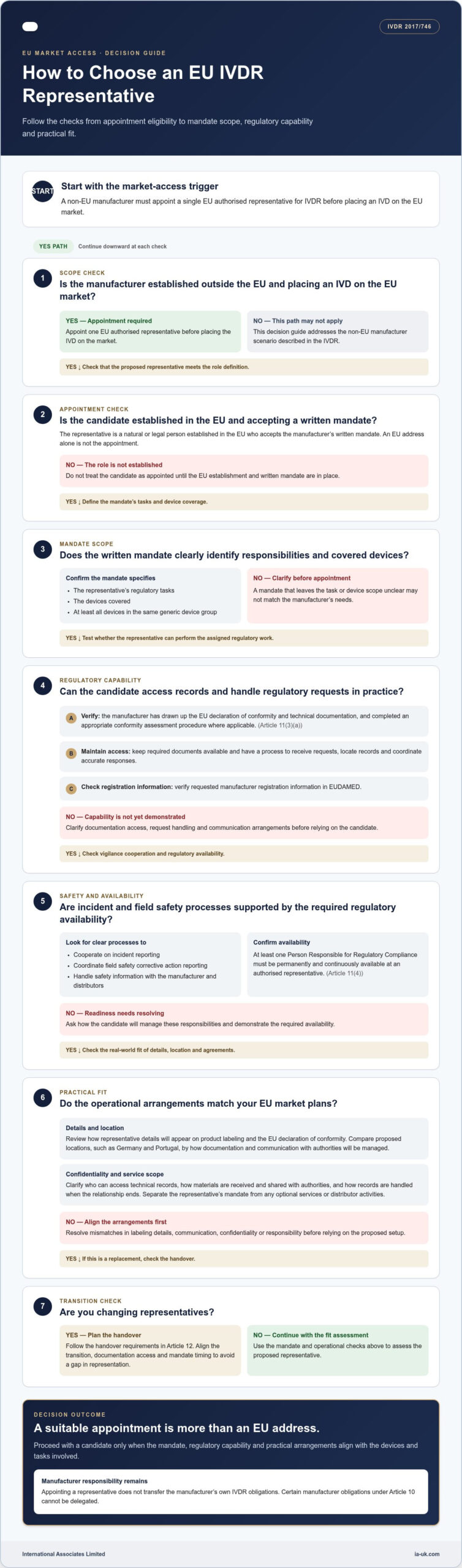
An EU address alone doesn’t establish that a representative is suitable for your IVD. Under IVDR 2017/746, a non-EU manufacturer must appoint a single EU representative for IVDR before placing its device on the EU market.
The appointment must also work in practice: the representative’s details, mandate and regulatory capability should match the manufacturer’s needs. Assess the address, labeling, qualifications and relevant experience.
This guide explains who needs representation and what to consider when choosing an EU-based partner. It covers the representative’s role, key documentation and how to assess experience for your EU market plans.
Key Takeaways
- Assess whether a representative can carry out the regulatory tasks in the written mandate, not simply provide an EU address.
- Review how the representative’s details will appear across product labeling and the EU declaration of conformity.
- Compare proposed locations, such as Germany and Portugal, by how the representative will manage documentation and communication with authorities.
- Look for relevant IVDR experience, regulatory expertise, and clear processes for handling technical documentation and vigilance matters.
- Plan representative changes around the handover requirements in Article 12, according to the European Union.
How Do I Find a Medical Device Representative in Europe?
For non-EU manufacturers, appointing an EU representative for IVDR is a condition of placing IVDs on the EU market. Assess the representative’s regulatory capability, documented responsibilities and practical arrangements for communicating with authorities.
Appointment Needs for Non-EU Manufacturers
Under IVDR 2017/746, a manufacturer established outside the EU must appoint a single EU authorised representative before placing an IVD on the EU market. The appointment must be accepted through a written mandate that identifies the representative’s regulatory tasks.
This requirement applies to the manufacturer, not just to a distributor or importer handling the device. Without a valid appointment, the manufacturer has not met the IVDR market-access requirement. Appointing a representative does not transfer the manufacturer’s own obligations.
For example, a non-EU company preparing to supply an IVD to an EU importer needs to appoint its representative before placing the device on the market. The mandate must cover the relevant devices and at least all devices in the same generic device group.
Replacing a representative requires a planned transition. According to the European Union, a change of EU Authorised Representative should follow the handover requirements in Article 12. Align the transition, documentation access, and mandate timing to avoid a gap in representation.
The IVDR Representative Role
An EU authorised representative is a natural or legal person established in the EU who accepts a written mandate from a manufacturer outside the EU. Under IVDR Article 2(25), the representative acts on the manufacturer’s behalf for specified regulatory tasks. The mandate formalises the role and defines its scope.
This involves more than providing an EU postal address. The appointment assigns regulatory responsibilities to the representative, while the manufacturer retains its own obligations under the IVDR.
Before signing, ensure the representative can perform the assigned tasks and access the relevant technical documentation. The mandate should identify the devices it covers and set out practical communication arrangements, including how regulatory requests and safety information will be handled.
Failure to appoint an EU representative for IVDR means a non-EU manufacturer has not met the IVDR condition for placing IVDs on the EU market. Under Article 11(5), a representative may also be jointly and severally liable for defective devices if the manufacturer fails to meet its obligations.
Regulatory Communication and Responsibilities
The representative acts as a regulatory contact between the manufacturer and EU Competent Authorities. This channel supports communication when an authority requests records, seeks clarification or requires cooperation concerning a device.
Under Article 11(3)(a), the representative must verify that the manufacturer has drawn up the EU declaration of conformity and technical documentation, and completed an appropriate conformity assessment procedure where applicable. Verification does not transfer responsibility for creating compliant records.
Article 11(3) sets out mandatory representative tasks, which must be specified in the mandate. These include keeping required documents available and verifying requested manufacturer registration information in EUDAMED. The representative needs processes for receiving requests, locating records, and coordinating accurate responses.
The representative also cooperates with the manufacturer and distributors on incident and field safety corrective action reporting. Under Article 11(4), specified manufacturer obligations under Article 10 cannot be delegated. The European Union requires at least one Person Responsible for Regulatory Compliance to be permanently and continuously available at an authorised representative.
EU Authorized Representative: who needs one?
Once the appointment requirement is clear, compare the service scope, confidentiality arrangements and commercial terms. These details determine how the representative will support the manufacturer beyond accepting the mandate.
Additional representation services
A representative’s core regulatory tasks are distinct from optional support services. The mandate can define the required responsibilities, while a separate service agreement can set out additional activities and communication arrangements.
Assess each proposed service against your device’s regulatory needs. For example, a representative may assist with device or IVD registration when required, coordinate incident and field safety corrective action reporting, or review labeling and technical documentation. Clarify who performs each task, what information they need and how regulatory requests will be handled.
A distributor may support commercial supply, but that role does not automatically include the representative’s regulatory responsibilities. If one organization is proposed for both roles, distinguish distributor activities from the authorised representative’s mandate and assigned services. This clarifies accountability when a corrective action or authority request arises.
Confidentiality and information handling
Representation involves access to sensitive technical documentation, conformity records and regulatory correspondence. Before signing, review the agreement’s confidentiality provisions and identify which personnel can access those materials.
Practical safeguards should explain how documents are received, stored, shared with competent authorities, and returned or retained when the relationship ends. For example, establish an approved contact list and a controlled process for sending updated technical files. These arrangements help prevent outdated records from being used in regulatory communications.
Confidentiality arrangements must also support the representative’s mandate. The agreement should allow required information to reach authorities when the representative performs its assigned duties. A blanket restriction on disclosure would conflict with that purpose.
Evaluating services and pricing
Compare proposals by scope, not just by the headline fee. Check whether the quoted arrangement covers mandatory representation alone or also includes documentation review, registration assistance, vigilance coordination or scheduled regulatory communication.
Pricing depends on the case and is provided after a quote request. Relevant factors include the number and complexity of devices, the documentation involved and any additional services. Ask for these elements to be itemised in the proposal so you can compare the mandate and service agreement consistently.
Before accepting a proposal, assign each service to a responsible party: manufacturer, representative or distributor. Confirm that the mandate covers the relevant devices and supplementary work has a defined scope. To compare services, review the EU and UK authorised representative service alongside the regulatory tasks your organisation needs covered.
EU-REP labeling and declaration of conformity
The IVDR authorised representative’s details must appear in specified product information and the EU declaration of conformity. Unlike an importer or distributor, the representative acts under a written mandate covering defined regulatory tasks.
Keep the representative’s name and address consistent across the device’s labeling and conformity records. Their placement and format affect how users and authorities can identify the representative.
Representative and Importer Details on Labels
Representative labeling identifies the EU-based representative by name and address on the product label, outer packaging and/or instructions for use. This links the device to the representative named in the manufacturer’s mandate.
Plan these details as part of the physical labeling process. Compare the final artwork with the mandate and device documentation, then confirm that the representative’s name and address match exactly. Importer details identify a separate economic operator and should not be presented as the representative’s information.
DIN EN ISO 15223-1:2022-02 specifies the authorised representative symbol. Apply the symbol and accompanying details consistently, so the role is clear on the relevant materials. International Associates Limited recommends placing the representative’s name and address directly on the physical device label rather than relying only on digital labeling.
Representative Details in Declarations of Conformity
The EU declaration of conformity must include the authorised representative’s information. This identifies the representative associated with the manufacturer’s conformity declaration and helps maintain consistency between the declared device and its labeling.
Before issuing or updating the declaration, compare the representative’s legal name and address with the mandate and labeling artwork. For example, if the mandate names one legal entity but the declaration lists another, the records do not clearly identify the appointed representative.
Instructions for use may also include the representative’s details, but this is recommended rather than mandatory. Treat the declaration as a required record and the instructions as an additional place to help users identify the correct contact.
Representative, Importer, and Distributor Roles
The authorised representative acts for a non-EU manufacturer under a written mandate, while an importer and distributor perform distinct roles in the supply chain. This distinction matters because labeling one operator does not identify or replace another.
The representative’s name and address belong to its specific role. An importer’s details should be recorded separately where applicable, and distributor activities should not be confused with the representative’s regulatory responsibilities. For clinical investigation reporting, IVDR Article 76 addresses recording and immediate notification of serious adverse events to competent authorities.
Use a final labeling review to compare each named operator with its actual role, the mandate and the declaration of conformity. EU and UK authorised representative information can help clarify the regulatory role when reviewing those records.
Choosing an EU representative address in Germany or Portugal
Germany and Portugal can both provide an EU location for representation, but the country name alone does not establish suitability. Compare the representative’s actual establishment, ability to fulfil its mandate and practical arrangements for handling technical records and authority communications.
Establishment matters more than the country label
The representative must be established in the European Union. A letterbox company is not sufficient: the representative needs a genuine physical presence to perform its role. Apply the same test to an address in Germany or Portugal. Assess whether the named legal person operates from that location and can fulfil its assigned obligations.
For example, a German address should identify the representative signing the mandate, not merely a mailing contact. Apply the same check to a Portuguese address. Before the appointment takes effect, match the legal name and address across the mandate, product information and regulatory records.
Compare operational fit, not market access
The representative’s EU country does not determine where the manufacturer may market a compliant device. CE marking is valid across the 27 EU Member States, as well as Iceland, Liechtenstein, and Norway, regardless of the representative’s EU location.
Choosing Portugal over Germany, or Germany over Portugal, should therefore depend on how the representative will perform its work. Consider the manufacturer’s communication needs, the representative’s access to technical documentation and its process for receiving requests from competent authorities. These practical factors matter more than assuming one address provides broader market access.
A manufacturer whose records are maintained by teams in several countries can compare how each proposed representative will receive, organize and provide access to those materials. The key question is whether the established representative can fulfil its mandate through a workable communication process.
Check address consistency and regulatory readiness
Review the documentation to assess the proposed address before finalizing the labeling. Compare the representative’s legal name and address in the written mandate with the details prepared for the device label, outer packaging or instructions for use. A mismatch can make it unclear which legal entity has been appointed.
Next, confirm the representative’s operational arrangements for authority correspondence and access to required documents. Consider EUDAMED registration and technical documentation in light of the representative’s assigned responsibilities. The manufacturer should keep a clear record of who receives authority requests and coordinates responses.
In practice, select the German or Portuguese address only after connecting it to an established representative, a defined mandate and workable document-handling arrangements. The European Union recognizes the representative’s EU location for this role. The manufacturer’s decision should focus on execution, not the country name alone.
Representative qualifications and IVDR experience
An EU address establishes location, not regulatory competence. Assess the representative’s qualifications through documented IVDR experience, clear procedures and evidence that its staff can perform the mandate’s tasks.
Assess relevant regulatory knowledge
Look for demonstrated experience with IVDR 2017/746, rather than familiarity with medical-device rules alone. IVDs have specific conformity and documentation requirements, so relevant examples should involve in-vitro diagnostic devices and the regulatory processes that apply to them.
ISO 13485 certification is a useful qualification to assess, alongside direct experience with the IVDR and the EU MDR. Treat certification as one indicator, not proof by itself that the representative can manage your device’s particular regulatory profile.
Ask for a clear explanation of how the representative handles its assigned work. For example, can it describe how it reviews technical documentation, checks conformity records and responds to an authority request? Specific procedures and responsibilities are more informative than broad claims of expertise.
Test practical IVDR experience
Relevant experience should connect regulatory knowledge with operational tasks. Consider whether the representative understands EUDAMED registration obligations, document access, labeling review and communication with competent authorities. These examples help show whether its experience matches the work required by your mandate.
Use a sample scenario to assess its response process. If an authority requests a device’s technical documentation, the representative should explain who receives the request, how the relevant records are located and how communication with the manufacturer is coordinated.
Vigilance experience matters too. Ask how the representative works with the manufacturer and distributors on incident reporting and field safety corrective actions. A defined process helps show whether the representative understands the link between regulatory communication and device safety activities.
Check capacity, accountability, and fit
Review who will handle your account and how responsibilities are assigned. The European Union requires an authorised representative to have at least one Person Responsible for Regulatory Compliance who is permanently and continuously available. Ask how this role is reflected in the representative’s operating arrangements.
Assess whether the representative can manage your device portfolio, documentation and expected authority interactions. A manufacturer with several IVD types may need a representative whose experience reflects the technical and regulatory differences among those devices.
Document the agreed tasks in the mandate and related service arrangements. The representative can be jointly and severally liable for defective IVDs if the manufacturer fails its obligations under IVDR Article 11(5). Clear responsibilities and proven IVDR experience therefore matter when evaluating the appointment.
For support with representative arrangements and regulatory responsibilities, review EU and UK authorised representative services.
International Associates Limited: Social Accountability Audits
International Associates Limited provides Social Accountability Audits for organisations assessing workplace practices and social accountability requirements. This is separate from IVDR representative responsibilities, but may be relevant if your business also needs an independent assessment of its social performance.
Organisations strengthening broader management systems may also consider ISO 9001 Quality Management System Certification, ISO 14001 Environmental Management System Certification, or ISO 45001 Occupational Health and Safety. These services address distinct organisational standards and should be considered according to the systems the organisation intends to have assessed.
For organisations seeking an independent audit or certification assessment alongside regulatory planning, International Associates Limited offers a relevant next step. Contact International Associates Limited to discuss Social Accountability Audits or the applicable certification service.
Make Your Next Compliance Decision Deliberately
Choosing an EU representative for IVDR can be part of a broader market-readiness plan. As you move from selection to implementation, keep regulatory representation separate from other assurance needs. This helps your organisation assign each activity to the right process and maintain clear accountability as plans develop.
International Associates Limited offers Social Accountability Audits, ISO 9001 Quality Management System Certification, and ISO 14001 Environmental Management System Certification. These services address separate organisational assurance objectives; they are relevant when your organisation is also assessing social accountability, quality management, or environmental management.
Consider which assurance priorities align with your organisation’s current objectives, then take the next step at a pace that suits your planning. Contact International Associates Limited to discuss its audit and certification services. A clear, well-scoped plan can support confident progress.
Frequently Asked Questions
How has Brexit affected representation requirements for device companies selling in the UK and the EU?
Companies serving both markets need to plan their regulatory coverage separately. Following the UK’s departure from the European Union, a UK Responsible Person is required for sales in the UK, while EU market access requires an EU-based representative for manufacturers established outside the EU. Treat the UK and EU as separate destinations in product planning, and review representative details and labeling for each market whenever a device’s commercial route changes.
What Does the Process Look Like Once You Have Selected a European Representative?
After selection, coordinate the appointment with practical implementation. Set named contacts for regulatory requests, define how current records will be shared, and align labeling updates with the representative’s details. For an existing appointment being replaced, plan the handover under Article 12 and coordinate the outgoing and incoming representatives. Keep a dated record of the transition and confirm that relevant product information reflects the change before using revised materials.
What does the representative verify and maintain?
The representative’s document-control process should keep the current declaration of conformity, technical documentation, and applicable certificates identifiable and available for authority inspection. For IVDs, the required retention period is 10 years after the last device covered by the declaration has been placed on the market, or 15 years for implants. Manufacturers should therefore agree how document versions and market-placement records will be tracked throughout the retention period.
What are the IVDR authorized representative’s responsibilities and liabilities?
The representative performs the regulatory tasks assigned to it and cooperates with authorities, but it does not assume every manufacturer obligation. Article 11(5) makes the representative jointly and severally liable for defective IVDs when the manufacturer has failed to meet its obligations. The manufacturer must also establish measures for sufficient financial coverage of potential liability under IVDR Article 10(15). The mandate should support clear escalation when compliance concerns arise.
What qualifications and establishment requirements apply to an IVDR authorized representative?
The representative must be established in the European Union and have at least one Person Responsible for Regulatory Compliance who is permanently and continuously available. Competent authorities may inspect the representative’s understanding of its role, access to client documentation and processes for meeting its obligations. When reviewing a proposed arrangement, consider whether its operating procedures and document access can support an inspection, not just whether its stated address is within the EU.
How do manufacturers appoint an EU authorized representative under IVDR?
Appointment is made through a written mandate accepted by the representative. Define the covered devices and assigned tasks in that mandate, then ensure its scope includes at least all devices in the same generic device group. The representative’s details must also be registered in EUDAMED under the applicable economic-operator provisions. If the manufacturer changes representatives later, Article 12 handover requirements apply to the transition.
What documents and information must the manufacturer provide to its EU authorized representative?
Provide the records required to perform the mandate, including the EU declaration of conformity, technical documentation, applicable conformity assessment records and relevant certificates. Include current device identification and registration information, as well as contacts responsible for regulatory correspondence and vigilance coordination. Establish a process for notifying the representative when records change. Version dates and a controlled document index help distinguish current files from superseded material during authority requests or handovers.