
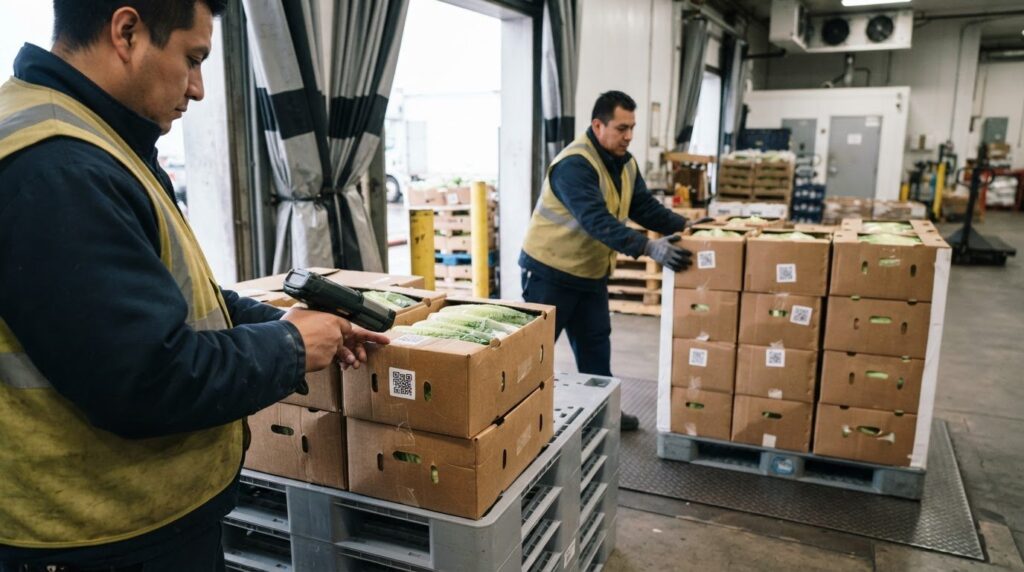
A traceability system can fail its purpose if records can’t connect a food lot to the events and businesses that handled it. The food traceability system requirements under FSMA Section 204 call for records tied to critical tracking events, a traceability plan, and retention of required records for up to two years from the date they were created or obtained, according to the U.S. Food and Drug Administration.
It’s reasonable to focus first on how long records must be kept, but retention is only one part of readiness. The FDA may request key data elements in an electronic spreadsheet within 24 hours or within a reasonable amount of time, and the traceability plan is required under 21 CFR § 1.1315, according to the Electronic Code of Federal Regulations. This guide explains which records, lot codes, supplier and location details, and plan elements matter, how the requirements relate to different supply-chain events, and what to consider when organizing records for retrieval.
Key Takeaways
- Map the covered foods and supply-chain activities first, then identify which critical tracking events create recordkeeping duties.
- Connect each traceability lot code to the relevant product, supplier, location, and reference records so information can be followed through the supply chain.
- Retain required records for up to two years from the date they were created or obtained, according to the U.S. Food and Drug Administration.
- Prepare the traceability plan to describe how records are maintained and can support product removal when a food safety concern arises.
- Consider ISO 22000 Food Safety Management certification as a way to assess a food safety management system alongside regulatory recordkeeping.
Critical Tracking Events and Key Data Elements
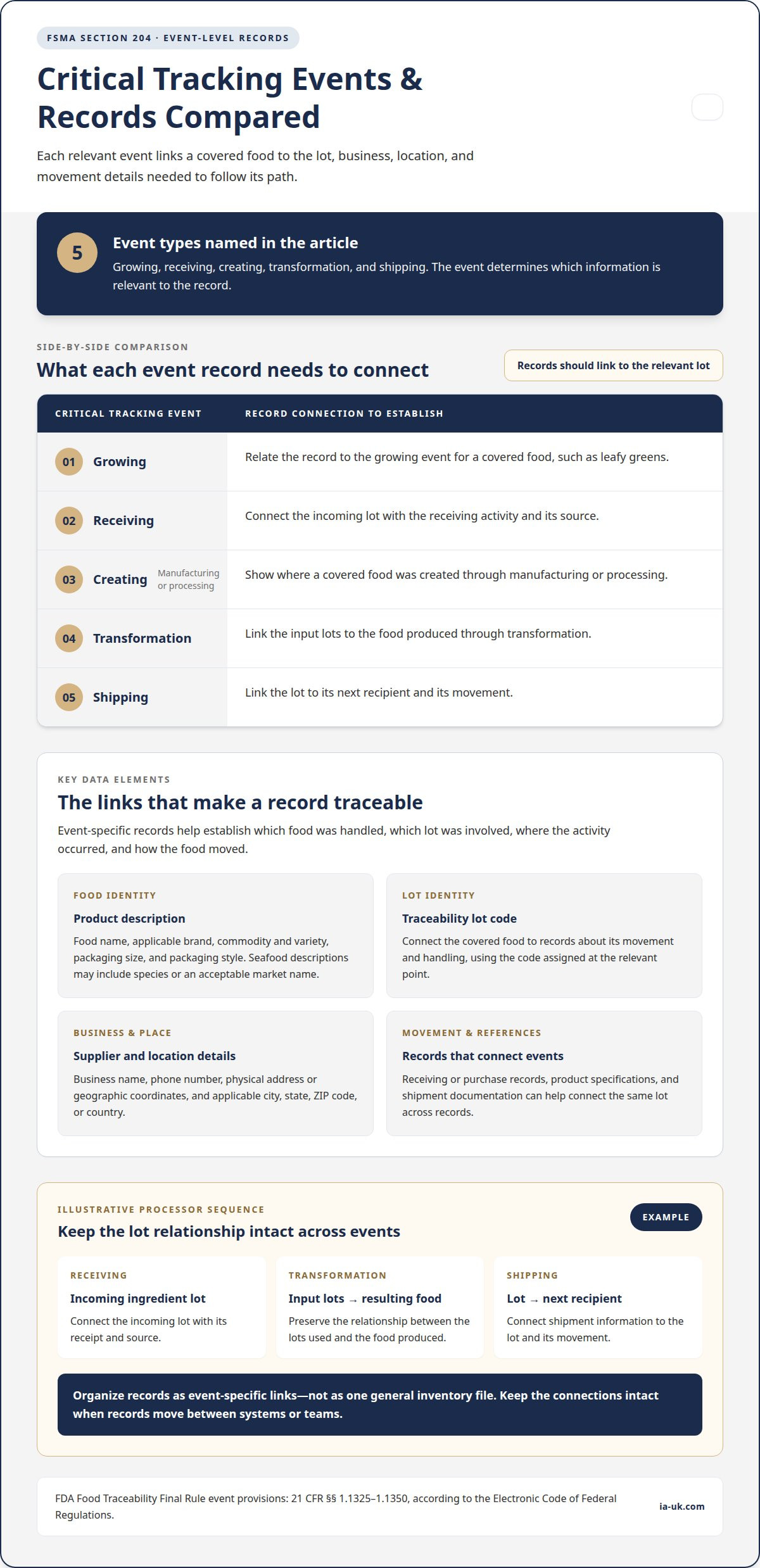
Critical tracking events identify points where covered foods enter, change, or move through the supply chain. The FDA Food Traceability Final Rule specifies these events in 21 CFR §§ 1.1325 through 1.1350, according to the Electronic Code of Federal Regulations. For covered persons handling Food Traceability List foods, records link key data elements to each relevant event. These links support the ability to track a product’s path.
The event determines which information is relevant. Growing, receiving, manufacturing or processing, transforming, and shipping are activities associated with traceability data. For example, receiving records connect a food lot to its incoming shipment, while transformation records link the resulting food to the lots used. Food traceability system requirements make these event-level connections central to effective tracking across the food industry.
- Growing: Records relate to the growing event for a covered food, such as leafy greens.
- Receiving: Information connects an incoming lot with the receiving activity and its source.
- Creating: Manufacturing or processing records show where a covered food was created.
- Transformation: Records connect input lots with the food produced through transformation.
- Shipping: Shipment information links a lot to its next recipient and movement.
Key data elements are details associated with each critical tracking event. They establish which food was handled, which lot was involved, where the activity occurred, and how the food moved. A lot code, product description, business identity, and location information can help establish those links. For instance, a receiving entry that identifies a product but cannot connect it to its lot or source provides less useful tracking information.
Think of the records as event-specific links, not as one general inventory file. A processor receiving a covered ingredient needs records that connect the incoming lot with its receipt. If the ingredient is transformed, records should preserve its relationship to the resulting product. A later shipment adds another traceable event. This structure helps personnel identify relevant records during a food safety inquiry.
To comply, map each activity involving a covered food to the corresponding event, then identify the data elements that document it. Keep links between events intact when records move between systems or teams. Food traceability system requirements are easier to apply when staff can use records to follow a specific lot backward to its source and forward through subsequent handling.
Traceability Lot Codes, Supplier Information, and QR Codes
A traceability lot code connects a covered food to records about its movement and handling. Under 21 CFR § 1.1340, a person shipping a traceability lot of a Food Traceability List food must maintain records linking specified information to that lot. The code’s source depends on the food and activity: it is assigned when most raw agricultural commodities are initially packed, when a first land-based receiver receives food from a fishing vessel, or when food is transformed.
Supplier records help establish where a lot came from and which business handled it. Location details include the business name, phone number, physical address or geographic coordinates, city, state, and ZIP code for a domestic location. For a foreign location, comparable information includes the country. A product description identifies the food name, applicable brand, commodity and variety, packaging size, and packaging style. Seafood descriptions may include the species or acceptable market name.
For each shipped lot, connect the code with clear supplier, product, and movement records. A useful reference set might include a purchase or receiving record, a product specification, and shipment documentation. These examples support record organisation; the required data depend on the applicable event and rule provision.
- Lot code: Identify the code assigned at the relevant packing, receiving, or transformation point.
- Supplier: Link the source business to its location details and the food received.
- Product: Match the food description to its commodity, variety, brand, and package details.
- Reference records: Connect receiving and shipping documentation to the same lot identifier.
- Recipient: Provide specified information to the immediate subsequent recipient, excluding a transporter.
QR codes can make a lot identifier easier to scan and associate with digital records. For example, a code on a case label could open an internal record containing the supplier, product description, and shipment references. The QR code is a practical technology choice, not a substitute for maintaining the required information. The FDA Food Traceability Rule does not require a specific format or technology for maintaining and sharing records with restaurants.
When implementing traceability technology, preserve a reliable link between the printed or scanned code and the underlying records. Test a sample lot across receiving, transformation, and shipping entries. Confirm that the code leads staff to the right supplier and product information, rather than merely to a general inventory page. This supports consistent tracking across the supply chain and keeps records tied to the applicable food traceability list requirements.
FSMA Section 204: Who Must Follow the Food Traceability Rule?
FSMA Section 204, also called FSMA 204, established additional traceability rules for certain foods in the supply chain. Coverage depends on the food handled and the business’s activities, not simply its industry label.
Food Traceability Rule Scope
The Food Traceability Final Rule covers people who manufacture, process, pack, or hold foods on the FDA’s Food Traceability List. The list includes categories such as leafy greens, certain cheeses, shell eggs, finfish, crustaceans, and specified fresh produce.
This scope matters because handling a listed food can trigger recordkeeping for relevant critical tracking events under the Food and Drug Administration’s rule. The threshold does not, by itself, describe every coverage condition or exception. Businesses should assess both the food category and their role in handling it.
Section 204(d) addresses traceability lot codes for listed foods. The code links relevant records to the lot as it moves through supply-chain events. A business handling both covered and other foods should distinguish the listed products and associated records, rather than assume one general process determines coverage.
Risks and Penalties for Noncompliance
The central risk of failing to meet traceability requirements is being unable to produce records that demonstrate a covered lot’s movement and handling. In a food safety inquiry, gaps can also hinder identification of affected products and the records needed to trace them.
The requirements specify recordkeeping and FDA access, but the facts stated here do not establish a particular penalty amount. Businesses should treat missing records as a compliance exposure and an operational risk, especially when a request concerns a specific lot or product.
The FDA may request a copy of Key Data Elements in an electronic spreadsheet within 24 hours or within a reasonable amount of time, according to the U.S. Food and Drug Administration. The FDA Food Traceability Final Rule requires covered businesses to maintain Key Data Element records for up to two years, according to the U.S. Food and Drug Administration. The FDA Food Traceability Final Rule also requires a traceability plan under 21 CFR § 1.1315, according to the Electronic Code of Federal Regulations.
These requirements make record access and plan coverage practical compliance considerations. A business should be able to connect its covered foods, activities, lot records, and plan procedures. A restaurant, for example, needs to determine whether its foods and sales circumstances place it within the rule’s scope, then organise applicable records for retrieval. A manufacturer must likewise identify listed foods and the events associated with its operations.
How to Get Started: Traceability Plans and Product Removal
The Food Safety Modernization Act was signed into law in 2011, establishing a stronger focus on preventive food safety. A traceability plan turns recordkeeping into an operational process: it documents how a business identifies covered foods, captures relevant data, and responds when a lot requires review or removal.
Begin by mapping the foods and activities handled at each facility. A company receiving, transforming, and shipping a listed food should document each activity and assign responsibility for keeping its records connected. This initial map identifies where information enters the system and where gaps could disrupt product tracking.
- Identify covered foods: Compare products handled with the Food Traceability List, then record relevant product descriptions.
- Map activities: List each applicable event, such as receiving, transformation, or shipping, at each location.
- Assign record ownership: Name the role responsible for entering and maintaining records for each activity.
- Document record links: Connect lot identifiers to supplier, product, and movement information.
- Test retrieval: Select a sample lot and trace its records through the documented process.
A useful plan describes the system in terms employees can apply during routine work. It can identify the records used at each event, where those records are stored, and how staff retrieve them. For example, a receiving procedure can explain how an employee associates a shipment record with its lot identifier. A transformation procedure can describe how input records connect with records for the resulting product.
Product removal depends on identifying the affected lot and the records that show its path. If a food safety concern involves a particular lot of fresh produce, staff can use linked receiving and shipment records to identify relevant product movements. The plan should define who coordinates the response, how the lot is distinguished from other inventory, and how related records are assembled. These are practical procedures, not a substitute for applicable regulatory duties.
Test the plan with a realistic scenario, such as a supplier notice involving one lot. Have the responsible team locate the associated records, identify affected product, and document the decisions made. Record any delays or unclear responsibilities, then revise the procedure. This exercise checks whether the plan works in practice, rather than merely existing as a document. A traceability plan should remain aligned with current products, facilities, and record systems.
Food Traceability Plan Requirements: A Practical Compliance Guide
A traceability plan connects food safety procedures with records used to follow covered products. The FDA Food Traceability Final Rule requires a plan under 21 CFR § 1.1315, according to the Electronic Code of Federal Regulations. A practical way to apply food traceability system requirements is to document relevant activities, responsibilities, and record access in the plan.
Start by describing how the operation handles foods on the Food Traceability List. A seafood business, for example, can map how it receives fish from a vessel, processes or holds it, and ships it onward. For each activity, the plan can identify responsible people and explain where associated records are maintained. This operational detail helps staff use the plan during routine work and investigations.
A useful plan can organise procedures around these practical elements:
- Covered products: Identify listed foods handled at each facility, such as finfish or fresh leafy greens.
- Activities: Map relevant critical tracking events, including receiving, transformation, and shipping.
- Record connections: Explain how lot identifiers link to product, supplier, location, and movement information.
- Record maintenance: Describe where records are stored, who maintains them, and how authorised staff retrieve them.
- Response roles: Assign responsibility for locating affected lots and coordinating product removal procedures.
Keep the plan aligned with actual operations. If a seafood processor adds a product line or changes how it receives fish, the documented process should reflect that change. Staff should be able to identify which records support each activity and how those records connect. Reviewing food traceability system requirements against current products and procedures helps identify outdated plan details.
For a suspected contaminated product, the plan should support a controlled response. Staff can identify the lot in question, locate records showing its receipt or creation, and trace relevant shipments. The process should also define who coordinates decisions and how findings are documented. These steps help distinguish potentially affected product from unrelated inventory.
Test the written procedures against a realistic example, such as a supplier notice involving one seafood lot. Record how staff locate relevant documents, identify product movements, and escalate the issue internally. Unclear responsibilities or missing record connections indicate where the plan needs refinement. The practical takeaway is to organise the plan around real products, events, records, and response roles.
International Associates Limited: ISO 22000 Food Safety Management
International Associates Limited provides ISO 22000 Food Safety Management certification for organisations seeking independent assessment of their food safety management systems. This can be a relevant next step when a business wants its management system assessed against an international standard while separately addressing applicable FSMA Section 204 recordkeeping duties.
Certification and regulatory compliance serve related but distinct purposes. A traceability plan documents how covered foods and records are handled under the FDA rule; ISO 22000 certification assesses whether an organisation’s food safety management system meets the standard’s requirements. Certification should not be treated as a substitute for required traceability records, lot-code links, or a compliant plan.
Consider ISO 22000 certification when your organisation is formalising food safety controls across its operations or seeking independent verification of its management system. The assessment follows the requirements of the specific standard. Formal stage 1 and stage 2 audits are used to verify whether an organisation meets those requirements. The outcome depends on the audit evidence and the applicable standard, not simply on having written procedures.
For a food business, this distinction can help define the right next step. If the immediate gap is that staff cannot connect a covered lot to its supplier or shipment records, the priority is to address traceability processes and documentation. If the broader need is independent assessment of the food safety management system, ISO 22000 certification is relevant. A business may need both forms of work, but one does not replace the other.
International Associates Limited also provides Social Accountability Audits, ISO 9001 Quality Management System Certification, and ISO 14001 Environmental Management System Certification. These offerings address different assessment needs; for food safety management system certification, ISO 22000 Food Safety Management certification is the directly relevant option. Identifying the intended scope and applicable standard helps keep the assessment focused on the organisation’s requirements.
If independent assessment of your food safety management system is the next step, contact International Associates Limited to discuss certification.
Frequently Asked Questions
How long must I keep the records required by the rule?
Keep required records for up to two years from the date they were created or obtained, according to the U.S. Food and Drug Administration. To apply this consistently, record the creation or receipt date with each file and use it to determine its retention period. A schedule based on individual record dates helps prevent premature deletion when records from separate transactions are stored together.
What are the FDA food traceability requirements under FSMA 204?
FSMA 204 applies additional traceability recordkeeping to covered persons handling foods on the Food Traceability List. The practical first decision is whether the food and the organisation’s activity fall within the rule’s scope. Then identify the records associated with the operation, such as receiving or shipping documents, and make sure staff can retrieve the relevant material for a particular product rather than searching general files.
What key data elements and critical tracking events must food businesses record?
Covered records link key data elements to applicable events, including growing, receiving, creating, transformation, and shipping. The exact details depend on the event and food. For implementation, use a consistent record layout that identifies the event, product, lot, location, and related source documents where applicable. This helps personnel distinguish an event record from a general inventory entry that lacks lot-level context.
How long must traceability records be kept, and how quickly must they be provided to the FDA?
Required records are retained for up to two years from their creation or receipt, according to the U.S. Food and Drug Administration. The FDA may request Key Data Elements in an electronic spreadsheet within 24 hours or within a reasonable amount of time, according to the same agency. A useful readiness measure is whether staff can export the requested information without manually rebuilding it from separate systems.
What lot code and traceability plan requirements apply to covered foods?
Lot-code requirements depend on the food and the event that establishes the lot. The code may originate at initial packing for most raw agricultural commodities, first land-based receipt of food from a fishing vessel, or transformation. A traceability plan is required under 21 CFR § 1.1315, according to the Electronic Code of Federal Regulations. Keep internal procedures clear about which event creates or assigns each applicable code.
How do food traceability requirements differ for manufacturers, processors, distributors, and retailers?
The applicable records depend on the activities each business performs, not just its job title. A company that both processes and distributes covered foods may need to account for records from both stages. Retailers should assess the foods they hold and their circumstances under the rule. A practical review separates facilities, product categories, and activities so one location’s process is not assumed to cover another’s.
What records and traceability rules apply to imported food in the United States?
For imported food, assess whether the product is on the Food Traceability List and identify the U.S. business’s role in receiving, holding, processing, or shipping it. Foreign supplier location records use comparable identifying information and include the country. Keep supplier documents associated with the relevant product and transaction so staff can distinguish the actual source from an importer, broker, or other intermediary in the supply chain.
What technology and software options are used for food traceability, and how do their costs compare?
Businesses can use paper records, electronic files, or software, since the FDA Food Traceability Rule does not prescribe one technology format. Compare options by whether they connect lot-level records across the organisation’s actual workflows and support useful retrieval. Costs vary with implementation scope, existing systems, integration needs, and ongoing maintenance, so a meaningful comparison starts with the operation’s requirements rather than a generic price estimate.