

Export access depends on more than holding a Halal certificate. Halal audits help businesses assess whether their ingredients, production controls, traceability records and corrective actions support the requirements of their target markets. Certification requirements can differ by destination, including Indonesia and Gulf markets.
For exporters, the practical challenge is showing that Halal controls work throughout production, not just at final inspection. Shared equipment, supplier changes and incomplete records can make it harder to demonstrate separation and compliance.
This guide explains what an audit typically examines, how to prevent cross-contamination, how to prepare records and how to address findings. Export plans should shape audit preparation because the destination market, product type and production process affect which controls and evidence matter. This gives businesses a clearer way to assess readiness and identify where to strengthen their Halal system.
Key Takeaways
- Align audit preparation with the destination market, since Halal requirements can differ between export destinations.
- Assess how ingredients, shared equipment, cleaning procedures and staff practices are controlled to prevent cross-contamination.
- Organise traceability records, supplier evidence and training documentation so they support the controls used in production.
- Turn audit findings into corrective actions with clear responsibilities, documented steps and follow-up evidence.
- Use the audit scope to identify whether physical separation, documented procedures or both need strengthening before export.
2. Cross-contamination prevention
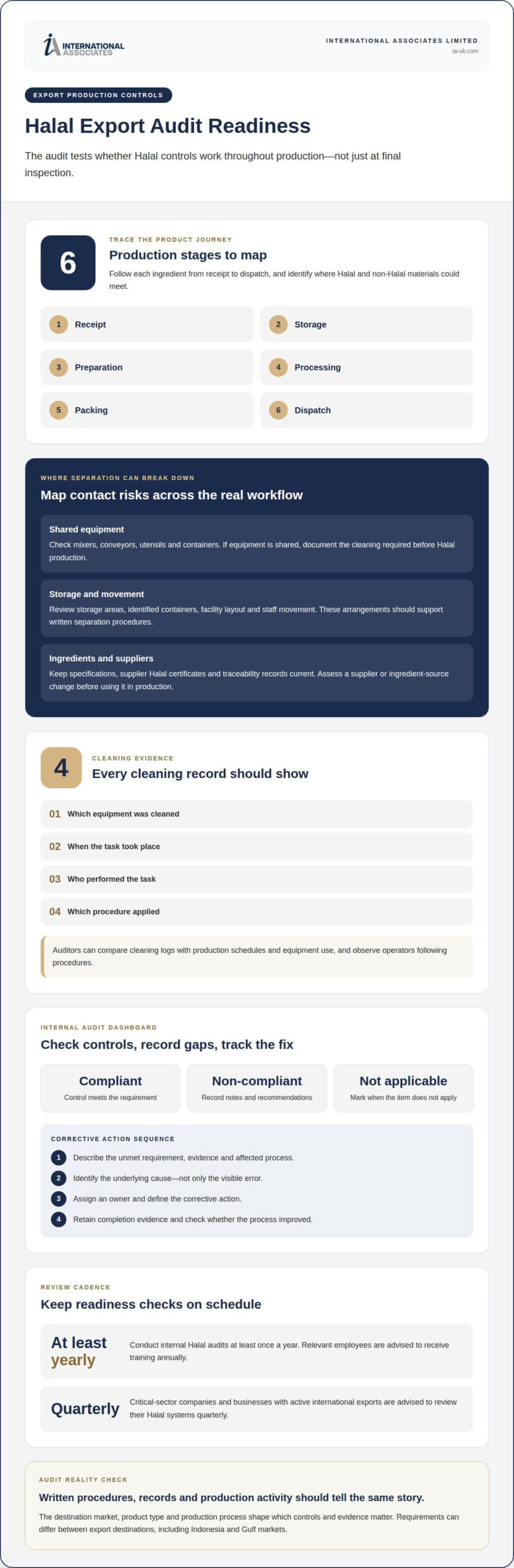
Preventing cross-contamination starts with identifying where Halal and non-Halal materials could meet. Trace each ingredient from receipt through storage, preparation, processing, packing and dispatch. Map shared mixers, conveyors, utensils, containers and staff movement. Halal audits assess traceability, contamination controls and safeguards across manufacturing stages.
Use dedicated production lines where the facility can maintain them. If equipment is shared, document cleaning procedures that must be completed before Halal production begins. Specify the equipment, cleaning method, responsible role and required records. During Halal audits, auditors can compare procedures with cleaning logs and observe operators following them during production.
Physical controls should reflect the actual production layout. Separate storage areas, clearly identified containers and controlled movement can reduce accidental contact. For example, a manufacturer can label ingredient bins and assign specific storage locations. Facility layouts help auditors assess whether these arrangements support written separation procedures.
Supplier and ingredient controls matter too. Keep ingredient specifications, supplier Halal certificates and traceability records up to date. When a supplier changes an ingredient or its source, assess the change before using it in production. Halal audits can examine how purchasing decisions connect with product records, including how teams identify affected batches if an ingredient’s status changes.
Cleaning evidence should show more than a completed form. Record the equipment cleaned, when the task took place, who performed it and which procedure applied. Auditors compare these records with production schedules and equipment use. A mismatch between a cleaning log and the production sequence may indicate a control failure that needs investigation.
Staff practices are another operational control. Train relevant employees on the Halal requirements for their roles, including contamination prevention, product handling and documentation. Companies are advised to train relevant staff annually. A practical exercise could ask operators to identify designated utensils and explain how they record a cleaning step.
Internal audits help test whether controls work between certification visits. Businesses should conduct internal Halal audits at least once a year, using a checklist to mark each item compliant, non-compliant or not applicable. Record detailed notes and recommendations for non-compliant items, then assign corrective actions and retain evidence of completion.
For food processing, ISO 22002-1 is listed as a prerequisite-program standard. It can help frame operational hygiene controls alongside Halal-specific procedures. Organisations can connect documented responsibilities with broader management system certification practices, including controlled records and assigned procedures. Halal audits still need to assess Halal ingredients and handling directly.
3. Initial audit stages and corrective actions
Common reasons for failing a Halal audit include incomplete ingredient records, weak supplier controls, ineffective separation and gaps in staff training. An unverified animal-derived ingredient, for example, can undermine evidence that a product meets Halal requirements. Missing cleaning logs or inconsistent handling instructions can also show that controls are not applied consistently.
To prepare, map the product process from ingredient receipt through dispatch, then organise records for each stage. Pharmaceutical files may include ingredient specifications, process flowcharts, supplier Halal certificates and facility layouts. Assign an owner to each record so staff can retrieve current documents and explain how the system works.
The initial review establishes the audit scope and examines relevant procedures and records. The auditor then compares documented controls with activity on site, including ingredient receipt, storage, processing and packing. For example, if a flowchart shows a dedicated route, a site walk-through can establish whether production follows it.
Prepare staff to explain their actual tasks rather than memorise general statements. A receiving employee should describe how incoming ingredients are identified and recorded. Production staff should explain the handling procedures relevant to their work. Employees need instruction on Halal requirements, contamination prevention and documentation. Halal audits can test whether this knowledge matches written procedures.
Audit findings should identify the unmet requirement, supporting evidence and affected process. Record detailed notes and recommendations for every non-compliant checklist item. Then identify the cause, assign an owner, define the corrective action and retain evidence of completion. For example, a missing supplier certificate may require obtaining the document and improving reviews of purchasing records.
Corrective action should address the underlying cause, not just the visible error. If an operator used an outdated form, replacing it may not prevent the problem from recurring. Review document control, remove obsolete copies, brief relevant staff and examine later records to confirm they use the current version. This helps show whether the response improved the process.
Internal audits help identify gaps before external assessment. Businesses should conduct internal Halal audits at least once a year, record non-compliant findings and track actions through to completion. Critical-sector companies and businesses with active international exports are advised to review their Halal systems quarterly.
Where readiness depends on staff capability, role-specific instruction can strengthen implementation. Lead auditor training can build understanding of audit methods and evidence review, but it doesn’t replace Halal-specific operational training. Teams can explore lead auditor training when developing internal audit competence.
4. Physical and documented separation of Halal and non-Halal production
Separation is effective only when the facility layout and records describe the same controls. Start with a site plan showing the movement of Halal ingredients, non-Halal materials, equipment and finished goods. An auditor can compare the plan with actual production routes. If a product crosses a shared area, document how its identity remains controlled.
Dedicated rooms or production lines can provide clear physical separation where the facility supports them. Shared spaces require defined controls for storage, handling, scheduling and equipment use. For example, assign marked locations to Halal materials and identify containers by product name and status. Staff should be able to follow those identifiers during receiving, production and dispatch.
When production equipment is shared, the documented procedure should identify the equipment and the transition between product runs. Record the cleaning activity, the person responsible and the production sequence. During an audit, compare these records with batch documents and schedules. A mismatch, such as a cleaning record dated after production began, needs investigation.
Documentary separation also depends on keeping product records distinct and traceable. Use batch or lot identifiers to connect ingredient records, production steps and finished-product dispatch documents. For example, a batch record should link the product to its ingredients and relevant supplier evidence. This lets an auditor trace a sample product through the records without relying only on staff explanations.
Control document versions as carefully as physical labels. The current facility layout, approved procedure and staff work instructions should describe the same separation method. If a production area changes, revise the layout and affected instructions before relying on them. Obsolete copies can lead operators to follow an earlier route or storage arrangement.
Auditors assess conformity by comparing written controls with observed practice and sampled records. They may trace a product from receiving to dispatch, then check whether its identifiers remain consistent. They can also compare staff explanations with the relevant procedure. Differences between the documented system and activity on the production floor may indicate that controls need revision or clearer implementation.
Keep evidence proportionate to the process. A facility using separate lines should show which products use each line and how the arrangement is maintained. An operation using shared areas should document transition controls and product identification. Neither a floor plan alone nor a collection of forms proves separation. Evidence must match the product, workflow and actual operating conditions.
Halal-certified pharmaceutical manufacturers should prevent cross-contamination through strict separation, dedicated production lines or thorough cleaning of shared equipment, regular internal audits and Halal compliance training.
5. Halal audits for export-focused businesses
Export planning should start with the destination, not a generic certificate checklist. Halal certification requirements can differ by destination country, including Indonesia and Gulf markets. Identify each target market, product category and applicable certification expectations before finalising the audit scope. This helps the team focus on evidence relevant to its intended export route.
How often are Halal audits required? Businesses should conduct internal Halal audits at least once a year. Critical-sector companies and businesses with active international exports are advised to review their Halal systems quarterly.
Turn that quarterly review into a practical export-readiness check. Compare products intended for each market with the certificate scope and current production controls. For example, if an exporter adds a product variant, assess its ingredients, manufacturing route and supporting records before including it in export plans. Record decisions so the audit trail reflects the change.
Track destination differences in a controlled market matrix. Create an entry for each destination, covering product range, certification documents and open requirements. For Indonesia and a Gulf-market destination, do not assume one set of records or standards automatically covers both. Assign an owner to update each entry when the company changes a product or export market.
Export teams should coordinate quality, purchasing, production and sales. Purchasing can track supplier documents; production can confirm the approved process; sales can identify destination and customer requirements. A brief review before a new shipment helps uncover mismatches between product records, certificates and the intended market.
Keep certificates and supporting records linked to specific products and facilities. An export file should let reviewers follow the product name, certificate scope, ingredient evidence and relevant production records. If a certificate covers only part of a product range, distinguish covered items from others in internal planning and customer documentation.
For each market, record unresolved gaps as actions, not informal notes. State the issue, responsible team member, required evidence and completion status. For example, purchasing can own a missing supplier document while production confirms whether the ingredient is used. Review open actions during the next quarterly system review.
Halal audit planning should reflect the actual export plan, not just certificate status. Map intended markets, products and evidence, then assign relevant teams to keep records aligned. Regular Halal audits can help identify whether changes to products, suppliers or destinations require adjustments to the system. This alignment gives exporters a practical basis for managing market-specific certification needs.
5. What is a halal audit and what does it cover?
A Halal audit evaluates whether an organisation’s products and processes meet applicable Halal requirements. Its scope can include food, chemicals, cosmetics, pharmaceuticals, dietary supplements and packaging materials. The auditor reviews relevant activities and evidence, then compares documented procedures with operational practice. Define the scope by identifying the products, facilities and processes under assessment.
Product review starts with ingredients and their sources. Auditors may examine specifications, technical data sheets, supplier certificates and product formulations. For pharmaceuticals, animal-derived ingredients such as gelatin or enzymes may be eligible when sourced from Halal-certified suppliers and the animals were slaughtered according to Islamic guidelines. The evidence must link the ingredient to the product being assessed.
Process documents help show how a product is made. Auditors may review process flowcharts, facility layouts, cleaning procedures and production records. A flowchart should match the actual sequence from receiving materials through processing and packing. If the site changes a production step, the relevant document should reflect that change.
Supplier controls and traceability records are also examined. Auditors may follow a selected raw material through purchase records, receipt documentation, production use and the finished product. This tests whether the organisation can link an ingredient’s origin to the products made with it. Clear batch references make that connection easier to demonstrate.
People and procedures form another part of the assessment. Staff training records can show whether employees understand the Halal requirements relevant to their tasks. HACCP food-safety training alone does not cover Halal-specific requirements. For example, a production operator may understand general hygiene controls but still need instruction on Halal handling and documentation.
The audit also considers record management and corrective actions. Auditors may sample internal audit results, non-compliance notes and evidence of completed actions. A checklist can help teams mark each item compliant, non-compliant or not applicable. Detailed notes on non-compliant items help define the required response and support follow-up.
Applicable supporting standards depend on the activity. ISO 22002-1 is listed as a prerequisite-program standard for food processing, while other activities may require different controls. The audit’s focus should therefore reflect the product category and processes in scope, rather than applying one checklist unchanged across every operation.
Organisations seeking formal third-party assessment can consider Halal Certification to assess their products, records and operating controls against relevant requirements.
Certification is not confined to food production. Halal certification can apply to food-related businesses as well as the chemical, cosmetics, pharmaceutical, dietary-supplement and packaging-material industries. Define the audit boundary by business activity and the products, facilities and processes under review. This keeps the assessment focused on relevant operations and evidence.
A Halal internal audit checklist helps businesses conduct thorough reviews and verify whether their operations comply with Halal standards. Used as a working aid, it can organise the review, record what has been checked and identify where procedures or evidence need attention. A careful internal review connects stated requirements with the business’s practices and records, while keeping the assessment relevant to its scope.
International Associates Limited: Social Accountability Audits
International Associates Limited provides Halal Certification for organisations seeking independent assessment of their products and operational controls. Businesses can use this service when they need a formal review of Halal requirements, supporting evidence and audit findings relevant to their certification objectives.
Social Accountability Audits address a separate area of organisational assurance, focusing on social accountability practices rather than Halal product conformity. Choose the assessment that matches the issue: Halal Certification for Halal compliance or a Social Accountability Audit for social accountability. Contact International Associates Limited to discuss the relevant service, or visit ia-uk.com.
Turn audit findings into an export-readiness plan
Use the audit as a decision point: assign responsibility for each open action, define the evidence needed to close it and align the next review with export plans. This keeps Halal controls connected to operational decisions as products, suppliers or destination markets change. Well-managed Halal audits can help teams maintain a clear view of readiness and address gaps before they disrupt planned market activity.
International Associates Limited also provides Social Accountability Audits, ISO 9001 Quality Management System Certification, and ISO 14001 Environmental Management System Certification. These services address distinct assurance needs, while Halal Certification is relevant when an organisation needs assessment of its Halal controls.
For a practical next step, identify the products and markets in scope, then organise the questions your team needs answered about assessment and certification. Contact International Associates Limited to discuss the appropriate next step for your organisation’s Halal certification needs. A structured plan can help your team move forward with clarity.
Frequently Asked Questions
How does a professional become a Halal auditor?
A Halal auditor typically develops competence through relevant training, industry experience and progressive supervised learning. Practical exposure matters: aspiring auditors can accompany experienced auditors in production settings, learning to compare procedures with actual activity. Experience with traceability, process control and document management provides a useful foundation. Sector-specific knowledge also matters because audit evidence differs between food, cosmetics, chemicals and pharmaceutical operations.
Which businesses may need external advice to meet Halal requirements?
Additional expertise can be especially valuable for businesses with complex supply chains, multiple facilities, unfamiliar ingredients or limited in-house Halal knowledge. For example, a company sourcing animal-derived materials across sites may need help coordinating product evidence and responsibilities. A smaller operation with straightforward processes may manage its controls internally. Keep technical advice distinct from independent certification assessment, which evaluates whether the organisation meets applicable requirements.
What competitive benefits can effective Halal management provide beyond certification?
Consistent Halal management can support clearer purchasing decisions and more reliable responses to customer questions. For example, when a product team considers a new formulation, defined responsibilities can help identify which records and approvals need review before launch. This can reduce uncertainty between procurement, production and sales. These operational benefits depend on maintaining controls, rather than treating certification as a one-time achievement.
What are the steps in a Halal certification audit?
A certification audit typically has three stages: document review and readiness, operational audit, then reporting and certification. First, the scope and relevant records are reviewed. Next, the auditor assesses implementation on site or remotely. The final stage records findings and the certification outcome. A designated staff contact can coordinate evidence and direct questions to the people responsible for each process.
What records and documents are needed for a Halal audit?
Common evidence includes ingredient specifications, process flowcharts, supplier Halal certificates, facility layouts, raw-material records, cleaning procedures, technical data sheets, staff training records and supplier-control evidence. Organise files by product or process, and link each record to the relevant supplier or production activity. A document index, revision history and named record owner help auditors trace evidence and distinguish current procedures from superseded versions.