

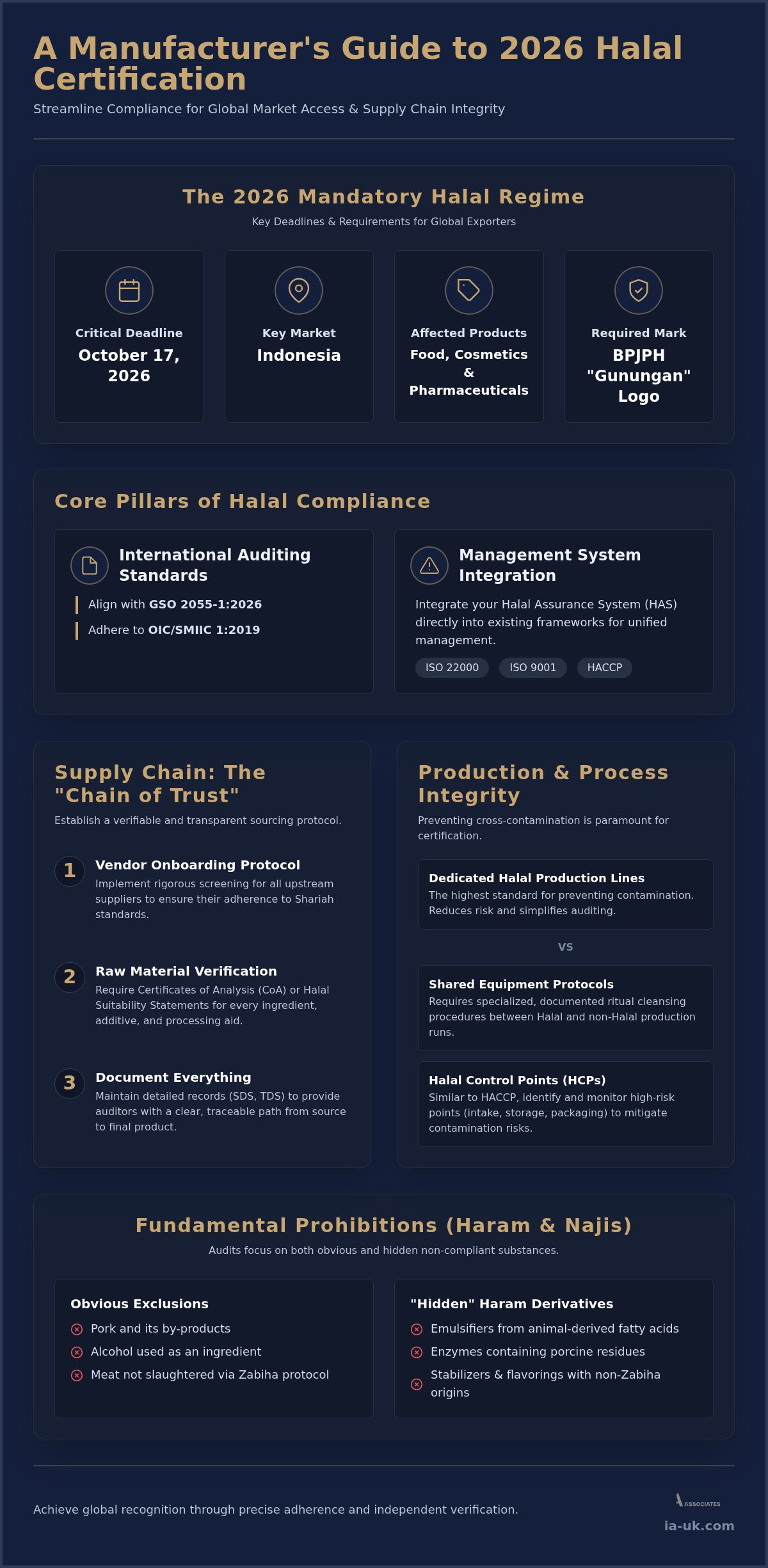
By October 17, 2026, the Indonesian market will enforce a mandatory Halal regime for food contact materials, cosmetics, and pharmaceuticals, making the BPJPH “Gunungan” logo the only valid mark for compliance. You’re likely aware that managing complex supply chain transparency and the constant risk of cross-contamination makes meeting Halal certification requirements a daunting technical challenge. It’s frustrating when sourcing certified raw materials feels like an endless cycle of verification that stalls your production timelines and creates unnecessary friction in your operations.
This article provides a professional roadmap for manufacturers to navigate the shifting regulatory landscape of 2026. We’ll show you how to streamline your documentation and align your technical audit preparations with the latest GSO 2055-1:2026 and OIC/SMIIC 1:2019 standards. You’ll learn how to integrate these protocols into your existing ISO 22000 or ISO 9001 management systems to achieve global recognition. From a practical audit checklist to strategies for securing your supply chain, this guide ensures your business remains a reliable partner in the multi-trillion dollar global Halal economy through precise adherence and independent verification.
Key Takeaways
- Align your export strategy with mandatory 2026 deadlines, including Indonesia’s October 17 requirement for all food, cosmetics, and pharmaceutical products to display the new BPJPH logo.
- Identify the technical Halal certification requirements established by GSO 2055-1:2026 and OIC/SMIIC 1:2019 to ensure your production processes meet the latest international auditing standards.
- Secure your supply chain by implementing rigorous vendor onboarding protocols that verify the Halal status of every raw material through a documented and verifiable “Chain of Trust.”
- Evaluate the operational efficiency of dedicated Halal production lines against shared equipment protocols that require specialized ritual cleansing procedures to prevent cross-contamination.
- Streamline compliance by integrating your Halal Assurance System (HAS) directly into existing ISO 22000 or HACCP frameworks for a unified approach to global safety and quality management.
Core Halal Certification Requirements for Global Manufacturers in 2026
In the 2026 regulatory landscape, manufacturers must treat Halal as a technical management system rather than a simple religious checkbox. The core of Halal certification requirements lies in the “Halal by Default” principle. This assumes all plant-based and mineral resources are permissible unless they’ve been contaminated or contain prohibited substances. Understanding What is Halal? involves recognizing that compliance extends to animal welfare and specific slaughter protocols known as Zabiha. For global operations, this means every ingredient must be traced back to its source to ensure no prohibited elements have been introduced during processing.
Every certified facility must appoint a permanent internal Halal Management Team (HMT). This group is responsible for maintaining the integrity of the production environment and ensuring that Shariah compliance is integrated into daily operations. Their primary duty involves the rigorous screening of all raw materials, additives, and processing aids. Even trace amounts of a prohibited substance can invalidate an entire production batch. This internal oversight is a mandatory prerequisite for any firm seeking to align their operations with international standards.
The Fundamental Prohibitions (Najis and Haram)
Manufacturers often struggle with “hidden” Haram components. While pork and alcohol are obvious exclusions, technical audits in 2026 focus heavily on secondary derivatives. Emulsifiers, enzymes, and stabilizers frequently contain animal-derived fatty acids or porcine residues. If an ingredient isn’t 100% synthetic or plant-based, it must have a valid certificate from its point of origin. This “Chain of Trust” is essential for maintaining the integrity of the final product. Non-Zabiha meat derivatives, even in flavorings, are strictly prohibited and will result in audit failure if detected.
Defining the Halal Control Points (HCPs)
Much like HACCP systems, compliance relies on identifying Halal Control Points (HCPs) where the risk of contamination is highest. These points typically occur during material intake, storage, and packaging. Establishing a robust management system certification framework allows firms to monitor these HCPs effectively. If a breach occurs, such as a cross-contamination event with non-Halal ingredients, the facility must have a pre-defined corrective action protocol. This includes isolating the affected product and performing ritual cleansing of the equipment before production resumes. This structured approach ensures that Halal certification requirements are met with the same discipline as ISO safety standards, providing a reliable bridge between religious requirements and industrial efficiency.
Supply Chain Transparency and Raw Material Verification
Maintaining supply chain integrity is the most resource-intensive aspect of 2026 compliance. Manufacturers must establish a “Chain of Trust” where every upstream supplier is scrutinized for adherence to Shariah standards. This isn’t merely a preference; it’s a technical necessity for maintaining the integrity of the final product. A single unverified processing aid or lubricant used by a tier-three supplier can invalidate the status of an entire batch. Consequently, obtaining a comprehensive Halal certification requirements profile for every raw material is the first step in audit preparation.
Verification relies heavily on Certificates of Analysis (CoAs). These documents provide the technical proof that a specific batch meets the required purity standards. For non-critical materials like pure minerals or certain synthetic chemicals, a “Halal Suitability Statement” may suffice. This document confirms the absence of animal-derived components and cross-contamination risks without requiring a full religious certificate for every base element. It acts as a bridge for suppliers who don’t operate in the food or pharmaceutical sectors but provide essential industrial inputs.
Vendor Onboarding and Documentation
Effective vendor onboarding requires a methodical review of Safety Data Sheets (SDS) and Technical Data Sheets (TDS). These documents reveal the chemical composition of ingredients that might otherwise be obscured by trade names. When evaluating new partners, manufacturers should utilize a Halal Certification Requirements Checklist to ensure no documentation gaps exist. It’s vital to verify that the supplier’s certification body is internationally recognized by the relevant authorities in your target market. All approved vendor lists must undergo an annual review to confirm that their certifications remain active and that their production methods haven’t changed.
Logistics and Warehousing Requirements
The risk of contamination doesn’t end at the factory gate. Third-party logistics providers must adhere to strict segregation rules to prevent contact between Halal and non-Halal goods. During transit, every shipment must be accompanied by a Bill of Lading that clearly identifies the Halal status of the cargo. In the warehouse, dedicated storage zones or physical barriers are necessary to maintain the integrity of raw materials. This level of oversight ensures that the Halal certification requirements are satisfied from the point of origin to the final assembly line. Ensuring your logistics partners understand these regulatory compliance standards is a key factor in passing a technical audit.
Production Integrity: Sanitation and Cross-Contamination Controls
Maintaining production integrity requires a rigorous approach to physical segregation and sanitation. While dedicated Halal production lines offer the most straightforward path to meeting Halal certification requirements, many global manufacturers operate shared facilities. In these instances, scheduling and physical barriers are critical. You must ensure that Halal production occurs only after a validated deep-cleaning cycle. This prevents any carryover from non-Halal batches, particularly when processing complex formulas that include animal-derived stabilizers or emulsifiers. Standard Sanitation Operating Procedures (SSOPs) must be updated to include Halal-specific controls to satisfy technical audits.
Personnel hygiene protocols are equally vital to the process. Employees must be trained to exclude all non-Halal items from the production zone. This includes personal food items or unapproved cleaning tools that could inadvertently introduce contaminants. A facility’s ability to demonstrate total control over the production environment is a primary indicator of audit readiness. This level of discipline ensures that the final product remains free from any substances deemed prohibited by Shariah standards.
Equipment Segregation and Dedicated Tools
Color-coding tools and utensils is an effective method for preventing accidental cross-use between lines. For shared facilities, scheduling strategies must prioritize Halal production immediately following a major sanitation event. Maintenance teams must also verify that all food-grade lubricants used on the line are Halal-compliant. Many standard lubricants contain animal-derived additives that would invalidate the certificate if they contacted the product. Implementing a robust management system certification framework helps track these technical variables across the facility and ensures consistent adherence to international standards.
Sanitation and Ritual Cleansing (Samak)
Ritual cleansing, or Samak, is a mandatory requirement when a production line has been exposed to high-level contaminants, such as porcine derivatives. This process is more intensive than standard deep cleaning; it often requires supervision by a qualified auditor to verify the procedure. When selecting cleaning agents, manufacturers should avoid alcohol-based sanitisers on direct contact surfaces. Residual alcohol can pose a significant compliance risk during the final inspection. Validation of these cleaning cycles is essential for 2026 compliance. Technical audits now rely on objective data, such as ATP bioluminescence testing or protein swabs, to confirm that no biological residues remain. These measures ensure that the facility maintains a high-stakes standard of purity that satisfies international regulators and consumers alike.
Documentation and Management System Integration
Manufacturers often treat Halal certification requirements as an isolated administrative task, yet 2026 compliance demands a unified documentation strategy. A standalone Halal Assurance System (HAS) often creates silos that lead to operational inefficiencies. By contrast, an integrated approach ensures that religious integrity is woven into the technical fabric of your quality management. Your HAS manual shouldn’t just list ingredients; it must define the specific roles, responsibilities, and procedures that govern your entire production cycle. This structural alignment prevents the fragmentation of data and ensures that compliance is maintained as a steady-state operational standard.
Mapping HCPs to HACCP and ISO Standards
Efficiency is achieved by identifying Halal Control Points (HCPs) that overlap with existing Hazard Analysis Critical Control Points (HACCP). For example, a shared storage area is a hazard for both food safety and Halal integrity. Mapping these risks into a single assessment reduces “compliance fatigue” and ensures that plant managers aren’t managing two separate, conflicting systems. Leveraging a globally recognized management system certification allows you to use your existing ISO 22000 or ISO 9001 framework as the foundation for Halal adherence. This synergy simplifies the documentation burden while providing a clearer audit trail for international inspectors. It’s a strategic way to demonstrate that your facility operates with a high level of procedural discipline.
Internal Audit and Management Review
Maintaining year-round compliance requires a robust internal auditing schedule. These audits shouldn’t be passive checks; they must be rigorous technical assessments performed by competent staff. A thorough gap analysis conducted six months before your formal certification audit identifies documentation lapses or production risks before they become non-conformities. Annual management reviews then assess whether the HAS remains effective as your product lines or supply chains evolve. This methodical oversight ensures your Halal certification requirements are satisfied through a transparent, verifiable process. Building this internal competency is essential for long-term market access. If you’re ready to align your facility with these high-stakes standards, you can explore our technical auditing services to begin the verification process.
The structure of a 2026-ready HAS manual includes your specific Halal policy, a defined organizational chart for the Halal Management Team, and a comprehensive traceability procedure. Auditors prioritize evidence that these documents are active. You must demonstrate that your SOPs account for the latest GSO and SMIIC standards. If your manual doesn’t reflect the mandatory Indonesian BPJPH requirements effective by October 2026, your certification for that market will be at risk. Documented training sessions further ensure that every operator understands why specific tools are color-coded or why certain cleaning agents are prohibited, creating a culture of collective responsibility.
How to Choose a Halal Certification Body: Decision Factors 2026
Selecting a certification body is a high-stakes decision that directly impacts your global market access. It isn’t enough to find a provider that understands the basic Halal certification requirements; you need a partner with specific recognition from international regulators. Market access depends on it. If your target market is Indonesia, your auditor must be recognized by BPJPH. For Gulf markets, GSO accreditation is mandatory. Choosing a body without these specific credentials can lead to rejected shipments and significant financial loss. It’s a risk your supply chain shouldn’t take.
Technical expertise is another critical differentiator. An auditor who specializes in meat slaughterhouse protocols may not possess the necessary chemical or pharmaceutical background to evaluate a complex manufacturing line for cosmetics. You should prioritize bodies that demonstrate a deep understanding of your industrial sector. Professionalism is also reflected in a certifier’s infrastructure. Modern, IT-driven audit processes ensure efficient turnarounds and secure data management, which are essential for maintaining your production schedule. Transparency in the certification cycle is equally vital. You need a partner that provides clear timelines and a predictable fee structure, allowing you to budget for your compliance goals without hidden costs.
Accreditation and Global Market Access
Independent, third-party verification is the cornerstone of stakeholder trust. When you evaluate a potential partner, you must verify the certification body’s accreditations to ensure they hold the necessary legal standing. Global markets like Malaysia (JAKIM) and the Gulf (GSO) maintain strict lists of approved bodies. A certificate from an unlisted provider won’t facilitate trade. This objective verification proves to your customers and regulators that your facility meets the highest international standards without compromise. It ensures your brand remains a steady hand in the world of corporate compliance.
The Audit Process: What to Expect from Professional Certification
A professional certification cycle follows a predictable, methodical sequence. It begins with a Stage 1 Documentation Review, where your Halal Assurance System manual is scrutinized for gaps. This is followed by a Stage 2 On-site Verification, where auditors inspect your production lines and interview the Halal Management Team. Once certified, annual surveillance audits are conducted to ensure your facility maintains compliance as your operations evolve. Selecting a partner that offers regulatory compliance across multiple standards, such as ISO 22000 alongside Halal, provides a more efficient and cohesive auditing experience. This unified approach reduces the number of separate inspections and ensures that Halal certification requirements are managed with the same rigor as your other quality systems.
Strategic Readiness for Global Halal Markets in 2026
Achieving compliance with 2026 Halal certification requirements demands a transition from reactive documentation to a proactive, integrated management system. You’ve identified how aligning these standards with your existing ISO 22000 or ISO 9001 frameworks reduces operational friction and ensures your facility is prepared for high-stakes technical audits. With mandatory deadlines in Indonesia and updated GSO regulations approaching, securing your supply chain through a documented “Chain of Trust” is no longer optional; it’s a prerequisite for sustained international trade.
International Associates Limited has provided independent assessment and verification services since 2005. Our global network of regional offices across Europe, Asia, and the Middle East offers the specialized expertise needed for complex, integrated management system audits. We act as a steady bridge between your industrial operations and the rigorous demands of global regulators. If you’re ready to secure your market position and demonstrate procedural integrity, you can Request a Professional Halal Certification Assessment today. We look forward to supporting your international growth with expert oversight and reliable verification.
Frequently Asked Questions
What are the most common reasons for failing a Halal audit?
Audit failures typically stem from incomplete supply chain documentation and inadequate physical segregation. Manufacturers often struggle to verify secondary derivatives in emulsifiers or processing aids. If a single ingredient lacks a valid certificate from a recognized body, the entire product fails. Inadequate sanitation records for shared equipment also pose a significant risk. Maintaining a rigorous Halal Assurance System manual is essential to prevent these common technical non-conformities during the verification process.
Can a facility produce both Halal and non-Halal products?
Dual production is permissible if the facility implements robust segregation and validated cleaning protocols. You must demonstrate that Halal batches are protected from contact with prohibited substances at every stage. This often involves color-coding tools and scheduling Halal runs immediately following a deep-cleaning cycle. While dedicated lines are the most secure option, shared facilities can achieve compliance through strict adherence to Standard Sanitation Operating Procedures and ritual cleansing when necessary.
Is lab testing for porcine DNA mandatory for Halal certification?
Porcine DNA testing isn’t a universal mandatory requirement but serves as a secondary verification tool. Auditing bodies prioritize process-based controls and documentation over finished product testing. However, certain regulators, such as Indonesia’s BPJPH, may require laboratory analysis for high-risk categories like processed meats or complex pharmaceuticals. You should treat testing as a way to validate your cleaning effectiveness rather than a replacement for rigorous raw material scrutiny and supply chain transparency.
How long does the Halal certification process typically take in 2026?
The timeframe for achieving certification generally ranges from three to six months. This duration accounts for the initial gap analysis, the Stage 1 documentation review, and the Stage 2 on-site audit. If non-conformities are identified, additional time is needed for corrective actions before the final certificate is issued. Readiness is the primary factor; facilities with existing ISO management systems often navigate the 2026 Halal certification requirements more efficiently due to established procedural discipline.
Do I need Halal certification if my product is 100% plant-based?
Certification is necessary for plant-based products to confirm the absence of prohibited processing aids and cross-contamination. Even 100% plant-derived items may utilize animal-based enzymes or lubricants during manufacturing. Auditors verify that no “hidden” Haram substances are introduced during the production cycle. For manufacturers targeting the global Halal market, this independent verification provides the technical assurance that consumers and regulators require, regardless of the product’s primary ingredient base.
What is the difference between Halal and Zabiha?
Halal is a broad term for what’s permissible, whereas Zabiha refers specifically to the Islamic method of animal slaughter. While all Zabiha meat is Halal, the Halal standard also applies to non-meat items like cosmetics, beverages, and pharmaceuticals. In a technical audit, the focus extends beyond slaughter to include ingredient purity and production integrity. Understanding this distinction is vital for manufacturers who must manage both raw material sourcing and complex industrial processing.
How often are surveillance audits conducted for Halal compliance?
Surveillance audits are typically conducted on an annual basis to ensure ongoing compliance. These inspections verify that your Halal Management Team is actively maintaining the standards established during the initial certification. Auditors review production logs, supplier updates, and internal audit reports to confirm that the Halal Assurance System hasn’t lapsed. High-risk facilities or those undergoing significant operational changes may be subject to more frequent oversight to maintain the integrity of their global certification.
Can I integrate my Halal audit with my ISO 22000 audit?
Integration with ISO 22000 is highly recommended to improve auditing efficiency and reduce documentation redundancy. You can map Halal certification requirements directly onto your existing food safety control points. This unified approach allows a single audit team to verify both safety and religious integrity, saving time and resources. It ensures that your Halal Assurance System isn’t a siloed administrative task but a core component of your facility’s technical management and global quality strategy.