

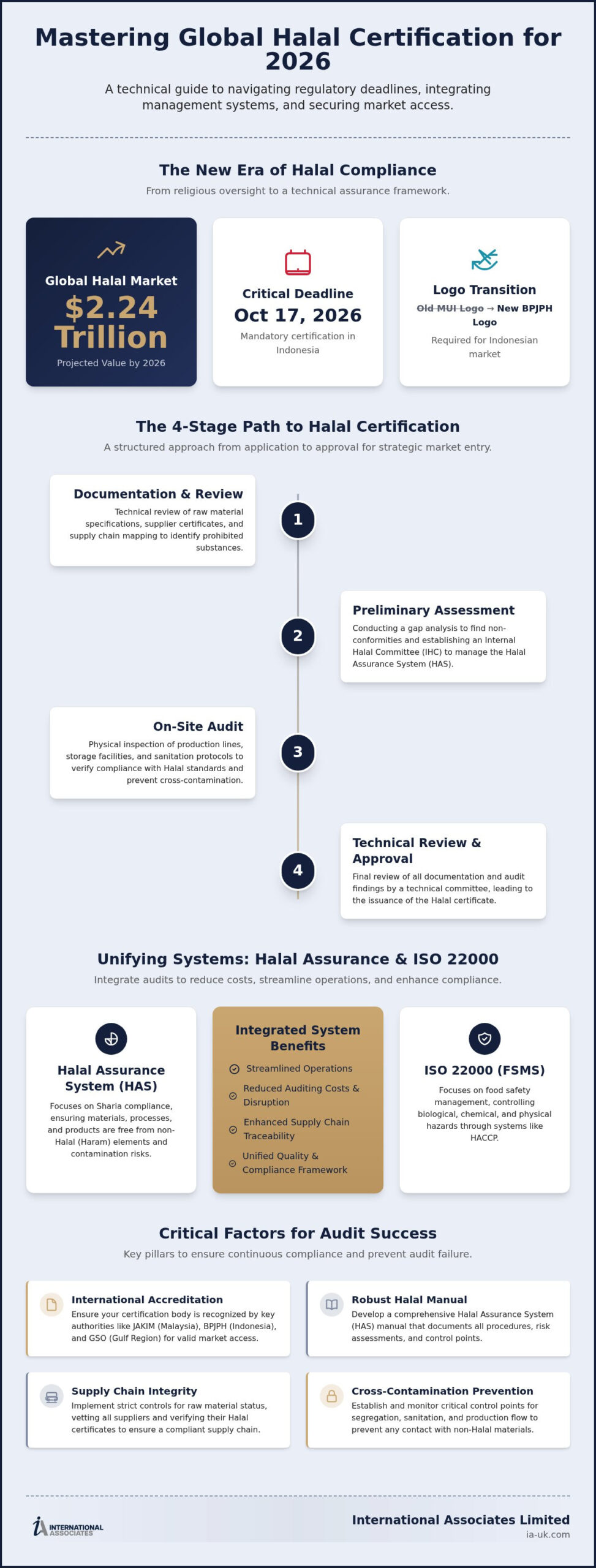
With the global Halal food market projected to reach $2.24 trillion in 2026, the financial risk of regulatory non-compliance has reached a critical threshold for international manufacturers. You likely recognize that navigating fragmented regional standards is an immense challenge, especially with the October 17, 2026, deadline for mandatory certification in Indonesia approaching. The threat of audit failure due to cross-contamination or the inefficiency of duplicate auditing costs can significantly delay your market entry.
This guide delivers a technical breakdown to help you master the Halal certification process while integrating these requirements into your existing ISO management systems. We’ve designed this resource to provide the clarity needed for high-stakes compliance decisions. You’ll gain a comprehensive understanding of the certification stages, the mandatory transition to the new BPJPH “Gunungan” logo, and the practical steps to secure your share of the expanding global market. By aligning your technical protocols with international standards like OIC/SMIIC 2:2019, you can establish a reliable, audit-ready framework that supports sustainable growth.
Key Takeaways
- Understand why the 2026 regulatory deadlines in markets like Indonesia necessitate a shift from religious oversight to standardized technical assurance.
- Streamline your path to market entry by mastering the four distinct stages of the Halal certification process, from initial application to final approval.
- Reduce operational disruption and auditing costs by integrating Halal requirements with existing ISO 22000 food safety management systems through integrated audits.
- Identify the critical accreditation markers, such as JAKIM and MUI recognition, required to ensure your certificate is valid across high-growth export regions.
- Learn how to establish a robust Halal manual and manage raw material status to prevent audit failure and ensure continuous compliance.
Understanding the Halal Certification Framework in 2026
In 2026, Halal certification has evolved beyond a religious designation into a rigorous technical assurance framework. It serves as a verified confirmation that products and manufacturing environments adhere to specific Sharia compliance standards. This shift is characterized by the global adoption of the OIC/SMIIC 2:2019 standard, which transitions oversight from purely religious bodies to international standardization organizations. For manufacturers, the Halal certification process is now a fundamental requirement for entering high-growth markets. It’s no longer just a label; it’s a technical passport for global trade.
Global Standards and Regulatory Bodies
The regulatory landscape is dominated by key authorities like the BPJPH in Indonesia, JAKIM in Malaysia, and the GSO in the Gulf region. These bodies have established strict cross-border requirements that impact every level of the supply chain. In Indonesia, Government Regulation 42/2024 mandates that health supplements and natural medicines must be certified by October 17, 2026. This deadline also marks the final transition to the new BPJPH “Gunungan” logo, making old MUI logos obsolete. Choosing an auditor with international recognition is essential. Without proper accreditation, certificates may be rejected at customs, causing significant financial losses. A robust regulatory compliance strategy ensures that your products meet these localized yet globally connected standards, including UAE.S 2055-2:2016 and GSO 2055-2:2021.
Halal as a Quality Management Pillar
Modern Halal compliance requires full supply chain traceability, moving far beyond the simple exclusion of prohibited substances. To achieve this, organizations must implement a Halal Assurance System (HAS). The Halal Assurance System is a proactive management tool designed to identify, evaluate, and control potential contamination risks throughout the production cycle. This system mirrors the structure of ISO quality standards, focusing on risk mitigation and procedural integrity. Understanding Halal Principles is the first step in recognizing that this framework provides access to over 2 billion consumers.
The business case for the Halal certification process is compelling. With the global Halal food market projected to reach $2.24 trillion in 2026, the ROI on certification is clear. Businesses that treat Halal as a quality pillar rather than a checkbox often see improved operational discipline. They benefit from a global-local duality, where a central management system satisfies diverse international offices and regional regulators. This methodical approach to information delivery and auditing builds a sense of procedural integrity that international buyers demand.
The 4-Stage Halal Certification Process: From Application to Approval
The Halal certification process is a methodical cycle designed to ensure absolute compliance with global standards. While some organizations view certification as a hurdle, a structured 4-stage approach transforms it into a strategic advantage. International Associates Limited utilizes a high-tech infrastructure to accelerate this cycle, providing the quick turnaround essential for meeting today’s rigorous market entry requirements. Efficiency is built into the framework from the start, ensuring that your business can navigate complex regulatory landscapes without unnecessary friction or ambiguity.
Stage 1 & 2: Documentation and Preliminary Assessment
The cycle begins with an intensive technical review of your supply chain. We examine raw material specifications and verify supplier certificates to ensure no prohibited substances enter the production stream. A critical component is the gap analysis, which identifies non-conformities before the formal audit. This prevents costly delays and resource waste. Your organization must also establish an Internal Halal Committee (IHC) to maintain the Halal Assurance System. The advanced IT infrastructure at International Associates Limited allows for real-time document submission, significantly reducing the administrative burden on your staff.
Stage 3 & 4: On-Site Audit and Technical Committee Review
Once documentation is verified, an on-site audit is conducted to observe production lines, storage facilities, and sanitization protocols. Auditors perform employee interviews and assess training records to ensure the workforce understands cross-contamination risks. This level of scrutiny aligns with recognized IFANCA Halal Certification Standards and other global benchmarks used by international auditing bodies. Finally, an independent Technical Committee evaluates the report without bias. This ensures the Halal certification process remains impartial and credible, providing the institutional weight necessary for global trade acceptance.
In 2026, the timeline for certificate issuance typically ranges from 4 to 12 weeks. This duration depends on the complexity of the manufacturing site and the readiness of the documentation. Preparing early is the most effective way to ensure a seamless transition into new territories. By identifying potential issues during the preliminary stages, you avoid the risk of audit failure and market entry delays. If you’re looking to enhance your internal expertise, you can explore the lead auditor training provided by International Associates Limited to better prepare your internal committee for these rigorous assessments.
Halal vs. ISO 22000: Integrating Food Safety and Religious Compliance
Many manufacturers mistakenly treat the Halal certification process as a standalone religious audit, distinct from their existing food safety protocols. In reality, the technical requirements of Halal standards like OIC/SMIIC 1:2019 share significant commonalities with ISO 22000. Both frameworks prioritize consumer safety, hygiene, and full supply chain traceability. By aligning these systems, organizations can eliminate redundant procedures and create a more resilient quality management structure. This integration is essential for businesses aiming to meet the 2026 global compliance deadlines without doubling their administrative workload.
Shared Requirements: Traceability and Hygiene
The foundation of both ISO 22000 and Halal compliance lies in the Hazard Analysis and Critical Control Points (HACCP) system. While ISO focuses on biological, chemical, and physical hazards, Halal standards extend this to include ‘Najis’ (impurity) contamination. Mapping your existing HACCP plan to include Halal critical control points ensures that religious requirements are managed with the same technical rigor as food safety. Many firms successfully utilize their ISO 9001 documentation structures to support Halal record-keeping, ensuring a unified approach to quality. This streamlined methodology is often highlighted in the Halal Certification Process documentation provided by leading international chambers, emphasizing that hygiene and traceability are universal pillars of trade.
The Efficiency of Multi-Standard Certification
Conducting an ‘Integrated Audit’ is the most effective strategy to reduce business disruption. Instead of hosting separate assessment teams, an integrated approach allows a single multi-standard auditor to verify both ISO and Halal compliance simultaneously. This significantly reduces ‘audit fatigue’ and optimizes resource allocation within your technical department. A technical decision-maker should consider the cost-benefit of integrated management system certification over standalone assessments. Beyond cost savings, this unified strategy builds institutional reliability, demonstrating to global buyers that your facility operates under a single, high-level standard of ethical and technical excellence. It bridges the gap between complex global regulations and the operational reality of modern manufacturing.
Audit Preparation: Critical Factors for a Successful Halal Assessment
Success in the Halal certification process depends heavily on the pre-audit phase. A robust Halal manual and clearly defined standard operating procedures (SOPs) are not merely administrative requirements; they’re the technical foundation of your compliance framework. Audit failure often stems from a lack of documented evidence rather than a failure in production. It’s essential to establish a system where every action, from ingredient reception to final packaging, is recorded with precision and transparency. This methodical approach ensures that your facility remains audit-ready throughout the year.
Documenting Your Supply Chain
Vetting suppliers is a high-stakes task that requires verifying certificates from recognized accreditation bodies. You must identify Halal Critical Control Points (HCCPs) where contamination risks are highest, such as shared storage or transport vessels. Manufacturers must maintain 100% traceability of all processing aids, including filtration media and catalysts, even if they don’t appear in the final ingredient list. This level of detail is a non-negotiable requirement for 2026 global trade. Utilizing the advanced IT infrastructure at International Associates Limited can help manage these complex datasets efficiently, reducing the risk of human error during the documentation phase.
Facility and Equipment Standards
Physical segregation is vital in multi-product facilities to prevent cross-contamination. If a contamination event occurs, you must have a protocol for ritual cleansing, often involving specific sanitization steps verified by an auditor. Segregation strategies must extend to logistics and warehouse management to ensure Halal integrity is maintained until the product reaches the consumer. A common pitfall is the failure to update packaging and labeling. In Indonesia, for instance, products must transition to the BPJPH “Gunungan” logo by October 17, 2026. Using old logos after this date is a technical non-conformity that can lead to market exclusion.
Staff competency is the final pillar of a successful assessment. Employees must understand the technical and ethical implications of their roles. Without professional training, even the best-designed systems can fail due to operational oversight. Ensuring your Internal Halal Committee is well-versed in current standards like OIC/SMIIC 2:2019 is a critical decision for any manufacturer. This proactive investment in human capital builds institutional reliability and long-term stability.
Secure your market entry and minimize audit risks with an independent Halal compliance assessment from International Associates Limited, tailored to your specific industry needs.
How to Choose a Halal Certification Body: Decision Factors for 2026
Selecting a certifying body is the most consequential decision in the Halal certification process. An invalid or unaccredited certificate doesn’t just waste capital; it can lead to immediate product seizures at international borders. In the 2026 trade environment, customs authorities in Indonesia and the Gulf States have significantly tightened their verification protocols. You must ensure your chosen partner holds direct recognition from the relevant national authorities to avoid costly market entry failures. The auditing team’s technical expertise must be sufficient to handle complex chemical and biological assessments without ambiguity.
Accreditation and Global Recognition
Verifying the accreditations of your certification body is a non-negotiable step for any exporter. For access to Malaysia, Indonesia, and the UAE, recognition from JAKIM, BPJPH, and the GSO is mandatory. An unaccredited certificate carries immense risk as we approach the October 17, 2026, deadline for mandatory certification in Indonesia. Customs officials will only accept documentation issued by bodies that adhere to international standards like OIC/SMIIC 2:2019. International Associates Limited acts as a sophisticated bridge, ensuring your technical documentation meets these high-stakes requirements before your goods ever reach the port. This independent assessment provides the security necessary for high-level market entry.
Service Delivery and Technical Support
Global brands require more than just a certificate; they need a partner capable of keeping pace with international tenders. Technical expertise and quick turnaround times are essential when competing in the $2.24 trillion Halal market. International Associates Limited combines its Glasgow-based administrative reliability with an expansive network of international offices in Asia and the Middle East. This global-local duality allows for rapid on-site assessments while maintaining the institutional weight of a UK-based auditing firm. The rhythm of our communication is steady and organized, reflecting a disciplined approach to professional inspections.
Many organizations now seek to integrate their religious compliance with broader ESG goals. You can streamline your operations by combining the Halal certification process with social accountability audits. This integrated approach reduces the frequency of site visits and provides a unified view of your facility’s ethical and technical standards. The advanced IT infrastructure at International Associates Limited ensures that audit reporting is efficient and methodical, mirroring the disciplined way modern businesses conduct their professional inspections. Choosing a partner with specialized expertise in high-stakes sectors provides the steady hand needed to navigate regulatory landscapes without unnecessary friction.
Securing Your Global Market Position in 2026
Mastering the Halal certification process is a technical necessity for manufacturers seeking to enter high-growth international markets. Success requires more than just meeting religious requirements; it demands a unified approach that integrates food safety standards with rigorous supply chain traceability. By aligning your management systems, you reduce auditing costs and eliminate operational friction. As global regulatory requirements continue to evolve, the choice of an accredited, independent partner becomes the defining factor in your export strategy.
International Associates Limited provides the steady hand needed to navigate these complex landscapes. We offer independent assessment and verification for global organizations, utilizing an advanced IT infrastructure to ensure a quick turnaround on all reporting. Our expertise in high-stakes regulatory compliance acts as a bridge between your production facility and international trade success. Don’t let compliance hurdles delay your growth. Contact International Associates Limited today for an accredited Halal certification quote and take the final step toward global market expansion. Your path to worldwide compliance is clear and manageable with the right professional support.
Frequently Asked Questions
How long does the Halal certification process take in 2026?
The timeline for the Halal certification process in 2026 typically spans 4 to 12 weeks. This duration depends on the technical readiness of your documentation and the complexity of your supply chain. Efficient organizations often achieve faster results by conducting preliminary gap analyses and utilizing advanced IT infrastructure for document submission.
Can I get Halal certification if my factory also processes non-Halal products?
Yes, certification is possible in multi-product facilities provided there is strict physical segregation. You must implement rigorous sanitization protocols to prevent cross-contamination between Halal and non-Halal lines. Auditors will verify these segregation strategies and ritual cleansing procedures during the on-site assessment to ensure total integrity.
Is Halal certification required for non-food products like cosmetics or pharmaceuticals?
Certification is increasingly mandatory for non-food sectors, including pharmaceuticals, health supplements, and cosmetics. In Indonesia, the October 17, 2026, deadline specifically targets natural medicines and supplements. Manufacturers must ensure compliance to maintain access to these highly regulated international markets and satisfy the new BPJPH labeling requirements.
How much does Halal certification cost for a small business?
The cost of certification is determined by the complexity of your manufacturing operations and the number of products involved. Factors such as the size of the facility, the number of production lines, and the geographical location of the audit also impact the final investment. You should request a tailored quote to understand the specific requirements for your business.
What is the difference between Halal and ISO 22000 certification?
ISO 22000 focuses on biological and chemical food safety hazards, whereas Halal certification ensures adherence to Sharia compliance. While they share traceability requirements, the Halal certification process includes specific audits of ingredient origins and ritual cleansing protocols that general food safety standards don’t cover. Integrating both systems reduces duplicate auditing costs.
What happens if a non-conformity is found during the Halal audit?
If a non-conformity is identified, the organization must submit a corrective action plan within a specified timeframe. Minor issues may only require documentary evidence of resolution. Major non-conformities might necessitate a follow-up audit to verify that the Halal Assurance System has been properly corrected. This methodical approach ensures that all technical standards are fully satisfied.
How often do I need to renew my Halal certificate?
Most certificates require annual renewal to ensure continuous compliance with evolving international standards. Some accrediting bodies offer multi-year validity, but these often involve interim surveillance audits to verify that the facility’s protocols remain functional. Regular renewals are essential for maintaining consumer trust and ensuring uninterrupted legal market access.
Is an on-site audit always required for Halal certification?
An on-site audit is a mandatory component of the initial certification cycle to verify production environments and employee competency. While some documentation reviews occur remotely, physical inspections of storage and processing lines are necessary to confirm that cross-contamination risks are managed according to international standards like OIC/SMIIC 2:2019.